2012年2月16日星期四

HKQAA Service Gauge Seminar (「企業上下同心.共創優質服務」研討會)

The Service Gauge Seminar (Chinese title: 「企業上下同心.共創優質服務」研討會) was organized by Hong Kong Quality Assurance Agency (HKQAA) on 16 Feb 2012. The seminar aimed to share the improvement of service quality from different industries.


The first speaker was Mr. Harry Chow (周騫) (Owner, BOSSible創富者; Founding Chairman, Hong Kong Franchise Development Association (HKFDA)) and his presentation entitled "How to use quality services to win customer's word of mouth in multiple shop (連鎖品牌如何利用優質服務贏取顧客口碑)"


Mr. Harry Chow questioned "Why we need word of mouth?". It aimed to increase Sale Efficiency. In order to achieve this goal, the following elements should be considered.

Word of mouth could:

- Reduce Promotion Cost (Most awareness, Most Accurate, Quickest and Longest Lasting)

- Increase Sales Volume (Most Trustable, Reliable and Effective)

- Revolving Order (Consistently Reliable, Efficient and Friendly)


Word of mouth establishment was based on 4P (i.e. Product, Place, Promotion and People).

A multiple shop's word of mouth could be established through "Monitoring", "Training" and "Transparency" to achieve the service with "Uniform", "Efficiency" and "Accuracy".


The second speaker was Mr. Tsang (曾栢威) (Senior Manager, Chief Group) and his presentation topic was "Break Through the Barrier, Create a Corporate Service Culture (闖過關卡,營造企業服務文化)"


Mr. Tsang said Service Culture included "Service DNA", "Enthusiasm", "Proud of Service", "Recognize the Target", "Collaboration" and "Create Value". Moreover, he use "Coffee in different location" to demonstrate different service culture. The most important was customer needs and expectations. Nevertheless, he briefed how to break through the barrier. There were four elements such as "Market Environment", "Organization", "Customer" and "Staff".


Then Mr. Tsang introduced "Broken Windows Theory". It indicated a broken window that left unfixed can quickly encourage more crime because it sended a message of apathy to everyone. He emphasized that the details should not be neglected.


The special guest was Mr. Law (羅偉祥) and he shared his experience on overcoming his barrier to achieve success. He cannot walk because of lack of oxygen (1min) at birth. However, Mr. Law had not gave up. He shared his experience being Insurance Agent and how he built up his brand.


The third speaker was Mr. Chow (周楚源) (Vice President, China Construction Bank Corporation Hong Kong Branch) and his presentation topic was "How to improve employee service level? (如何提升員工服務水平)"

Mr. Chow identified Five steps to improve employee service level below.

1. Communication before implement

2. Use Mystery Shopper Assessment

3. Enhancement of Training

4. Benchmarking

5. Top Management Committee by Action


The last speaker was Mr. Billy Man (文樹成) and his presentation named "Break Bureaucracy, Corporate Unity (破除官僚,企業上下同心)"

Mr. Man introduced Three Ts for breaking bureaucracy. Three Ts were "Transformation", "Taking Part" and "Team Work". Transformation meant reducing the bureaucracy such as Mr. Jack Welch's GE story. "Taking Part" meant to understand customer and employee need. Team Work was talking about Communication, Support and Reward.


Then Mr. Man introduced HKQAA's DISCS Model which employed in Mystery Shopper Assessment:

Design of Audit Form and Report

Implementation Plan

Service Standard Building

Control of Quality

Shopper Pool


Finally, Mr. Man mentioned the benefit to achieve the certification of Service Quality Management.


I brought a book named "Directions" after the seminar.


I got Mr. Law's chop on his part of the book.


Reference:

HKQAA - http://www.hkqaa.org


2012年2月14日星期二

Seminar on Supplement VIII to CEPA for Testing and Certification Industry

The Hong Kong Council for Testing and Certification (HKCTC), the Hong Kong Accreditation Service (HKAS) and Trade and Industry Department (TID) jointly held the seminar entitled "Seminar on Supplement VIII to CEPA for Testing and Certification Industry" on 14th February 2012. It is a pilot scheme to allow the testing laboratories accredited by HKAS to cooperate with designated Mainland certification bodies in performing product testing for all existing types of products under the new CEPA VIII measures on China Compulsory Certification (CCC).


In the beginning, Prof. Ching Pak-Chung (Chairman of HKCTC) gave a welcoming remarks. He said there were six organizations achieved HOKLAS accreditation for testing required by CCC (Toy) and implementing the CEPA arrangement.


Mr. LIU Weijun (Certification and Accreditation Administration (CNCA)) gave a speech. He expected CEPA VIII could enhance the cooperation of Testing and Certification industries between Hong Kong and Mainland.


Souvenir presentation and group photo


The first speaker was Mr. XU Zengde (CNCA) and his topic entitled "China Compulsory Certification (CCC) System".


Firstly, Mr. Xu introduced that CCC was established on 3 December 2001 and started to implement on 1 May 2003. It aimed to align the requirement to WTO/TBT. There were four unity included the product categories, technical certification and assessment process, logo and fee.
The 22 types of products were shown as follow diagram (in Chinese).


There were four models of CCC marks (S, EMC, S&EMC and F).


In CCC system, there had 10 certification bodies and 158 laboratories in Mainland China. Finally, Mr. Xu expected to establish dynamic modification mechanism for product categories, dynamic management mechanism and diversified certification models.


The second speaker was Mr. HUANG Shouyun (CNCA) and his presentation named "New Initiatives under Supplement VIII to the Mainland and Hong Kong Closer Economic Partnership Agreement (CEPA)". Mr. HUANG explained the new CEPA VIII extended the scope and enhanced the opportunity of cooperation between Hong Kong and Mainland China.

The third speaker was Ms Bella S W Ho (Sr. Accreditation Office, HKAS) and her topic was "Application Procedure for Accreditation of a Laboratory to Perform CCC Testing".


The first laboratory under CEPA VII had accredited since July 2011. There were 6 laboratories achieved the accreditation.


The following diagrams showed the accreditation procedure for CCC testing requirement.


This requirements included HKAS 02, HOKLAS 003, HOKLAS SC 33 and 45, as well as, CCC related requirements from CNCA.


The additional CCC requirements were shown in the following table which were compared with the existing HKAS requirements.


The fourth speaker was Mr. Raymond Wong (SGS Hong Kong) and his topic was "Obtaining Qualification for Testing to China Compulsory Certification (CCC) System - Experience Sharing".


Mr. Raymond Wong said SGS is the first laboratory accredited for CCC testing requirement in Hong Kong on 13 July 2011. He shared that CCC based on Product Categories instead of Test Standards. Moreover, it needed proper interpretation with Standard Specification in Chinese version.


Then Mr. Wong shared the cooperation with Mainland CBs for fulfilling the CEPA requirement.


The last speaker in the morning session was Ms. WANG Kejiao (China Quality Certification (CQC)) and her presentation title named "Services of Mainland Certification Body and CEPA Initiative".


Mr. Wang introduced the development of CQC since 1984.


CQC had assigned for CCC testing since 2002. Unit now, CQC accumulated to 37305 customers.


CQC had cooperated with HKSTC and HKSTC to be its CB laboratory since 1998.


Group discussion


Afternoon session, there were separated into two groups.

Group 1:
The first speaker in Group 1 was Mr. CHEN Jianbing (Senior Engineer, Shanghai Testing & Inspection Institute for Electrical Equipment) and his topic named "Low-voltage Electrical Apparatus". There were 9 product types for CCC testing.


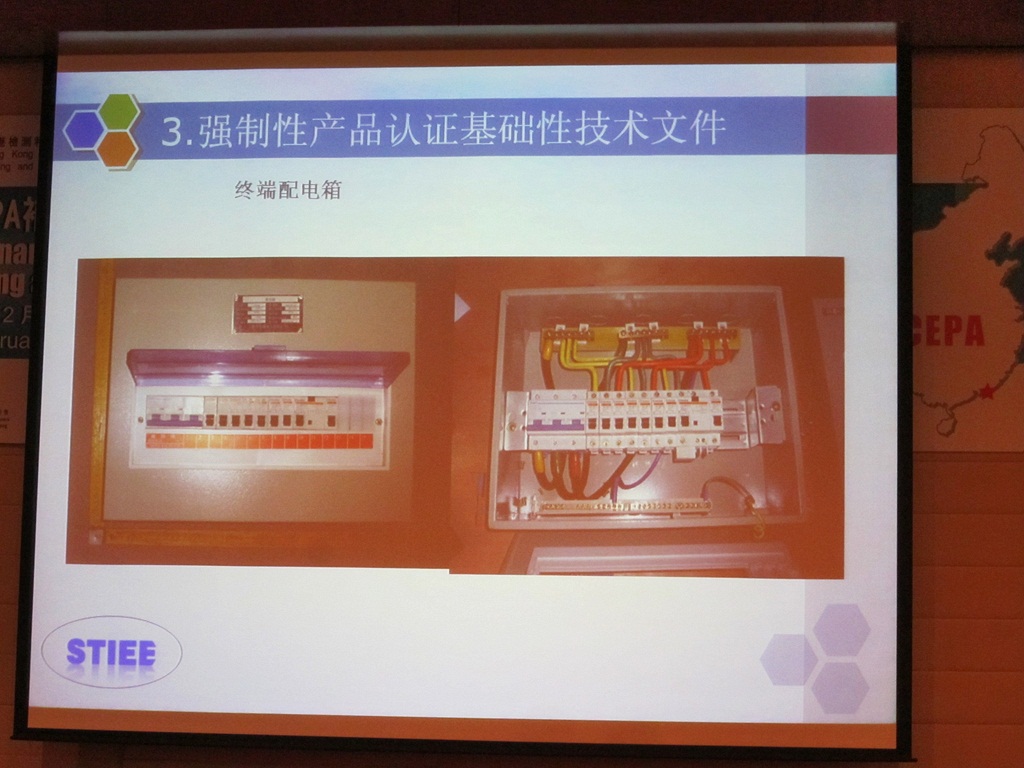
CCC technical document for low-voltage electrical apparatus were shown below.
1) CNCA-01C-010
2) CNCA-01C-011
3) CNCA-01C-012


The Mr. Chen demonstrated different types of low-voltage electrical apparatus to be tested for CCC requirements.
Finally, he shared some common nonconformities such as obsolete standard used, technical requirement checking, record verification or missing and calibration.


The second speaker in Group 1 was Ms. CHEN Yaoxi (Senior Engineer, North China Institute of Computing Technology) and her topic was "Wireless LAN Products and Information Security Products".


13 types of Information Security Products were discussed. Their tests were based on GB/T 18336-20089 and ISO/IEC 15408-2005 (Information Technology - Security Technology - Evaluation criteria for IT security).


Ms. Chen briefed different standards for different product below.
Firewall - GB/T 20281-2006
Smartcard COS product - GB/T20276-2006
Data backup & Recovery product - CNCA/CTS 0051-2007
IDS product - GB/T 20275-2006
Security Operation System - GB/T 20272-2006
Security Database System - GB/T 20273-2006
Network vuliability scanning product - GB/T 20278-2006
Anti-spam email product - CNCA/CTS 0031-2008
Information Security Testing Laboratory Requirement - CNAS-CL02:2006 and CNAS-CL20:2006

Group 2:
The first speaker in Group 2 was Prof. CHEN Lu (Senior Engineer, China Building Material Test and Certification Centre) and her presentation entitled "Safety Glass".


Prof. Chen introduced different testing requirement and method for glass safety included corrosion test, environmental test, impact test, etc.


Some testing were specific for vehicle glass such as optical performance test.


At the end, she shared some common nonconformities during CCC assessment such as calibration, environmental condition, operation requirement and standard ISO 17025 requirement.

The last speaker in Group 2 was Mr. DENG Jun (Research Associate, China National Agricultural Machinery Quality Supervision Testing Center) and his topic was "Agricultural Machinery".


Mr. Deng mentioned the accreditation for agricultural machinery based on CNCA-05C-029:2006 and CNCA-05C-074:2010.

Group Discussion


Reference:
Mainland and Hong Kong Closer Economic Partnership Arrangement (CEPA) - http://www.tid.gov.hk/english/cepa/further_liberal.html


2012年2月12日星期日

以品質管理原則來評估特首參選人能力的調查簡報 (CE Survey Briefing Report)

2012是選舉年,大家都關心香港的特首選舉。由各有意參選人宣佈參選、泛民初選、至近期的候選人提名,各方都不斷作出評估。不同的大專院校都有做不同的民調來分析特首參選人的民意走勢,但沒有對特首參選人的能力作出調查及評估。因此,我嘗試用八大品質管理原則作其評估的基礎。我相信品質管理原則的應用可由管理一個機構的層面擴展至管理社會事務的層面。基於服務品質(Service Quality)是以顧客感覺(Customer Perception)為主,所以由品質專家們以顧客感覺來評估特首參選人的能力較為合適。


以下是八大品質管理原則用於社會層面的論述:

一、市民為重 (Customer Focus - CF)

組織是靠顧客而存在,而政府則以市民為依歸。特首最重要的能力是瞭解現在與未來的市民需求;作出適當的政策來符合市民的要求,及致力於超越市民的期望。

二、領導才能 (Leadership - LD)

領導者建立組織的目標與方向,激勵和鼓舞組織成員達成組織的目標與方向。同樣地特首需要建立一個願景來說明香港未來的目標與方向。特首正如品質管理中的領導者,他須創造與維持內部環境,使社會中各成員能完全投入達成這個願景及目標。

三、全民參與 (Involvement of People - IP)

即香港的各階層市民,令他們的完全參與使其能力運用於香港的長遠利益。要做到這一點,領導才能是最重要。

四、流程方法(Process Approach - PA)

當各社會政策與相關的資源經過管理而成為流程時,便會更有效率地達成所期望的結果。其中一個品質管理工具名為流程圖(Process Map),它把所有重要流程列出,然後把每一個主要流程細分並進行評估,最後發現流程的改進空間。

五、系統管理 (System Approach to Management - SM)

鑑別、瞭解與管理社會各行各業的相互關聯及過程,而成為對社會達成目標的效果與效率有所助益之系統。如現有的公務員體制、問責制、選舉制、稅制及法制等,都須要有統一的系統標準;它就是公平、公正及公開。

六、持續改善 (Continual Improvement - CI)

香港社會整體績效的持續改善是特區政府不變之目標。如用品質管理工具「戴明環」,以計劃、實施、檢查、行動四式(Plan-Do-Check-Act Cycle or Deming Cycle)不停循環,達到持續改善。

七、據實決策 (Factual Approach to Decision Making - FD)

有效的決策是以資料與資訊的分析為基礎。所以特區政府應該加強政策研究,分析社會現象,掌握確實數據來作出決策。如善用香港各大學作政策研究基地。

八、互利關係 (Mutually Beneficial Supplier Relationships - MS)

供應者在這裡應換作社會的持份者(Stakeholder)。香港社會與其持份者是相互依賴的,且互利關係增強彼此創造價值的能力。所以在制定政策時,需要平衡社會各方的利益,達到雙贏。


本調查是以線上問卷方式進行,把八大品質管理原則的題目再加上三條背景資料的題目以了解參與者的職位、工作經驗及行業),一共十一條題目。在一月一日至一月十四日期間,問卷發放到一千名品質專家的電郵中,其後再發三次電郵作提醒。結果收到七十三名品質專家的回覆,回覆率大約是百分之七。他們的背景如下:

回覆者大約有百分之七十是中級至高級的管理層,而工作有十年以上的大約有百分之八十;他們工作行業的分佈是製造業(約百分之四十);服務業(約百分之三十)及非營利/政府/教育(約百分之二十五)。


八大品質管理原則的題目是用七級李克特量表(Seven-point Likert Scale)作評級,能力水平評估如下:7-非常有能力,6-比較有能力,5-稍多的能力,4-可接受的能力,3-稍遜的能力,2-比較沒能力,1-非常沒能力。


因為問卷調查開始早於泛民初選,所以特首參選人共四名。他們分別是:唐英年 (Mr. Henry TANG Ying-yen - HT); 梁振英 (Mr. LEUNG Chun-ying - CY); 何俊仁 (Mr. Albert HO Chun-yan - AH)和馮檢基 (Mr. Frederick FUNG Kin-kee - FF)。


在特首參選人的八大品質管理能力評分(圖一)中,梁振英在多項能力都領先,由其是領導才能、流程方法及據實決策。唐英年只有在互利關係及系統管理兩項能力中與梁振英的評分拉近。兩名泛民的特首參選人的評分在「可接受的能力」以下(除何俊仁在據實決策的評分為4.01)。


圖一:特首參選人的八大品質管理能力評分圖


特首參選人的能力評分,以平均數的平均值(mean of means)來作總結(表一)。梁振英的能力評分 (4.78) 比其他特首參選人顯著為高,接近「稍多的能力」。而唐英年的能力評分 (4.04) 比其他兩名泛民的特首參選人也顯著為高,剛剛有「可接受的能力」。在兩名泛民的特首參選人中,何俊仁的能力評分 (3.74) 比馮檢基 (3.60)為高,他們在「稍遜的能力」至「可接受的能力」之間,但接近後者。


表一:特首參選人的能力總體評分表(平均數的平均值)


今次的香港特首選舉是關係到2017普選特首的典範,希望各方都盡一己之力,參與其中。

本文只希望抛磚引玉,如有錯失,請多指教。


Reference:


2012年2月10日星期五

HKSQ Student Project Competition 2012 - Briefing Session

The HKSQ Company Based Student Project Competition offers an opportunity for students to work on an actual industrial case and propose resolution. This allows them to gain experience of resolving an industrial problem. The competition included three sessions. The first sessions was problems selection which problems were designed and explained by sponsor company (e.g. Vital-Health Livestock Development Limited in 2012). The second session was factory visit and the last session was presentation of suggested solutions.

Tonight was the briefing session of the competition. Firstly, I (Chairman of HKSQ) mentioned the rule of the competition.


Then Mr. Kwok Ming Cheung (Managing Director, Vital-Health Livestock Development Limited) was invited to explain the competition questions.


In the beginning, Mr. Kwok explained the relationship among HOST, ENVIRONMENT and AGENTS. Disease happened because of unbalance of the following three elements.


Regarding the first problem, additional fans are installed to maintain enough air supply and to reduce the temperature for chicken health. However, the electricity was highly consumed. How do we reduce the electricity consumption and maintain health environment?


Regarding the second problem, raw chicken and pork was packed after slaughtered and transported to packaging center. How do we maintain freshness period of packed chicken and pork?


After that students from different universities (included HKU, HKUST, PolyU and CityU) had selected the question.


Many students discussed the question with Mr. Kwok after the briefing session. They all were enthusiastic about the competition.


Reference:
HKSQ Company Based Student Project Competition - http://www.hksq.org/company_based_competition.htm
Vital-Health Livestock Development Limited - http://www.kameihonbochicken.com.hk/


2012年2月8日星期三

ASQ InfVoices - Encourage younger generation to study Science, Technology, Engineering and Math (STEM)

Paul Borawski has initiated a topic in February for ASQ Influence Voices that "How can we, those who understand, use, and love science and technology, pass it along?" It is a very interesting subject for me because I have serviced in Hong Kong Science and Technology Parks since 2003 and my service scope is in the science area. I believe education for teenagers to enhance their understanding and interest on science and technology is very important. In Hong Kong, it is a business city (money-driven value). Many secondary school students incline to select business related topics for their future study in university such as Business, Finance, Account and Management, etc. It is because their parent expect such subjects would give their children a better future career.

Therefore, when top students select business related subjects in university, the others take science and technology because they have no choice. Some professors had told me that top teachers teach a relatively lower rank students in science and technology in Hong Kong. After experiencing different financial crises in 1997/1998, 2001, 2003 and 2008, people change their mindset that business is not the only way to be studied in Hong Kong to have a brighter future.

Hong Kong Government has further promoted the InnoTech Month from the annual Innovation Festival which was launched in 2005. It aims to provide more opportunities for the public, in particular the younger generation, to experience Hong Kong’s achievements in innovation and technology aspects. It also emphasizes the importance of such achievements to our future development with a view to enhancing their interest in innovation and technology and nurturing more talent in this field. With this initiative, the InnoCarnival 2010 kicked off at Hong Kong Science Park in Sha Tin to promote innovation and technology culture among the community. One year after, HKSTPC joined hands with the Innovation and Technology Commission (ITC) and Hong Kong Federation of Youth Groups to introduce InnoCarnival 2011.


A wave of science and technology came to Hong Kong which was quite obvious in 2009 because of Professor Charles Kao Kwan who won the Nobel Prize for physics in that year. Then Charles K Kao Auditorium Naming Ceremony was held in Science Park on 1 March 2010. After that, The Father of Fibre Optics - Showcase Opening Ceremony was held on 19 January 2011 in Science Park.
Hong Kong Government used this golden opportunity to promote science and technology for citizens successfully. It enhanced younger generation in studying on science and technology. Moreover, Hong Kong Science and Technology Parks Corporate has continuously provided a platform to form science and technology industry clusters and created technical jobs to those students to develop their career.

Hong Kong Science and Technology Parks Corporate - http://www.hkstp.org/HKSTPC/en_html/en_index.jsp


LinkWithin

Related Posts with Thumbnails