Symposium on Food Identification and Authentication was organized by Hong Kong Council for Testing and Certification (HKCTC) and Hong Kong Accreditation Service on 17 Jan 2012. The symposium is focus on general issues about food adulteration and authentication, as well as technical aspects of food authentication. The contents were summarized below for sharing.
Afternoon Session
The first speaker in afternoon session was Dr. Terence Lau (Chief Operating Officer, Hai Kang Life Corporation Limited, Hong Kong) and his topic named "Application of nucleic acid detection methods on food identification and authentication: an industry experience"

Dr. Lau introduced different applications of Nucleic Acid Testing (NAT) included Medical (Hepatitis, HIV, TB), Forensic (DNA profiling, paternity testing), Bioarchaelogoy (human/animal origins), Pharmaceutical (Drug screening) and Veterinary (animal virus screening). Recently, NAT employed for food testing included Food Allergen, Bacteria and Viruses. The following table compared the culture method and NAT method (PCR).

Then some applications of NAT on Food Safety and Quality Control were discussed.

Dr. Lau introduced that NAT Technology included Polymerase Chain Reaction (PCR), Nucieic Acid Sequence Based Amplification (NASBA), DNA Sequencing and biosensors, etc. He explained the advantage of NAT method such as Rapid, Accurate, Capable to handle virtually all sample types and matrices, and Able to detect targets that cannot be (or difficult to be) detected by other methods. (e.g. Norovirus, Campylobacter sp, etc.)

The following diagram showed that this method used for authentication of Chinese Medicinal Material. The other applications were included Cordyceps sinensis (冬蟲夏草) and Edible Bird Nest (燕窩).
This technique had three major techical considerations.
1. DNA degradation
2. Adulteration such as presence of small amount of true product in fake product
3. Requirement of reference materials (CRM).

Finally, Dr. Lau concluded that nucleic acid based detection methods were useful for species identification. Moreover, regulatory agencies including China SFDA and AQSIQ recognized the needs for the development DNA based methods for such purposes. A good and reliable approaches as provided by DNA based methods could help quality control and assurances in industry.
The second speaker was Dr. Claude Guillou and his presentation entitled "Progress in food products authentication and traceability with stable isotopes and spectroscopic fingerprinting techniques through European Research Projects".

Dr. Guillou questioned "You do not have a molecule or ion such as "Sauvignon" or "Bordeaux" in a wine! So how to check the variety and geographic origin?" Then he gave a detection of adulteration formula as following diagram.

It used the food chain to detect the isotopic based on their distribution.

The following diagram introduced NMR specific carbon isotopic ratios to determinate spirits and alcoholic drinks.

Using principal component analysis (PCA) on NMR fingerprinting grouped different wine characteristic. Dr. Guillou said that the isotopes and fingerprinting was based on the regulation (EEC) No 2081/92 and No 2082/92 including Protected Designation of Origin (PDO), Protect Geographical Indication (PGI) and Certificate of Specific Character (CSC). Finally, he concluded very powerful analytical systems was needed to develop a platform for sharing reference analytical data (e.g. TRACE).

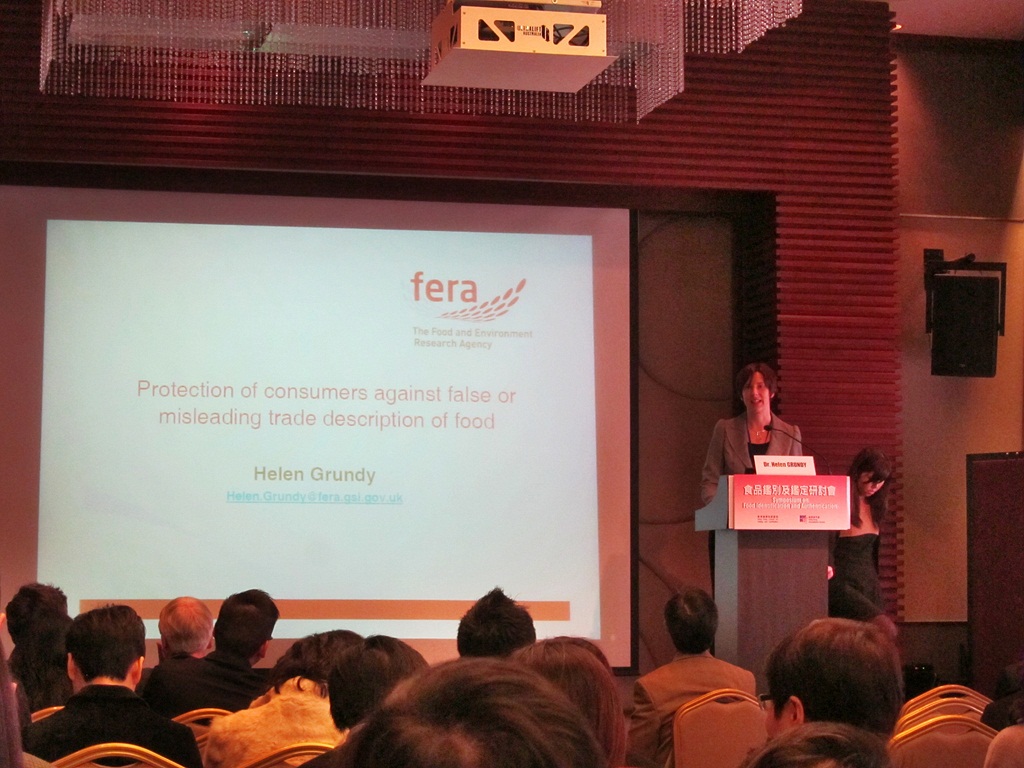
The third speaker was Dr. Helen Grundy and her topic was "Does my food contain undisclosed products such as pork derivatives? Has my wine been adulterated? Proteomics, Metabolomics and IRMS methods to study food authenticity".

Dr. Grundy introduced gelatine which was a protein and lacked essential amino acids. It used extensively in the food industry.

Then she briefed the gelatine production in Europe that 70% were used in food. She said consumer needed for accurate product labelling, to be able to scientifically verify species and to support paper trail.

After that she mentioned application of NMR for different food product. For instance, 1H NMR spectroscopic analysis was able to observe biological processes that occurred during meat storage. The concentration of specific amino acids increased linearly over time, and the rate of increase was related to storage temperature.

Dr. Grundy introduced the use of isotopic as an unique fingerprint. The diagram showed the analysis of Chicken HCNS stable isotope data. Finally, Dr. Grundy summarized LC-MS/MS for gelatine species origin and addition of binding products; Nuclear magnetic resonance (NMR) for maturation of beef and authenticity of manuka honey; and Isotope ratio mass spectrometry for identifying geographic origin, synthetic or natural.

Mr. Matthew Ashworth (Institute of Environmental Science and Research Ltd, New Zealand) was the fourth speaker and his presentation named "Development of an ISO 17025 accredited, quantitative species identification assay for mixed meat products - a work in progress".

Firstly, Mr. Ashworth introduced his institute's background and its capability on food safety program as follow.

The he briefed the meal species identification through techniques, Instrumentation, QA approach and validation. The current techniques included Qualitative PCR based analysis using common primer and MultiNA microchip electrophoresis system.

The detection limits with PCR/MultiNA was discussed.

The QA and Quantitation challenges such as calibration and reproducibility were mentioned. Finally, he planned to assess capability of PCR based technique and considering to use of mass spectrometry.

Dr. Philippe Corbisier (European Commission Joint Research Centre, Institute for Reference Materials and Measurements, Belgium) was the fifth speaker and he presented the topic "Challenges for the Reliable Quantification of Genetically Modified Organisms by PCR Methods".

GMO control was requested from consumers.

Analytical method using real time-PCR to measure food and feed products which containing GMO based on the requirement of Regulation (EC) No 1829/2003. (>0.9% GMO have to be labelled)

The analysis workflow from sample to result was showed in the diagram.

Certified Reference Material with known GM mass fraction was used for calibration.

Comparison of the calibration curves were discussed.

Proficiency test result was showed and HK Government Laboratory got a good result. Finally, Dr. Corbisier said GM quantification by PCR methods depended on a broader set of conditions that often considered. The qPCR had limited robustness and precision. Moreover, reference measurement systems (included adequate calibration) needed to be estblished and properly applied.

The last speaker of afternoon session was Dr. Daria CH Wong (HKAS) and her topic was "HKAS Accreditation Criteria on Molecular Testing of Food".

Limitations on applicability for DNA sequencing technique was discussed.


Dr. Daria introduced the HOKLAS Supplementary Criteria No. 43 - Species Identification by DNA Sequencing for Authentication Purpose.
1. Personnel
- Degree in molecular biology, biology, biochemistry or other relevant subjects
- 3 year relevant testing experience and 6 months experience in DNA sequencing
2. Environment
- Separate area for Post-PCR product purification and DNA sequencing
- Unidirectional movement of DNA material
3. Reagents and Equipment
- Extraction kits, PCR kits, sequencing kits

4. Method Validation
- Selection of target sequence
- Discriminatory power against different species
- Length of sequence (>500 base pairs)
-False positive rate and False negative rate
5. Measurement Traceability
- it shall match the relevant CRM/reference sequence at 98% or higher
6. Quality Assurance
- QC plan, Blanks, etc. (See diagram below)
Q&A Session

Reference: