The Multimedia Technology Forum was organized by Vocational Training Council (IVE) and The IET Hong Kong (IET) on 24th Nov 2012. The Forum did feature the fast growing business opportunities of social media in the digital advertising industries. Several distinguished speakers from those outstanding digital advertising industry to share with us the latest information of the markets.
In the beginning, Dr. Angus CHEUNG (Chairman of IET HK) gave a welcome Speech. He said the cost for business operation in Hong Kong was high. But multimedia industry was no need of much land but need creativity.
Dr. Eric LIU (Asso. Academic Director, IT Discipline, VTC) gave an opening speech that he hoped more exchange between academic and industry.
Then group photo for award presentation (第七屆穗港澳蓉青年技能競賽(網頁設計)香港區頒獎禮) was taken.
Group photo for all speakers and supporting organization representatives
The first speaker was Mr. Benny LEUNG (COO, Green Tomato Limited) and his topic was "Pass Book".
Passbook is one of applications in iOS that allows users to store coupons, boarding passes, tickets, store cards and other forms of mobile payment all together. Benny introduced 4 types included Boarding Passes, Event Tickets, Store Cards and Coupons. Moreover, it could also apply for membership card and using QR code to identify details.
Then Benny briefed the Pass Duck. It is a self-serve platform that allows you to create and distribute Apple Passbook contents across iOS and Android. He mentioned 3 modules included Service Setup, Self-serve Panel and Tracking & Report.
The second speaker was Mr. Thomas LEE (Regional Business Development Director of Outblaze Ventures Limited & Totally Apps Holdings Limited) and his topic named "Global Mobile Media Market & Mobile Game Business". Thomas is professional in Street Fighter Game in secondary school. He studied ecology in university and then he changed his career into electronic game industry.
Thomas analyzed the smartphone growth in global market and found that China was number on App session growth in 2011. He said the mobile game model was free download but In-App purchasing. If the huge download number achieved, only 1 or 2 % people paid the game that was enough.
Then Thomas analyzed the Top Android Phones usage in Asian and found that Samsung was dominated. He mentioned developer should think global but not local. Morever, he said mobile App / Game was suitable for Hong Kong and encouraged student to join this industry.
Before tea break, Mr. SL Mak (Vice-Chairman, The IET Hong Kong) performed IET membership drive.
The third speaker was Mr. Johnny WONG (CEO, Hotmob Limited) and his presentation was "Mobile Marketing in Hong Kong".
Johnny said that a Premium Mobile Ad Network, with Premium Advertiser, Publishers and Deliver Quality Results CPM cost 8-10 times higher that Global Ad Network. Moreover he would like to provide Luxury Mobile Adverising Solutions with innovative technology and ideas. The following market figures in Hong Kong were stated and it was why Mobile Ad to be attractive.
Then Johnny demonstrated some showcases included Banner Ads, The Pop Up, The HTML Pop Up, The App Sponsorship, and Advertorial. The following survey showed mobile behaviour in Hong Kong. Most people (66%) used unlimited data plan. Top three Apps Usage were Social Network, News and Games.
Finally, Johnny concluded the core value of mobile advertising was behavioral targeting. Quality Advertising delivery was based on demographics, user footprint, locations, profile, comments and users habit.
The last speaker was Mr. Willy LAI (Business Director, Fimmick) and his presentation title was "Facebook Marketing in Hong Kong".
Willy briefed the Facebook environment and showed the growth from 2009 to 2012. The Facebook population in Hong Kong was found 4,110,000 (active users).
Then Willy explained that they did not use total visitor number or Total Likes but People Talking About This (PTAT). If PTAT > 10% indicated Excellent.
Finally, Willy mentioned the Edgerank algorithm in Facebook which was Time decay + Weight + Affinity. That is why not all your friends feed could be read in the facebook. Willy also stated that 6 to 12 months for traditional development process was not fast enough. Now, App product in Beta version was issued within 2 or 3 month and then debug.
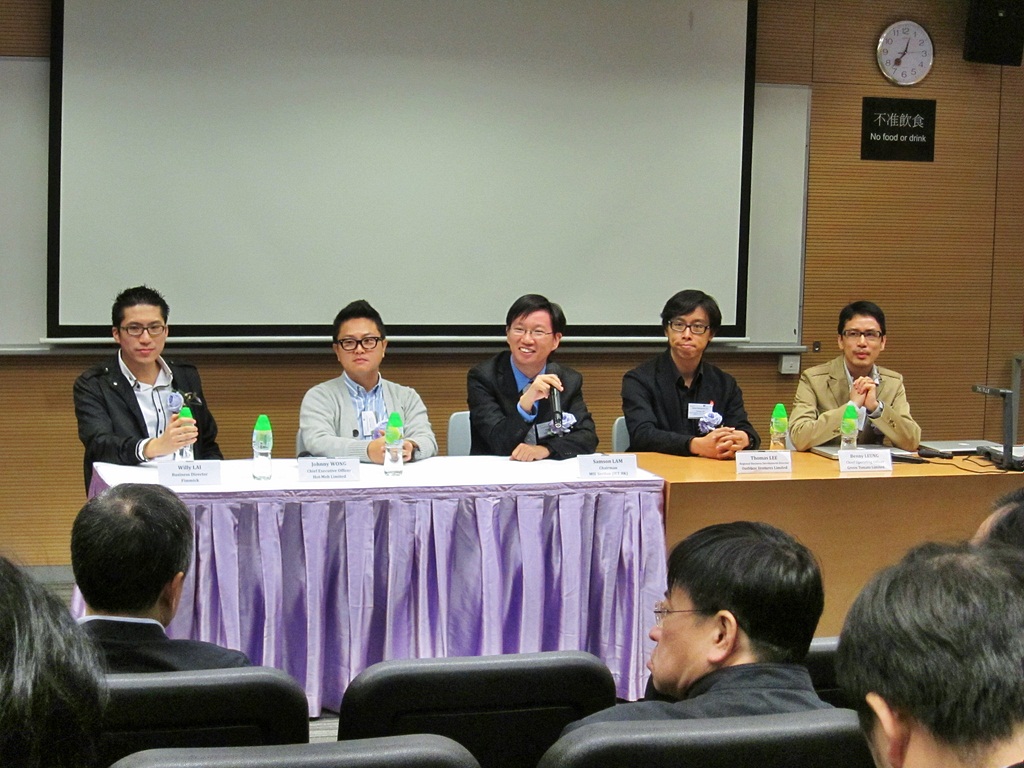
Panel Discussion
Dr. Jacob Cheung (Chairman of ICT Section, The IET Hong Kong) was a moderator.
Mr. Dave CHONG (Chairman, MILES Alumni Association of PolyU) gave a closing speech.
Reference:
Multimedia Technology Forum 2012 - http://mit.vtc.edu.hk/mtforum2012
2012年11月25日星期日
2012年11月24日星期六
Visit to Ngong Ping 360 Cable Car Terminal
"Technical Visit to Tung Chung Cable Car Terminal" was organized by Hong Kong Society for Quality (HKSQ) on 23rd Nov 2012. It was on of activities that HKSQ celebrated World Quality Month (WQM) 2012. Ngong Ping 360 Cable Car System was constructed by Hong Kong MTR Corporation, the operator of Hong Kong's rail system. It is now operated by a wholly owned subsidiary of the MTR Corporation - NP360. "Ngong Ping 360" means the passengers have 360-degree view of Lantau Island. HKSQ members visited the Operation Control Centre (OCC), Garage and had opportunity of appreciation of cable car operation.
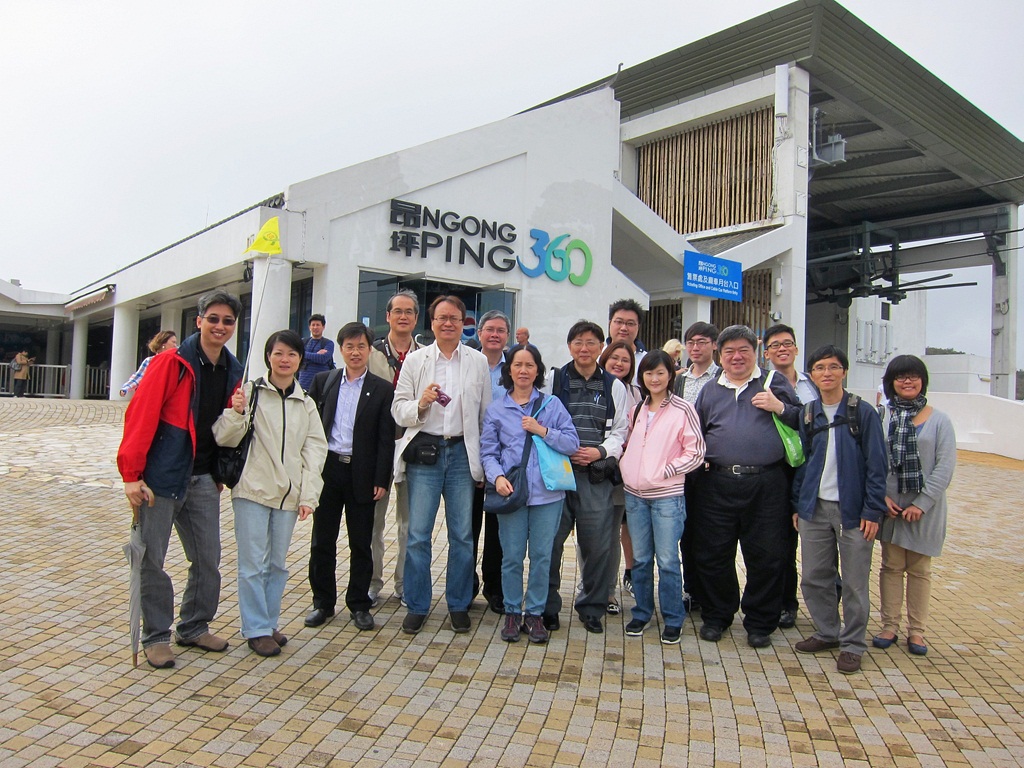
Then we went to the Ngong Ping 360 office and a group photo was taken.
In the meeting room, Mr. Karson Chui (Chairman, HKSQ) briefed today's arrangement and appreciated NP360 hospitality.
Mr. Samuel Lee (Cable Car Technical Support Manager, NP360) gave us a presentation entitled "Overview of Cable Car System". His talk included "Alignment", "Key Parameters", "System Configuration" and "Carriers & Garage".
The diagram showed the overview of the NP360 from Tung Chung Terminal to Ngong Ping Terminal. Mr. Lee said NP360 is one of most complicated cable car system because of two angle changing design based on the topography. The total length was 5.7km.
There are 2 Terminals and 2 Angle Stations (Airport Island Angle Station (AIAS) - 60 degree and Nei Lak Shan Angle Station (NLSAS) - 20 degree), as well as, 8 Towers. The maximum elevation is Tower 6 (585m) and the tallest tower is T2B (55m).
Then Mr. Lee explained the Bi-cable Design to us. Track rope is used to support cabins on line and Haul rope is employed to keep cabins moving on line. The line speed is 7m/s (max.) and station speed is from 0 to 0.25m/s. Three operation modes were introduced. The maximum capacity is up to 109 carriers using for holiday and the medium capacity is 84 carriers from working day. Special mode using 3 carriers (2 cabins and 1 work car) for maintenance.
The diagram showed Track Rope Anchoring. The red color block has 4mm gap which is a safety device to detect any deviation of cable mechanic system.
Different monitoring devices such as CCTV, Emergency Light and Wind Sensor, as well as, some safety device were mentioned.
After that Mr. Lee briefed the design of Crystal Cabins. There are 36 crystal cabins and 10 persions for each cabin. A single piece of layered tempered glass (3 layer (4.84cm) and added one protective coating) is adopted as the cabin bottom. New 360 Sky Lounge was introduced which made with Swarovski crystals inside the cabin.
Cabin was designed for max. 17 person (10 seats plus 7 standing) with Solar battery power, LED light and emergency facilities.
After the talk, our chairman represented HKSQ to present flag for Mr. Lee memory. Then we started to visit their operation centre.
Mr. Lee explained their work in Operation Control Centre. It was included monitoring cabins operation, environmental data such as wind speed and direction, and control emergency announcement.
They had emergency three steps poster. Step 1 - Stop and collect information; Step 2 - Think and analysis; and Step 3 - Make decision based on situation. NP360 has ISO 9001 and OHSAS 18001. Once incident happened, the red count would be activated. They had contingency plan on different time with different action.
We then visit the cabin car garage.
Then we took a group photo in the garage.
We saw a 360 Sky Lounge! Very luxury!
After the talk and visit, we enjoyed the cable car to the Ngong Ping terminal. We took a group photo again.
At the end, we enjoyed a lunch before dismissed.
We visited Big Buddha again.
Then we visited the "Wisdom Path".
Reference:
HKSQ World Quality Month - http://www.hksq.org/world_quality_month.htm
Ngong Ping 360 Cable Car Terminal - http://www.np360.com.hk/en/
Industrial Engineer at Disneyland and Tian Tan Buddha Visit - http://qualityalchemist.blogspot.hk/2009/04/industrial-engineer-at-disneyland-and.html
The whole visit was summarized below for sharing.
We gathered at MTR Tung Chung Station at 9:15am.
Then we went to the Ngong Ping 360 office and a group photo was taken.
In the meeting room, Mr. Karson Chui (Chairman, HKSQ) briefed today's arrangement and appreciated NP360 hospitality.
Mr. Samuel Lee (Cable Car Technical Support Manager, NP360) gave us a presentation entitled "Overview of Cable Car System". His talk included "Alignment", "Key Parameters", "System Configuration" and "Carriers & Garage".
The diagram showed the overview of the NP360 from Tung Chung Terminal to Ngong Ping Terminal. Mr. Lee said NP360 is one of most complicated cable car system because of two angle changing design based on the topography. The total length was 5.7km.
There are 2 Terminals and 2 Angle Stations (Airport Island Angle Station (AIAS) - 60 degree and Nei Lak Shan Angle Station (NLSAS) - 20 degree), as well as, 8 Towers. The maximum elevation is Tower 6 (585m) and the tallest tower is T2B (55m).
Then Mr. Lee explained the Bi-cable Design to us. Track rope is used to support cabins on line and Haul rope is employed to keep cabins moving on line. The line speed is 7m/s (max.) and station speed is from 0 to 0.25m/s. Three operation modes were introduced. The maximum capacity is up to 109 carriers using for holiday and the medium capacity is 84 carriers from working day. Special mode using 3 carriers (2 cabins and 1 work car) for maintenance.
The diagram showed Track Rope Anchoring. The red color block has 4mm gap which is a safety device to detect any deviation of cable mechanic system.
Different monitoring devices such as CCTV, Emergency Light and Wind Sensor, as well as, some safety device were mentioned.
After that Mr. Lee briefed the design of Crystal Cabins. There are 36 crystal cabins and 10 persions for each cabin. A single piece of layered tempered glass (3 layer (4.84cm) and added one protective coating) is adopted as the cabin bottom. New 360 Sky Lounge was introduced which made with Swarovski crystals inside the cabin.
Cabin was designed for max. 17 person (10 seats plus 7 standing) with Solar battery power, LED light and emergency facilities.
After the talk, our chairman represented HKSQ to present flag for Mr. Lee memory. Then we started to visit their operation centre.
Mr. Lee explained their work in Operation Control Centre. It was included monitoring cabins operation, environmental data such as wind speed and direction, and control emergency announcement.
They had emergency three steps poster. Step 1 - Stop and collect information; Step 2 - Think and analysis; and Step 3 - Make decision based on situation. NP360 has ISO 9001 and OHSAS 18001. Once incident happened, the red count would be activated. They had contingency plan on different time with different action.
We then visit the cabin car garage.
Then we took a group photo in the garage.
We saw a 360 Sky Lounge! Very luxury!
After the talk and visit, we enjoyed the cable car to the Ngong Ping terminal. We took a group photo again.
At the end, we enjoyed a lunch before dismissed.
We visited Big Buddha again.
Then we visited the "Wisdom Path".
Reference:
HKSQ World Quality Month - http://www.hksq.org/world_quality_month.htm
Ngong Ping 360 Cable Car Terminal - http://www.np360.com.hk/en/
Industrial Engineer at Disneyland and Tian Tan Buddha Visit - http://qualityalchemist.blogspot.hk/2009/04/industrial-engineer-at-disneyland-and.html
2012年11月19日星期一
ASQ InfVoices - The Quality Law of Motion - Acceleration
The November Topic of ASQ Influential Voice named "World Quality Month: Accelerating Quality" and Paul Borawski (CEO, ASQ) raised a question that "What can we do to accelerate the rate of adoption of quality?" Since I had studied Physics in my first degree, I would like to modify Newton's Second Law of Motion to interpret Quality Accelerating. In September, I used the term "Quality Velocity" to explain the trend of faster change on product and service. And then defined that "Quality Velocity" is committed to delivering the highest quality products or services, on time, each time and every time you buy to meet the requirement of shorter and shorter product/service life cycle. In this time, I would like to quote the Newton's Second Law that the acceleration (a) of a body is parallel and directly proportional to the net force (F) acting on the body, is in the direction of the net force, and is inversely proportional to the mass m of the body, i.e., F = ma, to interpret the Quality Law of Motion.
Where, F is Quality Force, m is the Mass of Organization and a is Quality Acceleration that a = dv/dt, (v is Quality Velocity) indicating that the velocity changed with time.
Based on Newton's First Law that natural tendency of objects to resist changes in their state of motion, this tendency is described as inertia. Moreover, the tendency of an object to resist changes in its state of motion varies with mass (m). It means that the larger organization (m) need greater force (F) to move the quality level. Quality Force could be separated into external and internal. External Quality Force is mainly come from Customer Requirement (CR); and Internal Quality Force usually come from Top Management Commitment (TMC).
"F = ma" is universal true in Physics World and Quality World. In order to increase the Quality Acceleration, we must do two things. One is to reduce the mass of organization using Lean Principles and the other is to increase the Force based on CR and TMC in which depends on Organization's Quality Culture. Quality Culture was discussed in August Topic of ASQ Influential Voice.
Reference:
Newton's laws of motion - http://en.wikipedia.org/wiki/Newton's_laws_of_motion
ASQ InfVoices - The Quality Velocity and Balance - http://qualityalchemist.blogspot.hk/2012/09/asq-infvoices-quality-velocity-and.html
ASQ InfVoices - The Quality Culture in Hong Kong - http://qualityalchemist.blogspot.hk/2012/08/asq-infvoices-quality-culture-in-hong.html
2012年11月17日星期六
Seminar on Improving Customer Satisfaction with better Supply Chain Management
Hong Kong Society for Quality (HKSQ) celebrated World Quality Month (WQM) in November and arranged different activities in this month. The 2nd seminar entitled "Imprving Customer Satisfaction with better Supply Chain Management" organized by HKSQ and co-organized by BSI and PolyU on 16 Nov 2012. The seminar aimed to help companies enhance performance and achieve strategic competitiveness through effective supply chain management (SCM).
Then she used Boeing 787 as example to explain the huge supply chain through six countries.
The follow diagram showed the business processes of SCM. She said it should be identified who was critical suppliers and the risk if they failure.
Ms. Patsy introduced key drivers to improve SCM and the first three drivers were "Resilience", "Responsiveness" and "Green Product/Service". After that she introduced Supply Chain Continuity Management (SCCM) which was combined Business Continuity Management (BCM) and Supply Chain Management (SCM). The SCCM model was showed below.
Step 1: Analysis of Supply Chain (SC)
Determine scope of SC and then mapping SC. Define critical product/service and priority its risk. Some methods of risk priority was demonstrated.
Step 2: Developing Strategies
Defining recovery requirements and review the supplier's continuity capability. The follow diagram explained the relationship between Recovery Time Objective (RTO) and Maximum Tolerable Period Downtime (MTPD). (Usually, RTO < MTPD)
Step 3: Operational
It related to respond effectiveness and the key points were 4C included Communication, Collaboration, Coordination and Culture. The steps on operational was mentioned in the diagram.
Step 4: Assurance Ongoing Management
It is to verify or validate and improve the level of continuity management, as well as, to monitor and proactive detection mechanism for any changes.
Finally, Ms. Patsy Cheng concluded that SCCM provided clear picture on supply chain and gaven a better understanding of supplier management, as well as, to ensure continuous operation of supplier.
Q&A Session
Mr. Karson Chui (Chairman of HKSQ) presented a souvenir to Ms. Patsy Cheng.
Reference:
HKSQ World Quality Month - http://www.hksq.org/world_quality_month.htm
Mr. Karson Chui (Chairman of HKSQ) presented a souvenir to Ms. Patsy Cheng.
Reference:
HKSQ World Quality Month - http://www.hksq.org/world_quality_month.htm
訂閱:
文章 (Atom)