2015年12月5日星期六

HKSTP DIY Marketing Workshop – Marketing Research

The DIY Marketing Workshops Series (4) named “Marketing Research” was organized by Hong Kong Science & Technology Parks Corporation (HKSTP) on 3rd Dec 2015. Marketing research is one of the most effective tools to know about your markets and customers. The findings of successful marketing research will definitely help companies to develop effective marketing mix.

Prof. Samart Powpaka (Associate Professor, Marketing Department; and Director of MSc Program in Marketing, CUHK Business School of The Chinese University of Hong Kong (CUHK)) was our guest speaker.


In the beginning, Prof. Powpaka introduced different types of research. He said the goal of academic research was to discovery theories; and a theory was an explanation of a phenomenon, as well as, it was facts.


Then he explained the research methodology that separated into “Concept” to “Construct” to “Valuable”. Where Concepts had constitutive definitions but was not able to be measured directly. Constructs were concepts that could be measured if operational definition added. The relationships among Concepts, Constructs and Variables were discussed. For instance, 1 concept → 1 construct → 1 scale → 1 or more observed variable. Different Scales were explained as follows:
i) Nominal scale – ID
ii) Ordinal scale – Ranking
iii) Interval scale - Degree of difference between items (without zero)
iv) Ratio scale – with zero value


After that Prof. Powpaka drew another diagram. The upper part (Perceived Quality (PQ) → Attitude (A)) was concept (in Empirical World) and the lower part (Xn → Yn) was Variables/Scales (in Abstract World). Since Concept was not be measured, we could only measure its variables and verified our concept relationship from Abstract World to Empirical World.


Three research design methods were introduced and they were Sample Surveys, Experiments and Field Studies. For A → B, Sample Surveys used when A and B both measurable; Experiments used when A was measurable and B was manipulable (with / with something); and Field Study when data collected by observation in the field. Each research designs had different strengths and weaknesses as the diagram showed.
- Sample Surveys are high in generalizability but low in precision/control and realism.
- Experiments are high in precision/control but low in generalizability and realism.
- Field Studies are high in realism but low in precision/control and generalizability.


There are two types of sampling that were probability and non-probability sampling. Prof. Powpaka drew a diagram to explain the following probability samplings:
- Simple random sampling (1)
- Stratified sampling (2)
- Cluster sampling (in red color)
- Systematic sampling (No particular pattern)
- Area sampling (e.g. US City → Block → Room → Person)


Prof. Powpaka plotted a table to explain different statistic techniques employed in specific conditions. Where DV – Dependence Variable, IV – Independence Variable, m – matrix, C – Character variable (e.g. Gender)


For Positioning Research, Prof. Powpaka showed the steps from “Need Recognition (Problem)” to “Search” to “Alternative Evaluation” and then obtained the Perception Map(s). Where A to F in diagram was Shopping Centre and 60 degree was ID line. It could estimate the ideal location.


After that Prof. Powpaka demonstrated the data analysis using SPSS using the model that X1-X11 were parameters and Y1 was Brand and Y2 Purchasing Intention. The first step used Factor Analysis to find how many factors (Data reduction) and then compared their Means (FS) and using factor scores for multiple regression with Y1. Finally, he used simple regression to find the relationship between Y1 and Y2.


At the end of the workshop, I asked Prof. Powpaka how to calculate Cronbach’s Alpha. He demonstrated and said it should be larger than 0.7. He also told me that Cronbach’s Alpha used as reliability test for sample survey under “Structural Equation Modeling”. (P.S. usually used to test model with large scales)


Reference:
HKSTP - http://www.hkstp.org


2015年12月3日星期四

HKQAA Seminar on “A New Era of Management System Standard - ISO 9001:2015”

Hong Kong Quality Assurance Agency (HKQAA) organized the seminar named “A New Era of Management System Standards – Common Myths, Truths and Lies about ISO 9001:2015” on 3rd Dec 2015. The seminar aimed to explore some of the common misconceptions about new ISO 9001:2015 standards including the role of ISO; the Quality Management Principles, Risk-based thinking, and the role of ISO 9001 in Sustainable Development, etc. Mr. Peter Fung (Chairman, HKSQ) had attended the seminar and took some photos for sharing.


Before the seminar, Mr. Edmond Fung (Assistant General Manager, HKQAA) introduced HKQAA Hong Kong Registration – Personnel Series. There were several types of registered personnel for individual applicant included Registered Quality/Environment Management Professional/Officer/Auditor for applicant who had competence and comprehensive working knowledge in Management Systems. Organizations which committed to the improvement of their employees’ competence could join as “Companions”. Then he mentioned some benefits to be a Registered Personnel.


Dr. Nigel Croft (Chairman, ISO Subcommittee responsible for ISO 9001 and ISO 9004 standards) was the guest speaker. Firstly, he joked that ISO stands for “International Sightseeing Organization” – Myth, truth or lie? “Lie!” He said ISO stands for “International Organization for Standardization” which based in Geneva.


Then he asked the second question “ISO 9001:2015 will revolutionize quality management” – Myth, truth or lie? It was Myth! He told us ISO 9001 was evolution but not revolution.


Dr. Nigel Croft also asked “ISO 9001 is ISO’s biggest selling standard of all time” – Myth, truth or lie? It was truth! ISO 9001 was the top of the list and others in the “top 10” included ISO 14001, ISO 9000, ISO 9004, IOS/IEC 17025, ISO/IEC 27001, ISO 19011, etc.

After that Dr. Nigel Croft briefed he was coached by Dr. Edwards Deming and recognized that there must be a method to achieve an aim. Management System was the method to achieve different aims through ISO 9001 (Consistent, Conforming Products), ISO 14001 (Prevention of Pollution), ISO 45001 (Safe Working Conditions), ISO 50001 (Efficient Energy Usage), ISO 22000 (Safe Food), etc.


He also asked “ISO 9001:2015 has abandoned the Process Approach” – Myth, truth or lie? The answer was Lie! Because 3 core concepts for ISO 9001:2015 were i) to identify the processes needed to achieve the planned results; ii) to continually monitor the risk (Risk-based thinking) and iii) to manage the processes and the system using PDCA.

Another question was “ISO 9001 does not guarantee business excellence” – Myth, truth or lie? It was Truth! ISO 9001 was fundamental level to ensure reliable products. Company needed increasing their QMS maturity to business excellence.


Dr. Nigel Croft mentioned new standard was changed in focus from Old “A” (Correction, Corrective Action and Preventive Action) in “PDCA” cycle to “P” & “A” in “PDCA” cycle. “P” was focused on “Risk Identification and Treatment/Mitigation” (Prevention) and “A” was for “Containment, Correction, Corrective Action (to prevent recurrence!), and Improvement (included Kaizen, but also breakthrough improvements and innovation).

After questions answered, Dr. Nigel Croft briefed summary of some other changes to ISO 9001:2015 which was similar he presented in the ITC & HKCTC Conference on ISO 9001:2015.

At the end, Dr. Nigel Croft concluded that ISO 9001 had undergone a “Major Revision” and he encouraged us to prepare transition NOW.


Reference:
ISO - http://www.iso.org/iso/home.html
HKQAA - http://www.hkqaa.org/en_index.php
HKSQ - http://www.hksq.org/
20151125 – ITC & HKCTC Conference on ISO 9001:2015 - http://qualityalchemist.blogspot.hk/2015/11/itc-hkctc-conference-on-iso-90012015.html


2015年12月2日星期三

The Gulf Cooperation Council Accreditation Centre - Secretary-General Visit to HKSTP Laboratories

We were honor that Dr. John Ho (Accreditation Officer, HKAS) accompany with Secretary-General from the Gulf Cooperation Council (GCC) Accreditation Centre to visit Laboratories of the Hong Kong Science and Technology Parks Corporation (HKSTP) on 2nd Dec 2015. Mr. Nabil A Molla (Secretary-General, GCC Accreditation Center (GAC)) was invited by the HKSAR Government to visit Hong Kong. The aim of the visit is to enable selected people from around the world who have a strong interest in Hong Kong to see the place first hand, and through site visits and meeting with people to acquire a better understanding about the situation in Hong Kong, about its economy, and its opportunities and problems. The main theme of the visit was “an overview of share facilities for testing and certification industry provided by the Government’.


In the beginning, I briefed the background of HKSTP and our Technology Support Centre (TSC). Then we took the photo in front of my office.
(Right: Dr. John Ho (HKAS), Mr. Nabil A Molla (GAC), Mr. YC Lee (HKSTP) and I)


After that we visited Wireless Communications Test Laboratory (WCTL) and Reliability Laboratory (RL). Mr. YC Lee (Senior Manager, TSC, HKSTP) introduced our new 3D printer and its products to Mr. Molla.


Then we went to Biotech Centre and took a photo in 7/F which could look back to the Golden Egg.


In this floor, we visited to the Probe and Test Development Centre (which operated in the class 10000 clean room). Mr. YC Lee explained the 3D SiP technology to the guest. We took a photo in front of the show room.


After that we went to Biotech Support Centre and our engineer demonstrated different biotechnology equipment.


The most advance DNA sequencer was demonstrated. We also visited to Material Analysis Laboratory and our engineer briefed the operation SEM and XPS to the guest.


Finally, I led visitors into Charles K. Kao Auditorium (also known as the “Golden Egg”). It is a lecture theater with 283 seats. I took a photo with Mr. Molla under Golden Egg.


Inside the auditorium, Mr. Molla was taken a photo in the stage and we would like to invite him to be our guest speaker when he came to Hong Kong next time.


Mr. Molla took a photo in the VIP room inside the Golden Egg.


At the end, we took a photo in front of the Golden Egg.


I would like to introduce the background of GCC, GSO and GAS below.
GCC
The full name of GCC is ‘The Cooperation Council for the Arab States of the Gulf’ which consists of seven member states, viz. United Arab Emirates, Bahrain, Saudi Arabia, Oman, Qatar, Kuwait and Yemen. The technical infrastructure of GCC is as follows:
(i) Unified standards and technical regulations (through GSO);
(ii) a common legal framework;
(iii) common National Metrology Institutes;
(iv) a regional metrology organization;
(v) a multi-economy accreditation body (i.e. GAC); and
(vi) a regional accreditation cooperation.
The main objective of GCC is to achieve a single market with economic integration and customs union among the GCC member states, leading to facilitation of the intra GCC trade as well as international trade through elimination of trade technical barriers.

GSO
The full name of GSO is ‘the GCC Standardization Organization’. It is operating under the GCC to fulfill its objective to achieve ‘a single market with economic integration and customs union among the GCC member states’ as well as concluding MoU with GCC trading partners, through harmonization of standards, technical regulations and conformity assessment procedures.

GAC
The full name of GAC is ‘the GCC Accreditation Centre’. It is a multi-economy accreditation body created by the GSO Council on 8 May 2013. It started providing accreditation service on 1 January 2014. GAC is a full member of APLAC.

Reference:
HKAS - http://www.itc.gov.hk/en/quality/hkas/about.htm
HKSTP Lab - http://www.hkstp.org/en-US/Services-Programmes/Technology-Support-Laboratory-Services/Overview.aspx#.VMD_TUeUchA
GCC Accreditation Center – http://gcc-accreditation.org/gac/
GCC Standardization Organization - http://www.gso.org.sa/gso-website/?lang=en
20150122: The Gulf Cooperation Council Accreditation Centre and Standardization Organization representatives visit to HKSTPC Laboratories - http://qualityalchemist.blogspot.hk/2015/01/the-gulf-cooperation-council.html


2015年12月1日星期二

HKCTC Seminar on Quality Management and Quality Assurance

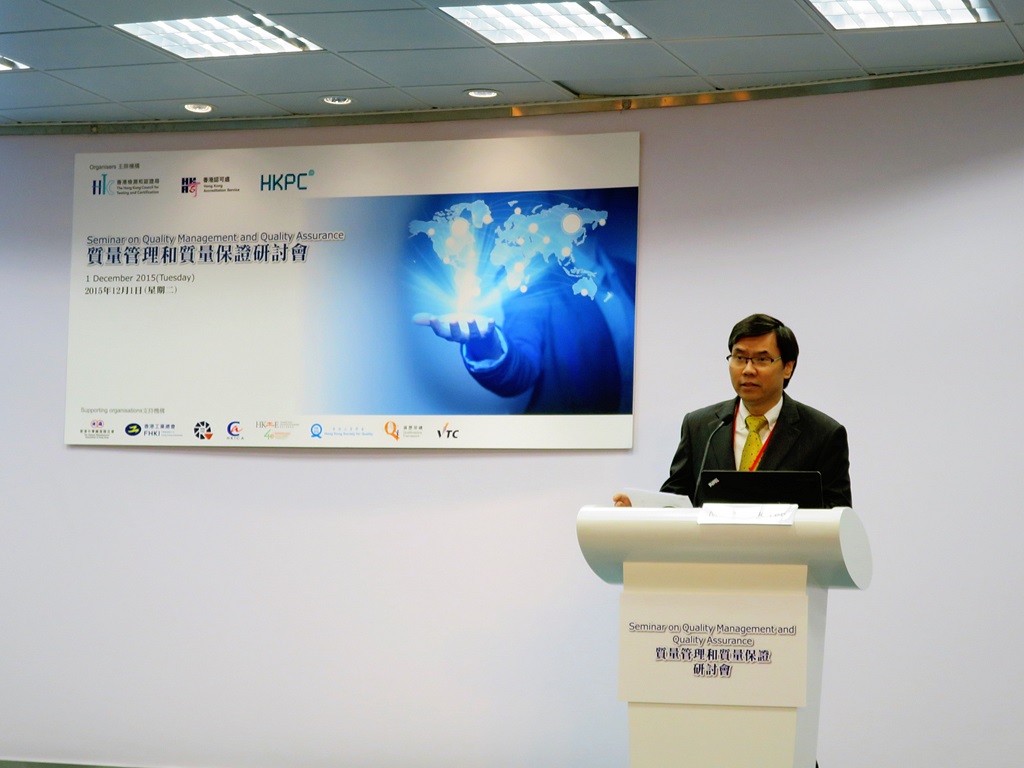
The Hong Kong Council for Testing and Certification (HKCTC), Hong Kong Accreditation Service (HKAS), and Hong Kong Productivity Council (HKPC) co-organized a seminar entitled “Quality Management and Quality Assurance” on 1st Dec 2015. Hong Kong Society for Quality (HKSQ) was one of supporting organizations. The seminar aimed to introduce to participants the latest development of international standard of quality management, and experience sharing on quality management.

In the beginning, Mr. Kesson Lee (Secretary-General, HKCTC) gave a welcome remark. He told us ISO established since 1947 and issued 20k standards in the world. He also added ISO 9001 Quality Management System standard, which first published in 1987, is one of the most widely used ISO standards around the world and in Hong Kong. There were about 1.1 million certificates issued and 14 certification bodies accredited by HKAS in Hong Kong. Recently, ISO/TC 176 Plenary Meeting was held in Hong Kong and 88 meetings/seminars were performed for TC 176 members.


Then all guest speakers took a group photo.
(Left: Dr. Chris K.Y. Lo (PolyU), Mr. Patrick Yen (HKPC), Mr. Kesson Lee (HKCTC), Mr. Mr. Howie Ng (HKV) and Dr. Tommy Lo (HKICA))


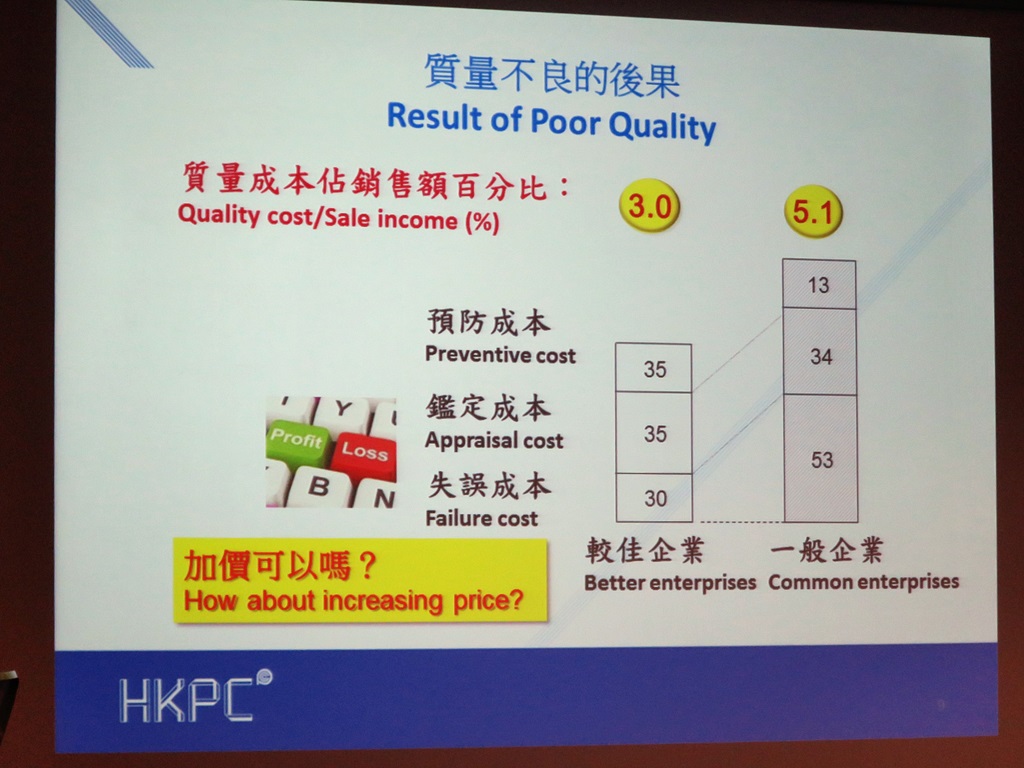
The first speaker was Mr. Patrick Yen (Senior Consultant, HKPC) and his topic entitled “Quality Management helps enterprises to enhance productivity and efficiency”. His presentation content included “What is Good Quality?” “Result of Poor Quality”, “How to Manage Quality?” and “Quality Improvement Cases”.


Mr. Yen discussed that the compliance with specification requirements and the lowest total quality cost were not necessary to be good quality. High Performance / Price Ratio may be a good quality. Then Mr. Yen introduced the result of Poor Quality because of considering preventive cost, Appraisal cost and Failure cost. Moreover, poor quality would result decreasing “Team Relationship”, “Production/Service Effectiveness” and “Reputation/Trust”.


Then Mr. Yen mentioned 5 steps to manage quality through “Total Inspection” to “Process Control” to “Quality Control” to “Quality Assurance” and final achieving “Quality Culture”. Culture included Quality System, Technology/Tools and Staff Development. Some quality improvement cases such as electronic and textile industry were discussed. Finally, he concluded in three points that “System cannot substitute people’s devotion”, “Using the best method also needs paying effort” and “Leadership is important”.


Mr. Howie Ng (Technical Director, Hong Kong Veritas Limited, Member of HKCTC & Member of ISO/TC 176/SC 2/WG 24) was the second speaker and his presentation named “ISO 9001 – the Past and Present”. Firstly, Mr. Howie Ng briefed the history of ISO 9001 in early versions 1987, 1994, 2000 and 2008. He commented that ISO 9001 is QA before 2000 version and it is QM after 2000 version. In ISO official survey 2014, the number of certificates in China (342,800), Hong Kong (2295), Macau (115) and Taiwan (10,328) were discussed.


Then Mr. Howie Ng reviewed the 28 years journey of ISO that he summarized the five key elements changed in the new ISO 9001:2015 standards. There were QM, Top Management Commitment, Risk-based Thinking, Improvement and Documentation. (I summarized Howie’s slide into the following diagram which showed what different among different versions of ISO 9001.)


During discussion for improvement, he explained Continual Improvement was “small step improvement” (Kaizen) which adopted from ISO 14001:1996. Continual means ‘one after the other’ or ‘recur’ and Continuous means ‘non-stop’ or ‘never ending’. No documented procedure mentioned in 2015 version, which did not mean without any document and record. Mr. Howie Ng explained they used the term “maintain” indicating “document” and “retain” indicating “record” in the standards.


Finally, Mr. Howie Ng summarized all changes of new standards including Annex SL, Top management embeds QMS, Risk-based thinking, revised terminologies, less mandatory documentation and concept of improvement.


During tea break, I took a photo with Mr. Howie Ng and Mr. Larry Lee (Customer Services & Compliance Quality Manager, GP Batteries International Limited)


I also took a photo with Dr. Tommy Lo (HKICA).


Dr. Lo Yiu, Tommy (President, Hong Kong Institution of Certified Auditors (HKICA)) was the third speaker and his topic was “Audit and Certification”. He reviewed the background of Testing and Certification Service which identified as one of the six pillar industries for propelling Hong Kong towards knowledge based economy in the 2009 Chief Executive’s Policy Address.


Dr. Lo mentioned the building / construction material was a pioneer of product certification in TIC in Hong Kong because of Housing Authority supported. There were several product certification schemes such as QSPSC, PCCS-PFPP, PCCS-CP, etc. Then he also stated that auditor was the second professional and who would audit different industries based on their technical domain.


After that Dr. Lo briefed the status of certification and audit in Hong Kong that was a voluntary scheme except HKSAR as major customer demanding supplier to be ISO certified in construction industry. There were no requirement on Auditor and only relied on Certification Bodies. Customer’s expectation was low so that they needed to promote and demand Professionalism.


Dr. Lo said auditor needed license to perform in China under CCAA accredited based on ISO 17024. HKICA would apply to be the first body in Hong Kong. There were about 60k certified auditors in China under CCAA and only 300 auditor registered in HKICA/IRCA in Hong Kong.


HKICA was planning to discuss mutual recognized with CCAA in China after CNAS accreditation in near future. The table showed the matching auditor levels between CCAA and HKICA. Dr. Lo explained there was different meaning of Lead Auditor. In China, Lead Auditor is an honor to grant to the experienced and outstanding auditor who has significant contribution in his field.


Finally, Dr. Lo concluded that Audit and Certification were co-existence and professional services. Competency, professionalism, continual professional development and training were essential for Auditor registration system. He hoped that the status of Quality Auditor would be same as Registered Safety Auditor after initiated by government.

The last speaker was Dr. Chris K.Y. Lo (Assistant Professor, Institute of Textiles and Clothing, PolyU) and his presentation title named “The Impact of Contextual Factors on the Efficacy of ISO 9000 Adoption”. Firstly, Dr. Chris Lo mentioned some scholars’ studies concluded positive and negative finding of enterprises employed ISO 9001. Then he introduced two research questions he asked “The effectiveness of ISO 9000 is highly controversial” (McGuire and Dilts, 2008) and “Under what contextual factors is the efficacy of ISO 9000 adoption stronger?”


In Dr. Chris Lo study, he used hierarchical linear modeling (HLM) with 7 hypotheses as follows.
- H1: Firms with Low Technology Intensity obtain more benefit from ISO 9000 adoption than firms with high technology intensity. (-ve)
- H2: Firms with Low Labor Productivity obtain more benefit from ISO 9000 adoption than firms with high labor productivity. (-ve)
- H3: Firms with High Labor Intensity obtain more benefit from ISO 9000 adoption than firms with low labor intensity. (+ve)
- H4: Firms in Less Efficient Industries obtain more benefit from ISO 9000 adoption than firms in more efficient Industries. (-ve)
- H5: Firms in Highly Competitive Industries obtain more benefit from ISO 9000 adoption than firms in less competitive Industries. (+ve, because use of inverted skill)
- H6: Firms in Industries with High Sales Growth obtain more benefit from ISO 9000 adoption than firms in industries with low sales growth. (+ve)
- H7: Firms in Industries with Low ISO 9000 Adoption Levels obtain more benefit from ISO 9000 adoption than firms in industries with high ISO 9000 adoption levels. (-ve)


Dr. Chris Lo got implications after the research that a one-size-fits-all approach to ISO 9000 certification may not ultimately lead to optimal outcomes.

Q&A session
I asked question to Howie about engage of people and QMS into business as well as to Dr. Tommy Lo that would HA lead registered quality auditor as requirement like safety auditor.


Mr. Larry Lee asked that new standards did not mention “Documented Procedure” that would be “No Word Book (無字天書)”. He foresaw very difficult to audit.


Mr. TF Chan (Member, CQI) also asked a question about preparing documentation.


Reference:
HKCTC - http://www.hkctc.gov.hk/en/home.html
HKCTC Seminar presentation file - http://www.hkctc.gov.hk/en/work_seminars.html#b50
HKAS - http://www.itc.gov.hk/en/quality/hkas/about.htm
HKSQ - http://www.hksq.org/

Remark:
I would like to explain the relationship among Quality Management (QM), Quality Assurance (QA) and Quality Control (QC).
QM is a set. QA and QC are sub-set of QM. That means QA & QC are both aspects of QM.
- QC is used to verify the quality of the output (Detection)
- QA is the process of managing for quality (Prevention)

In ISO 9000:2015:
Clause 3.3.4
Quality Management - management with regard to quality
Note 1 to entry: Quality management can include establishing quality policies and quality objectives, and processes to achieve these quality objectives through quality planning, quality assurance, quality control, and quality improvement.
Clause 3.3.6
Quality Assurance - part of quality management focused on providing confidence that quality requirements will be fulfilled
Clause 3.3.7
Quality Control - part of quality management focused on fulfilling quality requirements


LinkWithin

Related Posts with Thumbnails