2013年10月18日星期五

ANQ Congress 2013 Bangkok – Day 1

The first day of Asian Network for Quality (ANQ) Congress 2013 in Bangkok, Thailand was on 16 Oct 2013. Minda and I took a photo in front of the venue.


Then HKSQ group photo was taken inside the hall.
(Left: Ms. Meiyan Lin, Dr. KS Chin, Dr. Lotto Lai, Ms. Minda Chiang and Mr. Ivan Ng)


Before the congress, a traditional Thailand performance dance was showed.


In the beginning, Dr. Panisuan Jamnarnwej (Organization Committee Chairman, ANQ Congress 2013) gave a greeting speech and he would like to thank both the Standard and Quality Assoication of Thailand (SQAT) and the Foundation for TQM Promotion in Thailand (FTQM) for co-organizing ANQ Congress 2013; as well as to thanks all sponsors and participants.


Then Mr. Kenneth Liang Wai Yin (Chairman in ANQ and Singapore Quality Institute (SQI)) gave a welcome speech to us. The congress brought about so much positive impacts on the rapid momentum now evident across the whole spectrum of industries in Thailand, particularly in manufacturing, technology, innovation and customer service –excellence.
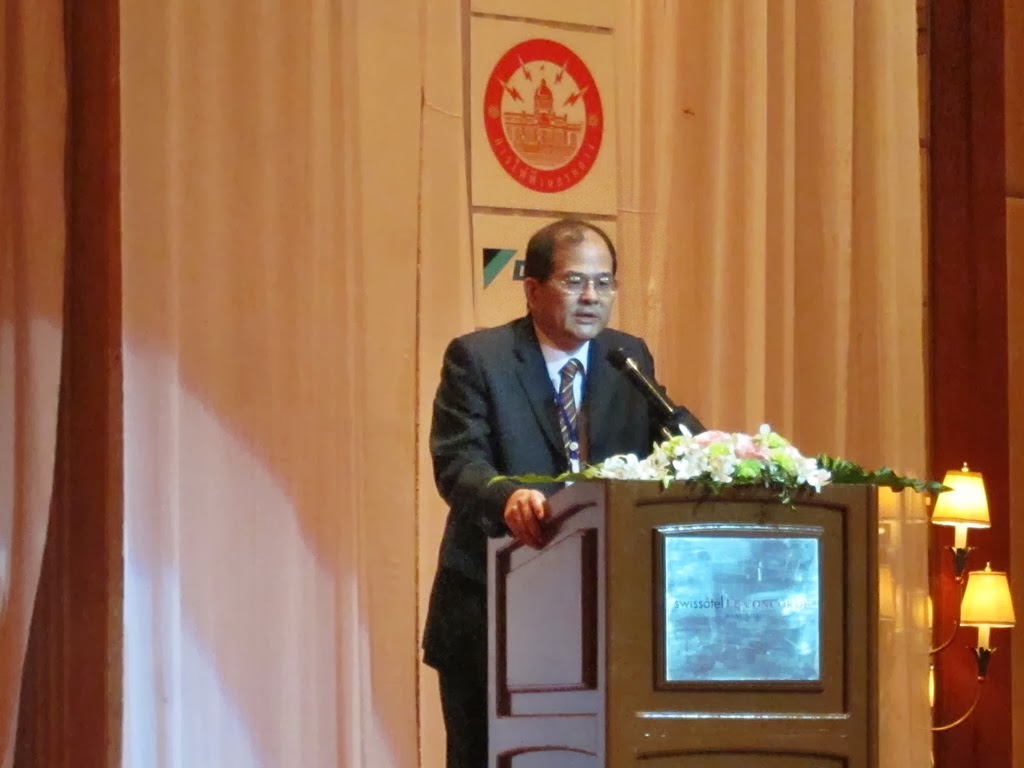

Prof. Phulporn Saengbangpla (SQAT) gave a welcome speech for Dr. Witoon Simachokedee (Permanent Secretary, Ministry of Industry) because of traffic problem during heavy rain this morning.


The first keynote speaker was Mr. Kan Trakulhoon (President & CEO of Siam Cement PLC, Thailand). His presentation the topic entitled “Innovative Organization – Journey towards Sustainable Excellence”.


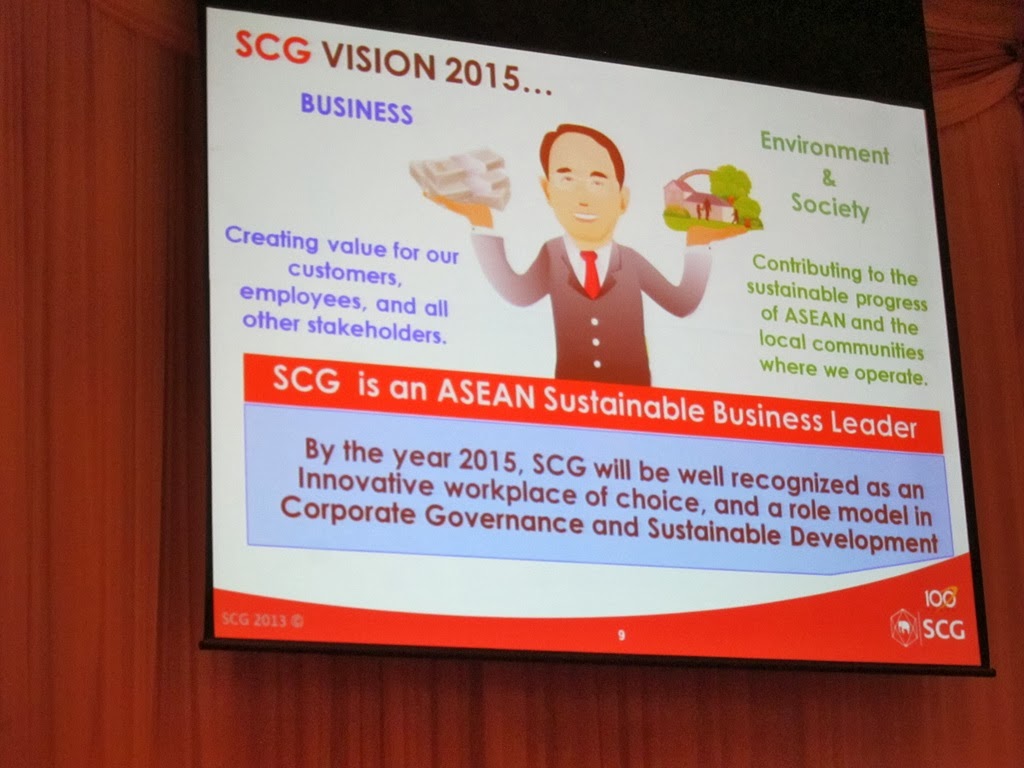
Mr. Kan Trakulhoon introduced Siam Cement Group (SCG) vision to be an ASEAN Sustainable Business Leader who balanced business and Environmental & Society. He said "Quality is a fundamental component for SCG growth strategies and Quality enhancement through Innovation." However, Quality Innovation required right culture with commitment to their core values included Fairness, Excellence, Value to Individual and Social Responsibility.

The second keynote speaker was Prof. Kazuyuki Suzuki (Professor, University of Electro-Communications, TOKYO) and his topic entitled “Prevention of Problems on Reliability and Safety”. He said events that cannot be predicted cannot be prevented.


For inductive approach, it included:
1) Sharing of problem information beyond organization
2) Abstraction and generalization of individual problems / Implementation of PDCA cycle
3) Practical use of incident information
For System approach, seven viewpoints were employed as the following diagram.


The third keynote speaker was Mr. Choi Pyeong-Rak (President & CEO of Korea Midland Power Co., Ltd. (KOMIPO)) and his presentation named “Realization of Happiness Generator Thru Creative Challenge, Outstanding Capability and Communication & Sharing.” Mr. Choi said KOMIPO vision 2025 is "Global Top Class Energy Company" and Slogan is "Happiness Generator, Korea Power KOMIPO".


He then mentioned that their management guidelines were based on Outstanding Competence, Communication Sharing and Creative Challenge. Finally, he concluded that KOMIPO to be reborn into a Truly Happy Energy-Specialized Enterprise disseminating "Happiness Virus" to all the peoples on the Globe.


After keynote speeches, Prof. Phulpor Saengbangpla introduced the Ishikawa-Kano Award (IKA) winner Mr. Rit Thirakomen (Chairman and CEO of MK Restaurant Group Public Co., Ltd., Thailand) and Prof. Yung-Ho Suh (Former Chairman, KSQM) presented Ishikawa-Kano Award (IKA) to the winners.


During the tea break, half HKSQ and HKAS “Tested in Hong Kong, Certified in Hong Kong” leaflets were distributed in the registration table. Most of HKSQ pins were consumed.


Photo with VQAH and SQAT members
(Left: Mr. Tran Hai Duc (VQAH), Dr. Ngo Van Nhon (VQAH), Dr. Lotto Lai (HKSQ) and Mr. Voravit Chamroenlert (SQAT committee member))


Photo with Dr. K. Nithyanandan (Project Director, International Academy for Social Excellence, Bangalore)


Photo with Indonesian team members
The lady in the middle is Ir. Diah Abriningtias (Wahana Kendali Mutu Quality Management Consultant – Marketing)


Lunch Break
HKSQ members have a lunch together.


Then we visited the post session and met Mr. Voravit Chamroenlert (Committee Member, SQAT).


After that I joined the parallel session named PM1: Process Management, Performance Improvement, Best Practices. The session I attended was presented by Dr. Orlov Kirill (PhD., Expert Business Excellence Ltd.) and his topic was “Back to the future – reconsideration forgotten Russian models and methods of management as paradigm shift.


Dr. Orloy Kirill briefed the recently change from Russia history. He quoted Russian proverb that “the new one is just an old thing that was forgotten”. Then he introduced the mission of the Russian Organization for Quality (ROQ) that “Creation of Quality Movement based on the Historical Russians Roots”. The valuable benchmarking between USSR and present day production in Russia was shown in the following table. Then Dr. Orloy Kirill also mentioned Deming 14 points and Ivao Kobayashi. Finally, he concluded that we should constantly remember historical Russians experience and used it in our everyday work on developing integrated management system.


The second team was Moch. Ja’far, Suyanto, Akhmad Bashori and Oktoria Masniari (PT. Semen Indonesia (Persero) Tbk.) and their presentation topic entitled 5R/5S Process Control Laboratory. Before presentation, they announced a slogan that “Together We Build A Better Future” and played a company video.


The theme of 5R/5S implementation aimed to increasing the productivity and cleanliness of working environment through the application of the 5R/5S culture. Then they introduced the flow of cement product and how their physical and chemical analysis laboratories assisted to control production process. The following diagram showed the schedule of 5R implementation in which adopted 5S concepts.


Finally, they concluded the improvement was so great from the Q-C-D-S-M-E which was Quality, Cost, Delivery, Safety, Morale and Environment.

Then I joined the other parallel session named QP1: Quality Practices. The speaker was Mr. Preetam Merchant (Head-Customer Quality, Passenger Vehicle Business unit, TATA Motors Ltd.) and this topic named “Quality Claim Management Matrix and its Applications”. Prof. Noriaki Kano was the first author of that paper and he assisted Mr. Merchant for implementation.


Mr. Preetam Merchant concluded that the Quality Claim Management Matrix (QCMM) could be used to identify the weak points as well as the problems that prevented the number of claims from being reduced. It could also be help develop measures for reducing the number of claims.


I (HKSQ) was presented in the afternoon parallel session named QP4: Quality Practices and my topic entitled “A Study of Laboratory Service Quality in Hong Kong – HKSTP Case Study”. I briefed the survey methodology based on SERVQUAL instrument and Kano Model for active customer and incubatees (start-up companies) respectively.


I found that the SERVQUAL instrument and Kano Model employed in our laboratories service quality survey and identified in terms of Service Dimensions and Attractive Quality. However, customer expectation and requirements increased year by year; and our service improvement speed had a little bit behind. Start-up companies were either not aware the important of management system or unable to afford the cost for establishment of the management system during Kano model survey. So our laboratories faced the challenges that to reduce the price and assist our customers / incubatees business success, as well as, keep our financial health


After my presentation, I went to the session from our Iran’s friend Mr. Mohammad Farshad Kavehpisheh (Member of the Board, ATEC Consultants) and his presentation topic was “Role and Effect of Education and Training Programs in Quality Improvement Plan for a Design and Engineering Company”.


Mr. Farshad Kavehpisheh said training and educating personnel were planned in two main areas: Technical and Quality Management. Technical training was what customarily an ongoing process in a design and engineering company. Quality training included Standard methods of Quality Assurance such as ISO 9001/2008; Developing the habit of using the Design QC Check Lists as a road map of design procedures; and necessity of Quality Oriented Thinking as a way of life and work

Then we took a photo after the presentation. Farshad told me didn’t only remember his song during ANQ Congress 2012 in Hong Kong but also remember his presentation! Actually, Farshard’s experience sharing in Design and Engineering Company in quality perspective was very good reference to us in architectural and urban planning field.


In the same session, the next presentation team was from Ristam Husen, Daud yosias, Muhammad Umar Said, Edward Yan Susilo and Bagus Mad Angistra (PT. Pertamina (Persero) Shipping) and their topic was “Reduction of Docking Repair Cost of 7000 Dwt Ship by Manufacturing Appropriate, Qualified and Cost Efficient Technology based Equipment”.


Their theme was “Docking Repair Cost Reduction at Dockyard Sorong” and considered their goal based on QCDSM stand for Quality, Cost, Delivery, Safety and Motivation. Then their improvement plan used own made equipment had 80% cost saving!


The last speaker I attended in the day one program was Dr. Ching-Chow Yang (Department of Industrial & System Engineering, Chung Yuan Christian University, Taiwan) and her topic entitled “Empirical Analysis of Critical Success Factors in Service Industry. Dr. Yang’s study tried to use Key elements of successful business model (Johnson et al., 2008) to find out the relationship among 4 dimensions included customer value proposition (CVP), key resources, profit formula and key processes to develop critical success factors for domestic service industry.


Dr. Yang concluded that TQM activities were able to assure the realization of quality practices in the initial stages. For pursuing the excellent business performance, they needed to successfully implement the practices in the “business quality” stage.


During Q&A, I had a question about structural model that why the relationship between Customer Value Proposition and Profit Formula was so low?

After the day one program, HKSQ group had a dinner for Thailand sea food.

Reference:
Asian Network for Quality (ANQ) - http://www.anforq.org/
SQAT - http://www.sqat.or.th/
ANQ 2013 - http://www.anq2013.org/
HKSQ - http://www.hksq.org/index.asp

2013年10月16日星期三

Pre-ANQ Congress 2013 – Bangkok City Visit

We arrived Bangkok on 13 Oct 2013 at night and visited Bangkok City on 14 & 15 Oct 2013. The first day we went to SIAM Center, SIAM Discovery & SIAM Paragon. Our hotel was SWISSOTEL LE CONCORD and we went to SIAM through MRT Subway first and then changed to BTS Sky Train.


In the shopping mall, we saw an art called “Absolute SIAM” of Mr. P who is full of humor “a man piss”. However, we verified that a man piss along the river when we traveled in long tail boat in next day.


Then Mr. Ivan Ng (HKSQ member) led us to go to Dusit Shani hotel for Thailand lunch.


The restaurant called Benjarong and we tried the traditional Thailand food. The cost was quite expensive.


At the end, we visited King Rama VI Statue which was near SILOM MTR Subway Station.


In the second day, we visited Wat Arun and Wat Phra Kaew (Emerald Buddha) Grand Palace using long tail board through canals.


Rental long tail board was Baht $250 per person.


Before went into Grand Place, I took a photo in front of Sulpakorn University.


A beautiful buildings and temples in the Grand Palace and some photos were shared below.


Finally, we took a “Tuk Tuk” costed Baht $200 per 3 person from Grand Palace to National Stadium BTS Sky Train.


2013年10月12日星期六

ESG Seminar - How to Make Smart Decisions by Avoiding 6 Thinking Traps

The Executive Study Group (ESG) seminar in October entitled “How to Make Smart Decisions by Avoiding 6 Thinking Traps” which was held by the ESG, Chinese University of Hong Kong (CUHK) and the Hong Kong Science and Technology Parks Corp (HKSTPC) on 11 Oct 2013. I would like to summarize the seminar for sharing below.


Before the seminar, Dr. Mark Lee played a game with us and asked which yellow circle is larger. By perception, yellow circle in right hand side seemed larger. However, they were the same size, indicating that human Intuition had bias.


In the beginning, Dr. Mark Lee introduced the content of seminar included "Limitation of Human Brains", "6 Thinking Taps", "Forewarned Is Forearmed", and "Group Discussion".

Dr. Mark Lee explained a common misconception that companies must "delight" their customers. It was too hard to delight customers. We should pay more sensitive to unhappy customers experience. It was because 65% of customers would likely speak negatively. Dr. Lee named it to be the Bad-Service Ripple Effect.

Dr. Lee explained how important of decision-making that determined success. However, most the way our brain works could sabotage our decision. Unconscious routine, known as heuristics, affected our decision-making which learnt from our own discoveries and experiences. It usually caused sensory mis-perceptions like the game before the seminar.


Dr. Lee said some invisible traps were hard to recognize called Invisible Traps. It was because everyone has the flows. Warren Buffett said "There seems to be some perverse human characteristic that likes to make easy things difficult."


After that Dr. Lee introduced 6 traps included "The Anchoring Trap", "The Status-Quo Trap", "The Sunk-Cost Trap", "The Confirming-Evidence Trap", "The Framing Trap" and “The Estimating and Forecasting Traps”.

Trap 1: The Anchoring (錨定陷阱 - 先入為主)
The anchoring is a pernicious mental phenomenon. Our mind gave disproportionate weight to the first information we received (First Impression). Dr. Lee quoted Warren Buffett statement that “In the business world, the rearview mirror is always clearer than the windshield.” Then Dr. Lee provided some actions which could be avoid the trap included:
1. Always view a problem from different perspectives
2. Think about the problem on your own
3. Be open-minded
4. Be Careful to avoid anchoring your advisers
5. Be particularly wary of anchors in negotiations


Trap 2: The Status-Quo (現狀陷阱 - 維持現狀)
People dislike change so that Status Quo is preferred. It is because Status Quo is comfortable and avoids taking action. Dr. Lee quoted Warren Buffett statement again that “Risk comes from not knowing what you’re doing.” Some actions were recommended as follows.
1. Always remind yourself of your objectives and examine how they would be served by the status quo
2. Never think of the status quo as your only alternative
3. Avoid exaggerating the effort or cost involved in switching from the status quo
4. Remember that the desirability of the status quo will change over time
5. Don’t default to the status quo


Trap 3: The Sunk-Cost (沉默成本陷阱 - 沒回頭的成本)
People did not like admitting mistakes. Tadashi Yanai (Founder of UNIQLO) said “One win nine losses”. So Dr. Lee mentioned how to create corporate culture to accept Good Decision but lead to Bad Outcome. He quoted IKEA case for investing to outsourcing to Eastern Europe for wood but fail. Since the decision based on rational information, the founder considered the loss as tuition without punishment. Warren Buffett also said that “When you find yourself in a hole, the best thing you can do is stop digging.” The remedy was mentioned by Dr. Lee below.
1. Seek out and listen carefully
2. Examine why admitting to an earlier mistake distresses you
3. Be on the lookout for the influence of Sunk-Cost Biases in the decisions and recommendations made by your subordinates
4. Don’t cultivate a failure-fearing culture


Trap 4: The Confirming-Evidence (證實性陷阱 - 先決定,後確認。)
Dr. Lee found a case that US manufacturer considered whether to call off a planned plant expansion and seek for not-so-independent opinion from the chief executive of a similar company that recently stopped a new factory. Remedies were suggested below.
1. Always check to see whether you are examining all the evidence with equal rigor
2. Get someone you respect to play Devil’s Advocate
3. Be honest with yourself about your motives
4. In seeking the advice of others


Trap 5: The Framing (框定陷阱 - 框架先設)
Set the frame would guide others thinking and decision. Dr. Lee raise different case to explain this phenomena such as “50% chance to losing $300 or winning $500” in your account with $2000” against “either $1,700 or $2,500”. One of interested case about smoking questions quoted. A man asked a priest about:
a) When I am praying, can I smoke?
b) When I am smoking, can I pray?

Dr. Lee introduced some action to be taken aginst framing below.
1. Don’t automatically accept the initial frame
2. Try posing problems in a neutral, redundant way
3. Think hard throughout your decision-making process about the framing of the problem
4. When others recommend decisions, examine the way they framed the problem.


Trap 6: The Estimating and Forecasting (估計和預測陷阱)
Dr. Lee pointed out three traps from the estimating and forecasting included “The Overconfidence Trap”, “The Prudence Trap” and “The Recallability Trap”. For recallability trap, our memory is our enemy because we frequently base our predictions about future events on our memory of past events. Then he quoted Warren Buffett statement that “Forecasts may tell you a great deal about the forecaster; they tell you nothing about the future.” and “I will tell you “how to become rich.” Close the doors. Be fearful when others are greedy. Be greedy when others are fearful.”


Finally, Dr. Lee concluded that Effortless Customer Experience reduced Disloyalty. Companies should focus on making service easier, not more delightful, by reducing the amount of work required of customers to get their issues resolved.

Before the group discussion, Dr. Lee used NLP method to give us an exercise to choose Two of the most difficult strategies and One of the easiest strategy.

Forewarned Is Forearmed (凡事預則立)
If you know about a problem or situation in advance, you will be able to deal with it when you need to. Warren Buffett said “I insist on a lot of time being spent, almost every day, to just sit and think. That is very uncommon in American business.”

Before the group discussion, Dr. Lee used NLP method to give us an exercise to choose Two of the most difficult traps to be avoided and One trap to escape.


Reference:The Centre for Logistics Technologies and Supply Chain Optimization, CUHK - http://www.logitsco.cuhk.edu.hk/
HKSTP - www.hkstp.org


2013年10月10日星期四

ASQ InfVoices – Hanzawa Naoki (半沢直樹) Beyond Quality

The October Topic of ASQ Influential Voice had been raised by Paul Borawski (CEO, ASQ) "Quality In Fields "Beyond" Quality". Paul briefed an innovative weekend event called Doors Open in which ASQ offices were opened for visitors more than 100 year-old building. Then he would like to discuss about “beyond” Quality in CSR and Innovation.

The Banking drama Hanzawa Naoki (半沢直樹) was scored the highest ratings in three decades in Japan. I would like to discuss it from quality perspective. Hanzawa Naoki had almost all elements on Ohmae's Professionalism included super-specialized knowledge, skills and moral values, adhere customer first, curiosity, analytical mind and never give-up with strict discipline. He has a vision to change the bank ecology system and also revenge for his father (it is only for drama).

Hanzawa Naoki is a bank staff and one of his duties is due diligent. He focused on people rather than machine. He has a good observation technique & skill to find the key values or key problems. Left upward photo showed that he found staff with excellence skill and their technical patent. Right upward photo showed that he observed no one to take the phone call in another factor for about 20min. The lower photos showed Japan TV advertisements; it was observed that most enterprises focused on Innovation such as “Toshiba leading Innovation” and “NISSAY insurance evolution through creativity”.


Lastly, I found that Japanese drama was developed in very detail and striving for excellence. I observed one screw which Hanzawa Naoki used to remember his father (His father suicide because the bank staff cheated him and causeed his factory going to bankrupt.). The screw with blood stains for 25 years and it located in the range of the 8th to 12th screw threads. It was consistent in the whole drama from Hanzawa Naoki as a child to the end of the story.


I would like to point out why the drama was so attractive in the following points:
i) Detail striving for excellence
ii) Humanization
iii) Audience Resonance

I think it is beyond customer need or potential need or expectation. The director of this drama was able to observe people’s feeling and subconscious, as well as, social phenomenon. All these ideas join together and become Innovation – Banking Drama Hanzawa Naoki (半沢直樹).

Reference: 
Japanese Hit Drama 'Hanzawa Naoki' Sells to Hong Kong, Taiwan - http://www.hollywoodreporter.com/news/japanese-hit-drama-hanzawa-naoki-642060
ASQ InfVoices – Sustaining Excellence through Quality and Innovation - http://qualityalchemist.blogspot.hk/2013/09/asq-infvoices-sustaining-excellence.html
大前研一著的「專業 – 你的唯一生存之道」 (Ohmae's The Professionalism) - http://qualityalchemist.blogspot.hk/2008/04/blog-post.html
半沢直樹:銀行職員的使命 - http://anotherdayhasgone.blogspot.hk/2013/09/blog-post.html


2013年10月8日星期二

HKCTC Seminar on Integrity and Professional Development in Testing & Certification Industry

The Seminar on Integrity and Professional Development in Testing & Certification Industry was organized by the Hong Kong Council for Testing and Certification (HKCTC) and co-organized with Association of Construction Materials Laboratories, HKTIC, HKICA, ICAC, HKQF and VTC. The value of testing and certification services depended on its credibility. Therefore, this seminar aimed to bring together representatives of relevant public organizations, professional bodies and gurus in the industry to share their wealth knowledge in the two major pillars of credibility included Integrity and Professionalism.

In the beginning, Mr. Kesson K.S. Lee (Secretary-General, HKCTC) gave a welcoming remarks. He briefed the existing status of Testing and Certification Industry.


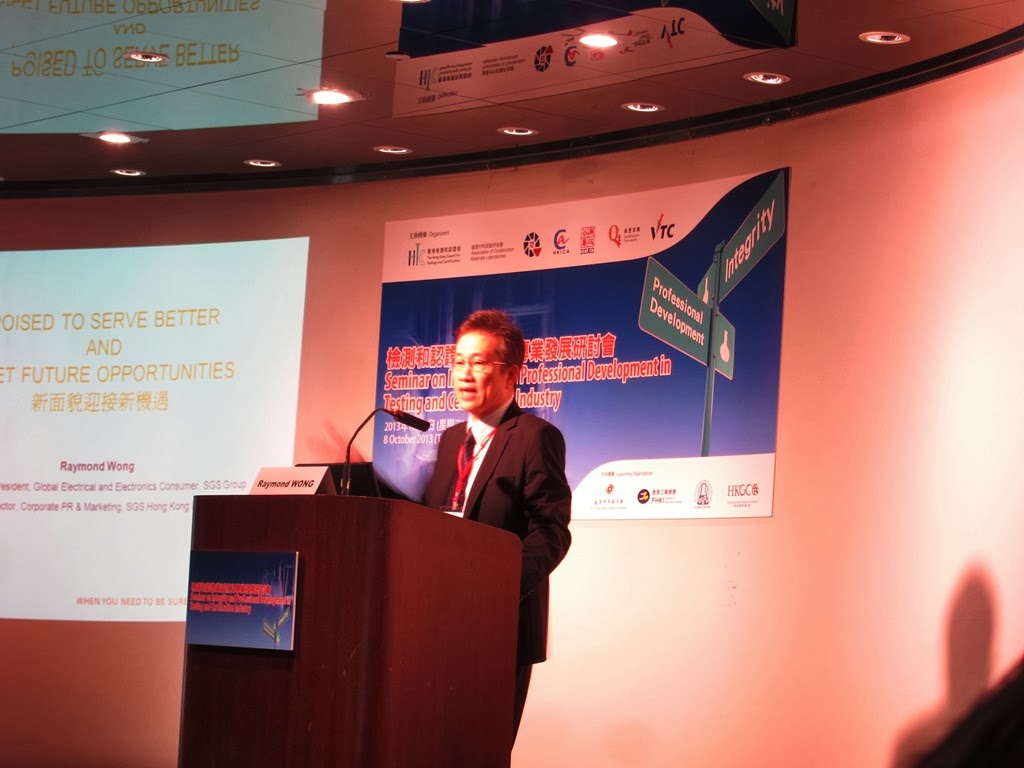
The first speaker was Mr. Raymond Wong (Deputy Vice President - Global Electrical & Electronics Consumer, SGS; Director - Corporate Public Relationship & Marketing, SGS Hong Kong) and his presentation entitled "Poised to Serve Better and Meet Future Opportunities". Mr. Wong explained different opportunities such as globalization, rise awareness on quality, health & safety and environment, concern on corporate social responsibilities, etc.


Then Mr. Wong introduced the two major elements of SGS that were People (i.e. Trust, Integrity & Professionalism) and Knowledge (i.e.Regulation, Technical and Market). In addition, Mr. Wong mentioned their Code of Integrity in which annual Integrity Training Program and E-learning were provided to employees. For professional development, they separated into Academic Knowledge, People Development and Skill Training. There were 6 levels from "Lead Self" to "Lead Others" to "Lead Others and Manage Business" to "Lead Leaders and Grow Business".


The second speaker was Mr. Lawrence Chung (Deputy Executive Director of Hong Kong Ethics Development Centre, ICAC) and his topic named “Professional Integrity for Testing and Certification Industry – A Perspective from the ICAC”.


Mr. Chung said to fulfill the Law which was a minimum requirement. The highest requirement was Professional Integrity. Professional Integrity included 3As that were Alert (Common Integrity Risk), Aware (Anti-corruption Law) and Act (Ethical Decision Making). For prevention of Bribery Ordinance, it need to avoid another 4As (Agent, Accepts/solicits, Act and Approval) stated in the following diagram.


Finally, Mr. Chung introduced corruption prevention plan to us. It started from “Codes & Guidelines”, “System Controls”, “Ethics Training” and “Ethical Leadership”.

The third speaker was Mr. Michael Lee (Chairman, Association of Construction Materials Laboratories) and his presentation topic was “Integrity in the Recent Past of Construction Testing and Certification”. Firstly, Mr. Lee introduced three high risk testing operations included Nondestructive testing, On-site testing and Sampling of test specimen.

For Nondestructive testing, it was high risk because ultrasonic test for welding was no electronic records to prove the presence of defects. For On-site testing, slump test for concrete workability had not done but result was “pass”. For Sampling, it only selected good test sample or pretreated sample. Then Mr. Lee shared the following case of handle over capacity situation.


Finally, Mr. Lee suggested to perform refresher Course on “Code of Conduct” every 3 year and developers to employ material testing laboratory directly through Architect, not by construction company.

Mr. Felix Chan (Convenor, Education and Training Subcommittee, TIC Industry Training Advisory Committee (ITAC), Qualifications Framework (QF)) was the fourth speaker and his topic entitled “Introduction to the Specification of Competency Standards for Testing and Certification”. Mr. Chan introduced the 7-level hierarchy of QF and which aimed to foster life long learning. Then he also briefed the Specification of Competency Standards (SCS) and Recognition of Prior Learning (RPL) mechanism.


Testing, Inspection & Certification was one of nineteen ITACs and SCS covered different competency requirements at different stages of testing workflow. Moreover, TIC industry had separated into three main functions included “Laboratory/On-site Testing (LOT)”, “Inspection (INS)” and “Certification (CERT)”.


The application of SCS in TIC industry included “HRD & HRM”, “Benchmarking & Recognition” and “Education & Training”. Finally, he reminded the coming TIC SCS Industry consultation period would be from 1 Nov 2013 to 30 Jan 2014. Moreover, the consultation session would be held on 13 Nov 2013 from 3:30pm to 5:30pm in the Auditorium, CGO, Tamar.

Mr. Dominic Lam (General Committee Member, HKTIC) was the fifth speaker and his topic named “Professional Certification Scheme for Testing Personnel: Why and Who needs it”. Firstly, Mr. Lam introduced the industry profile and its role such as supporting manufacturing, export and other service industries for Hong Kong economic.


Then he introduced the Professional Certification Scheme for Testing Personnel (PCSTP) for demonstration of individual’s professional competence. The overall scheme was showed in the following table. In order to continuous improvement, the scheme encouraged to accumulation of continuing professional development units (CPDUs) for re-certification.


At the end, Mr. Lam used an example “CEO vs King of Hong Kong Style Milk Tea” to explain what ever how high position you are, you are still not a professional and got nothing if missing integrity!

Dr. Lawrence Chan (Deputy Executive Director, VTC) was the sixth speaker and his presentation was “Professional Development and Continuing Training for Practitioners of the Testing and Certification (T&C) Industry”.


He introduced VTC’s different T&C programmes to support industry. The existing T&C In-service training were separated into 9 professional areas included “Chinese Medicines, Construction Materials, Environmental Protection, Electrical Appliances, Food, Furniture, Garment & Textile, Jewellery and Toys. In additional, they established Testing & Calibration Centre in July 2013 and operated under ISO 17025 requirements, as well as, planned to seek HOKLAS accreditation in July 2014.

The last speaker was Ir. Dr. Tommy Lo (President, Hong Kong Institution of Certified Auditors) and his topic entitled “Auditor Training for the Testing and Certification Industry”. He introduced the factors to be considered by auditor for Product Certification Scheme.


Then he briefed the auditor in Testing and Certification Industry included Laboratory Assessment, System Certification Assessment and Product Certification Technical Auditor. Currently, five product certification technical auditor registrations were available and they were Cementitious products, Fire engineering products, Tiles products, Aluminum windows products and Sanitary ware products.

Q&A Session


Mr. Lawrence Chung said there were near 4000 cases received in ICAC those cases were ~62% from private companies, ~30% from government department and ~7% from public bodies.
Mr. Raymond Wong discussed about Integrity Culture which not only for staff but also for customer. He added that SGS sent 20 MC questions quiz about integrity for staff monthly.
Mr. Dominic Lam answered how to increase the recognition of PCSTP such as industry acceptance and HOKLAS considered in Approved Signatory.

Reference:
HKCTC: http://www.itc.gov.hk/en/hkctc/about.htm
HKTIC - http://www.hktic.org/
VTC T&C In-service Trainign Information Portal –http://t-cert.vtc.edu.hk/


LinkWithin

Related Posts with Thumbnails