2016年3月22日星期二

HKQF Conference - "Collaboration with EQF and Implementation of CAT"

The QF Conference for Mobility and Progress: Collaboration with EQF and Implementation of CAT was co-organized by Education Bureau (EDB) of the Government of the HKSAR and Qualifications Framework Secretariat (QFS) of Hong Kong on 22 March 2014. Hong Kong Council for Accreditation of Academic and Vocational Qualifications (HKCAAVQ) was a supporting organization. The conference aims to promote programme collaboration and articulation amongst stakeholders, including education and training providers, professional bodies, companies, unions and others. All conference participants would be invited to visit exhibitions, exploring opportunities for collaboration and articulation in the context of Credit Accumulation and Transfer (CAT). Before the conference, Mr. Matthew Yien (HKQF – ITAC Secretary) and I (Former Chairman, HKSQ) took a photo for memory.


In the beginning, Mr. Eddie NG, SBS, JP (Secretary for Education, HKSAR Government) gave a welcoming address. He briefed the comparability study of the Hong Kong Qualification Framework (HKQF) and the European Qualifications Framework (EQF).


2016年3月19日星期六

HKSTP the 2nd Briefing Session on HKQAA Hong Kong Registration – Start-ups

The 2nd Briefing Session of HKQAA Hong Kong Registration – Start-ups was coorganized by Hong Kong Science and Technology Parks Corporation (HKSTP) and Hong Kong Quality Assurance Agency (HKQAA) on 18th Mar 2016. In order to nurture and support local technology start-ups, HKSTP and HKQAA signed a Memorandum of Understanding (MOU) on 24 March 2015.  This collaboration aimed to strengthen the support and network for technology companies, helping them develop innovative business, fostering knowledge transfer and boosting their competitiveness.   Before the briefing, we took a group photo for memory.
(Left: Ms. Mona Li (HKQAA), I and Mr. Nic Chan(HKQAA))


The 1st Briefing Session was held on 25 Jan 2016 and then HKSTP Quality Startup Workshop was performed on 25 Feb 2016.  The workshop aimed to share HKSTP records which fulfilled the registration scheme 25 questions requirements in order to accelerate the learning process for our incubatees.


2016年3月18日星期五

ASTRI – HPE Conference on Big Data and Analytics for Smart City

ASTRI and HP Enterprise (HPE) co-organized the Conference named “Big Data and Analytics for Smart City” on 18 March 2016 in Hong Kong Science and Technology Parks.  HP predicted that Big Data’s value could be unleashed for business users by condensing it and intelligently presenting only what was relevant and contextual to the problem at hand.  Before the conference, a group photo was taken.


In the beginning, Mr. MY Wong (Chairman of the Board, ASTRI) gave a welcome speech.  He expected the Big Data Analytics could transform City to Smart City.


Then Mr. Allen Yeung (Government CIO) gave an opening remark.  He said AlphaGo story last week demonstrated how AI employed Big Data Analytics.  And he also used Hong Kong Observatory and Hong Kong Airport as example to explain how Big Data cooperation to create values.  Finally, he asked us to think what City would look like after 5 to 10 years.


2016年3月17日星期四

HKSTP TecONE Seminar on Creative Design Add Value to Innovative Technology

The TecONE seminar named “How does Creative Design Add Value to your Innovative Technology” was organized by Hong Kong Science & Technology Parks Corporation (HKSTP) on 17th March 2016.  ARTOP GROUP is one of Science Park companies shared how to add value to product with industrial design that took account of aesthetics, usability, ergonomics and so forth, to demonstrate why creative design could optimize product function, style and appearance for better commercial value.


The first speaker was Mr. Savio Lai (Operating Director, ARTOP GROUP) and he introduced their company background to us.  The design service process of ARTOP were Orientation (定位), Design (設計), Achieve (實現) and Value (價值).

Then he shared many projects from their different customer and Huawei was one of their long-term customers and their cooperation started for design first commercial 3G mobile phone since 2004.


2016年3月12日星期六

HKSQ Student Project Competition 2016 - Presentation

The HKSQ Company Based Student Project Competition offers an opportunity for students to work on an actual industrial case and propose resolution annually. It aims to give opportunity for student to gain experience of resolving an industrial problem.  The competition included three sessions.  The first session was problems briefing and selection which problems were designed and explained by sponsor company (LSG Sky Chefs Group).  The second session was Plant visit on 30 Feb 2016. The last session was presentation of their suggested solutions on 12 Mar 2016.


In the beginning, Mr. Ricky Suen (Exco member, HKSQ) presented the rules of the HKSQ Student Project Competition 2016 presentation.  Presentation was 20min plus 5 min Q&A.
There were three topics as below:
Topic 1:   Food Assembly
Topic 2: Dish Wash Equipment & Loading Process Improvement
Topic 3:   Internal Delivery Process
  

2016年3月4日星期五

HKSQ Seminar on Certified Quality Manager (CQM) Certification

The seminar entitled “HKSQ CQM Certification” was organized by Hong Kong Society for Quality (HKSQ) on 4th Mar 2016.  In order to develop local quality professionals, HKSQ has established a couple of HKSQ Certification programs in past few years which include Certified Quality Engineer (CQE), Certified Laboratory Quality Specialist (CLabQS).  HKSQ launch another new certification program named Certified Quality Manager (CQM) recently.  This seminar would introduce the academic qualification and professional experience requirements, certification examination format and schedule as well as the training course to help those who wish to seek recognition of their professionalism in Quality Management.  Mr. Karson Chui (Former Chairman, ASQ CMQ/OE, CQE and CQA) was our guest speaker.


In the beginning, Mr. Karson Chui explained the benefit of certification such as demonstration of quality knowledge, life time learning, career investment and recognized status in quality arena.  He then briefed different HKSQ Certifications (Details at http://www.hksq.org/cert_hksq.htm )


2016年2月29日星期一

HKCIE Seminar on Extenics (可拓學)

The seminar entitled “Extenics: China original theory” which organized by Hong Kong Chinese Institute of Engineers (香港中國工程師學會), Hong Kong Institution of Engineers (HKIE) –Manufacturing & Industrial Division (MIE), Hong Kong Society for Quality (HKSQ), TQM and Shenzhen Intellectual Property Society (SZIPS) on 29 Feb 2016.  Extenics (可拓學) is original developed by Prof. Cai Wen (蔡文) through his 30 years research.  Extenics includes three steps and they are “Extension”, “Transfer” and “Evaluation”.  In the world, there are three famous innovation methodologies.  They were “Theory of Solving Problems Inventively (TRIZ - Theoria Resheneyva IsobretateIskehuh Zadach)” which was developed by Alshuller in Russia; “Nakayama Masakazu (NM) method which was develop by Nakayama Masakazu in Japan; and “Extenics” which was developed by Prof. Cai Wen in China.  Dr. Aaron Tong (Former Chairman, HKIE-MIE & HKSQ) and I took a photo with Prof. Cai Wen.


Prof. Cai Wen (蔡文) (The Director of International Academy of Extenics (HK), The National Distinguished Experts of China) was the first speaker.  He introduced the theory of Extenics and how it generated creative thinking.  Extenics Theory (可拓學) is equal to Fundamental Principles of Extenics (可拓論) plus Extenics Innovative method (可拓創新方法) and Extenics Engineering (可拓工程). 


2016年2月22日星期一

HKSTP & TecONE Conference on Re-Industrialisation

The conference named “Re-Industrialisation – Impact and Opportunities for Hong Kong” was organized by Hong Kong Science & Technology Parks Corporation (HKSTP) and TecONE (HKPC) on 22nd Feb 2016.  “Re-Industrialisation”, one of the outlined initiatives in the Chief Executive’s 2016 Policy Address, is a potential new direction that drives the city’s economic growth and era of smart manufacturing.  In the beginning, Mr. Andrew Young (Chief Commerical Officer, HKSTP) gave welcome remarks for Mr. Allen Ma (CEO, HKSTP).  He said Venice (威尼斯) was business centre in the past but it was not able to keep their position about environment changed (new sea travel route discovered).  Therefore, HKSTP began hosting the Smart Living@Science Park exhibition as showcasing solutions that innovated, designed and made in Hong Kong.


Then Mrs. Agnes Mak (Executive Director, HKPC) gave welcome remarks.  She said they aimed to attract high value-added industries back to Hong Kong for three areas:
i)             Brand Value-added (e.g. CEPA, IP)
ii)          Operation Model (e.g. Automation & Smart Manufacturing)
iii)        Product and Service Innovation (e.g. coop with Universities and R&D centres; Market oriented)


Group photo


2016年2月17日星期三

ASHK Public Lecture – Meeting the Decarbonization Goals of COP21

The Academy of Science of Hong Kong (ASHK) organized a public lecture named “Meeting the Decarbonization Goals of the UN Climate Change Conference in Paris: COP21” on 17 Feb 2016. The Kadoorie Institute, HKU is co-organizer. Before the lecture, I met Mr. Terence S.S. Chan (Secretary-General, ASHK) and took a photo for memory.


The lecture background was mentioned in the leaflet. At COP21 the nations of the world agreed to limit the mean global temperature rise since the Industrial Revolution to 2 degrees Celsius, with an aspirational target of 1.5 degrees if possible. Most experts agree that when translated into carbon dioxide concentrations in the atmosphere, these goals are highly unlikely to be met without new technologies, with the more stringent target being impossible without negative carbon emission. The lecture would introduced two technologies in Prof. Shu’s research group that (1) Supertorrefaction (STR), which uses the high heat capacity of molten salts to convert renewable waste biomass at high throughput into biocarbon that is either not burned, or is used bioenergy with carbon capture and sequestration (BECCS); (2) Two-Fluid Molten-Salt Breeder-Reactors (2F-MSBRs) that operate on the renewable Thorium (Th) fuel cycle instead of the once-through uranium fuel cycle used by today’s light-water reactors. So it should be possible to limit the rise of carbon dioxide concentration in the atmosphere to a maximum of 450ppm at year 2050 and then bring that level down to 350ppm before year 2100.

2016年2月10日星期三

對暴力說不

不分青紅皂白地,自以為真理在手。這絕對不是公民抗命!
甘地的非暴力主義名為Satyagraha,意思是「真理的力量」。尋求真理將永遠不容許使用暴力來對付自己的敵人;必須通過耐心和理解使對手擺脫謬誤;而耐心則意味著心甘情願地忍受痛苦。


很多泛民政客的言論自由只想為暴徒淡化和卸去責任,這只會姑息養奸!
只有湯家驊對何俊仁的「擔心有人『醜化』運動」的批評說出道理來。

「暴力便是暴力、傷人便是傷人,背後理念如何崇高也改變不了事實!目前首要工作是維護法治,回復社會秩序!希望政客們正視問題所在,不要轉移公眾視線!」 (http://hd.stheadline.com/news/realtime/hk/1048388/)


參考:
(4) 標少札記


2016年2月4日星期四

HKAS ISO 50001 Seminar for Certification Bodies

Hong Kong Accreditation Service (HKAS) organized a training entitled “HKAS ISO 50001 Seminar for Certification Bodies” on 4th Feb 2016. The International Organization for Standardization (ISO) related the international standard ISO 50001 for energy management system (EnMS) as a globally accepted framework for energy management in 2011. In 2014, ISO also released the ISO 50003 on “Requirement for bodies providing audit and certification of energy management systems”.  Before the seminar, we took a group photo with speaker Ms. Deann Desai (Project Manager, Georgia Institute of Technology, USA) and Dr. M.K. Kwok (Senior Accreditation Officer, HKAS).


Dr. M.K. Kwok (Senior Accreditation Officer, HKAS) gave an opening remark and introduced our guest speaker Ms. Deann Desai (Project Manager, Georgia Institute of Technology, USA). Ms. Desai currently served as the administrator and secretary and as an expert for the U.S. Technical Advisory Group for Technical Committee 242 and 257.


In the beginning, Ms. Deann Desai briefed the history of ISO 50001:2011 Energy Management System which had been published on 15 June 2011.  It expected to influence up to 60% of the world’s energy use by energy planning and efficiency.  ISO 50001 is important because of reducing “environmental and societal costs” and enhancing “Energy performance”, “Green House Gas impact”, “Positive contributions toward reducing depletion of energy resources”.


Then Ms. Desai said ISO 50001 provided a framework for energy management using data-driven decision making.  This ISO standard was requested by the United Nations Industrial Development Organization (UNIDO) which had recognized industry’s need to mount an effective response to climate change and to the proliferation of national energy management standards. Then she briefed the summary of ISO Survey 2014 and found that ISO 50001 increase 40% from 2013 to 2014.


Some definitions were reviewed below.
Scope – decisions, activities, and facilities, which are going to be included in the EnMS. (note: can include multiple boundaries)
Boundary – physical, site, or other organizational limits associated with the scope.
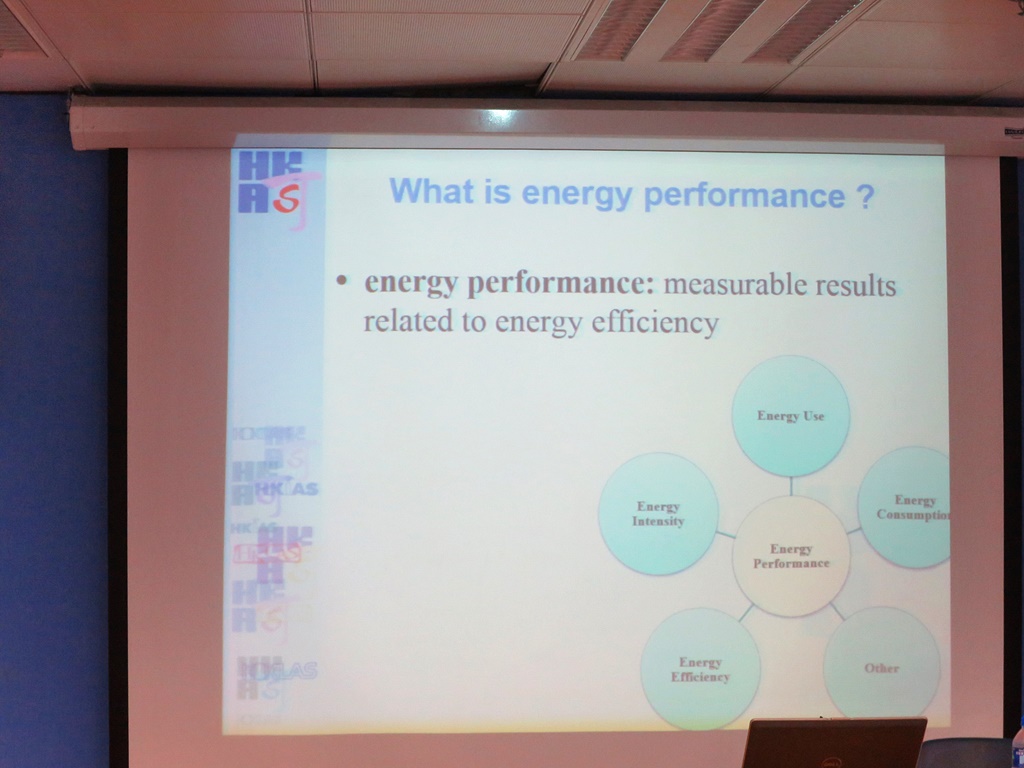
Energy consumption – quantity of energy applied (consumed)
Energy use – manner or kind of application of energy (note: ventilation, lighting, heating, cooling, transportation, processes, production lines, etc.)

Continual improvement – recurring process which results in enhancement of energy performance and the energy management system (note: achieve in overall energy performance, consistent with energy policy)


Energy performance – measurable results related to energy efficiency, energy use and energy consumption.

Ms. Desai told me that Energy Intensity was different in different industry and some would use Energy Output / Energy Input or Energy Input / Energy Output or or Energy Use / Product.  For automotive industry, people would ask how many energy consume to build a car.


After that Ms. Desai briefed the ISO 50000 family and their relationship as following diagram.


Some barriers to industrial energy efficiency were showed in the following diagram.  The only solution was that top management need to engaged in the management of energy on an ongoing basis.  Energy efficiency should be integrated into daily management and operational practices.


The core values of Energy Management System were separated into Management System and Energy Performance in diagram below.


The following diagram showed that the great improvement was found initially but become steady afterward.  However, it could be continual improvement after energy save culture created in the organization.


Energy Planning process included “Legal and Other Requirement”, “Energy Review”, “Baseline”, “EnPI”, “Objectives, Targets, Action Plans” and “Review and Update”.


She said the measurement plan based on “What kind of data I expected to see?” Key characteristics of Energy Performance were briefed.


Finally, she briefed the draft standard of ISO 50002 for Energy Audit and ISO 50003:2014 for requirements for bodies providing audit and certification of EnMS.  Lastly, Ms. Desai introduced ISO 50001 Global Impacts Research Network (ISO 50001 GIRN) and Energy Management Working Group (EMWG) to us.
  
Reference:


2016年2月1日星期一

HKSQ Seminar on Quality Water Supply from Source to Home

The seminar entitled “Quality Water Supply from Source to Home” was organized by Hong Kong Society for Quality (HKSQ) and co-organized with ASQ, BCH Dept., & SEEM Dept., CityU on 1st Feb 2016.  Hong Kong had just celebrated the 50th anniversary of the supply of Dongjiang water to this Pearl of the East.  Incidentally, quality of in drinking water in the recent months had aroused attention of various stakeholders in Hong Kong.  The seminar aimed to share the background of Dongjiang water and discussed the quality issues.  In the beginning, Dr. KS Chin (Former Chairman, HKSQ; Associate Professor, SEEM Dept., CityU) took a photo with speaker Dr. Richard Cheung (Associate Professor, BCH Dept., CityU) for memory.


Dr. KS Chin introduced the guest speaker’s background. Dr. Richard Cheung is a member of Advisory Committee on the Quality of Water Supplies and Resources established by the Water Supplies Department of the Government of the Hong Kong Special Administrative Region. He is also a member of the Steering Committee for the "Quality Restaurant Environmental Management Scheme" funded by the Environmental Conservation Fund.


Firstly, Dr. Richard Cheung said that Dong Jiang Water was the major source of Hong Kong’s water supply which upto 70% to 80% of our drinking water.  


Then he showed the map to explain Dong Jiang water come from Xinfengjiang Reservoir to Taijuan Pumping Station and then through the closed aqueduct (Red color line) to Shenzhen Reservoir.  Hong Kong draw water from Muk Wu Pumping Station.
  

The Closed Aqueduct passed different mountains through many pumping system to supply Hong Kong.  It is a great engineering work.


After briefing the source, Dr. Cheung introduced the Water Supplies Department (WSD) website in which contained much information such as WHO guidelines for Drinking water Quality as follows:
Part A – Microbiological quality
Part B – Chemicals of health significance as described by WHO’s Guidelines for Drinking Water Quality (WHO 2011)
Part C – Radiological quality
Part D – Other parameters


Recently quality issue of drinking water was happened in Consumer part.  The following diagram showed the first part was responsible by Water Authority and the second part was responsible by Agent and the last part was responsible by consumers.  But the recently problem was by Housing Department because of public house.
  

Based on Centre for Health Protection advice, we had better run water for 2 to 3 minutes prior to using it form drinking and food preparation.  However, Dr. Cheung said if seldom people would use NSF 53 standard water because the water flow was too slow. 


Lastly, Dr. Cheung arose several challenges for Quality Personnel below for discussion.
a)      Hardware (various parts of the plumbing system)
b)      Personnel training and supervision of procedure during construction
c)      Testing and Certification of the finally completed plumbing system
d)     Routine testing of Water Quality


Q&A
During the discussion, I said that I had measured city & rural area’s air participates (20 years ago) which contained lead in 0.158µg/m^3 and 0.114µg/m^3, respectively.
Minda had asked Doctor (specialist for children) who said most of pregnant woman would like to eat more fish than normal.  Sea fish contained much more lead. So lead could be come from food.


At end of the seminar, Dr. KS Chin (Former Chairman, HKSQ) presented a souvenir to Dr. Richard Cheung.


Reference:
HKSQ - www.hksq.org

SEEM Dept., CityU – http://www.cityu.edu.hk/seem/


2016年1月30日星期六

HKSQ Student Project Competition 2016 – LSG Plant Visit

The HKSQ Company Based Student Project Competition offers an opportunity for students to work on an actual industrial case and propose resolution annually. It aims to give opportunity for student to gain experience of resolving an industrial problem.  The competition included three sessions.  The first session was problems selection which problems were designed and explained by sponsor company – LSG Sky Chief in 2016.  The second session was plant visit and the last session was presentation of their suggested solutions.  The LSG Plant Visit was held on 30 Jan 2016 and the group photo was taken for memory.


Mr. Peter Fung (Chairman, HKSQ) led the visit and LSG shuttle bus carried students to the site.


HKSQ exco members and each universities leaders coordinated students for this event.


In the beginning, Mr. Steward Leung (Senior Lean Analyst) briefed the program and house rules.


Then Ms. Maggie Lam (HR representative) briefed LSG Graduate Trainee Program in 2016 and the program objectives were:
-          To recruit high-caliber career starter
-          To cultivate potential cadidates to be future professional leaders

-          To share experienced and skills to the trainee for supporting their career development


She said the program period was 18 months where they would be attached in the  assigned department for 15 months and rotated to other Operational Departments for 3 months.  Operational Departments included Production, Airline Services, Transportation and Warehouse.  Their career path were from Graduate Trainee to Supervisor to Officer to Senior Officer to Assistant Manager and finally to Manager.  The recruitment Timeline is show as following diagram.


Before plant visit, we needed to wear uniform like lab coat and slip resistant shoes.


We separated into two teams to visit the plant and Mr. Eddy Yung (General Manager) led the first team.


We went to warehouse and then to vegetable room.  In here, all students needed to wash their hands. 


Inside the plant, we visited different function areas and some photos taken for recording.


Before lunch, we discussed the topic in meeting room separately. Some photos were taken for each team with their supervisors for memory.


PolyU


CityU


HKU


HKUST


CUHK


In afternoon session, we separated into three teams for three topics and went to their specific process line for detail study.


After that we were back to meeting room and discussed again. Students would think what further data and information they needed to collect from LSG.


We finished the whole field study at 4:00pm.

Reference:
HKSQ Company Based Student Project Competition - http://www.hksq.org/company_based_competition.htm
LSG Sky Chefs - http://www.lsgskychefs.com/
20160122: HKSQ Student Project Competition 2016 - Briefing - http://qualityalchemist.blogspot.hk/2016/01/hksq-student-project-competition-2016.html


LinkWithin

Related Posts with Thumbnails