2012年9月12日星期三

反駁香港專上學界聯會署聲明

反駁香港專上學界聯會署聲明 - 大專生領頭罷課 要求撤回國教科

本人反駁理據如下:

第一點:教育專業審視,國教科存問題 (撤回理據不足)

你們說此科本質上就存在問題,必須撤回。這相信是根據曾榮光文章的香港國民教育課程的偏差與扭曲。他的立論基於多民族不同血緣例如新加坡和美國。所以和我們傳統學的「同根同心」有不同。但對於小學生來說,傳統觀念是比較容易理解。作者主要批評國民教育的定位問題及範圍不夠廣(只適用於懂漢語的香港公民)。他是理性討論,文章沒有提出要撤回國民教育科。其實很多項目可以透過溝通來修改,如懂漢語的在港中國公民首先試行;也可以討論建立有香港特色的國民教育。身份認同等複雜概念絕不適合於小學或初中階段教授,所以只需要教授簡單的香港史,回歸後的一國兩制及基本法己足夠。而「教學當中又將歷史出奇地斬劈得支離破碎」則沒有根據。因為學校自訂教材或選用其他學校認為合適的材料已經解決了這個疑問。以上看來,必須撤回的結論是犯了不充分的邏輯謬誤。所以「從教學而言,身份認同等複雜概念絕不適合於小學或初中階段教授,於沒有充分獨自思考判斷能力下則成強行灌輸,則所謂「洗腦」」是批評槄草人謬誤。

第二點:政府非推不可 政治意圖明顯 (沒有充分證據)

「不惜一切硬推國教科,其政治意圖實不言而明。」有什麼根據?在時任行政長官曾蔭權連續五年在《施政報告》中提及國民教育,已經是前任政府一直以來的政策。而且之前的反國民教育的絕食未有充分的理據。除非以下的條件成立,就符合用生命為思想自由而作出抗議及犧牲。
一)中國模式參考資料或其他偏頗的參考資料成為正式或指定教材;或
二)課程指引中的不合當評估如以情感為準則及學生互相評價等,堅持不改;和
三)以上其中一點成立及在今年九月或三年「開展期」後強制所有中小學校實行。
就當時情況,用浸大撰寫的中國模式參考資料的論點偏頗及課程指引其中一些不合當的評估準則來否定整個國民教育科,及將國民教育等同於洗腦,都犯了不充分的邏輯謬誤。
因此「全盤皆錯的教育」這指控是犯了妄下結論的邏輯謬誤。

第三點:罷課支援罷課 守護後代成長 (妄故他人自由)

  邁可。桑德爾(Michael J. Sandel)提出:古典正義論是源於美德,現代正義論則從自由出發。 但這一刀切是有誤導之虞的。就自由來說,你們有罷課的自由。但同時要尊重中、小學生及家長的意願,他們才是主要的持份者。

本人認為自由是香港其中一個重要的核心價值,我們不能強迫學校開辦國民教育科,同時也不能強迫學校撤回國民教育科。學校及家長協商後再自行決定如何處理是最好的解決方法。

我認為的國民教育應可包括以下:
  1. 中國近代史(可由中港台三地專家合編) 
  2. 中國地理 
  3. 中國不同民族的特色 
  4. 中國政府架構 
  而評核標準應以客觀知識來評估.


Reference:
香港專上學界聯會署聲明 - 大專生領頭罷課 要求撤回國教科,am730,2012年09月10日,http://www.facebook.com/notes/香港專上學生聯會學聯/香港大專學界聯署聲明大專生領頭罷課-要求撤回國教科/10151023106040718
曾榮光 - [《德育及國民教育科課程指引》的批判],明報專訊,2012年08月31日,http://commentshk.blogspot.hk/2012/08/blog-post_6997.html 
邁可。桑德爾(2011)‘正義: 一場思辨之旅’(English: Michael J. Sandel (2011) “Justice: What’s the right thing to do?”) 
李天命(1996)破惘 – 思之旅 (星篇) (第五版) 明報出版社 
冀劍制(2011)邏輯謬誤鑑識班-訓練偵錯神經的24堂邏輯課 (第二版) 漫遊者文化出版

如何避免被人洗腦 C觀點 - 施永青 (2012年08月01日)
文中說:...要防止被人洗腦,關鍵是要養成獨立思考的習慣,並有能力對自己的見解進行反思。很明顯,參加群眾集會與示威遊行,對獨立思考與進行自我反思都沒有好處。因為人最容易被群眾的行為所影響,在眾口一詞的口號聲中,人最容易失去獨立思考的能力;並很容易把自己既有的成見變得更鞏固。捷克作家米蘭.昆德拉(《生命中不能承受之輕》的作者),就視此為最媚俗的行為,他對遊行示威最為厭惡。 http://www.am730.com.hk/article.php?article=114905


2012年9月7日星期五

CityU EngD(EM) Orientation 2012

Tonight is the Orientation of Engineering Doctorate in Engineering Management - EngD(EM) which established in the Department of Systems Engineering and Engineering Management (SEEM), City University of Hong Kong (CityUHK) and the program had started since 2000. Four EngD(EM) candidates were successful elected to join the program in 2012. The admission requirements are relevant Master or postgraduate research degree with minimum 5-years technical and managerial experiences; and the first degree is in engineering or science discipline.

In the beginning, Prof. Tsui (Department Head, SEEM of CityUHK) gave an welcome speech.


Dr. HY Sun (Program Leader) introduced the EngD(EM) program that he Engineering Doctorate (EngD) is a professional doctorate degree and focuses on Technology and Engineering Management.


Then Dr. Sun explained the different between PhD and EngD. PhD aims to produce academic researchers by continuing expansion of fundamental knowledge. EngD is an alternative to the traditional PhD, being better suited to the needs of industry, and providing a more professionally oriented doctorate in engineering. The EngD at CityUHK is a 4-year professional Doctoral program aiming at developing students' innovative thinking through tackling strategic, important industrial projects meeting the specific needs of industry. The following diagram showed the structure of the program.


The diagram demonstrated the major different research approach between PhD and EngD.


After that Dr. Walter Fung (Vice President of CityU EngD Society) introduced CityU EngD Society. The mission of the society is to gather and connect all the graduates and students of CityU Engineering Doctorate Program. We organize activities, forum and conferences regularly to get our members connected. The society also host forum of documentation and discussion so that our members can share and contribute to the community.


During the introduction of the society, I showed some past activities which summarized in my blog at http://qualityalchemist.blogspot.hk/search/label/EngD .

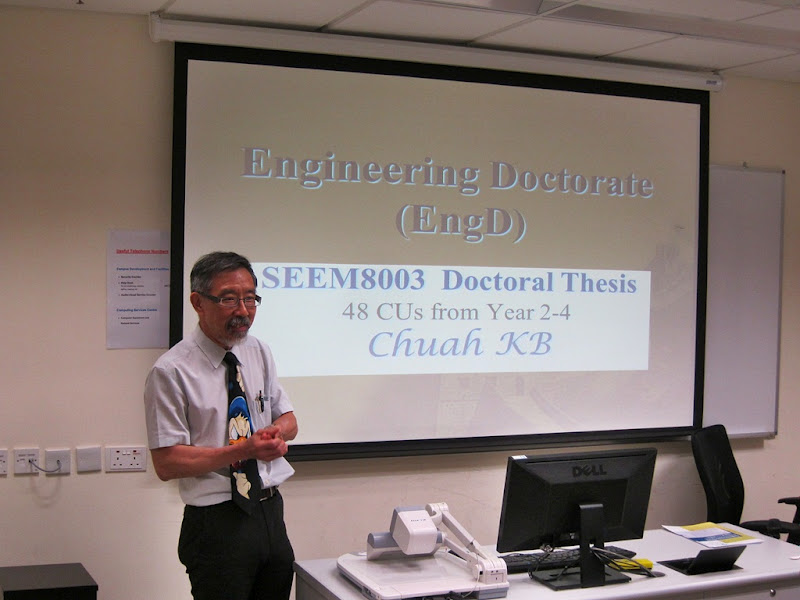
Lastly, Dr. Bing Chuab introduced the EngD course named "SEEM 8003 - Doctoral Thesis". It was a very important course.


Reference:
Engineering Doctorate (Engineering Management) - http://www.cityu.edu.hk/seem-mbe/prg-engd.htm
CityU Engineering Doctorate Society - http://cityu-engd.homepage.hk/


2012年9月2日星期日

Technical Seminar on Precision Manufacturing of Critical Components and Advanced Products

The Technical Seminar on Precision Manufacturing of Critical Components and Advanced Products was held on 1st September 2012. The seminar was jointly organized by Manufacturing and Industrial Engineering Section (MIES), The IET Hong Kong, and MILES Alumni Association of The Hong Kong Polytechnic University. Hong Kong Society for Quality (HKSQ) was one of supporting organizations. The seminar aims to provide technical knowledge and share experience on Precision Manufacturing of Critical Components and Advanced Products. Ms. Minda Chiang (Honorary Secretary, HKSQ) represented HKSQ to attend the seminar. The summary was shown below.

In the beginning, Mr. Thomas Chan (Chairman, Branch Committee, IET) gave a welcoming speech.


Then Mr. Dave Chong represented MILESAA gave an openning speech.


The first speaker was Prof. K.L. Yung (Professor and Associate Head, ISE Dept., PolyU) and her topic entitled "New Development of Precision Manufacturing".


Firstly, Prof. Yung briefed the traditional precision manufacturing methods and then he introduced some new precision manufacturing methods included Picosecond Laser Ablation, Micro-Electroforming, Micro Injection Moulding and Nanofiber Moulding.


At the end, Prof. Yung mentioned some applications in biochip and microneedles array.


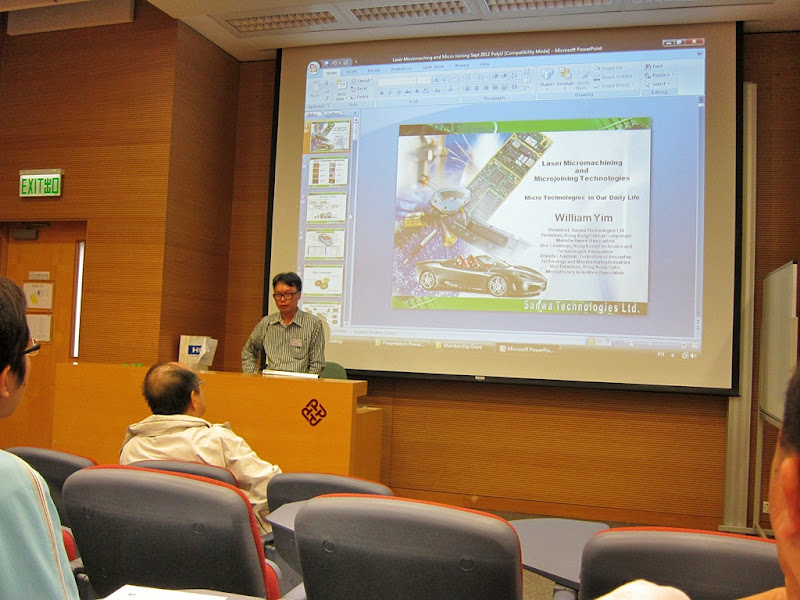
The second speaker was Mr. William Yim (President, Sanwa Technologies Limited) and his presentation title was "Laser Micromachining and Microjoining Technology".


Mr. Yim introduced several micro-technologies applications included Electronic Manufactruing Services (EMS), Medical EMS, Semiconductor Manufacturing, Critical Component Manufacturing, etc. Then he focused on Laser Micro Machining and briefed different types of laser.


Before break, Ir. MK Lam (Vice Chairman, MILESAA) and Mr. Ricky Lee (Committee Member, MIES-IET-HK) brief the membership of MILESAA and IET.


The last speaker was Mr. Stanley Cheung (Director, Global Wise Precision Technology Co., Ltd.) and his presentation named "Micro Injection Mould Making".


Mr. Stanley Cheung mentioned the traditional mechanic and non-traditional laser micro injection moulding. Then he briefed high precision EDM machining applications.


Q&A session


Ms. Minda Chiang (Honorary Secretary, HKSQ) represented HKSQ to received the souvenir.


Group photos were taken.


Reference:
IET (HK) - http://www.iee.org.hk/iee/eng/main/home.jsp
PSES (IEEE-HK) - http://ewh.ieee.org/soc/pses/Chapters/
HKSQ - http://www.hksq.org/index.asp


Angel Investment Forum (天使投資-伯樂如何尋找千里馬?)

The Angel Investment Forum (天使投資-伯樂如何尋找千里馬?) was co-organized by Hong Kong Science & Technology Park Corporation (HKSTPC), Hong Kong Business Angel Network (HKBAN) and Hong Kong Economic Journal (HKEJ) monthly on 1 Sep 2012.


Before the forum start, group photo of speaker was taken.


Robert Chow (周融) (Chairman, Robert Chow and Friends Limited) was invited to chair the forum. He said the 3% to 7% return on investment (ROI) was too low. Organization investor was looking for 25% or more ROI.


The first speaker was Mr. Allen Yeung (楊德斌) (VP - BDTS, HKSTPC and Chairman of HKBAN) and he explained what is Angel Investment. Angel Investment was started more than twenty years ago in USA and Europe. The investor supported the potential start-up company in early stage included cash, technology and networking, etc. Those angel investors would get some share of the start-up company.


The Mr. Allen Yeung explained the investment risk and amount in different stage of the start-up company growth. The investment in early stage would suffer high risk but it could be very high return if success.


Then Mr. Allen Yeung introduced Hong Kong Business Angel Network (HKBAN) which was formed by Hong Kong Science and Technology Parks Corporation (HKSTPC), HKVCA, CUHK, HKUST, HKU and POLYU in 2010. Angels were being invited to join several Investment Matching Gatherings (IMGs) where entrepreneurs from the incubation programme of HKSTPC and universities had presented their business plans. Then nine succeed cases were shared.


The second speaker was Prof. Wilton Chau (周志偉) (Associate Director, CUHK and Vice Chairman of HKBAN) and he shared his investment experience. He explained why risky of angel investment. It was because of limited resources, no track record, no customer's base, highly dependent on entrepreneurs, very difficult to measure and usually in a total loss situation.


Angel Investment risk was certain and the next questions were how much money could earn, what is the maximum loss and any non-monetary return, etc.


Then Prof. Chau mentioned the complex venture development path. He said the project would be fail if one of part was fail. Therefore, Prof. Chau taught us to question before investment as below:
Where is the current position?
Where will the finish point be?
How to go from the current point to the finish point?
Any execution plan or hurdles? Can the management plus you have the ability to overcome this hurdles?


Finally, Prof. Chau said investor needed to look for someone with experience and track record. No Trust No Investment is always true.

The third speakers were Mr. Martin Tsang (曾偉華) (Project Director and co-founder of AMOS Enterprises Ltd) and Ms. Liza Wong (王麗文) (Guru Online). Liza was angel investor of Martin’s company. They shared their matching experience.


Ms. Liza Wong said the investment match was like “Marriage” as follows:
Vision (緣份) 
Value System (價值觀一致) 
Integrity (互信) 
Financing (理財有道) 
Passion on business (他愛我比我愛他多) 
Before investment: understand industry prospect, business model & founder capability (婚前:睇到佢實一實) 
After investment: give enough freedom for the founder (婚後:隻眼開隻眼閉) 
Link up resources and connection (盡力幫助老公) 
Discuss investment amount and shareholder rights (婚前要討論禮金)


But Ms. Liza Wong pointed out some dissimilar between investment and marriage below.
Exit plan vs not a life (一生一世)
Many investment vs not unique (一夫一妻)

The last speaker was Mr. Shih Wing Ching (施永青) (Chairman, am730) and his topic was Hong Kong start-up environment. He said the younger generation had more chance to study in university, the less chance they would be entrepreneur. Mr. Shih also said the social environment became hate the businessman that was no good for entrepreneurship.


Mr. Shih said entrepreneur solved the problem by themselves, not through government or parties. Then he explained the value of his start-up fund with two conditions. One was in the distribution model of surplus that shared to shareholders, staffs and re-investment after minus all expenses. The other value was employed the theory of Lao-tzu (a Chinese philosopher in the Spring and Autumn Period). Until now, 7 companies succeed to apply Shih’s fund where 2 had higher potential, 4 were striking and 1 die.

Q&A Session


Photo with Mr. Robert Chow (周融)


Photo with Mr. Shih Wing Ching (施永青)


Reference: 

2012年9月1日星期六

Seminar on Power Electronic Packaging and 3D Sensing SiP

The seminar entitled "Power Electronic Packaging and 3D Sensing & Connect SiP for IoT" was co-organized by Hong Kong Science & Technology Park Corporation (HKSTPC) and Hong Kong Applied Science and Technology Research Institute (ASTRI) on 31 Aug 2012.

The first speaker was Dr. Ivan Sham Man Lung (Senior Manager, Material & Packaging Technologies Group, ASTRI) and his presentation entitled "Market, Opportunities and Challenges of Power Electronics Packaging".


Dr. Ivan Sham explained that power semiconductors are semiconductor devices mainly used in the circuits of inverters/converters for switchig and converting of electricity and controlling of motors. It included power MOSFET, diodes, IGBT, bipolar transistors, and SiC devices, etc. Then he briefed the market trends of Power Semiconductors which was driven by energy-saving standards, wind power generation and HV/EVs. Dr. Sham said Insulated-gate bipolar transistor (IGBT) markets were growing dramatically in the upcoming few years, particularly from the demands of Green Technologies.


Key challenges and issues of product development were substrate and module design for superior electrical and thermal performance. Moreover, transient electro-thermo-mechanical multi-coupling simulation for accurate prediction for reliability estimation was needed. Thermal design was very important and it depended on cerarmic types of substrate, solder layer, thermal interface material properties and cooling condition.


Finally, Dr. Sham introduced the next generation power module solution which was developing by ASTRI involved DBC design, wirebondless technology and heat dissipation. It was expected to enhance heat dissipation from 40% to 70% and to extend of die attach lifetime upto 3 times; as well as, to reduce the parasitic inductance and resistance of wirebond interconnect upto 99% and 85%, respectively.


The second speaker was Mr. Steve He (Senior Manager, Advanced Packaging Technologies, ASTRI) and his topic named "3D Sensing & Connecting SiP for Internet of Things: Challenges and Opportunities".


Firstly, Mr. Steve He mentioned the definition of Internet of Things (IoT) that uniquely identifiable objects (things) and their virtual representations in an Internet-like structure. It was very difficult to understand in English definition but in Chinese was obviously (物聯網就是物物相連的互聯網。). It had three key components of IoT that were "Sensing", "Connecting" and "Processing".


Mr. Steve He said the 3rd IT wave after PC & Internet was IoT. The following diagram showed the distribution of IoT R&D centers in China.


At the end, Mr. He introduced some typical applications such as Anti-counterfeit, Food Safety, Mobile Payment, Smart Home and Ambulance. He also showed how 3D System in Package (SiP) as a solution to reduce the size of chips.


Reference:
HKSTP Laboratories - http://lab.hkstp.org/default2.asp 


2012年8月31日星期五

反國民教育的邏輯謬誤

首先是以偏概全,用浸大撰寫的中國模式參考資料的論點偏頗及其中一個不合當的評估來否定整個國民教育,犯了不充分的謬誤。將國民教育等同於洗腦,犯了不當預設的謬誤。關注組會將支持與不支持國民教育的立場簡單化、絕對化,犯了非黑即白(不當二分法)的謬誤。


最近看了一些對國民教育較正面的文章,分享如下:

張圭陽文章道:香港已沒有言論自由了,只容許發表反對政府的言論,要是有一點持平的心態,便會被對抗者臭罵,要求向抗爭者道歉; 一份沒有法定地位的教材指引,可以引致全面否決國民教育,這種荒謬的邏輯,常見於六十年代文革之中,五十年後,竟重現在香港 。

陳文鴻文章道:我不贊同國民教育作為獨立學科,要進行國民教育,加強常識和歷史的教育,加強老師、家長的身教,作用和意義更大。我也同意浸大撰寫的中國模式參考資料論點偏頗,不適宜作中小學教學的參考資料。但是我亦不反對以不考試的方式,在學校開展國民教育的教學。 支持或不支持的兩個極端之間還有許多人有許多選擇,支持或不支持也帶有不同的條件。把立場簡單化、極端化,並且加以道德的標籤,或對反對者妖魔化等,本身便可作為國民教育的負面案例。 可是,當反國民教育走上反洗腦便把運動的意義和作用歪曲。國民教育怎可將之等同於洗腦 — 誰洗誰的腦?那有這樣容易洗腦?持此論者忘記了校本位的政策開放重點,忘記了三年開展期的準備。

張潤衡文章道:作為中國人,了解國家便同樣是我們的責任。懇請大家反思一下,究竟我們在反的是甚麼呢?是反對自己的國籍,還是反對國民教育裡的內容和洗腦方法呢?請為理而反,莫為反而反!

劉澄文章道:作為結論,筆者仍然支持推行國民教育 (也可以獨立成科),但條件是:一、必須扔掉《中國模式國情專題教學手冊》,二、教育界能以中立的內容推行「國民教育」。如果我們堅持上述的基礎,便不應盲目地否定「國民教育」本身的意義。

劉炳章文章道:國民教育科的編排涉及五大範疇,由個人到家庭再到社會、國家和世界,逐步遞進,遠不止現在焦點討論的所謂「洗腦」內容,也能夠涵蓋公民權利及義務、個人和社會及國家的關係等內容,包含了廣闊的世界觀,對培養國際視野有正面的幫助。以為一本參考手冊就能夠「洗腦」,則無疑將人看得太低,充滿一種「話語霸權」的味道;而選擇罷課、罷教,更只會禁絕討論,不是可取之道。

吳志強文章道:香港是開放型社會,資訊來自四方八面,單是推行「德育及國民教育科」,只有部分內容介紹國家的狀況,而且教材可由學校及教師自由選用,很難想像會經由老師為學生洗腦,而口口聲聲說學生會被洗腦的人,也太侮辱香港的教學水平和老師質素吧!洗腦只會存在於極度封閉的社會,當今之世,相信仍有條件推行政治洗腦教育的,就只有北韓這個與外界隔絕的極權國家。推行「德育及國民教育科」就會為香港學生洗腦?真是天大的笑話!看了多篇文章,國民教育科都沒有提及中國地理,風土人情,小數民族,國家組織,人口分佈等。當年只有世界地理,很少有中國的資料。

看了多篇文章,國民教育科都沒有提及中國地理,風土人情,小數民族,國家組織,人口分佈等。當年只有世界地理,很少有中國的資料。
用品質管理的PDCA循環(Plan-Do-Check-Act Cycle)來不斷改善,才是國民教育的應有方向。之前的(Plan)已過,現在所設的委員會在這三年試行期(Do)的工能是(Check),之後是(Act)來改善。

Reference:
劉炳章 - [國民教育欠缺理性討論],太陽報,香港營,2012年08月17日,http://the-sun.on.cc/cnt/news/20120817/00418_014.html 
 張圭陽 - [文革式討論],明報,2012年8月25日,http://blog.sina.com.cn/s/blog_712c35fd01017rwt.html
 劉澄 - [洗腦?],晴報 「劉」意時事,2012年08月28日,http://blog.yahoo.com/_PFQOBGYZ4PBZELNVZCZSKYTUCM/articles/659476/index 
 陳文鴻 - [政治化、泛道德化],am730 滾滾鴻流,2012年08月28日,http://www.am730.com.hk/article.php?article=118871&d=1830 
 陳文鴻 - [反國民教育走歪路],東方日報 坦言集,2012年8月29日, http://www.orientaldaily.on.cc/cnt/news/20120829/00184_001.html 
 張潤衡 - [你在反甚麼?],am730 吹脹80後,2012年08月29日,http://www.am730.com.hk/article.php?article=119055&d=1831
吳志強 - [洗腦的謊言],am730 730視角,2012年08月31日,http://www.am730.com.hk/article.php?article=119592&d=1833

國民教育不合當評估的原因,是定義的問題,曾榮光寫的文章有詳細解釋。
曾榮光 - [《德育及國民教育科課程指引》的批判],明報專訊,2012年08月31日,http://commentshk.blogspot.hk/2012/08/blog-post_6997.html


跋:
收件人︰ "info@parentsconcern.hk" <info@parentsconcern.hk>
傳送日期︰ 2012年09月7日 (週五) 4:19 PM
主題︰ 對反國民教育及絕食行為的意見

敬啟者:

我認為絕食是用自己的生命作出抗議,是要維護比生命更重要的東西。
如1849年匈牙利愛國詩人裴多菲在作戰時犧牲,在年僅26歲時,曾寫下:「生命誠可貴,愛情價更高,若為自由故,兩者皆可拋。」
而洗腦的特點是具有強制性,長期性和非對稱性灌輸錯誤價值;而被洗腦者是在受阻礙或強制禁止接觸外間消息的環境中進行。
我認為反國民教育的絕食未有充分的理據。
如果以下的條件成立,就符合用生命為思想自由而作出抗議及犧牲。
一)中國模式參考資料或其他偏頗的參考資料成為正式或指定教材;或
二)課程指引中的不合當評估如以情感為準則及學生互相評價等,堅持不改;和
三)以上其中一點成立及在今年九月或三年「開展期」後強制所有中小學校實行。

但現在的情況是:
一)教育局不會用內容偏頗的參考資料作教材及沒有指定教材。
二)開展德育及國民教育科委員會了解社會各界對於三年「開展期」內籌備或實施德育及國民教育科的意見。 胡紅玉表示,委員會將檢視日後的教材,希望能有多元化的教材。
所以本人認為反對者可在不防礙他人的情況下作出不合作運動,但不至於到達絕食的地步。

就現階段,用浸大撰寫的中國模式參考資料的論點偏頗及課程指引其中一些不合當的評估準則來否定整個國民教育科,及將國民教育等同於洗腦,都犯了不充分的謬誤。

我贊成教育評議會提出先設立一年冷靜期,一年之後再商討是否推行國民教育科。
有一年時間作糾正國民教育課程指引中的不合當地方及定立參考教材的內容範圍。

香港市民
黎先生上


2012年8月26日星期日

ASQ InfVoices - The Quality Culture in Hong Kong

Paul Borawski (CEO, ASQ) raised the August Topic of ASQ Influential Voice named "Feelings and Quality Culture". Moreover, Paul asked two questions "What do you look for in the people you hire into the organization?" and "When you're in a culture of quality, how does it feel?". In this topic, I would like to separate into two parts. The first part discussed how leadership style affects quality culture and the second part considered the local situation.

(Photo: Quarterly Mass Communication Meeting in HKSTP)


Quality Culture is an attitude and set of values employed by a company/corporation to improve the quality levels included the quality of relationships with customers and communication between employees . The best way to establish a quality culture is through top management commitment. Therefore, Leadership style is absolutely related. Recently, I attended a seminar entitled "The 6 Leadership Styles to Win at Different Challenging Times" on 17 August 2012 in Hong Kong Science Park. I learnt that six leadership styles named 1. Coercive Style (強制型), 2. Authoritative Style (引領型), 3. Affiliative Style (親和型), 4. Democratic Style (共識型), 5. Pacesetting Style (師父型), and 6. Coaching Style (導師型) would affect the Working-Climate. According to Prof. David McClelland (Harvard University), Working-Climate would impact the performance and financial results such as sales, revenue growth, efficiency and profitability. His study indicated that Coercive Style (強制型) and Pacesetting Style (師父型) could destroy the Working-Climate. Leadership gives directions and values. However, quality system is also important to be designed for peer participation. It could let new employees know the Quality Culture of the organization, which cannot be simply come from corporation orientation program. Quality Culture growth depends on nourishment with vision, supporting with structure and flourishing with actions.

In Hong Kong, most large companies have their quality policy and culture. Three famous companies in Hong Kong could be referred. They are MTR, Towngas and CLP which had sponsored the ANQ Congress 2012 Hong Kong (http://www.anq2012.org/sponsors.html). In the past, manufacturing companies are found to have stronger quality culture than service companies in Hong Kong. In addition, large companies are higher awareness of quality culture than smaller companies. It may because large companies had a quality department.

Nevertheless, a obvious trend was observed that Hong Kong leaders seldom mention about Quality or Quality Culture, but most of them emphasize on Sustainability, Environment and Energy Saving.

In here, I would like to share my company's Vision, Mission and Values below.
Hong Kong Science and Technology Parks Corporation (HKSTPC)
Vision: Transforming innovation and technological advancement into value creation that benefits Hong Kong, Mainland – and the world.
Mission: In propelling Hong Kong towards a world-class hub for selected technologies, we provide facilities, services and a dynamic environment that enable companies to nurture ideas, innovate and develop.
Values: Integrity, Excellence, Safety, Sustainability and Commitment

Reference:
The 6 Leadership Styles to Win at Different Challenging Times - http://qualityalchemist.blogspot.hk/2012/08/the-6-leadership-styles-to-win-at.html 


2012年8月24日星期五

What Samson's work I observed (譚偉豪的工作之我見)

I would like to share my experience for participating Samson's activities in past 4 years.
As a professional, I have a habit to record all my activities in my blog as evidence of Continuing Professional Development (CPD).

(Photo showed Dr. Samson Tam's promotion materials and my IT books collection.)


Before 2008, I don't know Dr. Samson Tam. After his action fighting for renamed Technology Bureau under The Hong Kong Association for the Advancement of Science and Technology, I was aware a person who worked in the same field. The first cooperation with Dr. Samson Tam was on 2nd August 2008. HKSQ, HKQAA and HKSTP co-organized a seminar to introduce ISO 9001 and ISO 27001 standards, we invited Dr. Samson Tam as our modulator through Dr. Aaron Tong (HKSQ ex-chairman).
*Dr. Samson Tam as modulator chaired the open discussion session.

Then I was invited by SW Cheung (ex-boss) to join HKIE-ITD. Since I was HKIE-MIE member, I needed to add one more division based on my qualification and experience (I had a computer degree with 3 year ISMS experience.).
20080921: Samson Tam meeting with his Five Hundred Supporters
*The first time I joined Samson's support team.

After that I had attended several activities organized or supported by Dr. Samson Tam and summarized below.

20090508: HKIE Electronices Division 30th Anniversary Dinner
*Legislative Councilors Forum entitled “Technology and Engineering Develop in Hong Kong in the next 30 years” was moderated by Ir. Jolly Wong and Ir. Peter Yeung. The guests of forum were Ir. Dr. Raymond Ho, Mrs. Regina Ip and Ir. Dr. Samson Tam.

20100317: HKSQA Conference 2010 – Software Assessment and Certification
*Dr. Samson Tam was invited to give an opening address.
In that time, Samson had asked my opinion on software & personal certification. I had shared ASQ Certified Software Quality Engineer (CSQE) examination to him but it was not popular in Hong Kong.

Samson formed ToloMix which is a group of technology entrepreneurs and professionals working in the Hong Kong Science Park, who would like to share and exchange views of technologies, to uplift the image of the Science Park and to enhance the social network.
20110318: ToloMix Gathering - iPad2
*Dr. Samson Tam is a moderator of the event.
* Samson arranged the visit to ASTRI laboratories.

20110625: Hong Kong Competitiveness Seminar
*The group discussion was performed and panelist included Dr. Samson Tam Wai Ho (譚偉豪), Mrs. Fanny Law (羅范椒芬), Mr. LAU Kong Wah (劉江華), Ms. Emily Lau Wai-hing (劉慧卿), Prof. Chan Chi-fai, Andrew (陳志輝) and Dr. Ni (倪鵬飛).
All guests supported to establish Innovation and Technology Bureau in Hong Kong.

20111209: 深港「雲計算及數據中心」合作集思會 暨 交流計劃啓動式 (Cloud Computing & Data Centre Seminar)
*Dr. Samson Tam is officiating guest and gave a speech.

20120822: HKIE Forum for 2012 Legco IT Functional Constituency (FC) Election Candidates
*Dr. Samson Tam presented his proposal if he elected and answer IT industry questions.

Reference:
Ir. Dr. TAM Wai Ho Samson - http://www.samsontam2012.hk/ 
The Hong Kong Association for the Advancement of Science and Technology - http://www.hkaast.org.hk/


2012年8月23日星期四

HKIE Forum for 2012 Legco IT Functional Constituency (FC) Election Candidates

For the 2012 Legislative Council (Legco) Election to be held on 9 September 2012, HKIE - Information Technology Division organized Forum to facilitate HKIE - IT Division members to meet the candidates on 22 August 2012. I was attended the forum and recorded as follows.

In the beginning, both FC Election Candidates took a photo with Ir. Prof. CHOY Kin Kuen (President of HKIE). Prof. Choy was the chairman of that forum and briefed the rule that each candidate had 10 minutes to present and then questioned from audience. Each person allowed to question not more then one minute.


The first IT FC election candidate speaker was Dr. Samson Tam and he explained his work in the Legco in the past four years, as well as, his future proposal if elected. He identified his role as bridge between industry and government.


The second IT FC election candidate speaker was Mr. Charles Mok and he said Dr. Tam's work was under expectation and explained his proposal if elected.


During the Q&A session, many professionals asked different questions and summarized as follows.
1. How to establish and practice the Technology and Communications Bureau?
2. How to build Data Centre hub in Hong Kong?
3. It needed to focus the information security and cloud computing.
4. How to strength IT SME business? CEPA?
5. How to improve the IT education included teachers and students standard?
6. It needed to attract more MNC in IT field establishing R&D centre in Hong Kong.


At the end, both candidates gave conclusive remarks.

It was a gentle forum for discussion IT future policy. No serious criticism / argument happened in this professional forum.

Reference:
1. Ir. Dr. TAM Wai Ho Samson - http://www.samsontam2012.hk/
2. Mr. MOK Charles - http://www.charlesmok2012.hk/


LinkWithin

Related Posts with Thumbnails