2019年10月24日星期四

ANQ Congress 2019 in Bangkok, Thailand – Day 2

Asian Network for Quality (ANQ) Congress 2019 was held by Standard and Quality Association of Thailand (SQAT) in The Berkeley Hotel, Bangkok, Thailand from 21-25 Oct 2019. The congress theme was “Quality Innovation for Sustainability”.  Day 2 of Congress was held on 24th Oct 2019.   In the beginning, Minda and I took a photo with Dr. Pramual Suteecharuwat (Assistant Professor, Department of Industrial Engineering, Faculty of Engineering, Chulalongkorn University, Thailand) in front of the ANQ flag which made by her.


We also took a photo with Ms. Larisa Fedyk (Head of the Central Organ the System, Federal Agency on Technical Regulating and Metrology System of Voluntary Certification) and Mr. Igor Pundel (Chairman of the Board of Directors the Systems, Federal Agency on Technical Regulating and Metrology System of Voluntary Certification).


The first session I attended was “Quality Management” and the first speaker was Dr. Ngo Van Nhon (VQAH; Institute for Quality Assessment Development (IQAD)) and his presentation topic entitled “ISO 21001: A New Management System Standard for Educational Organizations (EOMS) – Studying and Implementation”.  The new standard was more socially responsible for offering educational services.


The ISO 21001:2018 standard provided a great basis for education providers to enhance the quality of their products and services. Then Dr. Ngo introduced the framework of EOMS and he believed that if the standard was implemented, and complemented with best practices in the field of education, it would help organizations yield positive results for its beneficiaries – be it students, parents, community and interested parties.


The second speaker was Mr. Johnson Tan Swan San (Honorary Treasurer & Exco member, SQI) and his topic named “Enhancement of a Laboratory Management System via Application and Integration of Risk Management into ISO/IEC 17025:2017”.   Firstly, he briefed the requirements of the new version of ISO/IEC 17025:2017.


Then Mr. Johnson Tan introduced the four steps of Risk Management included Step 1 – Risk Idntification, Step 2 – Risk Estimation, Step 3 – Risk Evaluation and Step 4 – Risk Evaluation.  After that he used this four steps to distinct the Risk Analysis (Step 1 + Step 2), Risk Assessment (Step 1 + Step 2 + Step 3) and Risk Management (Step 1 + Step 2 + Step 3 + Step 4).  Finally, he concluded that the adoption of ISO 19011:2018 Audit Methodology focused on Risk-based Auditing Approach should be applied in conducting ISO/IEC 1705:2017 audits with a view to enhance Management System Performance.


After that I attended another session “Quality Process”.  The second speaker was Mr. Too Meng Ken (Principal Consultant, Too Meng Ken Consultancy; SQI) and his presentation title was “Optimizing Texturing Process of Solar Energy Industry through Six Sigma Methodology”.    The scope of Mr. Too’s project focused on qualifying Lower Grade Chemical A (higher metals content included Fe, Chromium and Nickel) for texturing use in solar cell manufacturing.


After DMAIC six sigma process, Mr. Too achieved the target that cost reduction upto 16%.  During Q&A, someone asked why used three factors but only two factors during analysis phase.  Mr. Too said because of time limitation and constraint in the business world.


The third speaker was Dr. Catherine Y.P. Chan and her presentation named “Quality Function Deployment (QFD) Fosters Innovation”.  She said in order to endure existence in the market, enterprises had tried every mean to seek for new products and services.  So that Innovation was key for sustainability in the long run.  


Then Dr. Catherine Chan briefed discussing methods for collecting VOC such as video recording, visiting, etc.   Since advancement of Technology & Information Technology, she asked us to consider new media, channels, methods and tools which could assist and support us on interacting customers and acquiring a thoroughly understanding with needs.


Finally, Dr. Chan introduced how QFD fostered innovation and she believed positive power generated from the QFD process which would develop innovation naturally and continuously.


The last speaker in this session was Mr. DurgalPrasad (DP) Muthukrishnan (Director Consulting, Cognizant) and his topic was “Enhancing Customer Experience (CX) in Digital World through Quality Architecture”.  Firstly, he introduced Congizant which established in 1994 and to be NASDAQ since 1998.  Then he addressed change of Quality role through world class Quality Architecture.


And then Mr. DP explained world class Quality Architecture solution evolved to address:
-          Product quality improvement in line with ISO standards
-          Influence business growth/outcome
He also explained the Quality Architecture that product quality characteristics profiled based on the business context and the economic benefits.


Finally, he explained 5 steps approach to setting up Quality Architecture Framework below.
1.       Customer Experience Scanning (CX Scanning)
2.       Diagnostic Study
3.       Analyse and Benchmark
4.       Define and Measure
5.       Improve


I met Dr. Takeshi Kaneko in the venue and took a photo for memory.


After end of this session, I went to the other session “Quality of Life”.  Ms. Larisa Fedyk (Head of the Central Organ the System, Federal Agency on Technical Regulating and Metrology System of Voluntary Certification) was the last speaker and her topic named “All-Russian Register - Projection into the future quality of life”.


2019年10月23日星期三

ANQ Congress 2019 in Bangkok, Thailand – Day 1 (Part B)

Asian Network for Quality (ANQ) Congress 2019 was held by Standard and Quality Association of Thailand (SQAT) in The Berkeley Hotel, Bangkok, Thailand from 21-25 Oct 2019. The congress theme was “Quality Innovation for Sustainability”.  Day 1 of Congress is held on 23rd Oct 2019. After lunch, my presentation in the parallel session for Quality Management.  Dr. Lotto Lai (HKSQ) presented the paper entitled “Preliminary Study on QMS based Innovation Management System (QInnoMS) with Extension Innovation Methodology”.  


Firstly, I introduced different definition of “Innovation” based on different standards and then introduced ISO 9001:2015, CEN/TS 16555-1:2013 and ISO 56002: 2019.  After that I proposed the integrated model to combine three standards models together.


Then I proposed the 20 steps implementation guide and using Extension Innovation Method under diamond thinking for organization innovation included system, operational, service, product and process.  


And then I introduced the Extenics and Extension Innovation Method which was developed by Prof. Cai Wen since 1976.  His first publication named “Extension Set and Incompatible Problem” in 1983 and then a new science discipline was created in China.  


Finally, I concluded that integrated QMS and Innovation Management System would be the trend and reasonable because Quality and Innovation are essential in the business world.  However, we needed to have innovation tools to make it happen.  Therefore, I proposed Prof. Cai’s Extenics and Extension Innovation Method.  At the end, I employed Prof. Cai Wen statement that “Let’s establishing Extenics Together!”


The second speaker was Dr. Lam Kong Ngan Kenny (Founding President, Shenzhen-Hong Kong Institute of Professional Management Association) and his presentation title was “PRC (Greater Bay Area) Guangdone-Hong Kong-Macao Construction Culture Difference”.  Firstly, Dr. Lam demonstrated different real cases in the construction site through videos.


Dr. Lam said safety awareness and time management were important in PRC construction projects.  But we needed to handle legal supervision in different areas so as to avoid safety accidents happen. 


After that he discussed some construction safety data in China, Macau and Hong Kong that included different types of injury and accidents.  


Finally, Dr. Kenny Lam concluded that study was based on implementation of the "Three pronged" strategy with “Integrity and Self-love”, “Lead by Example” and “Law Enforcement, Prevention and Education” to reduce the impacts of cultural differences on project success.


In our session, I also attended Dr. Su-Yol Lee (Associate Professor, College of Business Administration, Chonnam National University) and his presentation topic named “Corporate Response to Climate Change: Quality Management and Firm Performance”.   Firstly, Dr. Lee stated different areas drastic hot weather recently especially Korea had the hottest summer upto 35C in 111 years according to the Korea Meteorological Administration (KMA) on 23 July 2018.


Then Dr. Lee introduced global effort to fighting against climate change such as Kyoto Protocol and recently Paris Agreement in 2015.  South Korean Climate Change policies were mentioned that national goal of GHG reduction of 30% below business-as-usual by 2020 based on the National Strategy for Green Growth (2009) and revisited GHG reduction of 37% below by 2030 when joined the Paris Agreement (2015) as well as the Korea Emission Trading Scheme on 2015.  


Finally, Dr. Lee showed the research data such as regression analysis that indicating TQM capability contributed to increasing the levels of adoption/implementation of Carbon Management Practice (CMP) but the effects of TQM and CMP on a firm’s performance were not clear.  However, he believed quality management matters to fight against climate change.


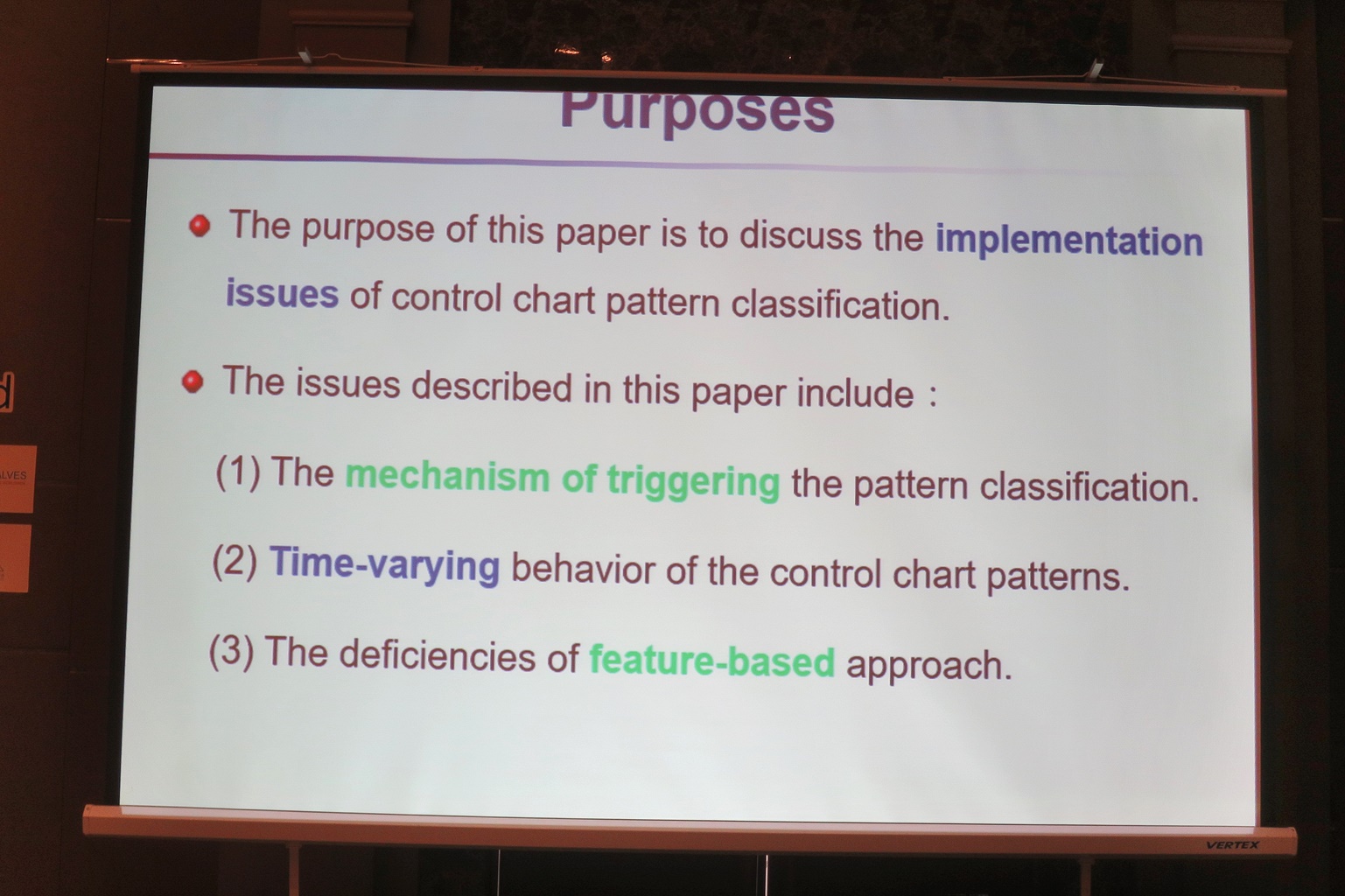
The last speaker in this session was Dr. Cheun-Sheng Cheng (Department of Industrial Engineering and Management, Yuan Ze University) and his topic was “The Challenges of Machine Learning-based Control Chart Pattern Recognition”.  Firstly, he introduced the background of control chart in SPC and he said many researchers pointed out that correct classification of non-random patterns could facilitate the course of diagnosing the assignable causes.  


Dr. Cheng study purposes included the mechanism of triggering the pattern classification, time-varying behaviour of the control chart patterns and the deficiencies of feature-based approach.  For classification approaches, it included rule-based, decision tree, artificial neural network, support vector machine and deep convolutional neural network.  


Lastly, Dr. Cheng introduced different techniques for classification of pattern such as moving window.  Moving window was found lacks of a triggering mechanism and we needed to consider different starting position within the data window.  Then he demonstrated some cases of using moving window starting point to observe the pattern of Trend, Cyclic, Systematic, Shift and Slope.  He said the overall classification accuracy was also highly dependent on the data window size.  At the end, Dr. Cheng introduced feature-based approach such as Convolutional Neural Network (CNN) approach as multi-channel deep CNN (MC-DCNN).  


Another two Hong Kong participants presented at the same time in the section “Quality Process”. 
The first speaker of HK team in that session was Dr. Chan Wai Lung, Raymond (Chairman & Executive Director, Finsoft Financial Investment Holdings Limited) and his presentation named “A Study on Discrepancy of Interest rates in China’s Repo Market before and after Trade Conflict”. 


Dr. Raymond Chan explained Repo market in seller side and Buyer side.  His research methodology employed factor construction and mono-factor regression.  His study offered a predictive model by applying Least Absolute Shrinkage and Selection Operator (LASSO) to predict one-day-ahead discrepancy of repo interest rate, which can explain over 60% variation in the discrepancy in both in-sample and out-of-sample period.


The second speaker was Dr. Wong Kwok Keung, Keith (Deputy Chair – The Chartered Institute of Plumbing and Heating Engineering) and his presentation entitled “Sustainable Development of Water Resources in Hong Kong Special Administrative Region, China”.  Firstly, Dr. Keith Wong briefed the history that HKSAR started procurement of fresh water from Dong-jiang (DJ) River of Guangdong Province in China since 1965. Now, near 80% of annual water consumption (0.82 billion cubic meters) in HKSAR is purchased under this scheme to support the enormous water demand in HKSAR, pricing at 4.78 billion HKD.


His study aimed at planning and assisting the HKSAR government to find out reason for the lack of water resources. To explore ways to increase the total number of water resources in HKSAR from 2 to 5, to help solving the current liability on DJ Water Supply Scheme by using an innovative and timeliness way to explore how to expand supply and reduce demand.


The 2nd Belt and Road International Quality Forum
And then I joined the 2nd Belt and Road session.  I took a photo with Prof. Kano in front of ANQ map which made by Prof. Phulporn Saengbangpla (Honorary Advisor, SQAT).


ANQ Congress 2019 in Bangkok, Thailand – Day 1 (Part A)

Asian Network for Quality (ANQ) Congress 2019 was held by Standard and Quality Association of Thailand (SQAT) in The Berkeley Hotel, Bangkok, Thailand from 21-25 Oct 2019. The congress theme was “Quality Innovation for Sustainability”.  Day 1 of Congress is held on 23rd Oct 2019.  Before the Congress start, Hong Kong team took a group photo with Prof. Noriaki Kano.  

(Left: Dr. Ivan Ng (HKSQ), Dr. Raymond W.L. Chan (Chairman & Executive Director, Finsoft Financial Investment Holdings Limited), Dr. Alan K.F. Mong (Deputy Project Manager, China Communications Construction), Dr. Lam Kong Ngan Kenny (Founding President, Shenzhen-Hong Kong Institute of Professional Management Association), Dr. Keith Kwok-keung Wong (Deputy Chair – The Chartered Institute of Plumbing and Heating Engineering), Dr. Catherine Chan (HKQFDA), Dr. KS Chin, Prof. Kano, Ms. Minda Chiang and I)

We had one more participant from Hong Kong Ms. Tiffany Li who was winner of HKQF Award Scheme for Learning Experiences under Testing, Inspection and Certification.  Minda and I took a photo with Tiffany for memory.


Dr. KS Chin and I took a photo with CAQ representatives Prof. Tang Xiaoqing (唐曉青) and Ms. Duan Yihong (段一泓), as well as, CSQ Secretary General – Dr. Jay San Chen (陳介山).  


Minda and I took a photo with Prof. Phulporn Saengbangpla (Honorary Advisor, SQAT).


Also took a photo with Prof. Kano.


And with Mr. Janak Mehta (Founder President, ISQ).


I met Prof. Ching-Chow Yang (楊錦洲) (President, CSQ)


Photo with India friends.

(Left: I, Mr. J. Ravikant (Member-Governing Council, ISQ), Mr. Janak Mehta, Mr. Vishwa Deepak Khandelwal (Team Leader-Business Excellence, Apollo Types Ltd.) and Mr. Deepak Kulshrestha (Principal Consultant, TQMI))

Photo with Singapore team Mr. GE Tan (Chairman, SQI) and Mr. Kenneth Liang (Former Chairman, SQI).


Photo with Korea team Prof. Youn Sung Kim, Prof. Wan Sean Shin (Former President – Korean Society for Quality Management) and Prof. Jeongil Choi (School of Business Administration, Soongsil University))


Then Minda and I were invited to take a photo with Vietnam team.

(Left 2 – Power, Left 6 – Dr. Ngo Van Nhon and Right 2 – Mr. Duc Tran Hai)

I met Ms. Larisa Fedyk (Head of the Central Organ the System, Federal Agency on Technical Regulating and Metrology System of Voluntary Certification).  


Photo with Prof. Shu Yamada (Dean, Graduate School of Business Sciences, University of Tsukuba).


Taiwan friend (CSQ) - Dr. Kelvin Cheng (Executive VP, FineTek)


Minda took a photo with performance team of Thailand.


Congress was almost start and Hong Kong teams were well prepared.


Traditional Thai dancing performance was showed in the beginning.


Firstly, Dr. Pasu Loharjun (Former Permanent Secretary, Ministry of Industry) gave Welcome Speech.  He said world had changed rapidly and all business especially industry entrepreneurs faced this challenge.  Success business should focus on consistency of their production and products “Quality”. 


Secondly, Dr. Panisuan Jamnarnwej (Chairman, ANQ; President, SQAT) gave Opening Remarks.  Firstly, he introduced Bangkok (locally called Krung Thep) – the City of Angels has the cultural heritage befitting a capital city of almost 240 years, as well as modern infrastructures to function as the regional hub bustling with economic activities.  The Congress high-lights were keynote presentation by ANQ founders, award-winning firms and individual professional to share experiences of highest value for the advancement of quality across industries.  


The first keynote speaker was Prof. Dr. Noriaki Kano (Professor Emeritus, Tokyo University of Science; Honorary Chairperson, ANQ) and his topic entitled “Innovation for Sustainability – Quality Development in Service Industries”.  Prof. Kano said “While manufacturing dynamically grew in Asia in 20th century, service industries shall be more and more developed in 21st century.”  


2019年10月22日星期二

Pre-ANQ Congress 2019 visit to University in Songkla, Thailand and Congress Registration

Asian Network for Quality (ANQ) Congress 2019 was held in The Berkeley Hotel, Bangkok, Thailand from 21-25 Oct 2019. The congress theme was “Quality Innovation for Sustainability”.  Before the Congress, we went to Songkla City which was in the south of Thailand.  Minda and I started the trip from Hong Kong to Bangkok and then transited to Hat Yai (Suvamabhumi International Airport).


Minda’s Warwick flatmate Ms. Enjoy and her husband Mr. Bic arranged us to the BP Samila Beach Hotel from airport.  We had dinner in Hat Yai.  We had visited Laos together to see their classmate Mr. Khamphone in 2016. (See reference)


I had beer with Bic. I had beer with Bic. It was interested that half cup with ice for cooling the beer.


Then we went to the hotel and took a photo for memory.


Pre-ANQ visit to the Prince of Songkla University (21 Oct 2019)
On 21 Oct 2019, we visited the Prince of Songkla University which Enjoy taught in the Faculty of Law.  The main name of the university we took at night when we passed.


Arrived the Law building, we all took a group photo in front of the Faculty of Law.


Dr. KS Chin and I also selfie here.


We passed the President’s Office Building.  


LinkWithin

Related Posts with Thumbnails