2010年11月5日星期五

Briefing Session on ICT Standards – Mainland and Hong Kong (Part 2)

A Briefing Session on Information and Communications Technology (ICT) Standards – Mainland and Hong Kong (內地與香港信息通訊技術標準交流與合作研討會) held by Innovation and Technology Commission (ITC) on 3 November 2010.

Session Two (ICT Technology, Internet, DTV, AVS & TD-SCDMA/TD-LTE)

In session two, the first speaker was Mr. K.K. Suen (香港貨品編碼協會總工程師及首席顧問 - 孫國江先生) and his presentation title was “The importance of ITC standards and direction on cross-boundary application” (探討在跨境應用層面上 信息標準的重要性和發展方向).


Then Mr. Suen introduced the ITC platforms in the international logistic. He said that the exchange of logistic information was very import such as cool chain.


RFID is the research items of standard in Guangdong


Finally, Mr. Suen suggested to enhance the awareness on the ITC standards to industry and encourage to apply the standard in different platforms.


The second speaker was Mr. Wen Ku (國家工業和信息化部科技司聞庫司長) and his topic was “The development opportunity of Ubiquitous Network / The Internet of Things” (泛在網/物聯網的發展機遇).


Mr. Wen briefed the definition of Internet of Things (IOT) as “In computing, the Internet of things, also known as the Internet of objects, refers to the networked interconnection of everyday objects. It is described as a self-configuring wireless network of sensors whose purpose would be to interconnect all things. The concept is attributed to the former Auto-ID Center, founded in 1999, based at the time at the Massachusetts Institute of Technology (MIT)” (From Wikipedia).


IOT was concerned by different National Leaders in the strategy of economic and technology development.


The following showed the internet segmentation model.


There were many standards in IOT included URL, Ipv4, GS1, AIM Global, RFID, etc.


Many international organizations were involved in IOT. Such as ISO, IEEE, EPCglobal, GSM, etc.


Mr. Wen concluded the key development in IOT as follows:

i) breakthrough the core technology

ii) Integrated the supply chain

iii) Established the related standard

iv) Training and developing talent pool


The third speaker was Mr. Chan (香港電訊管理局總電訊工程師 - 陳子儀先生) and his presentation entitled “Digital audio codec technology standard and terrestrial digital TV transmission standard” (數字音視頻編解碼技術標準及地面數位電視傳輸標準)


Mr. Chan introduced that GB20600-2006 national standard was decided to employ in June 2007. DTV covered about 85% population of Hong Kong and over than 53.3% family recevied DTV at the end of 2009.


Hong Kong used reception technical standard named HKTA1108.


HK Government invited parties to apply the channel from 219.584MHz to 221.120 MHz for digital audio.


Then Mr. Chan mentioned the ITC development from 1G to 4G.


LTE technology was discussed.


Mr. Chan said TD-LTE and TD-LTE Advanced was one of key technology development in China and he invited Hong Kong industry and professional for participating the development of standard.


Mr. Wong (AVS標準工作組秘書長黃鐵軍先生) was the forth speaker and he presented topic (數字音視頻編解碼技術標準AVS情況介紹與最新進展)


Firstly, Mr. Wong introduced some international standard used in AVS(Audio and Video coding Standard)such as ISO/IEC JTC1 SC29, ITU-T and JTC1 + ITU, etc.


The application license fee of MPEG was so large, because of seldom IP owned in China.


Therefore, the common patent policy for ITU-T/ITU-R/ISO/IEC were expected to grant a free of charge license to an unrestricted number of application on a worldwide.


For example, Google announced WebM would be free to insert H.264 standard.


ITU-T IPTV was included AVS on July 2009.


The following AVS trend was showed in sequence of MPEC-1, MPEC-2, MPEG-4, MPEG-4 AVC, AVS, etc.


Mr. Cheung (中國電子技術標準化研究所主任 – 張素兵先生) was the fifth speaker and his presentation was “The introduction of the application of terrestrial digital TV and its transmission standard” (地面數位電視傳輸標準及應用現狀介紹).


Firstly, Mr. Cheung briefed the development of terrestrial digital TV in China especially the Olympus in Beijing 2008.


He explained the situation of terrestrial digital TV in China in 5 points.

i) The technology of core device was mature.

ii) Digital TV industry was mature.

iii) The completion of terrestrial digital TV standard in China.

iv) R&D and testing platform was established.

v) The Internationalization of DTMB standard was in progress.


The last speaker in session two was Mr. Man (國家工業和信息化部電信研究院標準所無線室主任 – 萬屹先生) and his topic named “The development of TD-SCDMA/TD-LTE standard system” (TD-SCDMA/TD-LTE 標準系統及其演進).


Mr. Man briefed the TD-LTE technology testing environment below.


Moreover, the testing progress and development plan was mentioned.


The different steps for the development of mobile communication were demonstrated.


There were 5 countries proposed different IMT-Advanced selection in October 2009.


At the end, the speaker concluded the development of technology to be “Use for one generation, Research for one generation, Prepare for one generation”


Reference:

GS1 Hong Kong: www.gs1hk.org

MPEGLA: www.mpegla.com


Briefing Session on ICT Standards – Mainland and Hong Kong (Part 1)

A Briefing Session on Information and Communications Technology (ICT) Standards – Mainland and Hong Kong (內地與香港信息通訊技術標準交流與合作研討會) held by Innovation and Technology Commission (ITC) on 3 November 2010. It aims to enhance ICT technology standard between Mainland and Hong Kong through cooperation of professionals in both areas.


Ms. Janet Wong (香港創新科技署王榮珍署長, Commissioner of ITC) gave a welcoming speech.


Mr. Chiu (國家工業和信息化部 (港澳台辦) 趙文智副主任) gave an opening speech.

Ms. Wong and Mr. Chiu presented souvenir to each other.


Then a group photo was taken for memory.


Session One – Main Speech (Standard development in Mainland and Hong Kong)


The first speaker in Session One was Ching Pak-chung (香港檢測和認證局主席程伯中教授) and his topic was “Testing, Certification and Technical Standard in Hong Kong”.

Prof. Ching introduced that the testing and certification industry was identified as one of six economic areas in Hong Kong. Therefore, Hong Kong Council for Testing and Certification (HKCTC) was established in September 2009 based on the suggestion of Task Force on Economic Challenges.


Prof. Ching said the vision of HKCTC was “Hong Kong to develop into a testing and certification hub in the region by reinforcing the branding of Tested in Hong Kong, Certified in Hong Kong.” The major service areas were Five Mature Trades identified as Textiles, Clothing and Footwear, Toys and Games, Electrical Products, and Medical Testing; and Four Selected Trades included Chinese Medicine, Construction Materials, Food and Jewellery.

Prof. Ching mentioned many international standards (e.g. ISO, IEC) were employed in Hong Kong because of international trading. HKCTC would enhance the standards awareness and participating standard development through invite experts to join ISO technical committee.


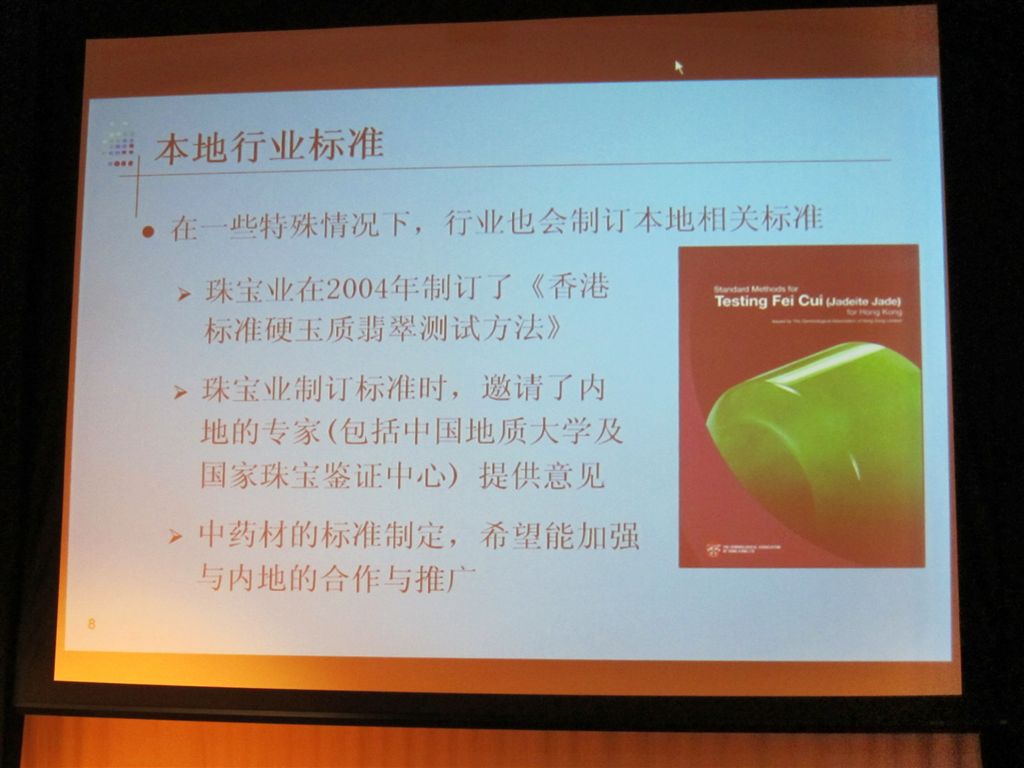
Moreover, some local industry standards were also developed such as Fei Cui testing.


Different product testing standards and management system standards were employed in testing and certification industry in Hong Kong.


Finally, Prof. Ching suggested establishing a platform for experts in Mainland and Hong Kong to share the information and resource. Moreover, it could enhance the cooperation between experts in both areas to establish new standards and then to promote worldwide, so as to increase the international reputation.

The second speaker was Ms.代 (國家工業和信息化部科技司代曉慧副巡視員) and her topic named “Overview of Industrial and Communication Standardization”(工業和通信業標準化概況).


She briefed the background of standardization in China, work process and how Hong Kong to participate the work of standardization in Mainland.


She introduced the legal requirement of the standardization in China.


It was separated into two types. One was national level and the other was industrial level. (One more type was not mentioned in here that was location level.) The standards were also separated into mandatory and recommendation.


Then she stated the five elements of working procedure of standardization included Technology Innovation, Testing and Certification, Application and Promotion, Industrialization and Intellectual Property.


The following diagram showed the main steps of standardization.


Finally, she suggested Hong Kong could join the standardization work in China through two organizations. They were China Electronics Standardization Association (中國電子工業標準化技術協會) and China Communications Standards Association (中國通信標準化協會).


Reference:
Innovation and Technology Commission:
http://www.itc.gov.hk/
Ministry of Industry and Information Technology of the PRC (國家工業和信息化部):
http://www.miit.gov.cn/
Hong Kong Council for Testing and Certification:
http://www.itc.gov.hk/en/hkctc/about.htm
China Electronics Standardization Association (中國電子工業標準化技術協會):
http://www.ccsa.org.cn/
China Communications Standards Association (中國通信標準化協會):
http://www.cesa.cn/

2010年11月4日星期四

通識及公共事務證書課程 單元一:今日香港 (Part 1)

I attended the General Education and Public Affairs Certificate Course on 11 Sep 2010. I would like to summarize the interesting things of this course for sharing. Since some topics were localized, some discussions were recorded in Chinese.

為了進一步豐富大眾對公共事務的認識、提升公民意識及社會參與,「新力量網絡」與香港教育學院合辦「通識及公共事務課程」,以推動實現「將學術知識普及到社會各界」的目標。


單元一:今日香港

第一課 (11 September 2010)普選之路:政制改革的回顧與展望
張炳良教授主講
http://qualityalchemist.blogspot.com/2010/09/lec-1.html

第二課 (18 September 2010)
閱讀殖民地: 透視港英政府的管治策略
王慧麟博士(Dr. Max Wong)主講.
http://qualityalchemist.blogspot.com/2010/09/lecture-2.html

第三課 (25 September 2010)
行政立法關係:演變與挑戰
方志恒先生(Mr. Brian Fong)主講
http://qualityalchemist.blogspot.com/2010/09/lecture-3.html

第四課 (2 October 2010)
香港政黨政治:過去、現在及未來
馬嶽博士主講.
http://qualityalchemist.blogspot.com/2010/10/lecture-4.html

第五課 (9 October 2010)
回歸後的香港經濟:危機、轉型與出路
羅祥國博士主講.
http://qualityalchemist.blogspot.com/2010/10/lecture-5.html

第六課 (23 October 2010)
發展教育樞紐:香港的機遇與挑戰
莫家豪教授主講.
http://qualityalchemist.blogspot.com/2010/11/lecture-6.html

第七課 (30 October 2010)
九七後的香港社會:階級衝突與社會矛盾
呂大樂教授主講
http://qualityalchemist.blogspot.com/2010/11/blog-post.html
Reference:
新力量網絡SynergyNet - 通識及公共事務證書課程
http://www.synergynet.org.hk/b5_m9_detail.php?id=1035
新力量網絡SynergyNet 的網誌 (Facebook): http://zh-hk.facebook.com/notes.php?id=250164765864

2010年11月3日星期三

九七後的香港社會:階級衝突與社會矛盾 (Lecture 7)

The lecture 7 of General Education and Public Affairs Certificate Course (通識及公共事務證書課程) was held on 30 October 2010. I would like to summarize using Chinese below.

第七課 (30 October 2010)
九七後的香港社會:階級衝突與社會矛盾
呂大樂教授主講 –香港大學社會科學學院副院長 / 新力量網絡主席)

首先, 呂教授說了時下一些對九七回歸後誤導的言論. 如下:
· 華資比英資更為剥削?
· 特區政府較殖民政府更偏幫資產階級?
· 以前港人對有權有勢的人沒有怨言?

呂教授解釋在一九九七年前, 英資有很多專利. 而英資財團分了山頭, 各不相干. 還有是他們不認識華人社區及不懂做華人生意. 所以在九七年前, 有錢人會用金錢影響政治, 但港人不太覺得影響自己生活. 但華資財團是家族生意, 多數是以地產發達, 之後伸展到各行各業及影響到港人的生活.


在八十年代中期, 香港社會經濟發展是一個對外開放的經濟體以出口導向的製造業為主. 之後是外向的服務業. 當時增加了就業及創業的機會.
下圖顯示出勞動人口按職業分佈. 高學歷有專業及行政, 經理; 低學歷有文員,銷售, 服務及生產等. 在81-91年間, 生產職業是負增長.

下圖是比較近期的勞動人口按職業分佈. 低學歷的工種很多都是負增長.


呂教授說香港作為全球城市也跟隨這類城市一樣, 發展出一個二元經濟結構. 如下:
· 高端的財經金融及商業服務
· 低端的勞動密集服務工種
香港不是沒有經濟增長, 也不是沒有社會流動的機會, 但流動的形態有所改變, 就是高學歷門檻.

下圖顯示專業及行政, 經理的變化. 金融及商業服務不斷上升.


下圖顯示各主要行業薪金指數. 金融業一枝獨秀.


在內地工作的香港居民數目持續增加.


在內地工作的香港居民的教育水平要求也不斷提升.


在內地工作的香港人之行業分佈有所改變. 製造業減少, 但貿易,酒店及飲食業增加.


而在內地工作的香港人的職業分佈發現, 專業需求增加, 但經理職業輕微減少.


表13及表14 是反映出中港經濟融合在公共機構及私人企業的不同看法. (I及II 是中產階級.)
對於公共或非營利機構的人來說, 大部分回答沒甚麼影響.


對於私人企業的人來說, 大部分回答有一些機會.


呂教授對二元經濟的總結如下:
中產階級之中, 有流動的 及在地的 , 這與學歷無關, 關鍵在於產業.
在一九九七年後, 對入息中位數的人衝擊最大, 而且收入最高的階層和中位的階層之間的距離越來越大.


呂大樂教授的書 “四代香港人”. 讀後很有共鳴.


呂教授在書上簽名留念.


Reference:
呂大樂- 维基百科,自由的百科全书

新力量網絡SynergyNet - 通識及公共事務證書課程
http://www.synergynet.org.hk/b5_m9_detail.php?id=1035
新力量網絡SynergyNet 的網誌 (Facebook): http://zh-hk.facebook.com/notes.php?id=250164765864

2010年11月2日星期二

發展教育樞紐:香港的機遇與挑戰 (Lecture 6)

The lecture 6 of General Education and Public Affairs Certificate Course (通識及公共事務證書課程) was held on 23 October 2010. The summary was shown as follow.

第六課 (23 October 2010)
發展教育樞紐:香港的機遇與挑戰
莫家豪教授主講.

Prof. Ka-Ho Mok (Associate Vice President, Dean & Chair Professor, Faculty of Arts & Sciences, The Hong Kong Institute of Education) is this lecture speaker and his topic was “The Rise of Transnational Higher Education in Asia: Challenges and Opportunities for Hong Kong”.


Prof. Mok introduced the recent trend for transnational higher education in Asia in the beginning. He mentioned the concept of higher education was changed from public goods to private goods (WTO). He also stated the importance of education was focused on Knowledge-based Society, Globalization and Technology.

Compared Hong Kong to London / New York, we are missing cultural facilities and cluster of higher education institute (for attracting international talent).

Prof. Mok explained an education hub had the following characteristics:
i) Concentration of leading educational institutions
ii) High-quality international faculty
iii) Large numbers of overseas students
iv) Cutting-edge frontline research
v) Excellent infrastructure
vi) Substantial revenues from student fees and other sources
vii) Able to contribute to society’s business environment

The following diagram shows the high increase of transnational higher education in East Asia and the Pacific.

The trend is increasing private sector in running higher education.

The expansion of the number of international students worldwide is a strong motivator for Asian countries to develop transnational higher education.


The comparison of the transnational higher education policy in Asia is shown as follows.

Significant new initiatives in East & Southeast Asia:
· Singapore → Global Schoolhouse
· Malaysia → Kuala Lumpur Education City
· Hong Kong → Regional Education Hub
· South Korea → Incheon Free Economic Zone

Significant new initiatives in the Middle East:
· United Arab Emirates → Dubai International Academic City
· Qatar → Qatar Education City
· Bahrain → Bahrain Higher Education City

The campuses of top universities in Asia


Case study of Singapore & Malaysia
Singapore is market-accelerationist state. (but Hong Kong is market-facilitator state)
Singapore aims for increasing national capability but Malaysia aims for economic and for local need first. Malaysia education positioning was middle class to attract Middle-East students (Because of religion convenience).

The limitations of Malaysia and Singapore in transnational higher education development are stated below.
Malaysia: An over-ambitious strategic planning?
Singapore: Overshadowed by issue of academic freedom and openness of society?

The current situation of Hong Kong is that it has very few overseas universities with branches in Hong Kong; moreover, 92% of students came from mainland China in 2007-2008.


The other places in Asia student are very few.


Then Prof. Mok mentioned the advantages and major obstacles for Hong Kong as an education hub.

Advantages:
· Highly-ranked universities
· Geographical position
· Excellent infrastructure
· Multicultural and multilingual society
· Strong commitment from the Central Government, and the Pearl River Delta provincial authorities.

Major Obstacles:
· Lack of visibility of Hong Kong international education
· No strategic positioning
· Need for government and universities to devise a viable business plan
· Lack of coordination across Hong Kong tertiary institutions
· Need for action
· Need for the educational infrastructure for international students

Finally, Prof. Mok added that we needed to use the closer relations between the mainland, Taiwan and Hong Kong for Great China multidiscipline study to attract international students.

Reference:
Profile Details of MOK, Ka Ho Joshua 莫家豪
https://oraas0.ied.edu.hk/rich/web/people_details.jsp?pid=112774

LinkWithin

Related Posts with Thumbnails