2016年1月22日星期五

HKSQ Student Project Competition 2016 - Briefing

The HKSQ Company Based Student Project Competition aims to offer an opportunity for students to work on an actual industrial case and propose resolution annually. This allows them to gain experience of resolving an industrial problem. The competition included three sessions. The first session is problems selection which problems are designed and would be explained by Sponsor Company. LSG Sky Chefs is the sponsor company in 2016. The second session is factory visit and the last session is presentation of suggested solutions by different universities students. The briefing session of the competition was performed on 22nd Jan 2016. Mr. Karson Chui (Hon. Treasurer & Former Chairman, HKSQ) led the briefing session.


Then LSG representatives Mr. Steward Leung (Senior Lean Analyst), Mr. Henry Mok (Senior Manager, Operations HK) and Mr. Eddy Yung (General Manager) introduced different topics for student teams.


There were three topics related to Process Improvement which were assigned for students to choose included Food Assembly, Dishwash Equipment Loading and Internal Delivery. After that students from different universities (included CityU, CUHK, HKU, HKUST and PolyU) had discussed to select which problem for competition. Following photos were taken during their discussion.


After 20 min discussion, we wrote down different teams’ 1st and 2nd priority choices. Since Problem 1 had 6 teams selected as 1st priority (more than 4 teams), it needed to random draw.


The final result was recorded on the whiteboard.

After the briefing session, the group photo was taken for memory.
Our exco member and guest, as well as, universities’ lecturers.
(Left: CP Chow (HKSQ), Victor Tee (HKU), Minda Chiang (HKSQ), Bill Chan (HKU), Dr. KS Chin (CityU), Karson Chui (HKSQ), Dr. Albert Tsang (PolyU), Eddy Yung (LSG), Steward Leung (LSG), Mr. Henry Mok (LSG), LSG representatives x2, I and Dr. Victor Lo (HKU).)


Reference:
HKSQ Company Based Student Project Competition - http://www.hksq.org/company_based_competition.htm
LSG Sky Chefs - http://www.lsgskychefs.com/


2016年1月20日星期三

HKQAA Seminar on Latest Trends of Sustainability Reporting and Independent Assurance

The Workshop entitled “Latest Trends of Sustainability Reporting and Independent Assurance” was organized by Hong Kong Quality Assurance Agency (HKQAA) on 20th Jan 2016. Sustainability reporting is the practice of measuring, disclosing, and being accountable to internal and external stakeholders for organizational performance towards the goal of sustainable development. The seminar aimed to share the latest trends and development in sustainability reporting and how independent assurance or verification could provide both report readers and the organizations’ management with increased confidence in the quality of sustainability performance data. Before the seminar, I took a photo with Ms. Connie Sham for memory.


Ms. Connie Sham (Head of Audit, Strategic Business, HKQAA) was the first guest speaker. In the beginning, Connie explained what was Sustainability Reporting that “the practice of measuring, disclosing and being accountable to internal and external stakeholders for organizational performance towards the goal of sustainable development.” Moreover, Sustainability Reporting supported continuous improvement in performance over time.


Then she quoted Peter Drucker’s statement that “What you can’t measure, you cannot manage. What you can’t manage, you cannot change.” Connie also explained Sustainability Reporting was Downstream which was come from what you performed and measured using PDCA of CSR on Upstream.


Connie said Sustainability reporting was a tool for Management and Governance, Extensive Communication / Branding / Reputation / Marketing, and External Stakeholder / Client Relations / Partnership Building, etc. A video named “Global Reporting Initiative: The 5 step process” was showed.


A GSR online tool named XBRL Report was introduced. It was a useful platform to consolidate all CSR data for reporting and increased the transparent of organization performance.


And then Connie reviewed the trends in Sustainability Reporting from N100 (100 largest companies) and G250 (World’s largest 250 companies listed in the Fortune Global 500 ranking) and found that both companies were increased to use sustainability reporting. Moreover, HKQAA reviewed the sustainability performance of 685 eligible listed companies for the Hang Seng Corporate Sustainability Index and found that the listed companies issued stand-alone or integrated sustainability / CSR reports were increased by 73% as compared to 2014.


One of sustainability reporting quality assessment methodology from KPMG was introduced. KPMG identified 7 criteria of industry best practice as follows:
1. Stakeholder engagement
2. Materiality
3. Risk, opportunity and strategy
4. Targets and indicators
5. Transparency and balance
6. Supplier and value chain
7. Corporate responsibility governance


After that Connie shared some good performance for outstanding companies and highlighted as follows.
- Provide detailed KPIs and measurable targets with tracking the achievement
- Identify and prioritize issues in terms of materiality and significance
- Provide self-assessment grid against the HKEx ESG reporting guide
Some improvement suggestions were also shared as below.
- Presenting a clear strategy of sustainability with measurable targets and its tracking performance
- Identifying all relevant stakeholders in the report
- Categorizing and prioritizing various issues based on significance

The second speaker was Mr. WK Wong (Manager (Carbon and Energy), HKQAA) and he introduced the topic of Drivers and Trends for Independent Assurance. Firstly, he explained what was Assurance using International Federation of Accountants (IFAC) definition that an assurance engagement as one “in which a practitioner expresses a conclusion designed to enhance the degree of confidence of the intended users other than the responsible party about the outcome of the evaluation or measurement of a subject matter against criteria.”


Then he quoted GRI to explain “Why” need an assurance. There were five points as follows:
1. Increase recognition, trust and credibility
2. Reduced risk and increased value
3. Improved Board and CEO level engagement
4. Strengthened internal reporting and management systems
5. Improved stakeholder communication
The trends in assurance of N100 and G250 were increasing.


Mr. Wong introduced Assurance Process which separated into four parts named Assurance Appetite, Assurance Methodology, Assurance Scope and Assurance Providers. Moreover, he also briefed the Assurance Checklist in three stages.
1. Planning stage:
    - Laws and Standard
    - Internal/External Audience
    - Scope / Level of Assurance
    - Added-value
    - Cost, etc.
2. Execution stage:
    - Engagement Plan
    - Documentation and Data
    - Visits to Key Operational Sites
3. Reporting and feedback stage:
    - Process of Assurance Report or Statement
    - Verification Report
    - Feedback


After that Mr. Wong briefed the different between Reasonable Assurance Engagement (+ve form of expression) and Limited Assurance Engagement (-ve form of expression).


Finally, Mr. Wong introduced HKQAA Verification Process below.
1. Acquiring Basic Information / Off / on-site Review
2. Risk Assessment
3. Establishment of Verification Plan
4. Verification Activity
5. Issue Verification Report, Statement and Opinion
6. QA Review
7. Submission of Verification Report

At the end, he reviewed the main changes HKEx ESG Reporting Guide (See reference). Four report principles was mentioned that were Materiality, Quantitative, Balance and Consistency.

Reference:HKQAA - http://www.hkqaa.org
20150622: HKQAA CSR Strategic Planning and Reporting Workshop - http://qualityalchemist.blogspot.hk/2015/06/hkqaa-csr-strategic-planning-and.html
ISO - International Organization for Standardization's Guidance on Social Responsibility (ISO 26000:2010) - http://www.iso.org/iso/home/standards/iso26000.htm
GRI - Global Reporting Initiative's G4 Sustainability Reporting Guidelines - https://www.globalreporting.org/Pages/default.aspx
ESG Guide - Environmental, Social and Governance Reporting Guide - https://www.hkex.com.hk/eng/rulesreg/listrules/mbrules/documents/appendix_27.pdf
Consultation Conclusions – Review of the Environmental, Social and Governance Reporting Guide - http://www.hkex.com.hk/eng/newsconsul/mktconsul/Documents/cp201507.pdf

2016年1月18日星期一

HKIE Seminar on Risk Management for ISO 9001:2015

The Hong Kong Institution of Engineers (HKIE) –Materials Division organized the seminar named “Risk Management for ISO 9001:2015” on 18th Jan 2016. ISO 9001:2015 was issued on 15 Sep 2015 and it is a revolutionary change of the 2008 version which focuses on the “Risk Management” of organizations. Ir. CK Cheung (Lead Assessor of the USA’s International Accreditation Service (IAS)” was our guest speaker and he would like to share his experience for achieving the new standards implementation in the coming three years.


In the beginning, Ir. CK Cheung said the most important of quality system was “Integrity”. Then he introduced the new version of ISO 9001:2015 in which emphasized “Risk” & “Opportunity”. He also quoted Albert Einstein statement that “If you can’t explain it simply, you don’t understand it well enough.” So he try to explain risk management in the simply way.


Then Ir. CK Cheung briefed the ISO 31000:2009 – Risk Management as reference to fulfill ISO 9001:2015 new requirements. The most fundamental of Risk Management included “Communication and Consultation (5.2)”, “Establishing the context (5.3)” and “Risk Assessment (5.4)” with “Risk Identification (5.4.2)”, “Risk Analysis (5.4.3)” and “Risk Evaluation (5.4.4)”; and “Risk Treatment (5.5.)”, as well as, “Monitoring and Review (5.6)”.


Ir. CK Cheung also mentioned the treatment of risk in the project if identified. Those Risk could be “Avoid”, “Mitigate”, “Transfer” and “Accept”.


Ir. CK Cheung discussed that there would be no Quality Manual but just had Risk Management Manual in which identified all processes of the organization. No longer single manual for all companies existed. Risk associated with company was depended on its scale.


He summarized the quality development from QC to QA to QM and ultimately to Quality Risk Management.


Then Ir. CK Cheung explained how to define risk management through Risk Assessment plus Risk Control and then through Risk Management Planning, Risk Resolution and Monitoring.


He also introduced four types of Business Risk included Operation Risk, Financial Risk, Hazard Risk and Strategic Risk in the following diagram.


Finally, he summarized several requirements related to “Risk” in the ISO 9001:2015 as follows:
- Determination of the processes taking under consideration risks & opportunity (4.4f)
- Risks & opportunity that can affect conformity of products & services and the ability to enhance customer satisfaction should be determined & addressed (5.1.2b)
- When planning for the QMS, the organization shall determine the risks & opportunity (6.1.1)
- The organization shall plan actions to address risks & opportunity (6.1.2)
- Determining type & extent of control of external provision (8.4.2) (It doesn’t use the word “risk”, but meaning is that risk is present.)
- In determining the extent of post-delivery activities the organization shall consider the risks associated with the products & services (8.5.5a)
- The management review shall be planned and carried out taking into consideration the effectiveness of actions taken to address risks & opportunities (9.3.1d)

Ir. CK Cheung used a project management & construction of a High Speed Railway Train as example to explain different issues such as political resistance, financial implication, environmental impact, labor & worker supply, etc. Lastly, he used the Risk Management Process diagram as a conclusion.


After the talk, HKSQ members took a photo with the speaker for memory.
(Left: I, Ir. CK Cheung (Director, WCC Engineering Ltd.) and Mr. Thomas Tsang (Manager, Leading Edge Construction Materials Testing Co., Ltd.))


Reference:
HKIE-Material Division – http://mt.hkie.org.hk/


2016年1月15日星期五

HKETA Annual Dinner 2016

Minda (Hon. Secretary of HKSQ) and I (Former Chairman of HKSQ) were honor to be invited by Dr. Aaron Tong (Former Chairman of HKSQ and Deputy Chairman of HKETA) to attend Hong Kong Electronics & Technologies Association (HKETA) Annual Dinner on 15 Jan 2016. We also met Prof. Fugee Tsung (Exco. member, HKSQ) who is Honorary Member of HKETA. We took a group photo for memory. (HKSQ team: Prof. Fugee Tsung, Dr. Aaron Tong, I and Minda Chiang)


In the beginning, Ir. Victor Ng (Chairman of HKETA) gave a welcome speech.


The keynote speech was Ms. Pamela Lam (Assistant Commissioner for Innovation and Technology Commission).


Then all HKETA committee members and VIPs toasted to all guests.


Mr. Kenneth So (Honorary Adviser of HKETA) gave a talk entitled "Mencius Revisited – On Corporate Governance" (孟子重探 – 論企業管治之道). Firstly, he quoted Peter Drucker statement that “… top management is a function and a responsibility rather than a rank or a business is to create a customer.” and also quoted Milton Fredman that “The social responsibility of business is to increase its profits.”


Then Mr. So discussed Jeremy Bentham’s Utilitarianism that “The greatest happiness for the greatest number of people” and used Immanuel Kant thinking “Act only on that maxim whereby you can at the same time will that it should become a universal law” to explain the important of ethic in business.
The following companies were bankrupted because of ethical problems.
i) Barings Bank (1762-1995)
ii) Enron Corporation (1932 – 2002)
iii) WorldCom (1983 – 2008)
iv) Lehman Brothers (1850 – 2008)


Therefore, Mr. So suggested using Mencius Seven Articles <<孟子七篇>> on Corporate Governance. These seven articles explained the code of conduct, action rules, argument and logical thinking, as well as, metaphor.


Mr. So explained the way of Corporate Governance in four dimensions including Vision, Mission, Performance and Entrepreneur Paradigm. The Chinese explanations were summarized as following diagrams.


Finally, Mr. So concluded that Confucianism Entrepreneur was not Businessman plus Scholar. They should have Confucianism plus Marketing Economic regulation and Entrepreneur Spirit, indicating that they would be Public Intellectuals.

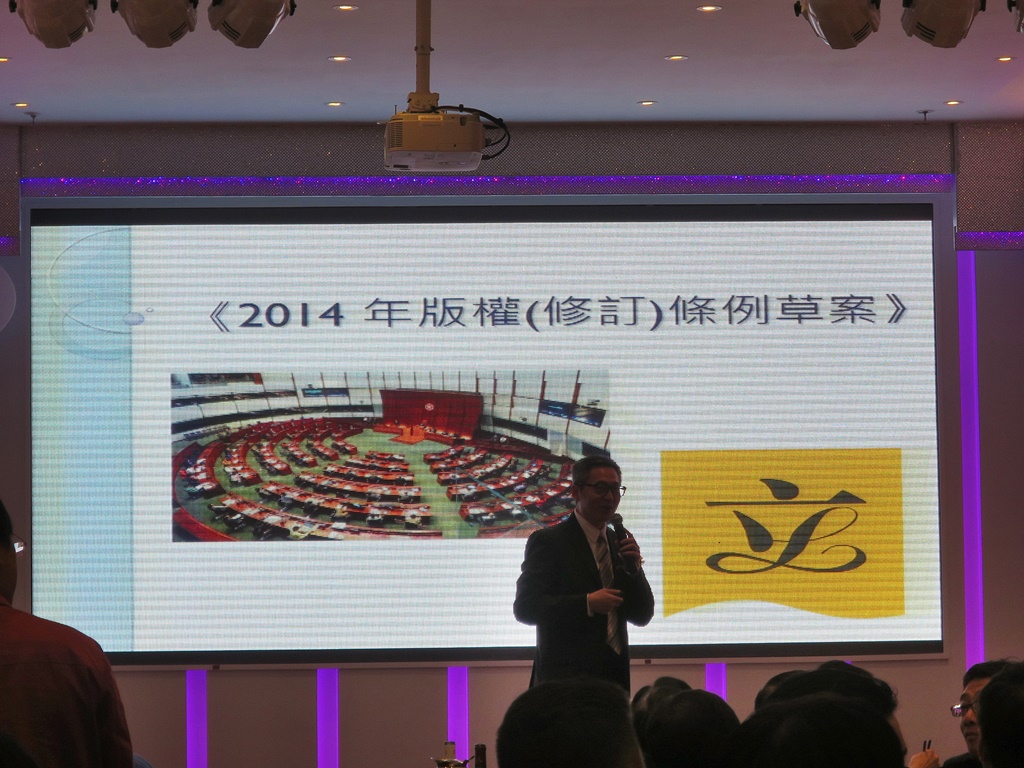
Mr. Ricardo Lee was the second speaker who discussed and explained the Copyright (Amendment) Bill 2014 with us.


Firstly, Mr. Lee explained some background of Copyright (Amendment) Bill 2014. The regulation suggested five areas as follows.


Then he showed some issues which public were concerned.


Mr. Lee discussed the need of update the Copyright (Amendment) Bill compared with other countries such as EU, Austria, UK, Singapore, New Zealand and Canada, etc. Especially, USA could consider to add HK to be observation list.

Finally, Mr. Lee explained the different of Fair Dealing, Fair Use and User Generated Content (UGC) to us. Lastly, he said it was a time to make decision how to balance the freedom of speech and copyright.


Photo with HKSQ friends (Left: Dr. Pat Cheung (TQM), Minda Chiang, I and Dr. Aaron Tong)


Reference:
HKETA - http://www.hketa.org.hk/
HKETA Annual Gathering 2013 - http://qualityalchemist.blogspot.hk/2013/01/hketa-annual-gathering.html


2016年1月13日星期三

HKSTP TecONE Seminar on Company Structure from Accounting Perspective

The TecONE seminar named “Group Structure and Planning for HK Companies from Accounting Perspective” was organized by Hong Kong Science & Technology Parks Corporation (HKSTP) on 13th Jan 2016. The right organizational structure often boosts business strength and protects company against risk. This seminar aimed to share how tax benefits and incentives vary in different types of business entities, which therefore relate to tax efficiency and cost reduction with an appropriate company structure.

The guest speaker was Dr. CHENG Faat Ting Gary (Managing Director, Gary Cheng CPA Limited) and his company also located in Science Park. His topics included different types of Business Entities in Hong Kong, choosing criteria, Tax Benefits and Incentives, Risk and Liabilities, as well as, Group Structure.


In the beginning, Dr. Gary Cheng briefed four types of business entities in Hong Kong that were Sole Proprietorship, Partnership, Limited Liability Company and Foreign Oversea Company (such as BVI, Cayman Island, Samoa, etc.)


Then Dr. Gary Cheng explained some factors for choosing certain business entity included size, scope, nature and purpose of your business, business liability, capital requirement, etc. The following table summarized the choosing factors of four types of business entities. 


Some tax benefit and incentive cases for different business entities were discussed such as offshore claims for trading profits, manufacturing profits and services incomes.


After that Dr. Cheng introduced some organization structure. For Start Up stage, he suggested to use simple structure in the following diagram, so as to protect your house for loaning.


Dr. Cheng mentioned different risks and liabilities to us. Nature of Risk included Credit Risk, Liquidity Risk and Market Risk (e.g. Interest Rate Risk, Exchange Rate Risk); and Liabilities included Unlimited, Limited, Joint and Several. Then he introduced an organization chart that separated different company by function in group (e.g. Trading, Manufacturing, HR Function, IP and Housing).


For Large Structure of Globalized Corporation, he suggested to separate by business unit under different regions that could maintain the feasibility.


Lastly, Dr. Cheng suggested us to review our current operation; gather documentary evidence to support what and how your claiming; and restructure your current operations to enhance tax efficiency.

Reference:
HKSTP - http://www.hkstp.org
TecONE - http://tecone.hkstp.org/t1_web/

LinkWithin

Related Posts with Thumbnails