2014年5月25日星期日

Visit to Crosby Management Institute (China), Beijing

Hong Kong Society for Quality (HKSQ) executive committee & member visited Crosby Management Institute (China) on 23th May 2014 before the Innovation of the China Quality - 2014 Zero Defect Management International Summit (中國品質的創新峰會—零缺陷國際峰會) in Beijing on 24th May 2014.


Their staff wrote a notice board to welcome us.


Dr. KS Chin (Former Chairman, HKSQ), Mr. Simon Tong (Member, HKSQ) and I (Former Chairman, HKSQ) met Mr. Freeman Young (楊鋼) (Founder & CEO, Crosby Management Institute (China)) and shared experience each other.


We observed Crosby’s statement in the meeting room “Do right thing right the first time”. Dr. KS Chin added “Doing right thing right at the right time and right place”. Simon introduced his systematic innovation business to Freeman. KS briefed the Total Quality Engineer degree course and I encouraged future cooperation to promote quality.


After our meeting, I represented HKSQ to present flag to Mr. Freeman Young and took a photo in front of the Institute.


Mr. Freeman Young mentioned his publication.


And he gave his new book to us for gift.


Then we had dinner with Freeman’s guests together.

(Left: Mr. Simon Tong, I, Dr. KS Chin, Mr. Freeman Young, Dr. MA ZhiHong (馬智宏) (Party Secretary) and Dr. YAO Zhiqing (姚致清), and Dr. MA’s colleague.)


We would attend the Innovation of the China Quality - 2014 Zero Defect Management International Summit (中國品質的創新峰會—零缺陷國際峰會) on 24th May 2014.  Mr. Freeman Young and Mrs. Young had lunch with us in Hong Kong at the same day one year ago.

Reference:
HKSQ Lunch with Mr. Freeman Young (Father of Zero Defect in China on 24th May 2014 - http://qualityalchemist.blogspot.hk/2013/05/hksq-lunch-with-mr-freeman-young-father.html
Crosby Management Institute (China) - http://www.zdchina.com.cn/


2014年5月22日星期四

ISSC Six Sigma Networking Night 2014

Hong Kong Society for Quality (HKSQ) was honor to be invited by Dr. Rita Wan to attend International Six Sigma Council (ISSC) Networking Dinner again on 22 May 2014. We have four members attended the dinner and they were Mr. Peter Fung (Vice-Chairman, HKSQ), Dr. Aaron Tong (Former Chairman, HKSQ), Mr. Ivan Ng (Member, HKSQ) and I (Former Chairman, HKSQ).

Before the event, We took a photo with Dr. Rita Wan (Chairman, ISSC) (Middle) and Dr. CO Chan (President, ISSC) (Right 2nd)


We also took a photo with Dr. Mickey Li (Chairman, Shenzhen Association for Quality (SZQA)) (Left 2nd) and Dr. Jason Kong (Vice-Chairman/Marketing, ISSC) (Right 1st).


In the beginning, Dr. Rita Wan (Chairman, ISSC) introduced the ISSC and reviewed the activities in 2013. The ISSC is a non-profit making organization of quality practitioners and subject matter experts that saw the need for standardization in the Six Sigma field.


ISSC Building Blocks which contained six pillars to support the quality excellence were introduced. Then Dr. Wan briefed the structure of ISSC that was governed by the Examination Board & the Executive Committee. There were more than 900 Six Sigma Green & Black Belt professional certified by ISSC up to now. Then Dr. Wan introduced the coming ISSC seminar named “Implementation of Lean Six Sigma in a Global Logistics Company” on 14 Aug 2014.


Mr. Simon CHENG (Senior Manager, Training & Development, HA) was our guest speaker and his topic named “LEAN Journey in Hospital Authority”. Before start, Mr. Cheng asked if you tired, please indicated how tired in number of fingers. One finger meant very tired and five fingers meant full of energy. Most of us raised four or five fingers.


In the beginning, Mr. Cheng introduced the background of Hospital Authority (HA). They had 42 hospitals, 48 Specialist Out-Patient Clinics and 73 General Out-Patient Clinics with 70,000 staffs. Then he briefed 3 level healthcare structures in Hong Kong. Primary Care was clinic consultation. Secondary Care needed to stay in hospital and Tertiary Care needed to transfer to specialist. HA’s vision, mission and values were mentioned and shown in the following diagram.


“Why HA needed LEAN?” asked by Mr. Cheng. Then he explained some problems but not limited to the follows they faced as “Long waiting time”, “Overcrowded wards”, “Duplication of work”, “Safety issues” and “Lack of coordinated patient care”. So they employed LEAN Concepts and the key milestone of HA was briefed as following diagram. Moreover, he also explain how they from LEAN to WISER. WISER stated for We Innovate Services Excel Regularly.


Finally, Mr. Cheng shared some success cases below:
Improving the Waiting Time in Specialist Outpatient Clinic (SOPC) from 32 min to 21 min
Shortening Patient Discharge Time at Post-Anaesthetic Care Unit from 42 min to 32 min
Improving the Discharge Medication Process from 42 min to 32 min
Endoscopy Patients Staying in Hospital 7hrs to 3.5hrs
Reducing Procurement Lead Time by Introducing Express Lane upto 80%

At the end, Mr. Cheng concluded LEAN as “Learning & Sharing”, “Engage Staff”, “Additional resources” and “Not a fad”.


After the talk all guests took a group photo.


Ceremony photo of ISSC Six Sigma Black Belt awardees


Then Dr. Mickey Li (Chairman of SZAQ) gave a guest speech. He introduced the first National Six Sigma Award in China that was coordinated by China Association of Quality (CAQ).


Dr. Rita Wan presented appreciated certificate to Minitab representation Ms. Iza Ng (Business Development Manager – Techmax HK).


Networking time and we shared our quality experience.


At the end, Dr. Rita Wan (Chairman, ISSC) gave a closing remark.


Group photo of all participants (including ISSC, HKSQ, IETHK, SSS, etc.)


Reference:
International Six Sigma Council - http://www.isixsigmacouncil.org/


2014年5月17日星期六

CityU Spring Research Conference on Systems Engineering and Management Science 2014

The 2nd Spring Research Conference on Systems Engineering and Management Science 2014 (SRC-SEMS'14) organized by Department of System Engineering and Engineering Management (SEEM) and Department of Management Science, City University of Hong Kong from 16 - 17 May 2014 in City University of Hong Kong Shenzhen Research Institute (CityUSRI), Shenzhen Hi-tech Industrial Park, Nanshan District, Shenzhen, China. The conference aimed to provide a research platform for academics and researchers, particularly young faculty and graduate students, in Greater China region and neighboring areas to share and exchange experience and research findings in various disciplines of Systems Engineering and Management Science


HKSQ members supported the activities.
(Right: Dr. Zoie Wong, Dr. KS Chin and I)


My two students who had studied “Quality Management for Laboratory Operation” were presented their final year projects in the conference. Dr. Ken Yau was their supervisor and He is HKSQ exco member.
(Left: Ms. P. Sathanmuang, Dr. Ken Yau, I and Ms. K.P. Chun)


In the beginning, Prof. Kwok Tsui (Head and Chair Professor, SEEM Dept., CityU) gave a welcome speech and presented a hot topic “Big Data Analytics”.


Prof. Tsui introduced the evolution of Big Data in Statistic and Computing Science from Data Analysis to Massive Data Sets to Data Mining and eventually Big Data. In 2004, MIT’s Technology Review predicted “Data mining is one of top ten emerging technology!” Data mining is extraction of meaningful/useful/interesting patterns form a large volum of data sources (signal, image, time series, image, transaction, text, web, etc.) Now, it is even bigger and named “Big Data”.


Finally, Prof. Tsui briefed some Big Data Project in US and in Hong Kong. In CityU, Center for Systems Informatics Engineering (CSIE) established and the following topics were under research included “Prognostics & Systems Health Management (PHM)”, “Public Health Informatics and Infectious Disease” and “Healthcare Big Data Analytics”.

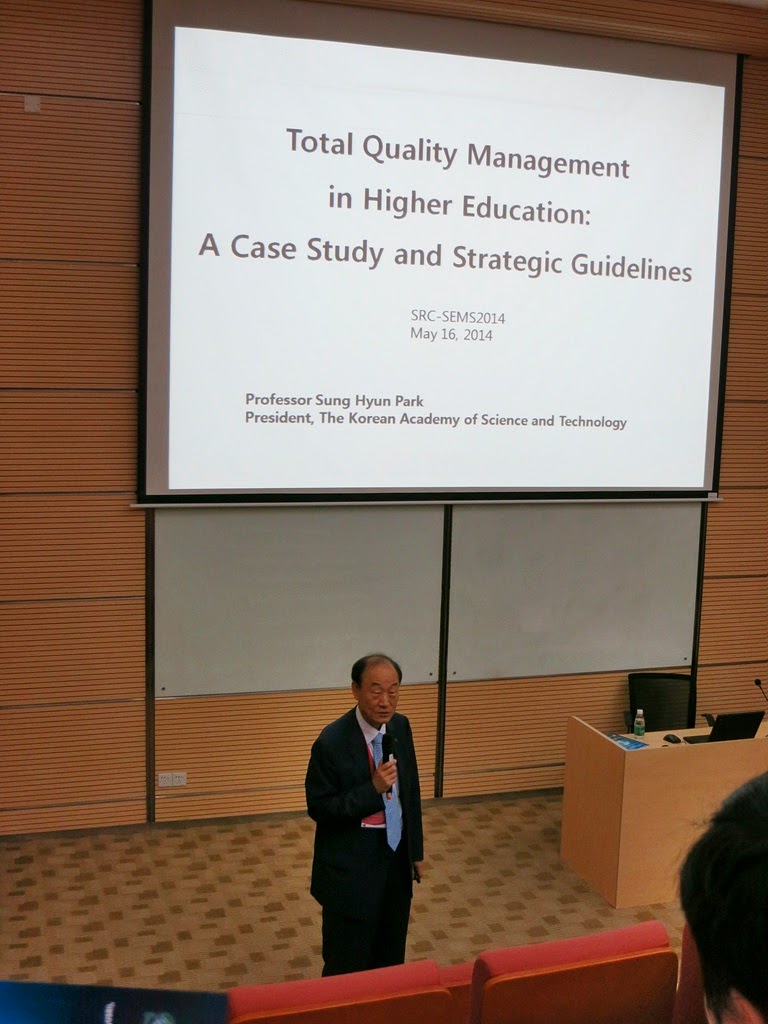
Prof. Sung Hyun Park (President, Korean Academy of Science and Technology, and Chair Professor of Department of Management of Technology, Konkuk University) was the first keynote speaker and his topic entitled “Total Quality Management in Higher Education: A Case Study and Strategic Guidelines”.


Firstly, Prof. Park mentioned how Samsung achieved a miracle. It was because they emphasized three things included “Quality First”, “Change (Innovation) for Survival” and “Boundless Research”. Then he discussed the Samsung quality management evolution and those experiences could apply to university.


Then Prof. Park explained quality in university that should be evaluation using four outcomes of students and research results factors below.
- Useful: “Fitness for its intended purpose”, “attractive quality “ and “perform its designed job?”
- Responsive: “Adapt to desires of industry and society?”
- Available: “Accessible to demand”
- Reliable: “Outcome operate consistently”
The following diagram showed the competitive advantage factor on student value.


After that Prof. Park raised Innovative University Management that included five elements.
1. Seeking customer value
2. The best use of modern technology
3. Responding to changes
4. Intellectual resource management (People, Technology & Knowledge)
5. Social existence
He also mentioned Malcolm Baldridge Education Criteria (2013-2014) and TQM implementation in Higher Education in Korea in which a case study of Sogang University in Korea was discussed.


Before the end of speech, Prof. Park told us “The Story of The Eagle” to explain how painful of change. He said “Many time, in order to survive we have to start a change process. We sometimes need to get rid of old memories, habits and other past traditions. Only freed from past burdens, we can take advantage of the present.”

Donation Ceremony - “5 Sets of 55” Quad Full High Definition Display Module” from Shenzhen China Star Optoelectronics Technology Co., Ltd.


The second keynote speaker was Prof. Shouyang Wang (Chair Professor of Academy of Mathematics and Systems Science of Chinese Academy of Sciences) and his presentation topic named “TEI@I Methodology and Applications in Economic Forecasting and Analysis”.


Prof. Wang mentioned how importance of oil price forecasting and briefed TET@I advantage. The name “TEI@I” is based on “Text/event mining” + “Econometric/mathematical modeling” + “Intelligence (Intelligent algorithms)” @ “Integration” where using @ to replace “+” aimed to emphasize the functional of integrations.

Empirical Mode Decomposition (EMD) was able to reduce any data from non-stationary and nonlinear process into simple independent intrinsic mode functions. The proposed framework from oil price tiem series data employed EMD transformation of data to Intrinsic Mode Functions (IMFs) and Residue and then using difference models for prediction.


Finally, Prof. Wang concluded that this methodology had been successfully applied to solve some other hard decision problems, such as financial risk management, monitoring of national economy, regional economic planning, etc.

The last keynote speaker was Prof. Alain Bensoussan (Chair Professor of Risk and Decision Analysis, SEEM Dept., CityU) and his presentation title was “Risk Management: An Overview”. Prof. Bensoussan discussed the Fukushima case and reviewed some of the key principles of risk management.


Prof. Bensoussan said risk management did not appear in TEPCO organization chart from the National Diet of Japan Independent Investigation Commission. The remarks about this official report showed a complete lack of competency in terms of Risk Management.


Finally, three pillars of risk management were proposed. They were “Quantitative Techniques”, “Organizational Aspects” and “Behavioral Aspects”.


We had lunch in the hall.


I took a photo with Dr. Yang Liu (University Lecturer, D.Sc. (Tech.) Industrial Management, University of VAASA (Finland)) for memory.


My presentation was in Day 2 morning section and the topic named “Preliminary study the Organization Innovation and TRIZ Implementation Model”. I briefed five success factors of Organization Innovation included System Innovation, Operational Innovation, Service Innovation, Product Innovation and Process Innovation. Then I mentioned the Interactive Knowledge Improvement Circle. Lastly, I discussed TRIZ implementation roadmap in Technology Support Centre of Hong Kong Science and Technology Parks Corporation.


After presentation, I received the certificate from Dr. Richard Fung.


Dr. KS Chin’s student presentations were showed as follows.

In Healthcare session, Ms. Meiyan Lin who was PhD student under Dr. KS Chin and her presentation topic named "Operations Improvement in Home Health Care: The Patient Assignment Problem”.


Ms. P. Sathanmuang presentation topic named “Evaluation of Total Quality Management in Hong Kong Home Care Services”.


Ms. K.P. Chun presentation entitled “Study of the User Requirement of DayCare Service”.


Reference:
HKSQ - http://www.hksq.org/index.asp
SEEM, CityU - http://www.cityu.edu.hk/seem/
SRC-SEMS'14 - http://www.cityu.edu.hk/seem/srcsems2014/
SRC-SEMS’13 summary - http://qualityalchemist.blogspot.hk/2013/05/cityu-spring-research-conference-on.html


2014年5月13日星期二

CityU 3rd Distinguished Alumni Award Reception cum SEEM Industrial Forum

The CityU 3rd Distinguished Alumni Award Reception cum SEEM Industrial Forum was organized by Department of Systems Engineering and Engineering Management (SEEM), City University of Hong Kong (CityU) on 12 May 2014. In 2009 when CityU celebrated its Silver Jubilee, the Distinguished Alumni Award (the Award) was launched to recognise and publicly honour outstanding alumni who had demonstrated remarkable personal achievements and significant contributions to their profession/career, the University and the community. The Award is held biennially and the 3rd Award is scheduled for 2013.

In the beginning, Prof. Robert LI (Associate Dean, College of Science and Engineering) gave a welcoming speech and appreciated the awardees contribution to CityU. (Prof. Li taught me in Polymer Science when I studied in Applied Physic in 1992.)


Prof. TSUI Kwok Leung (Head, SEEM Dept., CityU) gave an opening speech and he also appreciated awardees’ contribution and collaboration between industry and university.


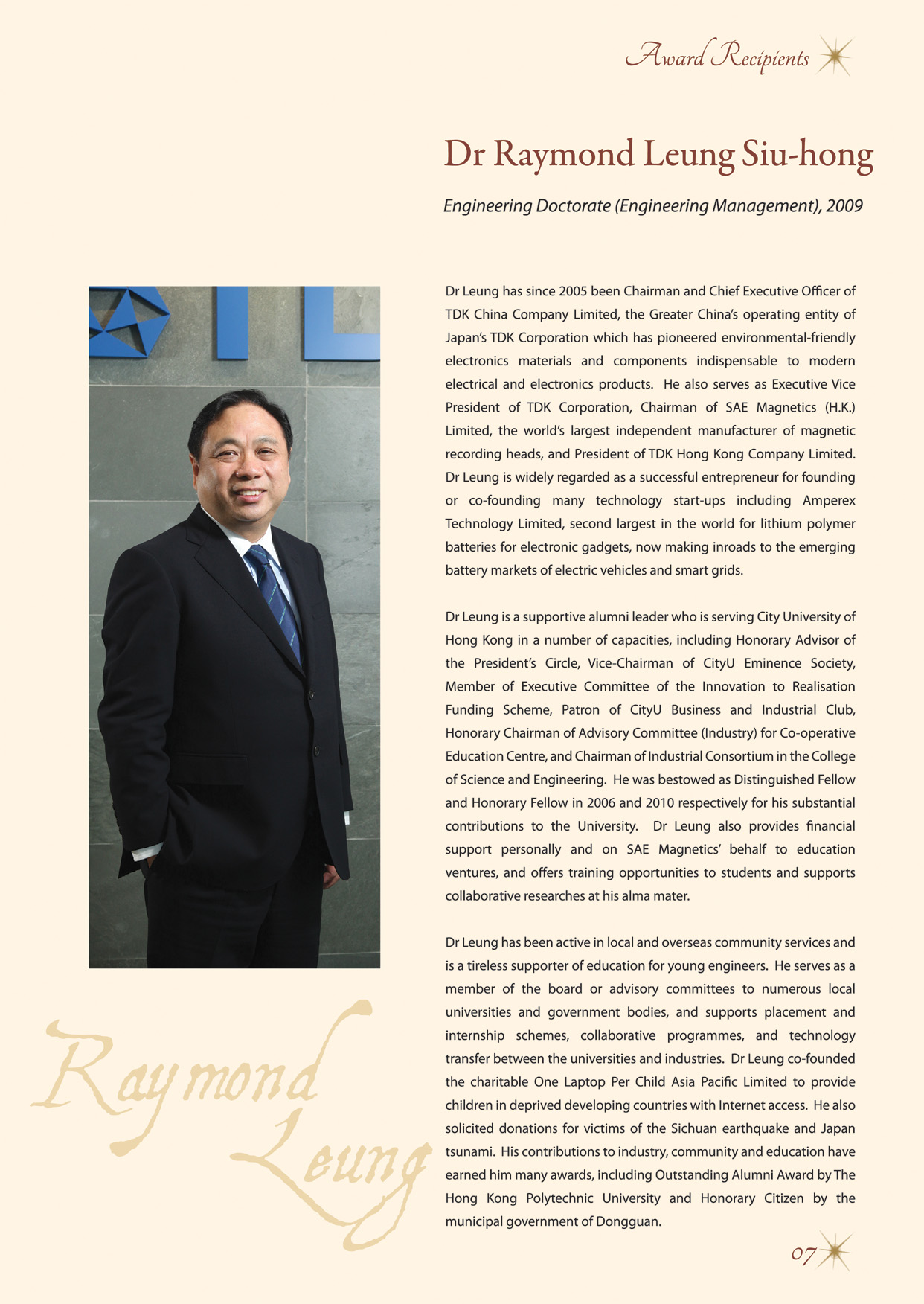
Then Dr. CHIN KS (Assistant Head, SEEM Dept., CityU) introduced the profile of Dr. Peter Ho Ka-nam the 3rd Distinguished Alumni Awardee in CityU. Dr. Peter Ho is Managing Director, Techworld Industries Ltd. He received MSc Engineering Management and EngD (Engineering Management) in 2007 and 2012, respectively. He serves as Founding Chairman of CityU Eminence Society, Director of CityU Research Limtied, Patron of CityU Business and Industrial Club (CUBIC). In order to recognize Dr. Ho’s staunch support to CityU, Lecture Theatre Ten and Twelve of CityU were named after him and his parents to “Peter Ho Lecture Theatre” and “Mr & Mrs Ho Chun Hung Lecture Theatre” respectively. (The 2nd Distinguished Alumni Awardee in SEEM Dept was Dr. Raymond Leung Siu-hong that Dr. CHIN KS had also mentioned but he was not free to attend the event tonight.) (Details in reference)


Then Dr. Peter HO (CityU Distinguished Alumni) gave a speech to us. Dr. Ho briefed his business since 1960 and he said the venue was very good because the background was Lion Rock. (It implied the Hong Kong Lion Rock spirit.) Then Dr. Ho shared that New Innovation Product was key success of company. The company failed because of lacking qualified engineer. He observed many students focused on Finance but not Engineering course. He added the new product development required talents who had knowledge mixture of mechanical design, electronic, software, and outlook design, etc.


It was honor that Dr. LO Wai Kwok (Chairman, SEEM Departmental Advisory Committee) to be our guest for Industrial Sharing on the topic entitled “How Do Universities, Private Industry and Government Work Together to Promote Hong Kong’s Competitive Edge?”.


In the beginning, Dr. Lo asked “what is Hong Kong’s competitive edge?” “5I’s” are Competitive Advantages included “Integration”, “Information”, “Integrity”, “International” and “Innovation”. Then he mentioned Financial Secretary announced the Budget 2014-15 with competitiveness as its main theme. The solution was to diversify Hong Kong economic development. He quoted the working group on Long-Term Fiscal Planning and analyzed the economic growth which expected to settle at a slower pace to 2.5% after 2025. Moreover, labour force would decline after 2018 (Peak Labour Force up to 3713k) and stabilized in the 2030s (Labour Force down to 3522k).


In order to have health economic, three elements should be in balance and they were “Economic Growth”, “Revenue” and “Expenditure”. That is to “Keep the expenditure within the limits of revenue…strive to achieve a fiscal balance, avoid deficits and keep the budget commensurate with the growth rate of its gross domestic product”. The following diagram showed economic growth bound to go lower as the economy became more mature except Singapore. It might because Singapore invested capital for stimulating economic growth and importing labors.


The CE announced the re-initiation of the ITB in 2014 Policy Address that “Innovation and Technology are drivers for economic growth and the key to enhance competitiveness of our industries.” Dr. Lo stated the proportion of local R&D investment only about 0.7% of the GDP which much lower than 3.7% in Korea and 2.3% in Singapore. Several suggestions were raised by Dr. Lo to the Government which was shown in the following diagram.


Finally, Dr. Lo hoped an encouragement for cooperation among the Government, industry, academia and research sectors included:
- Consolidate the pillar industries
- Foster the emerging industries
- Reinvigorate traditional industries
- Our economy can develop in the direction of diversification and high value-added
Before the end, Dr. Lo answered who was the winner of the 21st Century. They were Engineer with Business Sense and Businessmen with Engineering Sense.

The second speaker for Industrial Sharing was Prof. Alain BENSOUSSAN (Chair Professor, SEEM Dept., CityU). He explained Innovation which was doing things different rather than only doing things better. Then he compared Hong Kong and Switzerland. Both had similar population, similar economy in financial and tourism industry, connected with mainland China or Europe, etc. At the end, Prof. Bensoussan said “Innovation is anywhere”.


Presentation of Souvenirs
Dr. Lo presented a souvenir to Dr. Peter Ho.


Dr. Lo presented a souvenir to Dr. Raymond Leung (Since Dr. Leung is not available, his colleagues Dr. CY Chau for him received the souvenir.)


Dr. Tsui presented a souvenir to our guest speaker Dr. Lo.


Group photo of awardee and speakers


Group photo of all participants


Before SEEM Industrial Forum, we had visited the new laboratory in SEEM in Academic Building 3. The following photos were shown different laboratories.
Active Infrared Thermography for Detecting Sub-Surface Cracks


Health System Engineering and Health Informatics


Tracking and Discrete Dual Task Performance with Different Auditory Spatial Stimulus-Response Mappings


Reference:
SEEM Dept., CityU - http://www.cityu.edu.hk/seem/
CityU Eminence Society - http://www.cityues.org/
CityU EngD Society - http://www.engd.org/home.aspx
Dr. Peter Ho Ka-nam profile - http://www.cityu.edu.hk/aro/daa/profile_peter.pdf
Dr. Raymond Leung Siu-hong profile - http://www.cityu.edu.hk/aro/2011daa/profile3.jpg


LinkWithin

Related Posts with Thumbnails