2012年5月25日星期五

Visit to Hsinchu Science Park (新竹科學園區) and TSMC (台積電)

I appreciated Hsinchu Science Park (HSP) administration arranged a meeting and Prof. Yang (Professor, Department of Industrial and Systems Engineering, Chung Yuan Christian University) arranged a visit to TSMC on 24 May 2012.

We took a high speed train from Taipei station to Hsinchu station. It had free shuttle bus from Hsinchu station to Science Park Administration. I took a photo in from of the administration building.


In the beginning, Ms. Grace Chen (Investment Services Division, Hsinchu Science Park Adminstration) gave us an introduction of Hsinchu Science Park).


Ms. Chen briefed the history of Hsinchu Science Park It was established in 1980, aiming at cultivating domestic high-tech industries and talents. Development of the Hsinchu Science Park marked as historic witnesses of Taiwan's industry development phases from nothing to something.

Past HSP


Present HSP


Then Ms. Chen briefed three aims of HSP below:
i) To attract high-tech manufacturer investment,
ii) Tointroduce high-tech talent,
iii) To enhance high-tech industries development in Taiwan;
and introduced the distribution of science parks in Taiwan.


HSP contributed 4.5% GDP and had about 150,000 people working in here. The HSP land was rental only. Private company could build their own factory or rental standard factory after HSP review and approval. HSP provided infrastructure support such as waste water treatment plant (with ISO 14001).


HSP administration would provide one window for business to the related departments of government.


Six industries ratio in Taiwan's Science Park were IC (68.44%), Photonic (19.08%), Computer & its related product, ICT and Precision Engineering, etc.


HSP had international connection such as Association of University Research Parks (AURP), Asian Science Park Association (ASPA) and International Association of Science Parks (IASP).


Finally, Ms. Chen told us the five key success factors of HSP below:
- Good Infrastructure and one window service
- Good talent and culture
- Cooperation mechanism among industry, university and research, as well as, cluster effect
- Innovation development and operation mechanism
- Good capital market such as VC and financial securities


After the presentation and discussion, I represent HKSQ to present a flag to Mr. Huang Yi-Ching (Specialist, Investment Services Division, HSP).


Then we exchanged souvenirs.


At the end, we visited the Exhibition of Hsinchu Science Park.


The model of whole HSP


Ms. Chen explained some high-tech products from different companies in HSP.


Most products were related to semiconductor and electronic devices.


The next station was TSMC. It was a highly security area that no photo could be taken inside TSMC.


Dr. Rex Yang (Manager, Recruiting Department, HR Operations Centre, Taiwan Seminconductor Manufacturing Company, Ltd. (TSMC)), who was Prof. Yang's student, was responsible to introduce TSCM and his department to us. Firstly, we had a lunch in their canteen. Dr. Rex Yang studied Industrial Engineering (IE). Therefore, he designed different process of HR and also canteen management. For instance, staff satisfactory on the food was monitored through electronic system (from staff ID card!). Staff can rate each food after consumed. Good design canteen area for 3000 staff in here. Health program for staff to reduce fat was provided.


Then we had a meeting to understand the business of TSMC and its Corporate Social Responsibility (CSR) activities. HR used many different scheme to train up talent internally and built their loyalty. Humanware was concerned as one of significant factors.

After than we went back to Hsinchu station.


High speed train photo


Tonight, we had a dinner with Prof. Yang (Left 1) and Mr. Kenneth Leung (Chairman, Singapore Quality Institute) (Left 2).


Reference:
Hsinchu Science Park (新竹科學園區) - http://www.sipa.gov.tw/ 
Association of University Research Parks (AURP) - http://www.aurp.net/ 
Asian Science Park Association (ASPA) - http://aspa.or.kr/about/sub01.php 
International Association of Science Parks (IASP) - http://www.iasp.ws/publico/intro.jsp


2012年5月24日星期四

Visit to Chung Yuan Christian University (中原大學)

I am honour to have an opportunity to visit Chung Yuan Christian University (中原大學) on 23 May 2012. It was because my doctorate supervisor Dr. KS Chin (Asso. Professor of SEEM Dept., City University of Hong Kong) was invited to give a presentation for exchanging knowledge between universities.

(Photo: Left - I, Prof. Ching-Chow Yang, Dr. KS Chin and Mrs. Chin)

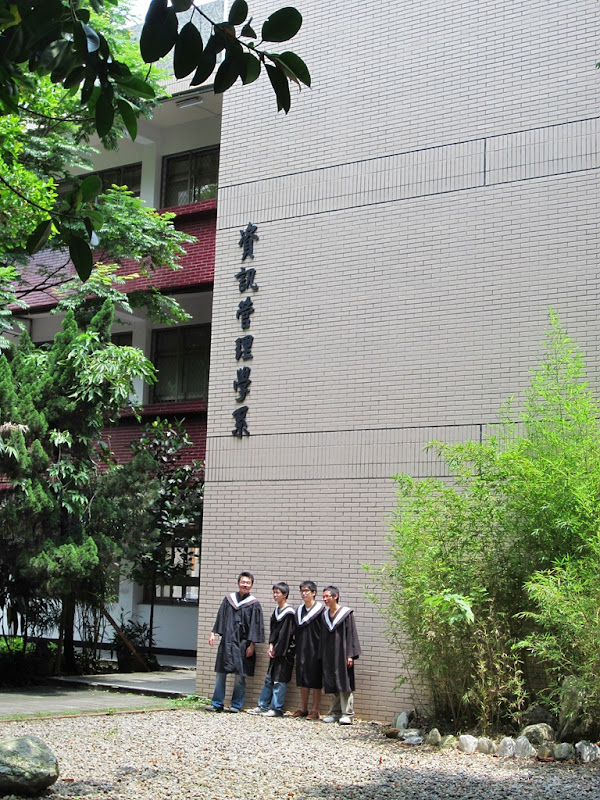
Before the seminar, Prof. Yang (Professor, Department of Industrial and Systems Engineering) led us to walk around the campus. We saw some fresh graduates to take photos for celebration.


An activity was started in Activities Centre for student.


After visit the campus, we had lunch with many professors from the Department of Industrial and System Engineering, Chung Yuan Christian University.


During the lunch time, Dr. Chin introduce the Department of Systems Engineering & Engineering Management, City University of Hong Kong to all professors.


Then Dr. Chin shared his research on assessment methodologies (e.g. Evidential Reasoning Approval).


The seminar was started after professors sharing. Prof. Ling-Huey Su (蘇玲慧) (Professor and Chair, Department of Industrial and Systems Engineering) introduced Dr. KS Chin to the research students.


Dr. KS Chin's topic named "Managing Organizational Innovation". Firstly, he discussed the concept of Innovation such as "Innovation means something new. " and "If the idea seems new and different to the individual, it is an innovation." Then Dr. Chin used different innovative product such as iPad for discussion.


The following table showed that new concept and discovery was very low in percentage of the innovation distribution.

Innovation was separated into many types included Orgnizational, Management, Production, Process, Marketing and Service. Dr. Chin focused on Organization Innovation which was the development or adoption of an idea or behavior that was new to organization. There were two approaches. One was Managerial Approach and the other was Methodological Approach.


Then Dr. Chin introduced the Organization Innovation Management (OIM) model and using the Analytic Hierarchy Process (AHP) based methodology to develop specific factor weightings.


The assessment of QIM was separated into 5 levels. If organization employed this assessment method, the basic line of organization innovation would be identified and then they could improve the low ranking key innovative factors first.

Dr. Chin also mentioned the OIM implementation roadmap which was step-by-step approach to assist organization for innovation management. Moreover, it employed Plan-Do-Check-Act cycle.


Q&A session


Prof. Su presented the department flag to Dr. Chin


We took a photo in front of Dr. Chin's poster.


Prof. Noriaki Kano was also invited on 18 May 2012 (Last Friday).


Then Prof. Su led us to visit their laboratories.


At the end, Dr. Chin and I took a photo in front of the banner named "Spirit of Industrial Engineering".


Reference:
Chung Yuan Christian University - http://www.cycu.edu.tw/


2012年5月20日星期日

HKQAA Seminar on the next version of ISO 9001:2015

The seminar entitled "The next version of ISO 9001 - What to expect" was organized by Hong Kong Quality Assurance Agency (HKQAA) on 19 May 2012. Dr. Nigel Croft (Chair of ISO/TC176/SC2 - the ISO subcommittee responsible for ISO 9001 and ISO 9004) was invited to explain about the key drivers for the revision, what to expect in the new version, and get ISO9001 users feedback through communication in this seminar. Recently, ISO has initiated the process for the next major revision to ISO 9001 standard, it was the first seminar in this topic in Hong Kong. I would like to summarize Dr. Nigel Croft to share the most new information about the idea of the major revision of ISO 9001 below.


Before the seminar, Dr. Nigel Croft initiated a group discussion exercise, He asked the question "What you would most like to see changed in the new version of ISO 9001" and requested to present the 3 most important items in each group.


After discussion, Dr. Nigel Croft summarized our discussions and most of identified items had been considered in the major revision of ISO 9001. There had more than 12000 responses to online user survey. Revision of the 8 quality management principles was also concerned.


In the beginning of the seminar, Dr. Nigel Croft explained "management system" which involved the interaction among "Hardware", "Software" and "Humanware".


Then he told about process which considered the RISK. He also mentioned the monitoring did not necessary mean measuring. Monitoring something was observing it and supervising it. The undesired outputs (waste) was considered its efficiency. It was also under Plan-Do-Check-Act cycle.


The slide demonstrated the version change of ISO 9001 in the past and expected to be major changed in 2015.


Dr. Nigel Croft said "Certification to ISO 9001" should be a result of a well-implemented quality management system rather than just "Certificate" itself. The vision of TC176/SC2 was mentioned that "SC2's products are recognized and respected worldwide, and used by organizations as an integral component of sustainable development". Moreover, update ISO 9001 aimed to reflect modern business practices, changing business environment, technology, and business terminology. The follow diagram showed some topics which addressed by the "Future Concepts" task group.


Common structure and format to align different ISO management system standards were suggested in ISO Directives Part 1:2012 Annex SL.


The high level structure was proposed as follows. In 4.1 "Understanding the organization and its context", the similar structure was used and it could be for different systems such as quality, environmental, information security, etc.


In clause 5.1, it emphasized the leadership and commitment. Dr. Nigel Croft asked how do you demonstrate the leadership? Do it need records? He added the leadership was a culture in the organization. It was not only presented in top management.


In clause 6.1, actions based on risks and opportunities should be considered. Therefore, risk management became more and more important in ISO 9001. Moreover, it used TQM's 5W1H (What, Who, Where, When, Why & How) to achieve its objectives.


In clause 7.2, more thinking and effort was used in competence. Dr. Nigel Croft explained to apply knowledge and skill to achieve the expected outcome of our job.


In clause 10 "Improvement", the term of "Preventive Action" was not used in the clause 10.1 and Dr. Nigel Croft explained that preventive action was a culture and not only for documents or records.


Finally, Dr. Nigel Croft said the new revision process for ISO 9001 would start in June 2012. The major changes were included updating modern business practice, more emphasizing on product conformity and improving the compatibility with other management system standards. It planned the publication date would be September 2015.

After the seminar, Dr. Nigel Croft and I took a photo for memory.


Reference:
International Organization for Standardization - http://www.iso.org/iso/home.html 
Hong Kong Quality Assurance Agency (HKQAA) - http://www.hkqaa.org/en_index.php 
Hong Kong Society for Quality (HKSQ) - http://www.hksq.org/index.asp


LinkWithin

Related Posts with Thumbnails