2014年9月5日星期五

ESG Seminar – Social Media Strategy (Xiaomi 小米科技)

The Executive Study Group (ESG) seminar in September 2014 named “Social Media Strategy – How Xiaomi Uses Social Media to Grow Explosively” which was held by the ESG, Asia Pacific Institute for Strategy Limited (APISL) and the Hong Kong Science and Technology Parks Corp (HKSTPC) on 5 Sep 2014. I would like to summarize the seminar for sharing below.


In the beginning, Dr. Mark Lee (Research Director, APISL) introduced a successful case using Social Medium which was Ice Bucket Challenge. Dr. Lee asked how long you missing plastic duck which was very hot in social medium before. So such event would be outdated later. Therefore, we need a social media strategy.


Dr. Lee briefed the content of seminar included "Xiaomi Beats Samsung in Chinese Market”, “Fan-Centric Strategy for Social Media”, “Social Media Links CEO and Fans Directly”, “Competitive Advantages of Being Fan-Centric”, “Fan Development Strategy”, “Execution Steps” and “Cross-Industry Sharing”.

Dr. Lee said Xiaomi smart mobile sales was number one in China. The top 5 players in China showed that only Samsung decreased, Lenovo, Yulong and Huawei were increased.


Then he reviewed the top 5 players in the world. Samsung was still number one but no growth. Apple was number two with little bit growth. However, Xiaomi grew 3 times within a year to the position at number five.


Then Dr. Lee explained Xiaomi Fan-Centric Strategy. Their mission slogan was “Live for fans (為發燒而生)” that they produced the Xiaomi phone because of the Mi-fans. Xiaomi (Logo MI) was not a smartphone company and it founded on 6 April 2010. MI means Mobile Internet (Mark interpreted that MI would not be Samsung but Google!) Their marketing positioning was highest value-to-price ratio.

Through the Fan-Centric Strategy, social media linked Lei Jun (CEO of Xiaomi) to MI-Fans. Lei Jun posted over 100 comments daily through sina Weibo and he had more than 11M fan followed. (More than HK population ~7M!)


The competitive advantages of Fan-Centric Strategy were free customer research, inter-Fan promotion with no cost and fan volunteer customer service. Through social media and fans activities, Xiaomi was no needed to expense any cost through TV advertisement (where SONY employed HK$514M in TV advertisement for Xperia Z smartphone). Therefore, Xiaomi got many value-added inputs by fans included massive users, free translation, free development and e-word of mouth.

Five elements of Xiaomi Fan Development Strategy were showed as follows:
i) Recognition of Fan Importance (KPI for number of fans & setup fan department)
ii) Rich Topics for Discussion Continuously (MI-User Interface, Café Wifi Password sharing)
iii) Building a Sense of Ownership (Free Testing by Fans)
iv) Serious about Fan Feedbacks (Quickly acknowledge, Power User Management, Advisory Group)
v) Segmentation by Level of Participation (Fan Classification, Grant Different Rewards)


Then Dr. Mark Lee quoted Prof. Mikolaj Jan Piskorski (Harvard Business School) to explain what successful social strategies were.


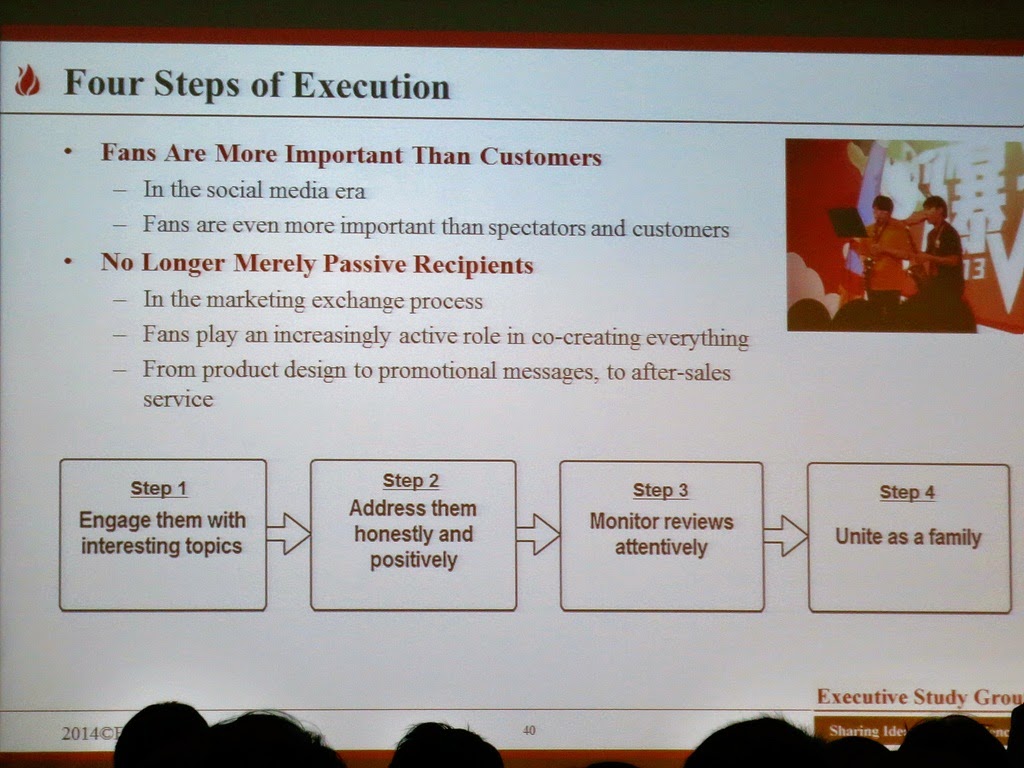
Four steps of execution for Fan Development Strategy were discussed.
Step 1 is to engage them with interesting topics.
- More than more “Likes” received using Six progressive levels to participation (from 1 to 6): Viewing, Forwarding, Commenting, Creating, Moderating, and Arbitrating.
- To increase participation levels
- Arouse curiosity among Fans
- Frequent new topics for discussion
- Create expectation (Annual Fan Festival)
Step 2 is to address them honestly and positively.
- Both positive and negative comments engaged
- Virtually no secrets
- Detected negative word of mouth quickly
Step 3 is to monitor reviews attentively.
- Company commitment on Fan Care
- Comment classification
- Feeling of being respected
- Systematic approach
Step 4 is to unite as a family.
- People relationship
- Gifts for Fans
- Gathering Events
- Same-city Reunions
- Face-to-face Meeting Opportunities
- Social Activities

Dr. Mark Lee said Fans become self-started engine for social media and it was important to be integrated with the company strategy for its fans.

Before the cross-Industry sharing, Dr. Lee gave us an exercise to find out two most impressive and one least impressive functions of Xiaomi. And then group discussion was performed.


Reference:
The Centre for Logistics Technologies and Supply Chain Optimization, CUHK - http://www.logitsco.cuhk.edu.hk/
HKSTP - www.hkstp.org
Information about Asia Pacific Institute for Strategy Limited (APISL) (亞太策略研究所有限公司)


2014年9月4日星期四

CityU EngD (EM) Orientation 2014

The Orientation of Engineering Doctorate in Engineering Management – EngD (EM) which established in the Department of Systems Engineering and Engineering Management (SEEM), City University of Hong Kong (CityUHK) was held on 4th Sep 2014. The EngD(EM) programme had started since 2000. It is designed for elite senior managers and engineers in all kinds of organizations in Hong Kong and mainland China. The programme aims to develop students’ creative thinking and overall capacity to apply innovative technologies and advanced management methods to meet the strategic needs of their organizations.

In the beginning, Dr. Alan Chan (EngD Prog. Leader, SEEM of CityUHK) gave a welcome speech to the new cohort. Dr. Chan’s talk entitled “A Platform for Innovation Leaders”.


Then Dr. Chan explained the different between PhD and EngD.
- PhD aims to produce academic researchers by continuing expansion of fundamental knowledge. It contributes to the continuous social and economic growth by making the fundamental knowledge useful in the world.
- EngD is an alternative to the traditional PhD, being better suited to the needs of industry, and providing a more vocationally oriented doctorate in engineering.

The diagram demonstrated the programme structure and model programmed path.


Then the profile of EngD (EM) candidate was mentioned and it included Education Background, Working Experience, Job Positions and Industry.


After that Dr. Amie Lai (President of CityU EngD Society) introduced CityU EngD Society. The mission of the society is to gather and connect all the graduates and students of CityU Engineering Doctorate Program. We organize activities, forum and conferences regularly to get our members connected. Moreover, I had summarized some EngD Society past activities in my blog at http://qualityalchemist.blogspot.hk/search/label/EngD .

And then we introduced each other and shared our background, as well as, our research subject and supervisor.

(Top Left: Mr. John Wong (2013), Mr. Jacky Ng (2014), Mr. Ben Leung (2014), Mr. Sajeesh Kumar Babu (2014), Dr. TW Liu (2004), Mr. Lee Hok Ling (2014) and Dr. WT Chan (2004))


(Low Left: I (2005) photo taking, Dr. Amie Lai (2004), Dr. Samuel Fung (2005), Dr. Herbert Yeung (2004), Mr. Arunkumar Subramanian (2012) and Mr. Alex Chan (2014)) (Two cohorts were late – Dr. Rocky Lam (2005) and Dr. PM Lai (2008))

Lastly, all cohorts took a group photo for memory.


Reference:
Engineering Doctorate (Engineering Management) - http://www.cityu.edu.hk/seem/pdf/EngD_Leaflet.pdf
CityU Engineering Doctorate Society - http://www.engd.org/


2014年9月3日星期三

ASTRI Industry and University Consultation Forum 2014

The ASTRI Industry and University Consultation Forum (IUCF) is a major event which was held annually in Hong Kong and Shenzhen. ASTRI organizes the IUCF to inform current and potential partners from industry and academia about the institute’s latest technical developments solicit suggestions for future R&D projects and cultivate opportunities to establish collaborations. I attended the morning part and would like to share industry and academic professionals’ view on Innovation and Technology.


Beginning the forum, Mr. MY Wong (Chairman of the Board, ASTRI) gave a welcome speech. He introduced ASTRI mission to enhance Hong Kong’s competitiveness in technology-based industries through applied research and one of goals to performing relevant and high quality R&D for transfer to industry. Mr. Wong expected more and more technology commercialization.


Then Prof. Tony F. Chan (President, HKUST) gave an opening remark. Before his speech, HKUST video was shown and one of their students to be young entrepreneur (DJI) and elected as top ten innovators in China. He said many discoveries on technology application were in Hong Kong but no industry invested such as Google glass. We were missing strategy and long term planning on Innovation and Technology. Therefore, Culture on Innovation and Technology should be developed. Prof. Chan also said there were many support to universities / faculties in Korea compared with Hong Kong. However, Hong Kong had our advantages such as global talents and capitals, as well as, close to China.


Mr. Vincent Tang (Acting Deputy Commissioner for Innovation and Technology, ITC) was our guest speaker to give forum address. He said ASTRI was one of Hong Kong R&D Centres and about 30% increase in the industry income. Upto Jun 2014, Hong Kong government supported ASTRI through ITF funding to initiative 3600 projects and funds upto HK$2500M. Recently, ITC launched R&D cash rebate fund to encourage industrial R&D projects.


Kick-off Ceremony for IUCF


Group photo


Dr. Frank Tong (CEO, ASTRI) gave us a talk entitled “An Overview of ASTRI’s Latest Development”. He introduced ASTRI was government subvention organization. It is one of the five R&D Centers in Hong Kong and focusing on R&D in ICT field. Hong Kong office in Science Park is headquarters and one liaison office in Hi-tech Industrial Park, Nanshan, Shenzhen. Then he briefed the income and funding, ITF-funded projects, staff academic qualification (~80% is Master or above), Patents Granted and Filed, and number of Technology Transfer.


After that he introduced ASTRI’s existing core competence included IC Design, Component Packaging & Manufacturing Technology, Software Embedded, Software Cloud and Communication Wireless.


Dr. Tong mentioned there were four types of project funding included ITF-funded platform projects, ITF-funded seed projects, Contract research projects and Industry Collaborative Projects. He also stated some achievements such as ASTR Hosted the National Engineering Research Center for Application Specific Integrated Circuit System (Hong Kong Branch), ASTRI-HP Information Technology Research Centre, and TCL-ASTRI Strategic Partnership.

Panel Discussion named “Advancing I&T through collaboration among Academia, R&D Centres and Industry”
Mr Wong Ming-yam (Board Chairman, ASTRI) was the moderator and the panel members were (Left):
- Ms. Cally Chan (Managing Director, HP Hong Kong)
- Prof. Tony F. Chan (President, HKUST)
- Prof. Roland Chin (Deputy Chancellor and Provost, HKU)
- Dr. Samson Tam (Chairman, Technology Development Committee, Federation of Hong Kong Industries)
- Prof. Alex Wai (VP (Research Development), PolyU)
- Dr. Frank Tong (CEO, ASTRI)


During the discussion, Ms. Cally Chan said Innovation is our DNA and Technology is our core in HP. She wore a RED cloth indicating that R – R&D Resource is important; E – Engagement of all key stakeholders and D – Deployment to local industry is significant. Prof. Roland Chin said Hong Kong had only 0.7%GDP invested from government in terms of research which was not enough. Moreover, job opportunities for technology students were limited. Dr. Samson Tam added government had ready want to make change. We needed to select at least some area becoming excellence such as ICT. In addition, two areas included mobile commerce (O2O) and Automation & Robotic. Prof. Alex Wai also commented that Industry and government needed to accept failure and learnt from failure. No Risk Taking and No Innovation! Prof. Tony Chan said universities needed to teach entrepreneurship and change mindset (culture revolution) through changing the reward system, society mind and government on R&D that was not expenditure but investment. Finally, Dr. Frank Tong said we needed role model for young people and issued more projects.

Reference:
HKSTPC - http://www.hkstp.org/
ASTRI - http://www.astri.org/main/


2014年8月30日星期六

HKETA Symposium on Innovation & Technology 2014

Hong Kong Electronics & Technologies Association (HKETA) Symposium on Innovation & Technology 2014 was co-organized with Hong Kong Science and Technology Parks (HKSTP) held on 29 Aug 2014 at Charles K. Kao Auditor in Science Park. The symposium aims to provide a linkage between users, business, research institutions and government institutions through updating information on Innovative technologies for smart living.

Before the symposium, we took a photo with Hon. Charles Mok (Legislative Councillor) in front of symposium poster.
(Left: Dr. Aaron Tong (Managing Director, TQM; Former Chairman of HKSQ), Hon. Charles Mok and I)


In the beginning, Ir. Victor Ng (Chairman of HKETA) gave a welcome speech. Ir. Ng pointed out a question we frequently asked “How Hong Kong’s Technology moving Forward?” and then he thanks for all speakers and panelists, as well as participants.


The first keynote speaker was Hon. Charles Mok (Legislative Councillor) and his presentation topic named “Innovation”. Mr. Mok’s talk included “What’s an innovation?”, “Source of Innovation”, “Rise of Innovation Platforms”, “Innovation Ecosystem”, “Finding core competency” and “Role of Hong Kong Government”.


Innovation had many meaning / definition he said. It included a new idea, a new way to do thing, fulfill a need, technology related, R&D driven, driver for competitiveness, and “The Edge”. Sources of innovation could be changes in industry and market structures, end-user driven, technology enabled, crisis and any difficult situations, asking lots of right questions, as well as, come from the innovators. Then he introduced different platforms included iOS, Android, Facebook, Twitter, AWS, PayPal, etc.

Then he briefed the innovation ecosystem should have entrepreneurs/Talents, Funding and Market. However, it also needed public policy as catalyst. Role of government could be in different way such as Education, R&D support, Financial policies, Support measures and Lead in adoption. The most important was to establish Innovation and Technology Bureau. Finally, Charles concluded the talk in the statement “Reengineering, innovating mindsets!”


Mr. Ricky Wong (Chairman of Hong Kong Television Network) was the second keynote speaker and his presentation entitled “Innovation in Hong Kong”. Mr. Wong shared his fail experience and he had fully demonstrated his persistence and never-give-up spirits with actions on the road of striking for a Free TV licence. He joked that Hong Kong Government had very innovative reasons to reject his application. He shared that innovation was come from pressure. For instance, IDD cost structure changed in 1993. He either shutdown his business or create new idea to run his business that was call-back technology. After application of Free TV license failed, he was exploring business opportunities in E-Commerce, aiming to build the largest and the most diversified in terms of brand names, products & services e-shopping mall in Hong Kong, which provided one-stop shop and 24 x 7 services.


Group Photo


The third speaker was Ir. Allen Yeung (VP, Business Development & Technology Support, HKSTP) and his talk was “Emerging Technology”. Firstly, he introduced 5 Technology Megatrends that prepared by Institute for the Future which was founded in 1968 and their service was using different methodologies to forecast the future, applied to business, government and non-profits organization.


The Five Technology Megatrends included “The Cloud as Supercomputing”, “Material Shifts”, “Robot Renaissance”, “Manipulating Biology” and “Decrypting the Brain”. Then Ir. Allen Yeung said the innovation methodologies trends were citizen science and data-driven discovery that Innovation was able come from everyone and anywhere.


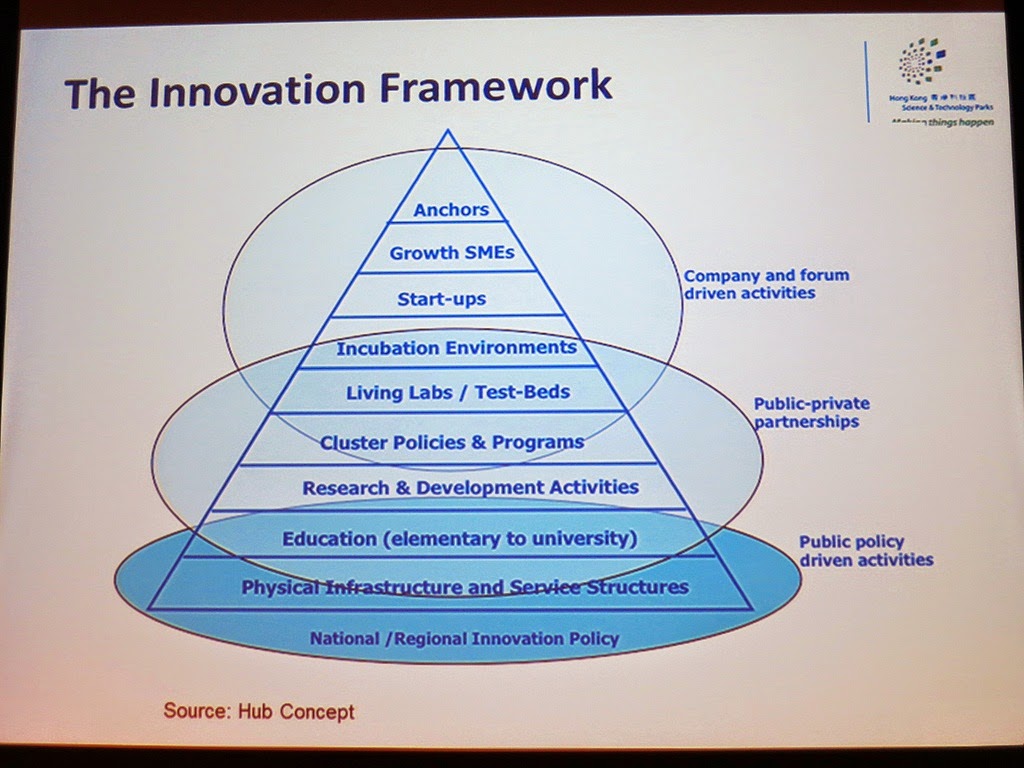
After that Ir. Allen Yeung introduced the innovation framework in which Science Park were implemented. Then he introduced tenant distribution in Science Park where 50x Multinational Corporations (MNCs), 250x SMEs and 150x Incubatees. Science Park would like to nurture future tech giants through Incubation Programme to Acceleration Progamme and finally our tenants to be IPO or M&A. At the end, Allen concluded “Complete Innovation EcoSystem” + “Leverage on Govt & HKSTP’s Support” + “Capitalize on Mega Trends” to be “Unlimited Business Opportunities”.


The fourth speaker was Mr. Matthew Man (Founder and CEO of Myndar) and his presentation title was “Changing Landscape of Retail with Big Data”. Mr. Man introduced why facebook book value US$6.3billion before IPO but increased to US$104 billion of IPO market value. It was because of Intangible Assets “Likes, Posted material and Comments” that were discrete data point (Big Data)!


Mr. Man said Big Data was equal to Transactions plus Interaction plus Observations. It has 3V characteristics that Volume (Data Size), Variety (Data Sources) and Velocity (Speed of Change). Then he introduced the retail technology under big data, Internet of Things (IoT) and Internet of People (IoP). IoT was “Machines can sens, process, exchange information and take action independent of human intervention.” IoP was “People can communicate and access information anywhere.” Lastly, Mr. Man Concluded “A Big-Data Mindset to reveal valuable secrets to make a discovery.”


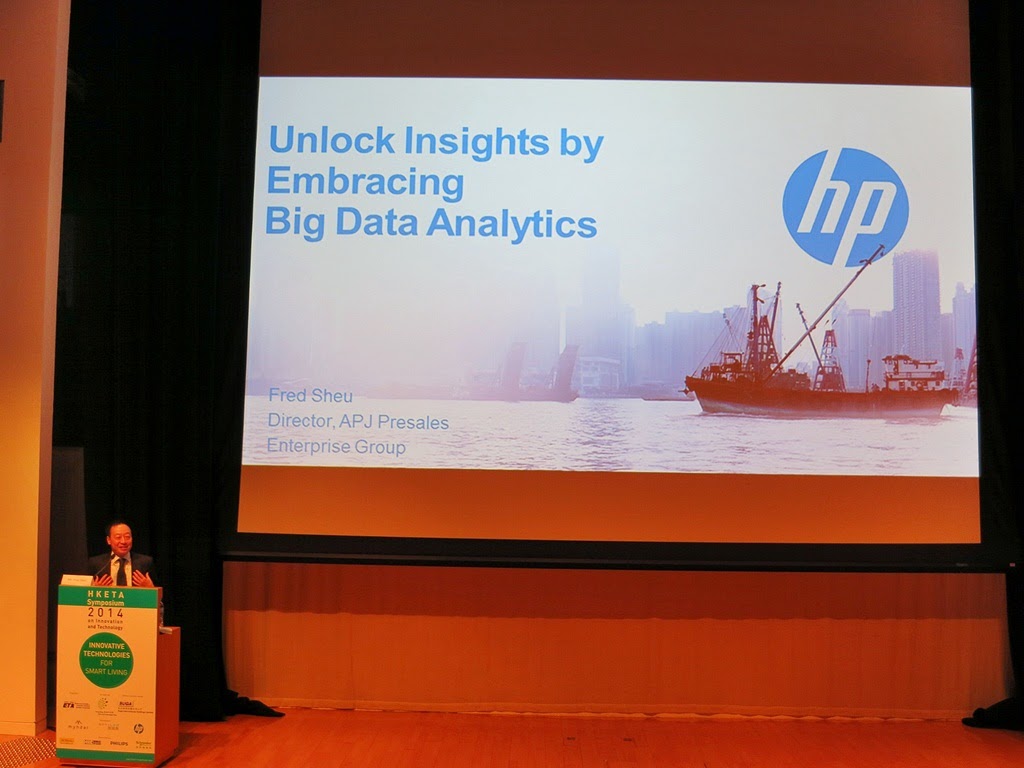
The fifth speaker was Mr. Fred Sheu (Director, APJ Presales, Enterprise Group, HP) and his topic named “Unlock Insights by Embracing Big Data Analysis”. He briefed the big data definition was high-volume, -velocity and –variety information assets that demanded cost-effective, innovative forms of information processing for enhanced insight and decision making.


Then Mr. Sheu briefed how to use data to get the answer for Clothing, Eatery, Home and Travel (衣食住行). He also said Big Data was for everyone. Moreover, he believed that Big Data would increase business through Foresight, Hindsight and Insight. He also said “Information has become a source of competitive advantage, and organizations risk becoming irrelevant if they can’t harness the power of their Big Data at the speed of business.”


Finally Mr. Sheu introduced HAVEn which was a Big Data platform from HP and ASTRI-HP Information Technology Research Centre which launched on 16 Dec 2013.

Panel Discussion with the topic “How Hong Kong’s Technologies Moving Forward” moderated by Mr. MY Wong (Chairman, ASTRI) and Prof. PC Ching (Professor of EE Dept, CUHK).
(Left: Mr. MY Wong, Prof. PC Ching, Hon. Charles Mok, Ir. Allen Yeung, Mr. Matthew Man and Mr. Fred Sheu)


Charles encouraged changing mindset to think how do we looking at technology. Allen said Science Park’s 5 technology clusters would match the 5 Megatrend. Matthew said to create business close to customer. New technology adoption could create market and user. MY asked Fred how technology of Clothing, Eatery, Home and Travel could be used for elder people? Fred replied simply to make technology easy for use. MY also ask Prof. Ching how to find Data Scientist. Prof. Ching said most of engineering school had statistics training. The most important thing was industry to tell university what type of talent they were looking for.

In restaurant, Mr. Eric Chan (Committee member, HKETA) gave short speech to start the lunch.


During the lunch, Dr. Alfred Ng (Assistant to Managing Director, Suga International Holdings Limited) presented the topic “IoT: New Challenges and Opportunities for Small and Medium-Sized Manufacturing Enterprises”. Dr. Ng explained why the value of normal electronic scale cost HK$200 but fitbit aria Smart Scale (with WiFi & Bluetooth) cost HK$1200. It was the values of being “Smart”!


Then Dr. Ng mentioned knowledge needed for making smart electronics appliances included “Microcontroller Programming, Mechanical Engineering, Circuit Designs, Manufacturing & Quality Control, RF, Cloud, iOS & Android Apps, and Network Security. He found that service needed by Electrical Appliances Makers was the last 5 elements but a service needed by small startup was the first 5 elements.


At the end, Dr. Ng concluded that IoT devices makers required more than just manufacturing services; and barrier to entry IoT can be very low by utilizing cloud services offered by global tech giants.

Reference:
HKETA - http://www.hketa.org.hk/
HKSTP - http://www.hkstp.org/


2014年8月28日星期四

CityU IIPCC Entrepreneurship & Innovation Seminar

The IIPCC Hong Kong Chapter Workshop/Seminar Series: Entrepreneurship & Innovation was organized by IIPCC-HK and coorganized by CityU Business & Industrial Club (CUBIC) and Hong Kong Science and Technology Parks (HKSTP) on 28 Aug 2014 in Lecture Theatre 15 at CityU. The International Intellectual Property Commercialization Council (IIPCC) Hong Kong Chapter is a non-political, non-profit/social organization for promoting IP Commercialization Best Practices to do common good; serving the socio-economic interests of local community; focusing on decent job creations, entrepreneurship and SME innovations.
(There were many participants in this seminar tonight!)


The guest speaker was Mr. David Ai (Director of Knowledge Transfer Office, CityU and Co-Founder of IIPCC Hong Kong Chapter) and his presentation entitled “IP Valuation: How to Set a Price on the Intellectual Property (Your Books, her Music, their Patents)?” He stated that not all patents are created equal and it could be classified three types as follows:
1) Utility Model Patents (Germany, Japan, China)
2) Patent Applications (“patent pending”) have risks
3) Even Granted Patents are NOT 100% Solid


Then Mr. David Ai introduced the Friendly FRAND Principle to us. FRAND stated to Fair, Reasonable And Non-Discriminatory. Then the case of Motoral and Microsoft indicated what was reasonable in terms of licensing.
(Avoiding photo copyright, I replaced the children photo to our photo (David and I took inside Golden Egg in Science Park).)


Finally, Mr. David Ai concluded why it’s Hard to Build IP Markets (comparison with Normal Market) as following points:
1) 1 seller, few potential buyers (Many buyers & sellers)
2) Truly unique product (Standard replaceable product)
3) Buyers Have Various Needs and in Complex Scenarios (Similar needs)
4) Many complex terms (Few terms and easy to transact)
5) Seller is disadvantaged (Equal access to information)


After the talk, four panel speakers were invited for discussion as follows: (From Left)
1) Mr. Johnson Kong who is a board member of IIPCC-HK.
2) Ms. Peggy Cheung who is a solicitor and registered trade mark attorney.
3) Mr. David Ai who is a Director of Knowledge Transfer Office, CityU and Co-Founder of IIPCC Hong Kong Chapter
4) Mr. Al Kwok who is Co-Founder of IIPCC Hong Kong Chapter and expert in semiconductor industry.


During the discussion, Peggy told us about JV in China and she said the most important was due diligent. Moreover, she said trademark was a very high value asset. Then Johnson said Patent was not guaranteed but it was only starting. Hong Kong needed to build IP trading ecosystem and to educate public about IP protection concept.

Then Mr. Al Kwok presented the commercialization Process of an invention from Idea (Problem-solving) to R&D Solution to Prototype and then to Product/Service. In this chain, the IP Value would be from Little (need proof of concept) to Some (need product realization) to More (if proven value to customers) and then to Much more (if very scalable). He also discussed the internal design (meaning engineer or infra-structure of system) and external design (meaning interface of human being). Finally, he said top management should be made sure “Integrated Design Capability” included Marketability, Scalability, Robustness, Manufacturability, Resuability, Quality/Reliability and Testability, etc.

Reference:
IIPCC - http://www.tmbell.com/hongkong/aboutiipcc.php
HKSTP - http://www.hkstp.org
CUBIC - http://www6.cityu.edu.hk/kto/index.aspx?id=PG-1200038
20140620 - Distinguished Entrepreneur Series: Recipes for Success - http://qualityalchemist.blogspot.hk/2014/06/distinguished-entrepreneur-series.html


2014年8月25日星期一

HKSTP Seminar on Business Model Canvas

The Seminar entitled "Introduction to Business Model Canvas (BMC)" was organized by Hong Kong Science and Technology Parks Corporate (HKSTP) on 25 Aug 2014. The seminar aimed to shake up the start-up world by offering a very clear and well defined approach to determine and validate key elements of business building, while taking into account the rapid changes that is normal for early ventures.

The guest speaker was Mr. Deepak Madnani (Founder, Paperclip Startup Campus) and he briefed why 9 out of 10 startups fail. He said the different between Startup and Entrepreneur was that business model was known or unknown. Most of Startups did not know their business model. From Startup to Entrepreneur, the period of startup should be finished as soon as possible.


Mr. Deepak Madnani said the lifestyles of startups were working to live their passion. They would like to search Scalable Startup and to execute it to be Large Company. In here, we needed business model and risk capital. He also told us that multiple types of Startups had different education, funding and tactics; but they had the same techniques to build them. Moreover, he explained no business plan but survived first that you needed to contact with customers. 

Then Mr. Deepak Madnani defined that a Startup is a temporary organization designed to search for a repeatable and scalable business model!


He introduced the 9 boxs of Business Model Canvas (BMC) as below.
1. Value Propositions
2. Customer Segments (Who & Why)
3. Channels
4. Customer Relationships (Get → Keep → Grow)
5. Revenue Streams
6. Key Resources (Finance, Physical, Intellectual and Human)
7. Key Partners (Partners and Suppliers)
8. Key Activities (Production, Problem Solving and Supply Chain Management)
9. Cost Structure


Finally, Mr. Deepak Madnani explained the BMC through LinkedIn as sample.

http://businessmodelinnovationmatters.files.wordpress.com/2012/05/linkedin-business-model.png

Reference:
HKSTP - http://www.hkstp.org
Paperclip Startup Campus - http://www.papercliphk.com/en/academy
Business Model Generation - http://www.businessmodelgeneration.com/


2014年8月22日星期五

ASQ InfVoices – Quality Evolution and Revolution (QUALITRIX)

Mr. Bill Troy posted the August topic of ASQ Influence Voices entitled “The Future of Quality: Evolutionary or Revolutionary?” I would like to explain the future of quality using the famous film “MATRIX”. Quality is in everywhere which like MATRIX. So I combined “Quality” and “MATRIX” to “QUALITRIX”.


Morpheus asked Neo for selection. He said “This is your last chance. After this, there is no turning back. You take the blue pill - the story ends, you wake up in your bed and believe whatever you want to believe. You take the red pill - you stay in Wonderland and I show you how deep the rabbit-hole goes.”  In here, blue pill is "Unchange" and the story of your company ends. Red pill is "Quality" and it is no turning back!

Being the Quality way, company will modify their product or service continuous. One of famous quality tools is Kaizen. The company will go through the Quality Evolution but it will be moving slowly and will be stopped based on the First Law of Organizational Motion (An object in motion will stay in motion unless acted upon by an Unbalanced Force (Friction)). (See reference)

Therefore, we needed “QUALITRIX RELOAD” for a period of time. It reminds us to review the theories from different quality gurus such as Deming, Crosby and Juran, as well as, different quality tools included six sigma, lean, SPC, etc.


The company usually involved both quality techniques and practices in their development journey and their product or service performance appeared S-curve. (Refer to Sustaining Excellence through Quality and Innovation)  Until the product/service stay in mature stage, we need some breakthrough to go to the next S-curve. That’s why we need innovation. One of famous tools named TRIZ (Theory of Solving Problems Inventively). Quality plus TRIZ that I also called it “QUALITRIX REVOLUTIONS”.


I would like to summarize my ideas in this topic as below.
i) Evolutionary change is continuous improvement. It could be employed Kaizen and Business process re-engineering (BPR)
ii) Revolutionary change is innovation breakthrough. It could be employed TRIZ or other new tools.
iii) Evolutionary change and Revolutionary change exist simultaneously. It is depended on which stage of company’s product/service in S-curve*.

Reference:
A View from the Q - http://asq.org/blog/
ASQ InfVoices - Law of Organizational Motion - http://qualityalchemist.blogspot.hk/2013/12/asq-infvoices-law-of-organizational.html
ASQ InfVoices – Sustaining Excellence through Quality and Innovation - http://qualityalchemist.blogspot.hk/2013/09/asq-infvoices-sustaining-excellence.html

*Remark: The early author stated technology innovation through S-curve was found as follows:
Abernathy, William J. and James M. Utterback (1978) “Patterns of Innovation in Industry,”  Technology Review, 80(7), June-July, 40-47.
James M. Utterback (1996) Mastering the Dynamics of Innovation (http://www.amazon.com/Mastering-Dynamics-Innovation-James-Utterback/dp/0875847404)


LinkWithin

Related Posts with Thumbnails