2013年6月26日星期三

International Symposium on Innovation Excellence and Practices 2013

The International Symposium on Innovation Excellence and Practices (ISIEP 2013) was held on 25 June 2013. The seminar was jointly organized by Institute of Systematic Innovation Hong Kong (ISIHK), Manufacturing and Industrial Division of the Hong Kong Institution of Engineer (HKIE) and Department of System Engineering and Engineering Management of City University of Hong Kong (SEEM, CityUHK) . Hong Kong Society for Quality (HKSQ) and Hong Kong Science and Technology Parks Corporation (HKSTPC) were supporting organizations. The seminar was first time in Hong Kong and aimed to share the worldwide industries leaders or the best minds in innovation practices.

Before the seminar, organizers and guests took a group photos.


Organizers (ISI, HKIE, CityU) and supporting organizations (HKSQ, HKSTPC) representatives took a photo with Miss Janet Wong (Commissioner for Innovation and Technology, HKSAR) and Ir. Dr. The Hon WK Lo (Representative of the Engineering Functional Constituency of the Legislative Council).

(Left: Ir. Dr. Lotto Lai, Ir. Dr. KS Chin, Ir. Dr. Victor Lo, Prof. Fugee Tsung, Prof. KL Tsui, Ir. Dr. Michael YH Li, Miss Janet Wong, Ir. Dr. WK Lo, Ir. Richard WN Tse, Ir. Chan Fuk Cheung, and Ir. Peter CK Chak)


In the beginning, Ir. Dr. Michael YH Li (Chairman of ISIHK) gave a welcome address. He commented that this symposium provided a platform for Network of Innovation.


Then Prof. Kwok TSUI (Head of Dept. & Chair Professor of SEEM, CityU) gave a welcoming speech. He expressed that quality management had started to focus on Innovation such as ASQ.


Ir. Dr. The Hon WK Lo (Representative of the Engineering Functional Constituency of the Legislative Council) presented an opening speech. He explained Innovation was creating some new idea which could be a transferable skill. He separated the concept among creativity, Invention and Innovation below.
Creativity: Thinking no one else through before
Invention: Transformation of thought into tangible ideas
Innovation: Turning the ideas into products (Ideas -> Concepts -> Prototypes -> Product)
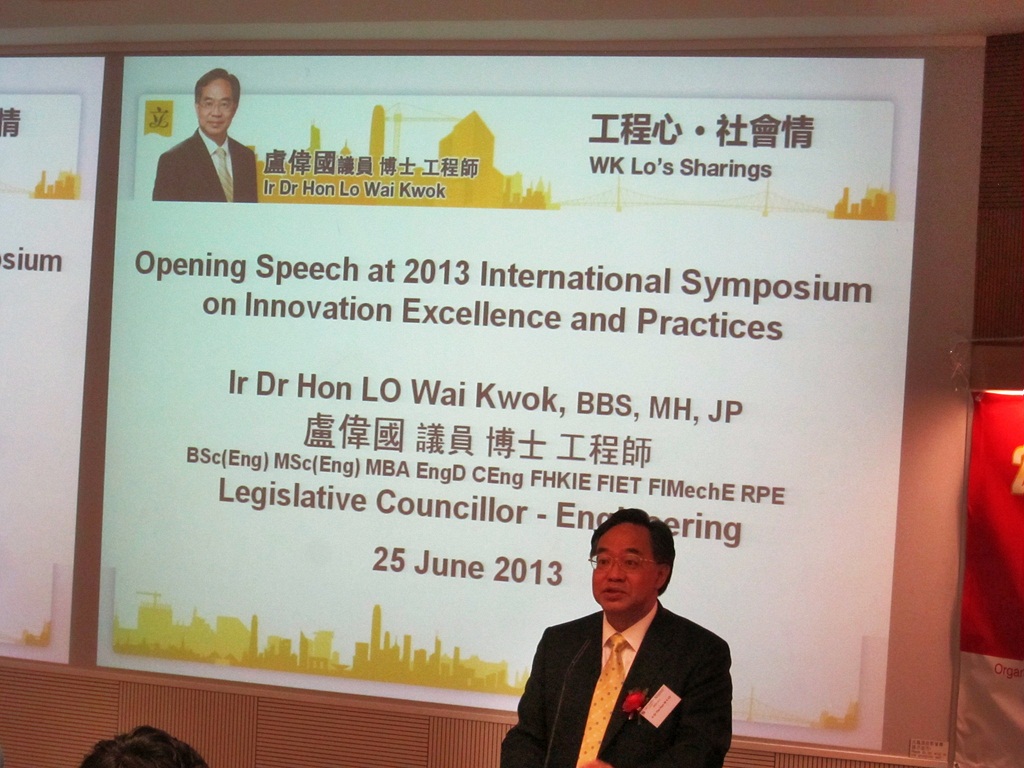

Dr. Lo said there were four types of innovation included Product, Process, Supply Chain and Marketing. The he mentioned four I's competitive advantages of Hong Kong that were Integration, International, Information and Integrity. Role of the Government on Innovation was discussed. He proposed to enhance investment in scientific research; promote the commercialization of technological achievements, industrialization of products, and internationalization of industries; and promote regional co-operation, boost technological co-operation between Hong Kong and the Mainland. Lastly, he concluded that "Innovation will make the world a better place for the younger generation!"

Miss Janet Wong (Commissioner for Innovation and Technology, HKSAR) gave an opening remarks and her topic named "The Government's Perspective and Vision about Innovation Development in Hong Kong. She briefed the mission of government on innovation to reinforce the innovation and technology (I&T) sector as an impetus for economic growth,as well as, spearhead Hong Kong's drive to become a world-class, knowledge-based economy.


The government aimed to create a vibrant ecosystem for all key players (including the Government, the industry, the academia and the research sector) to interact in a favourable environment with excellent hardware and software support. For hardware, it provided world-class technological infrastructure such as Hong Kong Science Park, 3 Industrial Estates and 5 R&D Centres. For software, Innovation and Technology Fund (ITF), which set up in 1999, had four programmes to support R&D and non R&D projects. The new scheme named R&D Rebate Scheme started in April 2010. Some funded projects were briefed included Thin-film silicon solar cell, LED lighting and 20 KW fast Charging Station.

Presentation of souvenirs and group photo with speakers and sponsors.


The session chairman of Morning Session was Ir. Dr. FC Chan (Immediate Past President, HKIE).


The first keynote speaker was Prof. Sergei Ikovenko (President, International TRIZ Association (MATRIZ), USA, Adjunct Professor, MIT) and his presentation entitled "Lowering Risk in R&D. Disruptive Innovation vs Sustaining Innovation, Knowing What is Best for Your Product Now." His presentation separated into six parts included "Sustaining or Disruptive Innovation?", "The Guiding Principle: Main Parameters of Value (MPV)", "The Tool: S-Curve Analysis", "System of Stage Indicators and Recommendations", "S-curve Landscape for Different MPVs" and "Results of S-Curve Analysis and Selection of Innovation Tools".


Prof. Ikovenko explained that Sustaining Innovation was improvement in parameters under same principle of operation and technology. However, Disruptive Innovation was for new market, value network, new opportunities and old technology substituted with new technology. Then he mentioned what is Main Parameter of Value (MPV) and Innovation as the diagram below. He also explained Marketing people considered on "High Level Need" which was high level expressions of value and independent of product implementation. However, Engineer considered "Physical Parameter" which was measurable physical parameter of the product. In between two side considerations, "Main Parameter of Value" was commonly understood expression of value delivered by a product for a specific stakeholder.


Then Prof. Ikovenko mentioned S-Curve Analysis which was an analytical tool that determined where a product was in its development and what steps should be taken to improve it. During the analysis, we needed to ask "In what stage are we?" and "What should we do in this stage?".


In summary, S-Curve analysis gave us insights as to what type of innovation we needed. Then we need to decide to use disruptive or sustaining innovation. If using Disruptive Innovation, it would jump to next S-Curve using different technology but same MPV or improving a totally different MPV. If using Sustaining Innovation, it would improve the same MPV with the same technology.

The second speaker was Mr. Young-Ju Kang (Senior Manager, POSCO; The First International TRIZ Master Level 5) and his topic was "TRIZ as a Tool of Concept Innovation". Mr. Kang explained why TRIZ needed using SONY Walkman and APPLE iTune as example.


Then he explained how TRIZ filled the gap of deriving concepts in product development stage. There were some reason TRIZ was needed including Cost Reduction, Patent Circumvention, System Improvement and Improving Engineers' Creativity.


Mr. Kang briefed Value Creation of POSCO was equal to Value Innovation (VI) plus Value Engineering (VE) with TRIZ. Value Innovation (VI) was mad a new product with new value factors. He used a hammer as example to explain how to create a new hammer using function analysis.
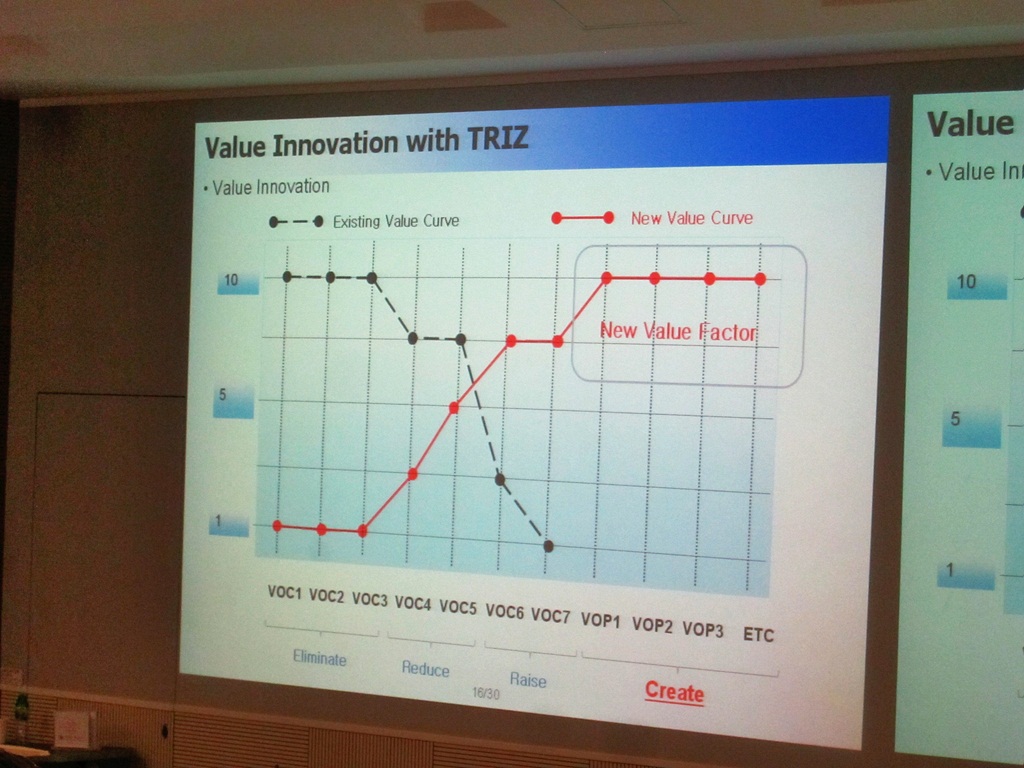

After that he introduced Value Engineering (VE) which was value-up system to improve the product. One example was using Pulverized Coal (Cheap) replaced Cokes (Expensive).
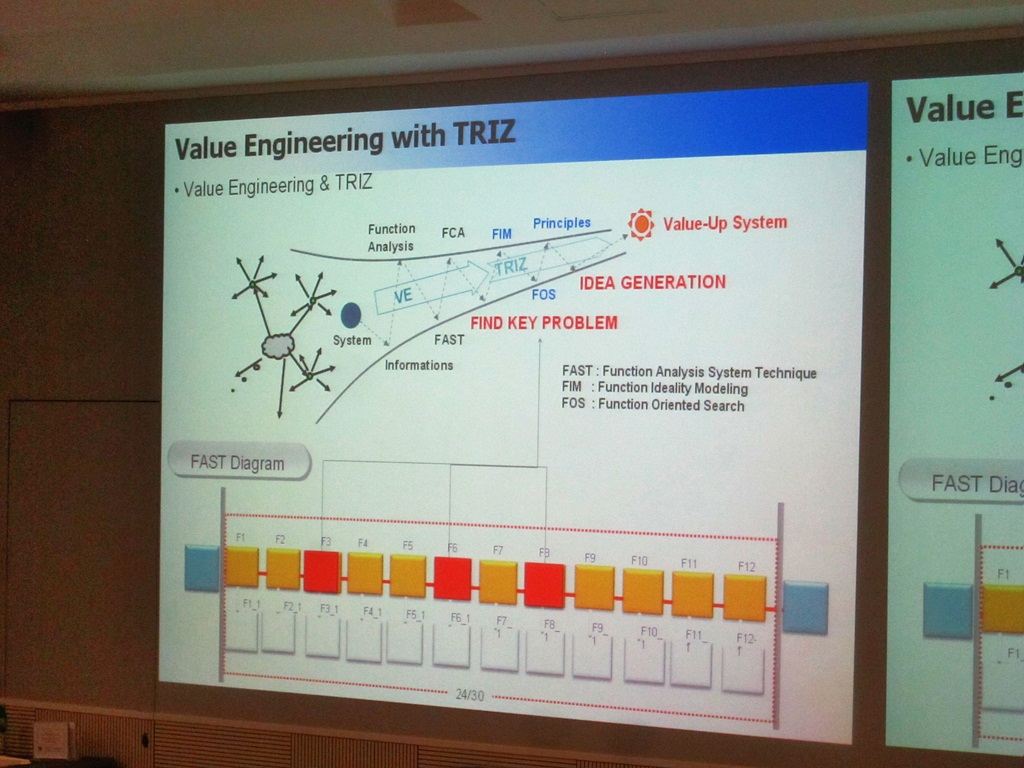

Finally, Mr. Kang introduced the propagation strategy of Value Creation - TRIZ.
1. Preparation Stage
2. Information Stage
3. Analysis Stage: Function Analysis, Su-Field Analysis, Cause Effect Chain Analysis and Flow Analysis
4. Concept Generation: Scientific Effects, 40 Inventive Principles, 76 Inventive Standard, Trend of Engineering System Evolution and ARIZ
5. Evaluation Stage
6. Development Stage
7. Post Study

The afternoon session chairman was Dr. Gregg Li (CEO, Gregg Li and Co; Vice Chairman of Business and Professionals Federation of Hong Kong).


The second session keynote speaker was Dr. Paul Filmore (Postgraduate Projects Manager, Plymouth University, UK) and his presentation entitled "Innovation in Project Management Training".


Dr. Filmore briefed the seven areas requirements for research students included "Research Skills and Techniques", "Research Environment", "Research Management", "Personal Effectiveness", "Communication Skills", "Networking and Team-working" and "Career Management". The most difficult to teach was identified as "Communication".


Dr. Filmore introduced two areas which was the development of the Research Grant Proposal and Complimentary specialist 'lectures' on specific issues. The justification of proposal involved Economic Impact, Commercialization and Sustainability. Then he mentioned the breakthrough-thinking and TRIZ which he spend a lot of time for teaching (See diagram below). Then he briefed MBTI Type Indicator which was a psychometric questionnaire designed to measure psychological preferences in how people perceive the world and make decisions.


The fourth speaker was Mr. Heikan Izumi (General Manager of Project Planning, Izumi Products Company, Japan) and his topic named "Innovative Problem-solving processes based in Japanese Expert Engineers' Solutions".


Mr. Izumi said many expert workers including engineers had retired from 2007 to 2012 in Japan. Therefore, he would like to study the problem solving process between expert and non-expert engineers so as to propose a problem solving method reduce their thinking gap. Expert Engineers were defined as excellent ranking engineer with more than 3 products development a year and the Non-expert Engineers were defined as normal ranking engineer with less than 2 products development a year.


During the study, Mr. Izumi defined two approaches named Specific Technology based Approach (STA) which applied specific technology directly to solve technical problems and Management of Technology (MOT) based Approaches (MTA) which found solutions through logical processes. However MTA was not popular for many engineers because expert engineers already thinking based on MTA as tacit knowing from experiences unconsciously and non-expert engineer depended on expert engineers through STA using MTA indirectly.

After Questionnaire Comparison, Expert Engineers were feeling MTA was more useful than Non-Expert Engineers. After Case study Comparison to reduce sound noise in an electric shaver, it was found that Expert Engineers' solutions covering more root causes than Non-expert Engineer's solutions.


Then Mr. Izumi suggested the problem-solving processes for Non-expert Engineer and they got similar solutions with Expert Engineers. Therefore, Non-expert engineers could have tacit knowing like Expert Engineers by using MTA thinking.

The fifth speaker was Dr. Lin Yue (General Manager, Beijing IWINT Technical Ltd., China) and his presentation title was "The Promotion Mode and Path of Innovation Approaches in Enterprise".


Dr. Lin Yue introduced IWINT business and then mentioned their Knowledge-based Innovation Solution. Moreover, they translated most TRIZ methodology and terms into Chinese. They separated the TRIZ into three parts such as Algorithm, Tools and Terms. In human capital, they provided a systematic training from awareness, experience, application, accumulation and sustainable development of TRIZ.


The last speaker was Mr. Heungyeol Na (TRIZ Expert / Senior Engineer, Samsung Mobile Display, Korea) and his topic entitled "The Successful TRIZ History of SMD (7 tips for the adoption of TRIZ in the company)".


7 Tips for adoption of TRIZ were discussed as follows:
Tip 1 - Try to make CEO to be assured of TRIZ
Tip 2 - Organize TRIZ Promotion Team
Tip 3 - Draw project with Top-down style at the early stage of TRIZ introduction
Tip 4- Choose the TRIZ method which has the problem solving process
Tip 5 - Be carry out TRIZ training course; starting with CEO
Tip 6 - Give Incentive to Internal TRIZ Expert who has TRIZ Level
Tip 7 - Collaborate with other tools which can compensate deficiencies of TRIZ

Top management support was found very strong in SMD. SME CEO recognized TRIZ was able to solve their business problem. Then Mr. Na briefed the TRIZ history of SMD.


The training schedule was introduced which was started from CEO (6 hrs training!!).


The current situation of SMD TRIZ in 2012 was showed in the following diagram.


Q&A session.


At the end, Ir. Dr. YM Wong (Chairman, HKIE-MIE Division) gave a closing remarks. Dr. Wong said Innovation was fundamental quality and competitive advantage in product development. Young engineers were likely to bring many new idea / concept through systematic innovation.


After the symposium, HKSTP team took a group photos and Dr. Aaron Tong joined us together.
(Left: Lotto, Ted, Annie, Danny, TM and Aaron)


The Networking Dinner was arranged after the symposium. All TRIZ Level 1 classmates took a photo with our teacher Dr. Micheal Li.

(Left: William Tsang, Herbert Lee, Dr. Micheal Li, Keble Chan and Lotto Lai)


During the dinner, the Hon Charles Mok (Representative of the Information Technology Functional Constituency of the Legislative Council) gave a honourable speech.


After that 2013 MATRIZ Level 1 Certificate Presentation Ceremony was performed and we took a group photo for memory.

(Left: Carlos Hung, Keble Chan, Prof. Kwok TSUI, Dr. Micheal Li, Ir. Richard Tse, Mr. Charles Mok, Prof. Sergei Ikovenko, Lotto Lai, William Tsang and Herbert Lee.)


Reference:
Institute of Systematic Innovation, HK - http://www.isi.org.hk/
SEEM of CityUHK - http://www.cityu.edu.hk/seem/
HKIE-MIE Division - http://www.hkie.org.hk/eng/html/aboutthehkie/Disciplines/mie.asp
MATRIZ - http://matriz.org/
HKSQ - http://www.hksq.org/index.asp
HKSTP - http://www.hkstp.org/en-US/Homepage.aspx


2013年6月22日星期六

Mansfield (萬賢堂) Grand Opening Ceremony

I was honor to be invited by Mr. Billy Man (Managing Director, Mansfield) to participant Mansfield Consulting Limited Grand Opening Ceremony on 22 June 2013. I knew Billy since 2011. After attended his seminar, I found that Billy is very experience and professional in Service Quality. Then I represented HKSQ to invite him giving us a Service Quality Seminar during World Quality Month in Nov 2011.


Then Billy explained their vision and services included Mystery Shopper Assessment, Service Leader Program, Corporate Training, Sellability Assessment, Barrier Free Service Assessment and Consulting Service. I was interesting in the Barrier Free Service Assessment because it would provide more job opportunity to less fortune people. My idea is that Mansfield provides consulting service and HKQAA provides certification service. It seems perfect matching.


Then I took a photo with some of Mansfield staff. Mr. Joe Lai is one of different ability staffs, who is familiar in Chinese and computer. Ms. Zonta Yung (Business Development Manager, Mansfield) responded for business development.


I also met Mr. Ronald, YF Lau (Chairman, Hong Kong Food Hygiene Administrators Association; Vice-President, Hong Kong Food Council). We exchanged many quality ideas included Food, Education, etc.


Many guests were coming and Billy was very busy.


Then the whole Mansfield team member took a photo. A guest Mr. Law (羅偉祥) (Vice-chairman, Direction Association for the Handicapped) also joined the opening and took a photo together.


I presented a Golden Sailboat to Billy. It indicated that sail smoothly through the New Business (一帆風順).


Let's view Mansfield office.


Training Room


One thing was special that they had considered different ability people.


Reference:
Mansfield Consulting Limited - http://www.mansfieldhk.com/

Billy's seminar:
Seminar on "Service Gauge" on 16 Aug 2011.
http://qualityalchemist.blogspot.hk/2011/08/seminar-on-service-gauge.html
Service Quality Seminar organized by Hong Kong Society for Quality (HKSQ) on 4 Nov 2011
http://qualityalchemist.blogspot.hk/2011/11/service-quality-seminar.html
Service Gauge Seminar on 16 Feb 2012.
http://qualityalchemist.blogspot.hk/2012/02/hkqaa-service-gauge-seminar.html

Barrier Free Accessibility Management System Certification
HKQAA Seminar on Barrier Free Accessibility Management System - http://qualityalchemist.blogspot.hk/2013/04/hkqaa-seminar-on-barrier-free.html

Related HKSQ Activity
HKSQ Dialogue-in-the-Dark Experience on 16 March 2013
http://qualityalchemist.blogspot.hk/2013/03/hksq-dialogue-in-dark-experience.html


2013年6月18日星期二

HKQAA-HKJC Carbon Disclosure e-Platform Launching Seminar

The HKQAA-HKJC Carbon Disclosure e-Platform (CDeP) Launching Seminar was co-organized by Hong Kong Quality Assurance Agency (HKQAA) and The Hong Kong Jockey Club (HKJC) which was held on 18 Jun 2013. CDeP aims to provide an efficient and user-friendly channel that organizations can use to showcase their commitment to carbon management and learn from others over the internet.

I attended the seminar and meet many HKQAA friends. We took a photo before seminar start.

(Left: PC Chan, I, Bryan Peng and Nic Chan)


Starting the seminar, Ir. Prof. Peter Mok (Chairman, HKQAA) gave a welcoming speech. He said HKQAA would continue to conduct R&D project included CDeP which used to encourage the uptake of carbon reduction by organizations in Hong Kong.


Then Mrs. Mimi Cunningham (Director of Human Resources and Sustainability, The Hong Kong Jockey Club) gave an opening remarks. She said Greenhouse Gas (GHG) emissions were approximately six tons CO2 equivalent per person in Hong Kong. Therefore, we had no doubt to set programs to reduce GHG emission. HKJC would focus on energy saving structure, lighting, IT data centre, etc; so as to set a saving target upto 30%.


Launching Ceremony and group photo


The first speaker was Ms. Connie Sham (Senior Manager of Strategic Business, HKQAA) and her topic named "Overview of HKQAA-HKJC CDeP and ISO 14064 GHG Emission Verification". CDeP had five characteristics included Motivation, Disclosure, Benchmarking, Improvement and Transparency.


Firstly, Connie introduced CO2 Equivalent to other gas included N2O, CH4, PFCs, HFCs and SF6. Then she briefed Hong Kong Policy Address (2011-2012) which set the objective to 50-60% carbon intensity reduction as compared with 2005.


The GHG Management circle was introduced. It is like PDCA circle but modified as Measure, Set Objectives, Avoid, Reduce, Switch, Sequester, Assess and Offset. She said the key drivers were Disclosure Guideline, Consumers, Company Strategy, Financial Risk & Opportunity, and Requests from Stakeholders.


Then Connie introduced the HKQAA-HKJC CDeP and its online questionnaire. After performance data collected, the first report was expected to be released at the end of 2013 

After introduced CDeP, Connie introduced the ISO 14064 family as the diagram below.
In ISO 14064 Part 1: Setting Boundaries, organizational boundaries separated into Operational Control and Equity Share. Operational Boundaries further separated into Direct Emissions (Control of the sources) and Indirect Emissions (Result from organization's activities but sources not controlled).


The second speaker was Mr. W.K. Wong (Manager, Carbon and Energy, HKQAA) and his topic entitled "Latest Trend of Carbon Management and Offsetting".


Mr. Wong introduced 400ppm World to us. Earth Systems Research Laboratory announced that atmospheric carbon dioxide concentrations reached more than 400 ppm, that's the highest levels of CO2 recorded in all of human history. Then Mr. Wong reviewed the key milestone of environmental policy in the world.


After that Mr. Wong introduced both China Carbon Reduction Policy and HKSAR Carbon Reduction Policy in the following diagrams. However, I found that the unit of China Carbon Reduction Policy was energy compsumption/carbon emissions per unit of GDP. Hong Kong's policy seems the absolute value.


Carbon Reduction Strategy included "TAX" and "CAP & TRADE" were discussed. Tradable Carbon Credit concept included compliance credit and voluntary credit was briefed. The following diagram showed the Credit generation.


Q&A Session:
I had asked two questions. One was the standardization of CO2 emission calculation and the other was the Carbon trade between Hong Kong and China. Connie said there were no limitation of the calculation in the initial stage of CDeP. Mr. Wong said Hong Kong is one country two systems, so we cannot trade our quote to China.


At the end, Dr. Michael P.H. Lam (CEO, HKQAA) gave an closing remarks. He said HKQAA would be taken an active role on sustainability in Hong Kong.


Reference:
HKQAA - http://www.hkqaa.org
HKQAA-HKJC Carbon Disclosure e-Platform - http://cdep.hkqaa.org/


2013年6月12日星期三

HKAS First Assessment Feedback Seminar for MedLab under ISO 15189

The Seminar named "First Assessment Feedback Seminar under the HOKLAS for Medical Testing Laboratories" was organized by the Hong Kong Accreditation Service (HKAS) on 11 Jun 2013.

Ms. Bella Ho (Senior Accreditation Officer, HKAS) gave an introduction of the seminar. She said the seminar was focused on the NC statement on ISO 15189 new requirement, feedback from laboratories and assessors, and continuous improvement. The NC harmonization seminar would be arranged at the end of 2013.


The speaker was Dr. Alex Chan (Accreditation Officer, HKAS) and his topic entitled "Discussion on feedback & Presentation on previous assessment findings".


It covered the findings from the assessments since 1 Jan 2013. The following topics would be discussed:
1. Overview of assessment findings reported;
2. Selected observations for discussion or clarification;
3. Requirements that laboraties may not be fully aware of.
The overall of assessments was shown in the following diagram.


A) Feedback from Labs and Assessors:
Case 1: Two identical blood grouping auto-analysers gave a final blood group and antibody screen positive or negative. Do it need additional correlation studies of the digitised parameters? During the discussion, it agreed that no need to make correlation of qualitative results by using digitised parameters (except quantitative results).

Case 2: Lab required to quote the source of the acceptable limits of performance for method comparison (e.g. The Royal College of Pathologists of Australasia (RCPA)). The acceptable limits of performance was discussed to be set based on your laboratory situation. 

Case 3: Assessor would like to have a collective understanding on the acceptance criteria for the method validation or verification, review correlation study, IQC and EQAP, etc. It would be discussed in the next harmonisation workshop.

Case 4: An autoanalyser with two detection channels (i.e. Can detect signals from two different reaction cells simultaneously). Do it need to perform correlation study between these two detection channels for the same assay?
During the discussion, both need and no need opinions were obtained. It needed to considered (1) fix for the purpose and (2) continuous improvement. It was also instrument dependence. If two detection channels were not separated, only using IQC and EQAP were enough. If two detection channels were separated, it needed to perform correlation study based on sensitivity concern.

Case 5: The use of stem cell. HKAS replied that the accreditation service had not expanded to stem cell yet.


B) Observations from previous assessments
1. Storage of items in refrigerators - Clinical sample vs reagent
HOKLAS 015 (4th Edition) 5.2.6 Accommodation and environmental conditions (Key words: Incompatible activities; to prevent cross-contamination);
HOKLAS 015 (5th Edition) 5.2.6 Facility maintenance and environment conditions (Key words: Incompatible activities; to prevent cross-contamination); 5.2.3 Storage facilities (Key words: Clinical samples and materials; to prevent cross-contamination)
Note: Eventhough blood sample is clean and reagent is clean, it could be cross-contaminated if they mixed.

2. Storage of items in refrigerators - Blood Product vs Drugs/reagents
HOKLAS 015 (4th Edition) 5.2.6 Accommodation and environmental conditions (Key words: Incompatible activities; to prevent cross-contamination);
HOKLAS 015 (5th Edition) 5.2.6 Facility maintenance and environment conditions (Key words: Incompatible activities; to prevent cross-contamination)
Note: The concept of effective separation to prevent cross-contamination such as separate refrigerators, items well labelled and compartmentalised.

3. Guidelines for statistical analyses
Precision, Linearity, method comparison and inter-instrument comparison were recommended to analyse and interpret the data with appropriate sources of reference.
Note: Laboratory could set criteria and document the justification of such statistical analyses using lab professional judgement.

4. Blood returning record
HOKLAS 015 (4th Edition) 5.3.12 (Key words: safe handing, transport, storage and use of equipment; prevent its contamination or deterioration);
HOKLAS 015 (5th Edition) 5.3.13 (Key words: safe handing, transport, storage and use of equipment; prevent its contamination or deterioration)
Note: Suitability of the returned blood products for transfusion is an important issue (e.g. Within 30min). It should be Major NC if not fulfilled the requirement.

5. Decontamination of biosafety cabinets (BSCs)
A disinfectant cleaner and 75% alcohol were used to decontaminated the BSCs once per month or on the day just after PM.
HOKLAS 015 (4th Edition) 5.3.7 (Key words: to decontaminate equipment prior to service, repair or decommissioning);
HOKLAS 015 (5th Edition) 5.3.1.5 Equipment Maintenance and Repair (Key words: to decontaminate equipment prior to service, repair or decommissioning; provide suitable space for repairs and appropriate PPE)
During the discussion, some lab decontaminate the BSCs per 3 month and before PM. The frequency of PM depended on the usage. The decontamination (e.g. Fumigation) should be performed prior to every PM (e.g. Access to potentially contaminated parts, carrying out filter penetration tests, after a spillage where inaccessible surfaces, etc.) (Reference: BS 5726:Part 4:1992 - 4.2 Fumigation).
Note: Adequately protected from biohazards; Justification and proof on the effectiveness of the decontamination procedures should be kept.

6. Functional check of autopipettes
HOKLAS Supplementary Criteria No. 2 recommended to verify autopipettes once every three months.
HOKLAS 015 (4th Edition) 5.3.2 (Key words: Equipment shall be shown to be capable of achieving the performance required);
HOKLAS 015 (5th Edition) 5.3.1.2 (Key words: capable of achieving the necessary performance)
According to Harmonisation Workshop for Microbiology on 1 Nov 2012, justification and objective evidence were needed to prove the performance of the autopipettes were satisfactory. For less frequent verification because of its infrequent use, lab should provide evidence. However, the extension was restricted to the same brand/model of pipette with similar routine frequency of use shown by the evidence.
Note: Key point was without justification.

7. Calibration labels on autopipettes
HOKLAS 015 (4th Edition) 5.3.2 (Key words: Equipment shall be shown to be capable of achieving the performance required);
HOKLAS 015 (5th Edition) 5.3.1.2 (Key words: capable of achieving the necessary performance)
Note: If calibration or performance verification is done and the problem is just out-dated label, this would only be a "Recommendation".

8. Evaluation of Euroimmune Analyser I
HOKLAS 015 (4th Edition) 5.5.2 (Key words: Only validate procedures for confirming the examination procedures are suitable for the intended use; The validations shall be as extensive as are necessary);
HOKLAS 015 (5th Edition) 5.5.1.2 (Key words: performance claims for the examination procedure have been met; relevant to the intended use of the examination results)
Note: If the test is qualitative in nature, and there are a sufficient number of positive/negative/borderline samples covered in the evaluation, the LOD determination may not be necessary depending on the intended use of the test.

9. Quality Control for coagulation
QC materials frozen which is against manufacturer's recommendation such as 2C to 8C.
HOKLAS 015 (4th Edition) 5.3.2 (Key words: capable of achieving the performance required);
HOKLAS 015 (5th Edition) 5.3.2.2 (Key words: store received reagents and consumables according to manufacturer's specifications.)
Note: Lab needs to provide evaluation data to support the rationale of freezing the aliquots.

10. Quality Control of Hematoxylin and Eosin staining (H&E staining)
HOKLAS 015 (4th Edition) 5.6.1 (Key words: verify the attainment of the intended quality of results);
HOKLAS 015 (5th Edition) 5.6.2.1 (Key words: verify the attainment of the intended quality of results)
Note: Daily QC of H&E staining is suboptimal. Alternative reference material showing different cellular staining pattens.

11. Sterilisation of Container
HOKLAS 015 (4th Edition) 5.3.2 (Key words: Equipment shall be shown to be capable of achieving the performance required);
HOKLAS 015 (5th Edition) 5.3.1.2 (Key words: capable of achieving the necessary performance)
Note: The media will be subjected to sterilisation after being made up. Therefore, a clean container, not necessarily sterilised should be used for media preparation.

12. Use of accreditation symbol
The new symbols have to be used for all new documents starting from 1 November 2010.

13. Fumigation Frequency
The fumigation of BSCs in the TB laboratory was found to be performed every three monts.
Note: No international standard or consensus on fumigation frequency was found. It depended on actual workload and examination procedures undertaken by the laboratory. For safety, the level of formalin shall be monitored after fumigation (ceiling limit of 0.3ppm recommended by the Labour Department).

14. Internal Audits
It was found the IA did not cover any new tests.
HKAS SC No.5 - Internal Audit and Management Reviews - 5.8 when organization seek extension of accreditation, the management should ensure audits are carried out and corrective actions are taken before the HKAS on-site assessment.

15. Elements covered in Code of Conduct document
HKAS SC No.6 - Code of Conduct 2.2(k) should be considered
2.2(k) - Procedures for reporting suspected violation and established mechanism for the prompt and fair adjudication of alleged violations

16. Records of the ingredients of in-house media
In-house media means media to be made up by weighing each specified component in the formula.
HOKLAS SC No.27 5.5.6 - Records shall be kept of the preparation details for all types of media including: (f) Media ingredients, manufacturer, manufacturer's batch number and quantity of each component
Note: No need to record provided that (i) the media are made in accordance with the formula give in the SOP; and (ii) Both positive and negative controls available to evaluate the performance of the in-house media after it's been made.
HOKLAS 015 (5th Edition) 5.3.2.3 Reagents and consumables - Acceptance testing (Key words: Consumables that can affect the quality of examinations shall be verified)
Note: Culture media are considered as consumables.

17. Source of Eggs for Lowenstein-Jensen Medium Preparation
It used for culture of mycobacteria such as Mycobacterium tuberculosis.
Note: a known source allowed traceability in case the eggs appeared to have problems. It belongs to supplier management.

Reference:
HKAS - http://www.itc.gov.hk/en/quality/hkas/about.htm

2013年6月4日星期二

VIIV24之公民抗命(Civil Disobedience)

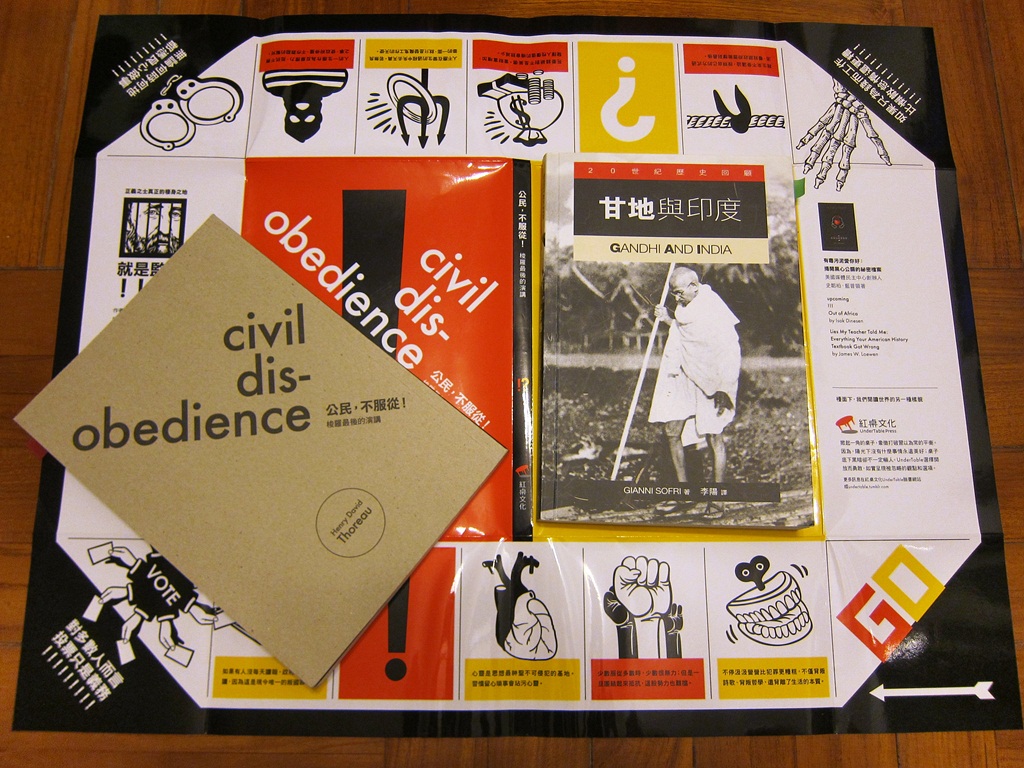
今年是六四第二十四個年頭(VIIV24),六四臨時記念館設在城市大學中。 今天想說說有關公民抗命。因為「佔領中環」運動的提出,它應源於公民抗命。我就嘗試用比較出名的公民抗命事跡及其背景作比較,及分享一些閱讀來的精句。

(圖一:民主女神像放在城市大學圖書館門前)


(圖二:六四臨時記念館)


(圖三:五月三十一日晚在PolyU開會,看到有六四講座,謝志峰是其中一個講者。)


事件1:梭羅在一八四六年七月二十四或二十五日,被逮捕及在牢裡關了一夜。因他從一八四二年停止繳人頭稅。而《公民不服從》寫於一八四九年。

當年背景:美國本土蓄奴,墨西哥受美國侵略。
美墨戰爭(1846-1848)是美國與墨西哥為邊界爭議引發的戰爭,當時大多數的美國人認為擴展領土是天命。廢奴人士則認為是美國為了延伸蓄奴的範圍,才極力入侵墨西哥。美國把現今的加州、內華達州、猶他州、大部份的亞歷桑那州與新墨西哥州地區、部份科羅拉多州及懷厄明州佔為己有。

文章中的精句:
  • 「政府管的愈少愈好」這句話梭羅由衷贊同。
  • 政府教育人民要尊重法律、法律即正義,此舉實不可取。人民唯一的義務是:無論何時,都只憑良心做事。
  • 我們要知道,法律不會讓人更講道義,每每因為遵守法律,人民反而淪為不義之事的幫凶。不適當地尊重法律,自然會導致這種下場:整隊軍人,上從將軍、團長、統帥,下至下士、小兵、火藥手浩浩蕩蕩,翻山越嶺,違背自己的意願、判斷跟良心投入戰場,也因此舉步維艱,於心不安。
  • 在實行蓄奴的州裡,自由之士唯一能住得有尊嚴的地方只剩下監獄了。
  • 但要是今年有一千人不繳稅,這抗爭的方法就是既非暴力也不流血,不過要是大家都乖乖繳稅,就等於是把錢送給政府去施暴、殘害無辜。實際上,如果革命可以和平地進行,那麼拒絕繳稅就是可行的做法。
  • 真理不會自相矛盾,也不會專用錯誤的手段去彰顯正義。

事件2:甘地在一九一零年代的非暴力與不合作運動包括:抵制英國貨,自己動手織布、鹽隊遊行及數次絕食抗議、入獄,以個人的身體作為政治的武器。

當年背景:印度移民在南非的公民自由和政治權利在很大程度上被剝奪的現狀及種族歧視問題。印度在英國的統治下,大肆開採自然資源,延誤了印度的經濟發展。印度的大地主便和英國大公司一起興旺發達了起來,而饑餓則越來越多地對農民構成了威脅。在一八五零年至九零零年間,總共發生了二十四次階段性的饑荒,造成了二千多萬人餓死。

書中的精句:
  • 甘地的非暴力主義名為Satyagraha,意思是「真理的力量」。尋求真理將永遠不容許使用暴力來對付自己的敵人;必須通過耐心和理解使對手擺脫謬誤;而耐心則意味著心甘情願地忍受痛苦。
  • 甘地認為一個堅持真理的人的目的永遠是以愛感化敵對者時,不可能拒絕和對手交道。

事件3:馬丁·路德·金在一九六零年代的非暴力運動包括:蒙哥馬利罷乘運動、入座運動和向華盛頓進軍。在一九六四年美國國會宣佈種族隔離與種族歧視政策違法。

當年背景:根據阿拉巴馬州法律,所有的公共設施都實行「分離且平等」的原則,蒙哥馬利的公共汽車也因此實行黑白分座。黑人大學生來到一家連鎖店的吧台買酒,遭到拒絕,理由是「我們不為黑人服務」,入座運動由此開始。在一九六三年爭取黑人工作機會和自由權的,及發表著名演講《我有一個夢想》。


事件4:六四民運在一九八九年,適逄五四運動七十周年,北京學生以非暴力方式與政府對抗。最後變成血洗京城。

當年背景:事件由哀悼胡耀邦起,大學生在追悼清官同時反貪官污吏。在四月十八日,北京五大學學生遊行靜坐,在遊行沿途高呯「打倒官倒」及「打倒貪污」。北京在1987年至1988年展開經濟改革時反而導致消費者物價指數提升高達30%;陸續有國有企業宣告關閉,導致當時中國總共有數百萬名工人處於失業狀態。同時中國社會除了那些尚未遭到撤職並持有「鐵飯碗」工作者外,絕大多數人民過去所享有的醫療保健、住宅補貼等社會福利紛紛取消。老百姓當時生活苦不堪言。


事件5:佔領中環計畫在2013年3月27日正式啟動,它是香港大學法律學者戴耀廷教授提出。他在1月16日投稿信報,以《公民抗命的最大殺傷力武器》為題,鼓勵市民及民間領袖以事先張揚的形式實行違法、非暴力的佔領中環行為。而參與者不是因一時衝動,是因一份對公義的渴求,並願意為公義負上代價。

現今背景:香港根據基本法在二零一七年普選行政長官,但泛民認為程序上有不公義的地方。其他問題包括:貧富懸殊的問題、青年人沒有發揮機會的問題、醫療及老人的問題等。總括政治權力分配不公及深層次矛盾。

以下表及圖是不同事件的不公義程度對非暴力程度*。只是筆者個人意見作為參考,如有更好的評估機制,請多多指教。

(*非暴力程度是考慮了康德所提出的自由法則,在不妨礙別人的自由這個前提下,我們可以盡量爭取我們的自由。)


對於佔領中環行動,我的看法是悲觀(同施老闆一樣)。因為它的道德感召力不足,這是不公義程度未到達人民醒覺的門檻。就算行動進行,當人過了四十歲,他們的專業資格已經完成,正是事業發展及賺錢的黃金十年。如要照顧父母又有兒女的更不會考慮。這是機會成本的計算。(我記得讓子彈飛最後的一場,給槍人們都不敢作反,直到人們認為已經推翻了權力後才敢作反。)最後參與的人,就只有吃政治飯的人,退休人士及學生或初出茅盧的青年人。如果有一萬人願意佔領中環,不如改作不繳稅,個人覺得效果更好。最後以施老闆的訪問中的一句作結:施永青承認,自己思想理想主義,但行動要照顧現實。


附錄:
有關支聯會的口號爭議:「愛國愛民,香港精神」「平反六四,永不放棄」,李卓人忘記了支聯會全名是「香港市民支援愛國民主運動聯合會」。
華叔說:『我認識到,真正的愛國,並不是愛一個政黨、一個政權、一個領導,而是愛自己的同胞,愛民族的傳統文化,愛祖國的大地山河,即是人民、文化、土地,這是我愛國的根本因素。』
司徒華(2011),《大江東去司徒華回憶錄》,OXFORD (第107頁)
而我最支持的口號是在2011年22周年的「平反六四,革命尚未成功;建設民主,同志仍須努力。」
(每年六四都在家中悼念,真的不想記起,但未敢忘記。從二十周年開始,每年六四都要寫一篇文章來悼念。)

去年今天:華叔的智慧

Reference:
亨利。梭羅(譯者:劉粹倫)(2012),《公民,不服從! 梭羅最後的演講》,紅卓文化。 (Henry David Thoreau, 1849: Civil Disobedience)
GIANNI SOFRI (譯者:李陽)(2006),《甘地與印度》,三聯書店(香港)有限公司。


佔領中環對談系列:可望而不可即的普選夢 (施永青)
立場是「反」(石鏡泉)
中環中女看佔中

魔術師之佔中通識
20130513:佔中通識(一)之洗腦由中學開始(2nd edition)
20130520:佔中通識(二)之花拳繡腿
20130521:佔中通識(三)之膠都廢事俾
20130610:佔中通識(四)之威人威威不是威
20130701:佔中通識(五)之跟馮培漳抬槓
20130714:佔中通識(六)之問卷調查


2013年5月26日星期日

ASQ InfVoices - Quality Trends in Uncommon Places

The May Topic of ASQ Influential Voice was "Quality Trends in Uncommon Places" which initiated by Paul Borawski (CEO, ASQ) on 9 May 2015. It has multiple topics for discussion included "Workplace Motivation and Goals", "Charm and Fascination (or Soft Skills)", "The Quality/C-Suite Connection" and "What's The Future of Quality?"

For motivation, I agreed with Daniel Pink that "Money" is a motivator. Besides money, the three key motivators are autonomy, mastery and purpose. It is similar idea in my article "Staff Motivation Snapshot" in 2008. It mentioned there were four common factors of motivation including "Worthwhile Work", "The Power of Acknowledgement", "Your Personal Credibility" and "Working Through People".

The second question from Paul is "How do you make yourself distinct as a quality professionals? As a quality professional, quality technique and philosophy (called hard skills) are default. But the soft skills included communication and leadership are also key elements to distinct quality professionals. I remembered I told my colleagues that my job (Quality Manager) is talking more than working!

The common problem is about the disconnect between the quality department and the C-suite. It is still very difficult to help building a bridge to the C-suite. I have only 10 min to brief about company quality management review to the C-suite annually.

Finally, ASQ do a beautiful job on studying the Future of Quality every three years and released Global State of Quality Research report recently. However, my personal view on the future of quality will be focused on New Industry - Social Media. "Quality in Social Media" should be the new topic and new trend of Quality in Uncommon Places. Recently, I read Dragon's book named "Social Marketology" and he introduced Social Media Platforms named "Social Pyramid Diagram" with Nine Significant Devices. I would like to show the diagram of Facebook for sharing.


One of roles and responsibilities Dragon proposed was "Community Manager" who span both internal and external communities. I expect the Community Manager also had a role as quality manager.

Reference:
Dragon, Ric. (2012) "Social Marketology: Improve Your Social Media Processes and Get Customers to Stay Forever", McGraw-Hill.


LinkWithin

Related Posts with Thumbnails