2013年5月12日星期日

CityU Spring Research Conference on Systems Engineering and Management Science 2013

The Spring Research Conference on Systems Engineering and Management Science 2013 (SRC-SEMS'13) organized by Department of System Engineering and Engineering Management (SEEM) and Department of Management Science, City University of Hong Kong from 10 - 11 May 2013. SRC-SEMS'13 aimed to provide a research platform for academics and researchers, particularly young faculty and graduate students, in Greater China region and neighbouring areas to share and exchange experience and research findings in various disciplines of Systems Engineering and Management Science

The conference was held in City University of Hong Kong Shenzhen Research Institute (CityUSRI), Shenzhen Hi-tech Industrial Park, Nanshan District, Shenzhen, China.


HKSQ members supported the activities. (Left: Mr. Ivan Ng, Dr. Andy Wong and I)


Since I only attended the afternoon session on 10 May 2013, I would like to summarize some of activities for sharing.

In Healthcare session, Ms. Meiyan Lin who was PhD student under Dr. KS Chin and her presentation topic named "An Integer Programming Model in Elderly Care Timetabling: A Case Study" Her study aimed to efficiently generate a service schedule to improve the operational performance of the center.


In Quality session, the second speaker was Mr. C.H. Lam, who was a study under Dr. Ken Yiu, and his topic was "Evaluation of Total Quality Management in Hong Kong Higher Education. His study purpose was to evaluate the programme organized in the university and student experience in the programmes, so as to provide the useful information to the university policy planners.


Mr. Ivan Ng presented his research subject named "The Impact of Cultural Factors on Quaity Management in South China". His study considered both Chinese cultural characteristics and the organization culture profile through a series of multiple individual interviews in Hong Kong and Shanghai, an online survey performed in Hong Kong to explores the best practices of Six Sigma with regards to objectives, values, implementation and change, as well as, outcomes.


I as session chair presented a certificate to Mr. Ivan Ng.


In my part, my presentation topic was "Extension the Application of the QISM Model to iLMS Model: HKSTPC Case Study". I had developed QMS based Information Security Management (QISM) model for my EngD study since 2008. QISM Model was integration approach between ISO 9001 and ISO 27001. This paper aimed to extend the existing QISM model to the Integrated Laboratory Management System (iLMS) Model and a case study involved in the Technology Support Centre (TSC) at HKSTPC.


Dr. Ken Yiu presented a certificate to me.


The last session I attend was presented by Prof. Jingxian Chen and his topic entitled "Easing the FMEA with the DHU Model of Software Architecture". Prof. Chen studied why FMEA worked well for hardware engineering but did not work in software quality assurance. He pointed out that hardware products and their manufacture processes possessed Work Breakdown Structure (WBS) property whereas the counterpart for software products had not known yet.


During the Banquet, Dr. KS Chin (Program Chair) gave an opening speech.


Then Prof. Kwok Tsui (Conference Co-chair; Head and Chair Professor, SEEM Dept., CityUHK) gave a welcoming speech.


I took a photo with Dr. KS Chin (my EngD supervisor).


At the end, we took a group photo for CityU members and guest speakers.


Reference:
SEEM, CityU - http://www.cityu.edu.hk/seem/
HKSQ - http://www.hksq.org/index.asp


IIE(HK) Seminar on Delivering Change and Creating Value through IE Methodology

The Seminar on Delivering Chang and Creating Value through Industrial Engineering (IE) Methodology was co-organized by the Hong Kong Productivity Council (HKPC) and Institute of Industrial Engineers (Hong Kong) (IIE(HK)) on 10 May 2013. Hong Kong Society for Quality was one of supporting organizations. The objective of this seminar is to share the success stories of applications of IE methodologies for service upgrading to bring about customer satisfaction.

In the beginning, Dr. Sammy Wan (President, IIE (HK)) gave an opening speech. He said industry engineer methodology was able to apply in different field included transportation, parks, public utility, logistic and healthcare, etc. It was honor that the seminar had invited different IE professional to share their experience.


It was our honored to have Ir. Dr. the Hon Lo Wai-kwok, BBS, JP (Member of the Legislative Council (Engineering Functional Constituency) to deliver an honorable speech. Dr. Lo said his first job was in IE and his first Master degree was also in IE. He remembered the principles in IE such as 4M – Man, Machine, Money and Method. Moreover, the first IE Internation Conference in China was held in 1988 which organized by HKIE – PIE division (now named MIE division).


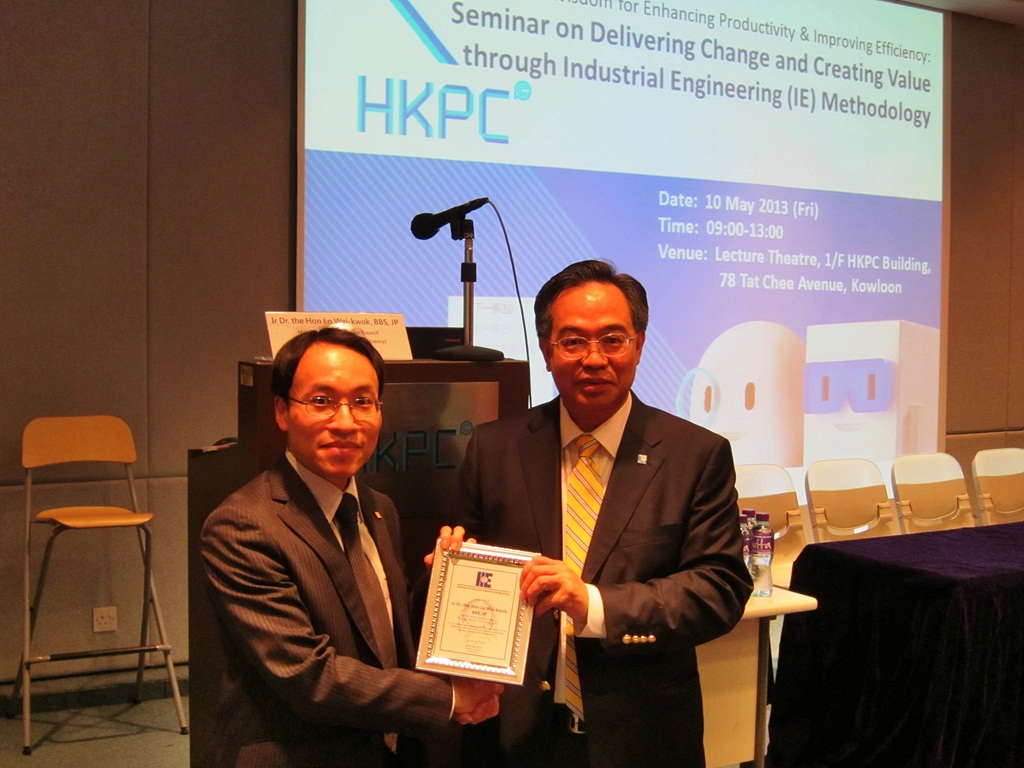
Then Dr. Wan presented souvenir to all guest speakers.


I was honor to take a photo with Dr. Lo before he went back to Legislative Council of Hong Kong (Legco) for meeting.


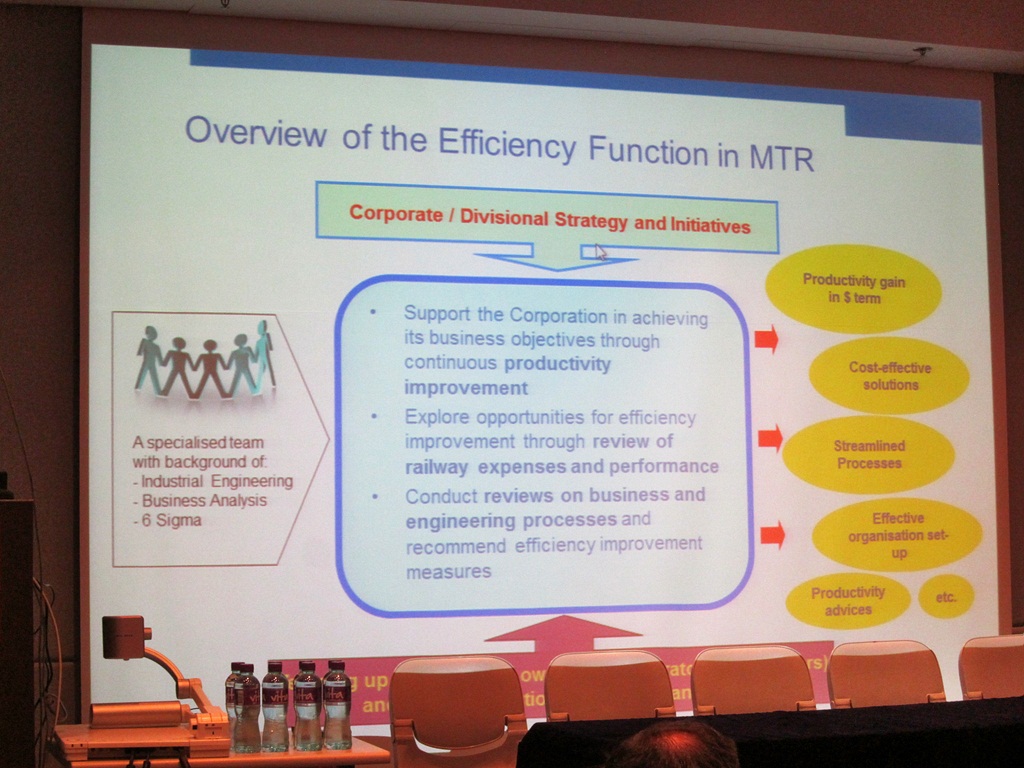
The first speaker was Mr. Ryan Y.Y. Li (Acting Corporate Efficiency Manager, MTR Corporation) and his topic entitled “Application of IE Techniques in Railway Service Delivery”. Mr. Li introduced the challenge in MTR for daily patronage over 5 million. Highly cost effective, no compromise in safety and quality were key challenge in MTR.


Mr. Li explained how Specialised Team in Corporate Efficiency Unit used IE knowledge could help in MTR to integrate various areas of railway operational and asset management knowledge and expertise. For example:
- To identify effectiveness and productivity improvement opportunities;
- To provide recommendations for achieving higher cost effectiveness and raising productivity;
- To facilitate implementation of improvement actions.

Mr. Li said the team approach was important through identified initiatives, conducted review, defined improvement actions and implemented changes. They were advocates of mind-set change for challenging the shortfalls in productivity during participation in the team environment.


Finally, Mr. Li introduced different typical application of IE techniques in MTR including:
- Enhancement of workshop capacity for new train overhaul
- M-Train overhaul process study
- Maintenance strategy for Light Rail Track Point machine assembly maintenance
- Maximizing utilization of non-traffic-hours (NTH)
- Customer service centre work study
- Review on business processes for ticket inspection unit
- Standardization of allowance claim process

Mr. Li shared his personal remarks that IE application was not necessarily rocket-science technology but it closed to our daily life. IE focused on taking a holistic view, and working with experts in different specialized areas, as well as, managing the white space of the organization chart. Moreover, he said while the theoretical base of IE was a science but its application was an art. Nevertheless, the most important complementary element for successful application of IE methodology was “Common Sense”!

The second speaker was Ms. Rosalyn Woo (Industrial Engineering Manager, Hong Kong Disneyland) and her presentation named “Turning Science into Magic in a Theme Park”. She briefed the four keys of Disney Guest Service included Safety, Courtesy, Show and Efficiency.


She said that the IE competencies included Capacity/Demand Analysis, Measuring the Impact, Process Design & Improvement, and Advanced Analytics. Its application covered Project Development (e.g. Park Expansion), Cost & Labor Optimization, and Operational Planning & Support. For costuming Inventory, the following activities were employed to reduce the labour cost, laundry cost, transaction time and inventory.
IE activities included:
- Project ROI, Technology testing and evaluation, RFID tags change-out schedule, Facilities and user interface design, Process flow design and Report creation


The Third speaker was Ir. Peter Chak (Customer Enquiries and Installation Services Manager, The Hong Kong and China Gas Company) and his presentation was “Inspection Robot for Gas Service Pipes”. Mr. Chak briefed the background of transmission of town gas. Then he explained why the risers got corroded because of building environment (e.g. Drainage pipes, Acid wash of external walls) and Hong Kong climate (High temp, Near saturation humidity, Sea-salt corrosion and Air pollutants).


Then Mr. Chak introduced the regular safety inspection for more than 1.75 million accounts and the cycle time was 18 months. But the low access rate during regular safety inspection (below 50%) and more than 50% risers were not able be inspected. Therefore, they developed Riser Inspection Robot with gas detector and camera which collected the image and leakage signals, then transferred by wireless system. The robot contained three system included Lifting system, Motion system and Inspection system. There were six classes of riser corrosion through vision inspection of the image taken. Moreover, Town Gas developed a Riser Health Index to monitor the healthiness of risers. Finally, Mr. Chak concluded they would development a comprehensive pipeline inspection system continuously.


Mr. Lam Wing-chiu (Terminal & Capacity Planning Manager, Modern Terminals Limited) was the fourth speaker and his topic entitled “Productivity Uplifting in Container Terminal”. Mr. Lam introduced the business of container terminal that they moved container boxes "to" and "from" container vessels to inland transportation. He said the container crane in horizontal level, indicating under operation. If the container crane left up, it mean the crane idle.


Reviewing the port statistics of top 10 container port in the world, Hong Kong was ranked second (after Singapore) since 2006 and then Hong Kong became the third port (after Singapore and Shanghai) since 2007. Shanghai overtook Singapore as the world's busiest container port in 2010. In 2012, The million TEU* of Shanghai, Singapore, Hong Kong and Shenzhen were 32.5, 31.6, 23.1 and 22.9, respectively.
(*The unit of container throughput is million TEU (Twenty-foot Equivalent Unit).)

The following diagram was comparison the throughput among Hong Kong, Shenzhen and Nansha. It could be confirmed Shenzhen would takeover Hong Kong in 2003 because of Dock Strike.


After that Mr. Lam introduced the "New Horizon" project in MIT aiming to improve operation performance and enhance productivity through changes three areas include Process Review, Technology Upgrade and Organization Realignment. The process would focus on Work flow review, Interviews, Time & Motion study and Activity log.

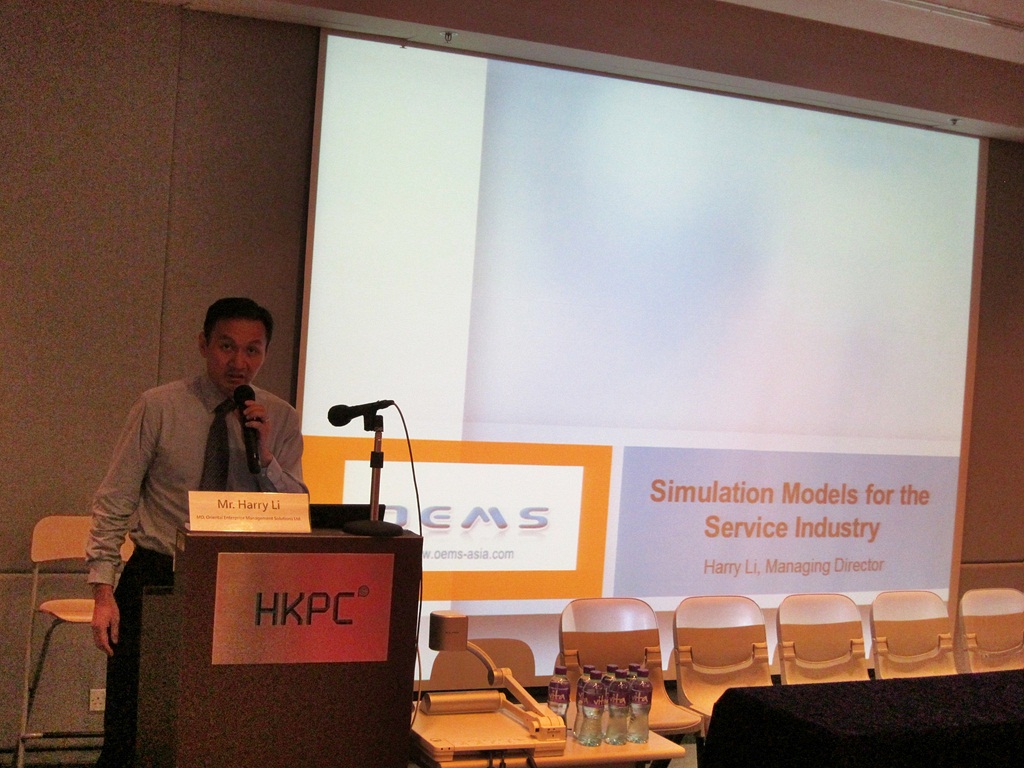
Mr. Harry Li (MD, Oriental Enterprise Management Solutions Ltd.) was the fifth speaker and his presentation was “Simulation Models for the Service Industry”. Mr. Li mentioned Simulation for Business allowed organization to "Experiment" using an accurate model before "flying the real thing" and allowed Businesses to Innovate profitably by enabling Low Cost "Serious Play".


Then Harry introduced several major applications of systems simulation in service industry such as Transportation, Airport, Call Centre, Financial, Insurance, Healthcare, and Logistics, etc. After that Harry shared his projects in Transportation System and Healthcare System.

For transportation system, the project objective was to simulate the flow of passengers in metro stations to identify bottlenecks and points of congestion during rush hours.

For Healthcare System, the project aimed to simulate one of the surgical floors of the hospital specialist cllinic and using the floor layout of the proposed clinic and use the data from another clinic around the area. One of suggestions was asked patients went directly to treatment rooms for pre-consultation rather than went to unoccupied consultation rooms for pre-consultation.


The last speaker was Ir. Dr. Encon Y.Y. Hui (RPE) and his presentation topic named "Challenges of Facility Management in the Healthcare Industry". Firstly, Dr. Hui used P3 to explain Facility Management (FM). P3 was Plant x People x Process.


Then Dr. Hui introduced hospital facilities included HVAC, Piped Services, Electrical, Medical System. Those facility elements had their life cycle planning. The follow table compared some characteristics among FM in Hospital, Manufacturing and Malls & Offices. Finally, he introduce IE Way named ROW stand for Risk reduction, Outcome orientation and We as a team for Win-win. Dr. Hui also reminded us to rethink IE that less focused on hardware specific details, more focused on system & software or soft technology.


The Q&A session

Reference:
IIE(HK) - http://www.iiehk.org/
HKPC - http://www.hkpc.org/


2013年5月9日星期四

ISSC Six Sigma Networking Night 2013

I (Former Chairman, Hong Kong Society for Quality (HKSQ)) was honor to be invited by Dr. Rita Wan to attend International Six Sigma Council (ISSC) Networking Dinner again on 8 May 2013.

Before the event, HKSQ exco members took a photo with Mr. Barry PW Lo (Guest Speaker) and Dr. Jason Kong (Vice Chairman of ISSC).
(Left: Prof. Fugee Tsung, Dr. Jason Kong, Mr. Daniel Choi, Mr. Barry Lo, Dr. K.S. Chin, Mr. Percy Chan and I)


In the beginning, Dr. CO Chan (President, ISSC) introduced the ISSC and reviewed the activities in 2012. The ISSC is a non-profit making organization of quality practitioners and subject matter experts that saw the need for standardization in the Six Sigma field. Moreover, ISSC mission is to promote best practice and standards in all areas of Six Sigma and Quality fields.


ISSC Building Blocks which contained six pillars to support the quality excellence were introduced. Then Dr. Chan briefed the structure of ISSC that was governed by the Examination Board & the Executive Committee elected by registered members of ISSC; and was supported by an Advisory Board consisting of Six Sigma companies and University professors majoring in the field.


Mr. Barry PW Lo (General Manager, Head of Bank-wide Operation, Bank of China) was our guest speaker and his topic named "Operational Excellence with Lean Six Sigma in BOCHK". Mr. Lo shared his Lead Six Sigma deployment experience since 2011.


Firstly, Mr. Lo introduced BOCHK which established on 1 Oct 2001 and over 260 branches, more than 900 self-serviced machines and other direct banking channels. Then he highlights their achievement in 2012 that the net operating income before impairment allowances increased 15.9%. Mr. Lo mentioned their RPC model (Relation, Product Management and Channel Management) and BOCHK Service Chain. In this chain, there were separated into three phases as Initiate, Scale Up and Transformation.


BOCHK Bank-Wide Operation Department (BWO) had approximately 1700 staff and 239 process. He used Lean Six Sigma in BWO to achieve Operational Excellence through Centralization (integrated similar nature process) and Industrialization (Culture change to make things happen). Moreover, they got the COO support (i.e. Top Management Committee).


Mr. Lo (ISSC certified Black Belt) led his team to Operational Excellence. Under his leadership, 13 Black Belts, 170 Green Belt and over 200 Yellow Belts were trained and completed 40 projects in 2012 and 70 projects in 2013. During Q&A session, other guest asked how to achieve it and what was the critical success factor? Mr. Lo told us because of environment in 2008 (Global Financial Crisis) that they needed to change.


After that Mr. Lo built Lean Six Sigma Cultivation with many activities included award & recognition, exhibition boards, lunar new year gift, YB focus group and spirit songs (He played the song and it was very high quality.)

During the networking time, we took a photo with Mr. Nick Williams (Group - Head of Business Transformation, HAECO).


Dr. Aaron Tong (Former Chairman, HKSQ) joined us to take a photo with guest speaker again.


Then Ir. Prof. Philip Chan (Arbitrator – Guangzhou Arbitration Commission) showed his new toys (Portable projector). Very useful!


Prof. Fugee Tsung won the networking game (Competition for collecting name card and remember the person character)


Group photo of all participants (including ISSC, HKSQ, IETHK, SSS, etc.)


After that Ir. Henry WH Leung (Chairman, Management Section Committee, IETHK) introduced the coming symposium named "Sustainability Management - Smart Use of Energy and Water for a Better Environment". (Refer to http://www.theiet.org/events/local/170633.cfm)


Luck draw after the dinner


At the end, Dr. Rita Wan (Chairman, ISSC) gave a closing remark. During our discussion, we would like to arrange activities such as award to promote Lean Six Sigma.


Reference:
International Six Sigma Council - http://www.isixsigmacouncil.org/

2013年5月4日星期六

Stem Cell Knowledge Exchange Exhibition 2013

Today (Saturday), I went to Hong Kong Science and Technology Park and found Stem Cell Knowledge Exchange Exhibition organized by Stem Cell & Regenerative Medicine Consortium (SCRMC), The University of Hong Kong. It is the first time exhibition in stem cell for secondary student in Hong Kong.

The Stem Cell & Regenerative Medicine Consortium (SCRMC) in the LKS Faculty of Medicine at HKU takes a multi-disciplinary approach by broadly integrating various existing unique strengths at HKU, novel medical concepts and state-of-the-art facilities to strategically focus on topics from basic stem cell biology to translational bench-to-bedside regenerative medicine. SCRMC was officially established in June 2010 with funding support from the LKS Faculty of Medicine, HKU and private donations.


Then I visited their exhibition which presented by secondary school students through their project about stem cell.


They had Facebook for stem cell (see reference).


Student prepared game to question about stem cell ethics arguments. Embryonic Stem Cell was deemed to be controversial as it involved the development of Embryos.


Prof. Ronald Li (Director of SCRMC) discussed with students about their topics.


The other topic about Stem Cell Cosmetology was presented but I was afraid nobody dared to try it.


Another team of student introduced the In-vitro meat which was the manufacturing of meat products through stem cell technology. They said the production of in-vitro meat without causing any pain to animals and it compromised the concern on animal rights while fulfilling human's eating habits.


After the award presentation, some student took a photo with Prof. Ronald Li for memory.


I was happy to met many secondary school students who were going to develop their knowledge in stem cell technology.

Reference:
Stem Cell & Regenerative Medicine Consortium (SCRMC) - http://www.med.hku.hk/stemcell/index.htm
Facebook site - https://www.facebook.com/hku.stemcell

LinkWithin

Related Posts with Thumbnails