2011年1月15日星期六

7 Steps to Grow More with Less

An Executive Study Group organized by the Chinese University of Hong Kong (CUHK) and the Hong Kong Science and Technology Parks Corp. (HKSTPC) is a monthly gathering which facilitates networking and interactions between academics and senior executives of leading enterprises. The topic entitled7 Ways to Grow More with Lesswas held on 17 January 2011.


Mr. Mark Lee was the speaker and his talk was included “The Granularity (Nano-View) of Growth”, “Winemaker's Logic”, “7 Ways to Grow Through Focus” and “Group Discussion”.


In the beginning, Mr. Lee explained why growth of company was so important. It was because the company might be acquired by other high growth rate company. Then he explained some common pitfalls for the growth.
i) Impact of the Economic - Low economic environment cause low growth?
ii) Pitfalls of Blind Expansion - seek growth by extending existing product lines
iii) Impact of Being More - Increase complexity of the organization and operation

Then He introduced the Portfolio Momentum Strategy which included "Organic revenue growth", "Learning from the skills of financial industry", "Through market growth of the segments represented in the portfolio", "Select acquisitions and divestment" and "Create market growth by introducing a new product category".

The diagram showed the different growth rate between Industry Level and Company Level. It explained that the positioning was very important.


Mr. Lee explained the traditional marketing analysis was not enough.


It should be down to Nano Level.


It did match the Winemaker's Logic that business leaders needed to cut back on marginal products, brands, and markets so as to improve the quality of growth.


Mr. Lee briefed the 7 Ways as follows:
1. Discovery: Figure Out What Works
(Understanding the company strength and sharing the successful factors)


2. Strategy: Focus through Lenses
(Concentrate resources on the best areas and prioritize of opportunities)


3. Vision: Find a Simple Hook
(Hook of vision could be a slogan to get everyone behind the strategy)


4. People: Unleash the Potential
(Freedom and Creativity Thinking)


5. Execution: Clarify and Delegate
(Close to customers and consumers such as decision of price)


6. Organization: Build Collaborative Networks
(Set up collaborative networks formally and informally)


7. Metrics: Manage Numbers and Tell Stories
(Simple KPI such as Sale, Profit and Cash Flow; and CEO as a Story Teller to propagating the culture)


Finally, Mr. Lee concluded that first 3 steps were classified as "Nano Analysis" and the last 4 steps were classified as "Bacteria Incubation". After that the group discussion was performed through participant's identification of which steps were the most difficult and the most easy.


For more information:

The Centre for Logistics Technologies and Supply Chain Optimization, CUHK: http://www.logitsco.cuhk.edu.hk/


2011年1月8日星期六

Top Ten Chinese Gold Songs in HKSTP (十大中文金曲頒獎音樂會)

The 33th Top Ten Chinese Gold Songs was performed in Hong Kong Science and Technology Parks (HKSTP) under Charles K. Kao Auditorium (Golden Egg) on 7 Jan 2011.

I had taken some photos at about 10:00pm for sharing. (I came back to HKSTP after EngD Society AGM meeting at CityU in that night.)


Beautiful scene of the performance stage under Golden Egg


Close view of the stage


The light effect reflected from the surface of Golden Egg was wonderful.


Many fans came for different singers


When I left, I saw that the biotech centre was lightening which was behind the Golden Egg.


Reference:
第三十三屆十大中文金曲頒獎音樂會 匯聚無窮創意音樂鼓勵樂壇齊步向前:
http://app3.rthk.org.hk/press/main.php?id=499

Seminar on Characterization Methods for PCB Industry

The seminar entitled “Characterization Methods for Printed Circuit Board (PCB) Industry” was organized by Hong Kong Science and Technology Parks (HKSTP) and co-organized by The Hong Kong Electronic Industries Association (HKEIA) on 7 Jan 2011. This seminar focused on some critical PCB manufacturing processes, studies of PCB reliability, and some analytical tests that were useful for PCB material laminate characterization. Some modern surface analysis techniques such as XPS, AES and ToF-SIMS as effective tools for solving problems related to metal surface finish in PCB were discussed.


The first speaker was Dr. Winco Yung (Asso. Professor of ISE, PolyU; Honorary Advisor, Hong Kong Printed Circuit Association – HKPCA; Center-in-charge, PCB Technology Center, PolyU) and his topic was “PCB Laminate Characterization and Quality Assurance”.


Dr. Yung presentation included PCB Lamination Technology, Common Defects in Lamination, Type of PCB Laminates, Material Characterization, Reliability Test and Case Study.


Firstly, Dr. Yung introduced the multi-layer fabrication. It begins with the selection of an inner layer core- or thin laminate material of the proper thickness. Cores could very from 0.038” to 0.005” thick and the number of cores used would be depended upon the board’s design. The basic materials of multi-layer board included copper foil, prepreg and inner-layer cores (copper foil and Glass fiber & resin).


Then the laminate panels bonded together under heat and pressure.


The typical pressing profile was shown.


The following common defects included Bow & Twist, Delamination, Blister, Measling, Misregistration, and Other defects were discussed.

I. Bow & Twist


II. Delamination


III. Blister


IV. Measling


V. Misregistration


The first five defects were summarized in the following table.


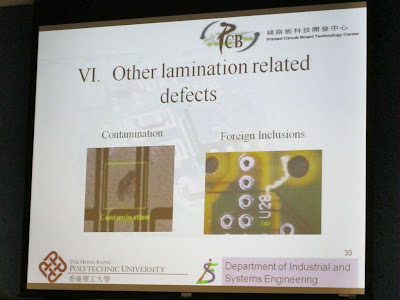
VI. Other defects


Other defects were summarized.


Then Dr. Yung briefed different type of PCB laminate such as FR4 (most economic), Halogen Free, High Speed and Flexible Materials.


After that Dr. Yung mentioned those materials characterization included:
1. Thermal properties
- Glass Transition Temperature (Tg) using TMA (Thermo-mechanical Analysis): Higher Tg, Higher Cost
- Coefficient of Thermal Expansion (CTE): Low CTE (z-axis)
- Decomposition Temperature (Td): High Td, Higher final product reliability

2. Electrical properties
- Dielectric constant (Dk) affect the signal speed
- Dissipation factor (Df) affect the signal integrity

Reliability Test for PCB (Thermal Shock, Interconnect Stress, Conductive Anodic Filament and Time to Delamination Test) was also discussed.

Conductive Anodic Filament (CAF) failure was the growth or electro-migration of copper in a PCB. The test was reference to the standard IPC-TM-650 2.6.25.


The micro graph for dendrite growth during CAF related test was showed.


The video showed the dendrite growth.


Finally, Dr. Yung discussed three case studies to us.


After the presentation, the souvenir was presented to Dr. Yung.


(Left: Dr. Raymon Chan (Specialist, MAL-HKSTP), Dr. Winco Yung and Ms.Trace Chan (Head – Membership & Promotion, HKEIA))

Then Dr. Winco Yung and I took a photo for memory. Dr. Winco Yung was past HKSQ ex-co member & Hon Treasurer. We had recognized in HKSQ since 1997.


The second speaker was Dr. Cindy Xi (Specialist, MAL – HKSTP) and her topic was “Applications of surface analysis techniques including SEM/EDX, AES, XPS, ToF-SIMS, Surface profilometer, AFM, FTIR and XRF for PCB industry”.

Dr. Xi introduced each analysis techniques and its application in Material Analysis Laboratory (MAL) at HKSTP. Some equipment were showed in following photos.


Field Emission Scanning Electron Microscope (FE-SEM)


X-ray Fluorescence (XRF) Spectroscopy


Fourier Transform Infrared (FTIR) Spectroscopy


Scanning Probe Microscope (SPM)


After the seminar, a visit to Material Analysis Laboratory (MAL) at HKSTP was arranged.

Reference:
Hong Kong Printed Circuit Association: http://www.hkpca.org/
PCB Technology Centre: http://www.pctech.ise.polyu.edu.hk/
MAL, HKSTP:
http://lab.hkstp.org/e/default_home.asp?url=/e/customize/analysis_MAL_introduction.asp
The Hong Kong Electronic Industries Association (HKEIA):
http://www.hkeia.org/

2011年1月3日星期一

Qualifications Framework Cocktail Reception 2011

It is my honor to be one of members of Testing, Inspection and Certification (TIC) Industry Training Advisory Committee (ITAC) to join the Qualification Framework Cocktail Reception on 3 Jan 2011.

Secretary for Education, Mr. Michael Suen, GBS, JP gave an opening speech and introduced the aim of Qualification Framework and new promotion videos.


There were many committee members to join the cocktails. Fifteen ITACs were included Automotive, Banking, Beauty, Chinese Catering, Electrical & Mechanical Services, Hairdressing, Import & Export, Information & Communications Technology, Jewellery, Logistics, Printing & Publishing, Property Management, Retail, Testing, Inspection & Certification, and Watch & Clock.


All chairmen of ITACs took a photo with Mr. Michael Suen.


The Permanent Secretary for Education, Mrs Cherry Tse Ling Kit-ching, introduced QA mechanism and then to take photos with each ITAC members for memory. The following photo was Testing, Inspection & Certification ITAC.


I met Mr. S.S. Lee (Chairman of Construction Industry Council, previous CEO of HKSTP). We had taken a photo with other TIC members.


(Left: Ms. Bess Choi (HKQAA), Mr. Terence Wong (HKFPA), Mr. S.S. Lee (CIC), Dr. Lotto Lai (HKSQ, HKSTP), Ms. Camdy Chow (TUV))

I am pleasure to met Prof. Enoch C.M. Young (Special Advisor & Director Emeritus, HKUSPACE) who had taught me twenty years ago in City University of Hong Kong and Prof. Timothy W. Tong (President of The Hong Kong Polytechnic University). I told Prof. Tong that I also studied in PolyU ten years ago.


(Left: Prof. Enoch C.M. Young, Prof. Timonthy W. Tong and I)

The cocktail was performed at Owners Box, 3/F Members Stand I, Happy Valley Racecourse, Happy Valley.


Reference:
(HKSAR Press Releases)Qualifications Framework is a long-term project to build manpower infrastructure: http://www.info.gov.hk/gia/general/201101/03/P201101030100.htm

The Qualifications Framework (QF) has been officially launched since 5 May 2008. Details at http://www.hkqf.gov.hk/

2011年1月1日星期六

Hong Kong Society for Quality (HKSQ) 25th Anniversary


It is our pleasure to inform you that 2011 is the 25th anniversary of Hong Kong Society for Quality (HKSQ).

The Predecessor of Hong Kong Society for Quality, formed in 1986, was the Hong Kong Group of the American Society for Quality Control (ASQC) International Chapter. It was renamed as Hong Kong Society for Quality Control (HKSQC) in 1989 to reflect increasing local involvement. The Society maintains its affiliation with ASQC after the name change. In 1997, HKSQC was renamed as Hong Kong Society for Quality (HKSQ).

The Society is a not-for-profit organization established with the objectives to promote greater awareness of the need for quality in Hong Kong for ensuring product and service excellence through continuous improvement of quality and customer satisfaction, and to provide continuing education to professionals involved in the quality and reliability disciplines. Being a leading quality management authority in Hong Kong and having a long and well-established relationship with ASQ, HKSQ has been recognized as a WorldPartner of ASQ since 2002. Furthermore, HKSQ is also a founding member of the Asian Network for Quality (ANQ).
Reference:
HKSQ: www.hksq.org

LinkWithin

Related Posts with Thumbnails