The Hong Kong Chartered Governance Institute (HKCGI) (香港公司治理公會) organized the 13th
Biennial Corporate Governance Conference (CGC) on 23rd Sep 2022. The
theme is “Repurposing in Changing Times – the Company, Governance and the
Governance Professional”. FHKI has free online ticket for advisors and members in
Compliance Committee. I was one of them to attend the online meeting.
In the beginning, Mrs. April Chan (Past President and Chairman,
Technical Consultation Panel, HKCGI) gave welcoming address. She surveyed
participants’ preference and found that 50% like hybrid mode (Physical and
Online) conference arrangement.
Then Mr. Ernest Lee (President, HKCGI; Technical
Partner, Deloitte, China) gave welcoming remark. He introduced conference aim
and topics.
The guest of honour Mr. Nicolas Aguzin (CEO, Hong Kong
Exchanges and Clearing Limited) gave a speech and he said ESG journey in good
corporate governance and became corporate DNA.
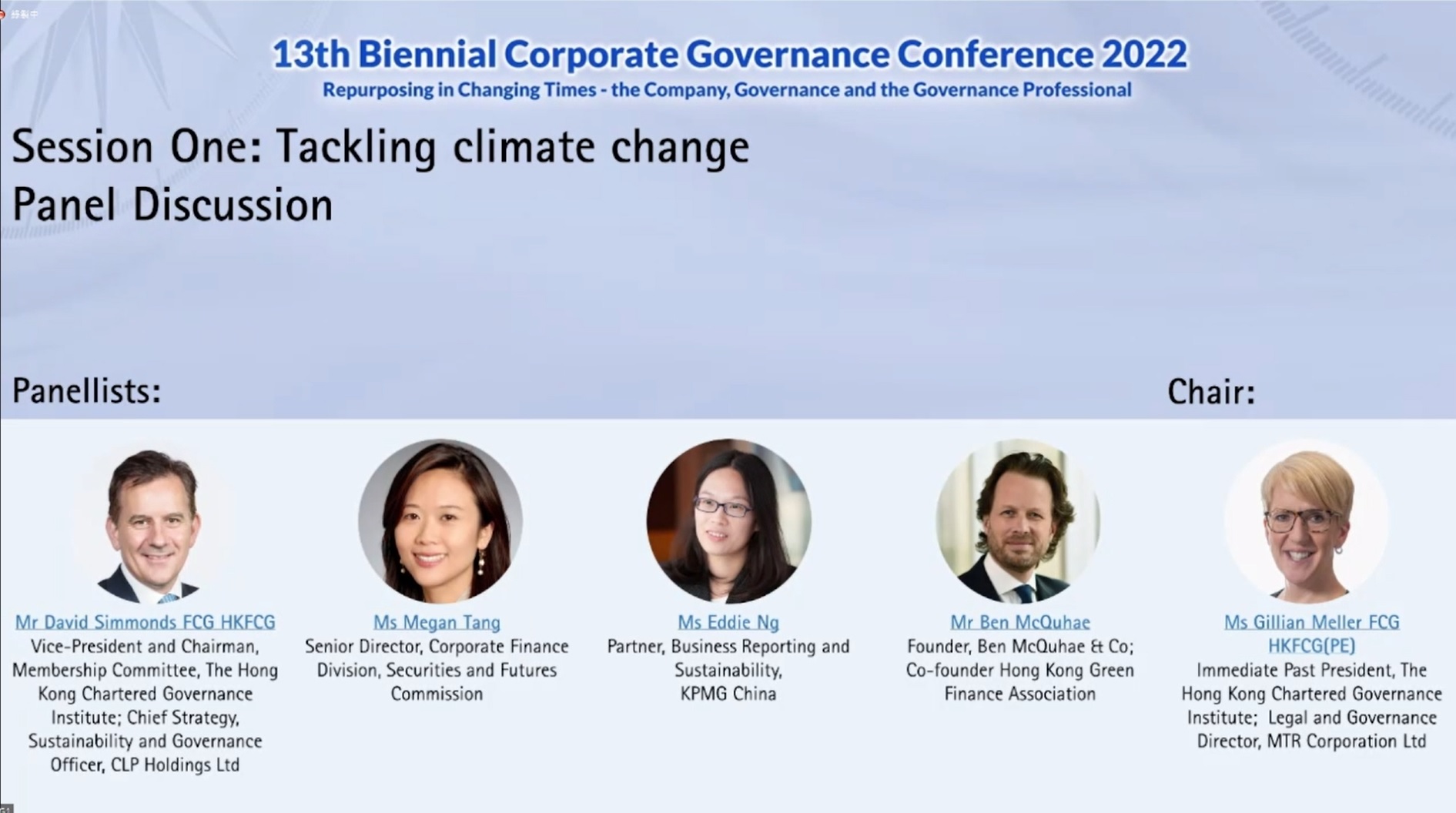
Session One: Tackling Climate Change
The first speaker in session one was Ms. Tereasa Ko (Senior Partner,
Hong Kong and China Chairman, Freshfields Bruckhaus Deringer; Co-Vice Chair,
IFRS Foundation) and her topic named “The pressing issue of our times – climate
change and harmonizing reporting standards”. She introduced sustainability
reporting and ISSB standard for developing global baseline. Finally, she concluded three key points.
i)ESG is not just paper work. It
needs implementing in each company and integrated into operation.
ii)No longer accepted just claimed
sustainability (No lip service).
iii)Following the work of ISSB
standards which will be accepted by HKEX.
The second speaker was Mr. David Simonds (Chief
Strategy, Sustainability and Governance Officer, CLP Holdings Ltd) and his presentation
entitled “Climate change governance - challenging yet rewarding”. Firstly, he discussed about consumer changing
to stand up for ESG.
Lastly, Mr. Simonds briefed CLP governance framework that
including Sustainability Committee in Board level and establishing Sustainability
Executive Committee in management level. For working level, they had
department, group function and business unit, as well as Group sustainability forum.
Before end of session one, panel discussion was performed. The
chairlady Ms. Gillian Meller surveyed participants and obtained following
response.
-94% participants (141) agreed
that Hong Kong company directors need to consider ESG matters to properly
discharge their fiduciary and statutory duties.
-85% agreed that organizations
should consider the risks (and opportunities) posed by climate change and
allocate resources to address these.
-61% said their company have a
strategy to decarbonize their business.
Session Two: Harnessing Technology
The
first speaker in session two was Mr. Adam Stuckert (Group Chief Digital
Officer, Tricor Group) and his topic entitled “Harnessing technological
advances”. In the beginning, he showed us a survey that 97% feedback agreed pandemic
accelerated digital transformation. Then
he discussed to develop digital experiences.
Finally, Mr. Adam Stuckert concluded in three key points.
The first point is pace of change that increasing the change and adopt the
digital technology. The second point is customer focus especially their digital
experience. The third point is foundations including security of data and
system.
The second speaker in this session was Mr. Kok Tin Gan
(Partner, PwC Hong Kong) and his topic named “Managing technology related risks”.
He firstly pointed out 50% of CEOs concerned about cyber risks. Threat actors
continue to innovate at unprecedented pace and scale.
Mr. Kok Tin Gan also added Hong Kong organizations
should be aware of the increased sophistication of cyber threats because of the
accelerated remote work practices due to COVID-19. Then he introduced a robust
cyber governance structure.
Session two panel discussion also performed some survey and the
result summarized as follows.
-86% of participants think the
pace of technology change is increasing in 2022 after the COVID-19 pandemic.
-Bell shape was observed about
confident that your organization is sufficiently managing and mitigating cyber
risks. Assumption: C-suites and board members should set their company’s culture
and tone for brand and reputation protection via a cybersecurity framework.
-57% response that their
organization have a Data Protection Officer (or similar role).
-78% didn’t agree AI would
replace human decision-making.
-67% agreed that there would be
a need for a board of directors with the onset of blockchain-based corporate
governance.
Session Three: Welcoming Diversity and Inclusion
The
first speaker in session three was Mr Nicholas Allen (Chairman and Independent
Non-Executive Director, Link Asset Management Ltd) and his presentation entitled
“Diversity and inclusion – need to be real and now”. In the beginning, Mr.
Allen discussed about individuals to make the sacrifices necessary for the
earth and the role of corporate on carbon offset.
Then he proposed three rules including diversity of board
members, educating and developing our workforces, as well as, walk the talk
culture. Lastly, Mr. Nicholas Allen discussed the right people in place through
the four steps and they were corporate intolerance for certain behavior, green
leases, genuine education and realistic views.
The second speaker was Ms Bonnie Y Chan (Head of
Listing, Hong Kong Exchanges and Clearing Limited) and her topic was “A
regulatory concern – and achieving practical regulations”. Ms. Chan firstly
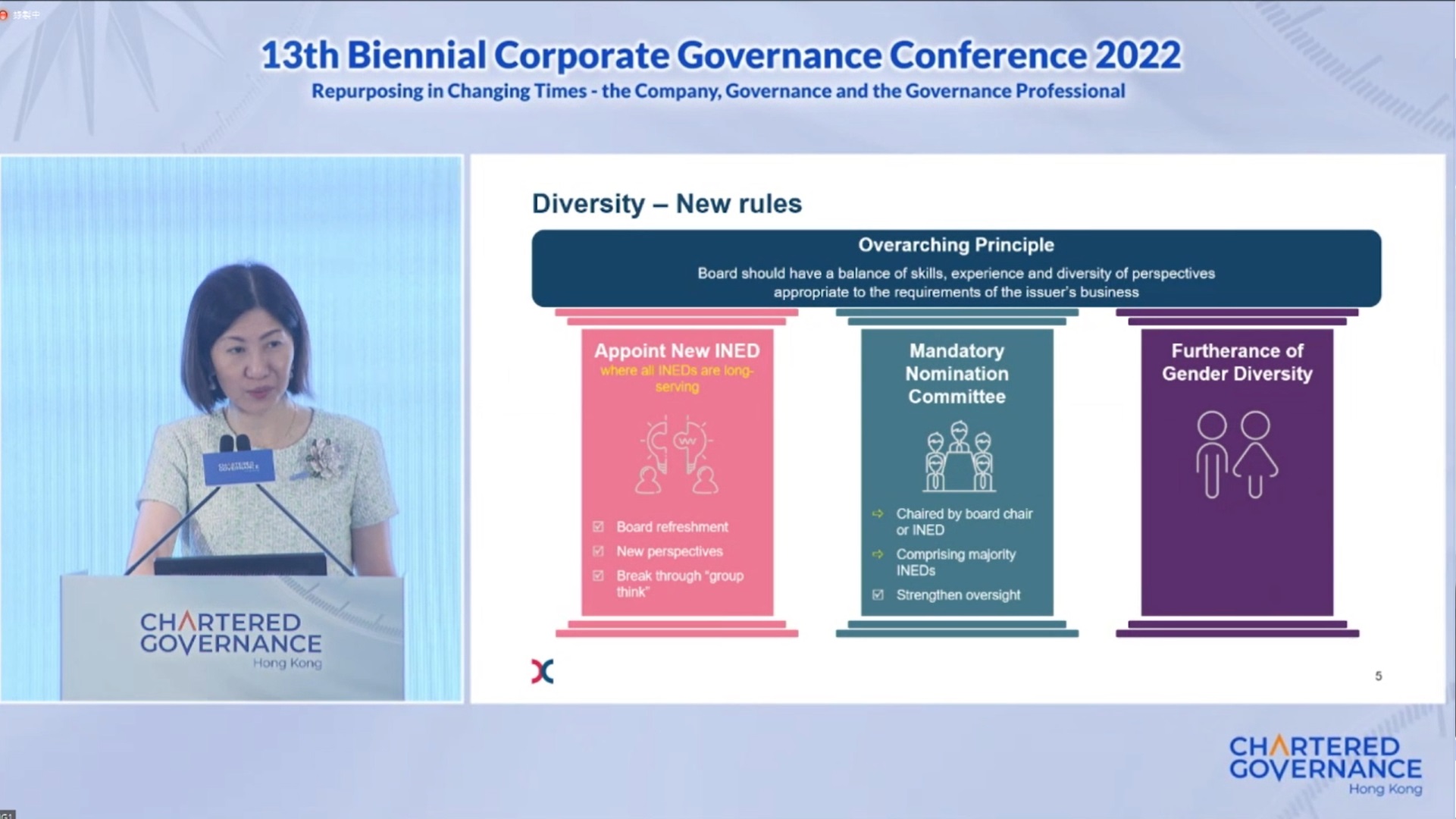
briefed their milestone of diversity policy from 2012 to 2022. Then she introduced
new rules on diversity.
Finally, she mentioned to build an inclusive corporate
culture. HKEX believe “Diversity, as one of the five core values at HKEX, is a
critical component of business success, long term sustainability and that it is
crucial for societal resiliency and prosperity. We are committed to the vocal
advocacy of diversity in all that we do.”
The third speaker was Mr. Nicholas Chilton (Head of
Board Advisory, South Pacific, Nasdaq) and his topic named “Diversity Equity
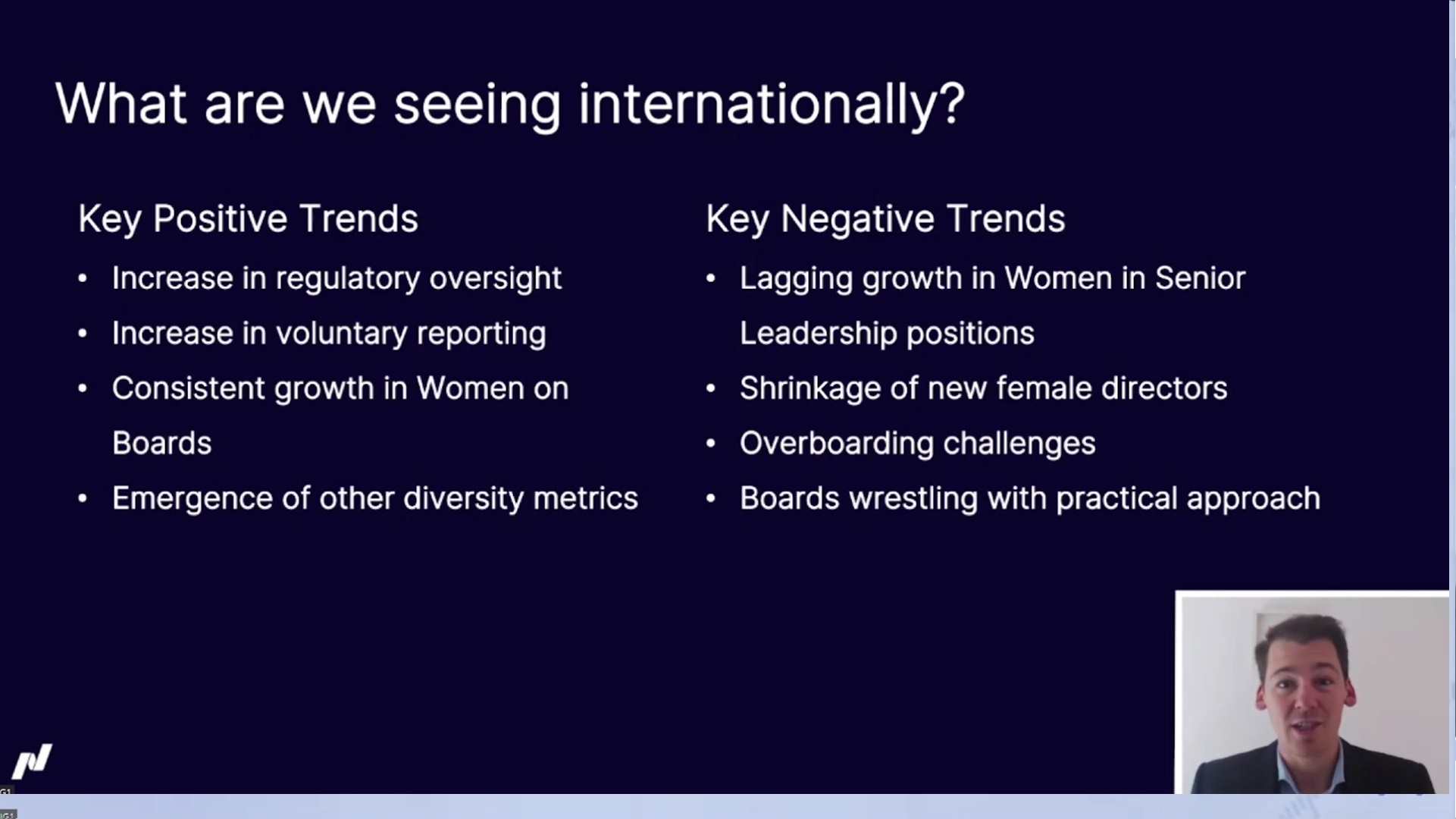
& Inclusion an International Overview”. In the beginning of the talk, he discussed
some key positive and negative trends.
Then Mr. Chilton discussed some statistics about women
on boards and there were separated into hard and soft mandate as well as no mandate
in different countries in the world. He finally concluded that culture is key
to defining diversity as material to the organization.
Session Three Panel Discussion was performed
afterwards.
During the discussing, Ms Edith Shih introduced the
board matrix to exam the corporate’s board diversity.
Then they discussed some survey results from participants and showed
as follows.
-44% under active consideration
and 38% not need because they had already met the new HKEX requirement for
independence and diversity.
-56% participants voted less
than 16% women in their board.
-52% agreed that it is important
for a board to be diverse in both gender and race.
-67% selected diversity of
socioeconomic background aside from gender.
-53% believed by regulation/laws
to incentivize good behaviors towards temperature rise within 1.5 degree
Celsius.
Session Four: Enhancing Hong Kong’s competitive advantage
Prof. Frederick Ma Si-hang GBS JP (Chairman, FWD Group Holdings Ltd)
was session chair and introduced speakers in the session.
The first speaker was Mr Joseph H L Chan JP (Under
Secretary for Financial Services and the Treasury, The HKSAR Government) and
his presentation topic named “The positioning and development strategies of
Hong Kong as an International Financial Centre”. Mr. Chan briefed Hong Kong’s
strengths in four dimensions to be international financial centre.
Moreover, we are leading in Asia across capital
markets, insurance business, and asset & wealth management business said by
Mr. Joseph Chan. Lastly, he introduced five-pronged approach for FinTech
development in Hong Kong.
The second speaker was Mr Amar Gill (Managing
Director, Head of APAC Investment Stewardship, BlackRock) and his topic
entitled “Hong Kong’s governance leadership - ESG and beyond”. In the
beginning, Mr. Gill overviewed global sustainable fund industry and discussed Task
Force on Climate-related Financial Disclosures (TCFD) recommendations.
At the end, Mr. Amar Gill suggested ten recommendations
for Hong Kong to be a true International Financial Centre.
Session Four – Panel Discussion
Group photo of the session
Corporate Governance in Conversation: Repurposing company reporting
Mr
Peter Greenwood (MA FCG HKFCG) was session chair and introduced Prof. Mervyn
King.
Prof. Mervyn King SC (Chairman Emeritus, The
International Integrated Reporting Council (IIRC)) was the last speaker in the
conference. He discussed the major changes in the governance and its impacts.
At the end, Mrs. April Chan (Past President and Chairman, Technical
Consultation Panel, HKCGI) gave closing remark.
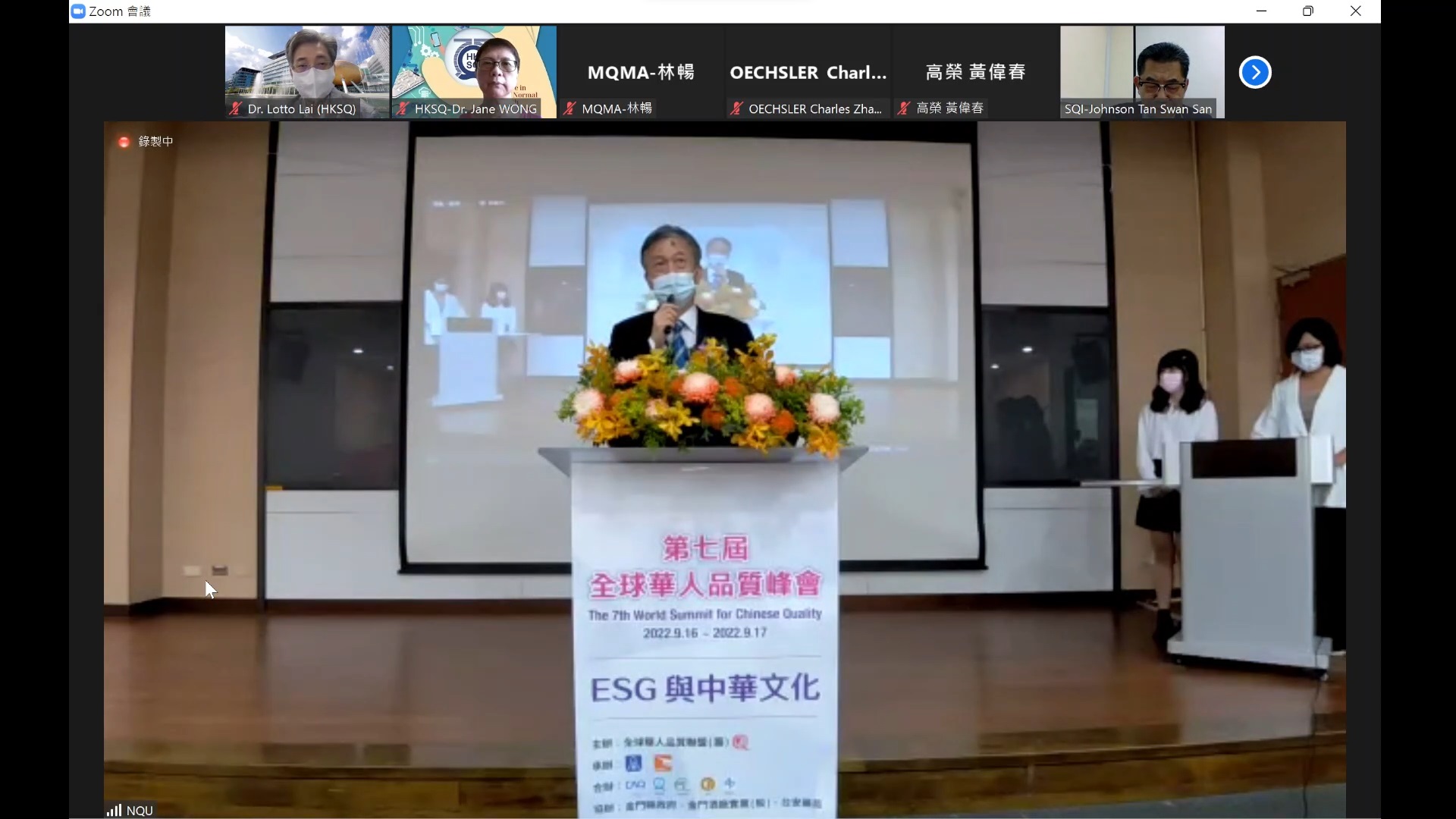
The 7th
World Summit of Chinese Quality (全球華人品質峰會) was organized by Chinese
Society for Quality (CSQ), National Quemoy University (金門大學) and pre-World Alliance for
Chinese Quality (pre-WACQ - 全球華人品質聯盟(籌))
on 16th Sep 2022. The theme was “Environmental,
Social, Governance and Chinese Culture”「ESG與中華文化」.
The summit was held onsite and online in Kin Men (金門). Minda
and I took a photo in front of the screen that we arranged onsite in CityU to
attend the summit.
I
captured participants group photo in the summit for memory.
In the beginning of the summit, Mr. Lu Ruiyan (Chairman, CSQ)
(盧瑞彥先生 - 臺灣廣運集團副董事長) gave
welcoming speech and he explained the relation among environmental, social and
governance (ESG) and Chinese culture. Finally, he said we need to exceed
customer expectation and sustainable development with the earth 「超越顧客期待與地球永續」.
Mr. Lee - 李增財(金門縣政府副縣長) gave
welcoming speech to all participants and introduced background of Kin Men (金門).
The representative of National Quemoy University (NQU)
gave welcoming speech and he briefed that NQU established in 1997. Then he
mentioned some Chinese cultures in Kin Men (金門) and
expected all of participants would visit here after pandemic.
World
Alliance for Chinese Quality member representatives’ speech section:
Firstly,
Mr. Jia fuxing (Chairman, CAQ) (賈福興- 中國質量協會會長) gave
a speech and reminded Three Treasures of Kinmen: Sorghum Wine, Tribute Candy,
Steel Knife (金門三寶:高梁酒、貢糖、鋼刀).
Then he introduced CAQ activities related to ESG and establishing ESG system
standard.
Then Mr. Johnson Tan Swan San (Chairman, SQI) (陳川昌- 新加坡質量學院主席) gave
a speech and he remembered joining the 3th WSCQ in Singapore and sharing
quality management. He expected we continued to participate the establishing
Chinese culture quality management and to enhance our quality level.
And then Dr. Jane Wong (Chairman, HKSQ) (黃惠僑- 香港質量學會會長) gave
welcoming speech. She briefed ESG and financial requirement in Hong Kong. As
one of the pioneers in developing the green bond market, Hong Kong is the first
region in Asia to sign a green bond commitment, reflecting the government's
commitment to the environment.
After that Prof. Lin Chang (Chairman, Macau Quality
Management Association (MQMA)) (林暢- 澳門品質管理協會會長) gave
speech. He said Macau economic was affected by pandemic and reduced half GDP
before pandemic. We needed to think how to recover in the post-pandemic era.
Thus, we promote ESG on industry and society about risk and quality management.
Finally, Mr. Chung (Director, THQA) (鍾國屏 - 臺灣醫療品質協會理事) gave
a speech and he firstly introduced THQA to us. He supported the healthcare
industry should focus on customer satisfaction and achieve perfection as
Chinese culture (盡善盡美).
Summit
keynote speech session:
The
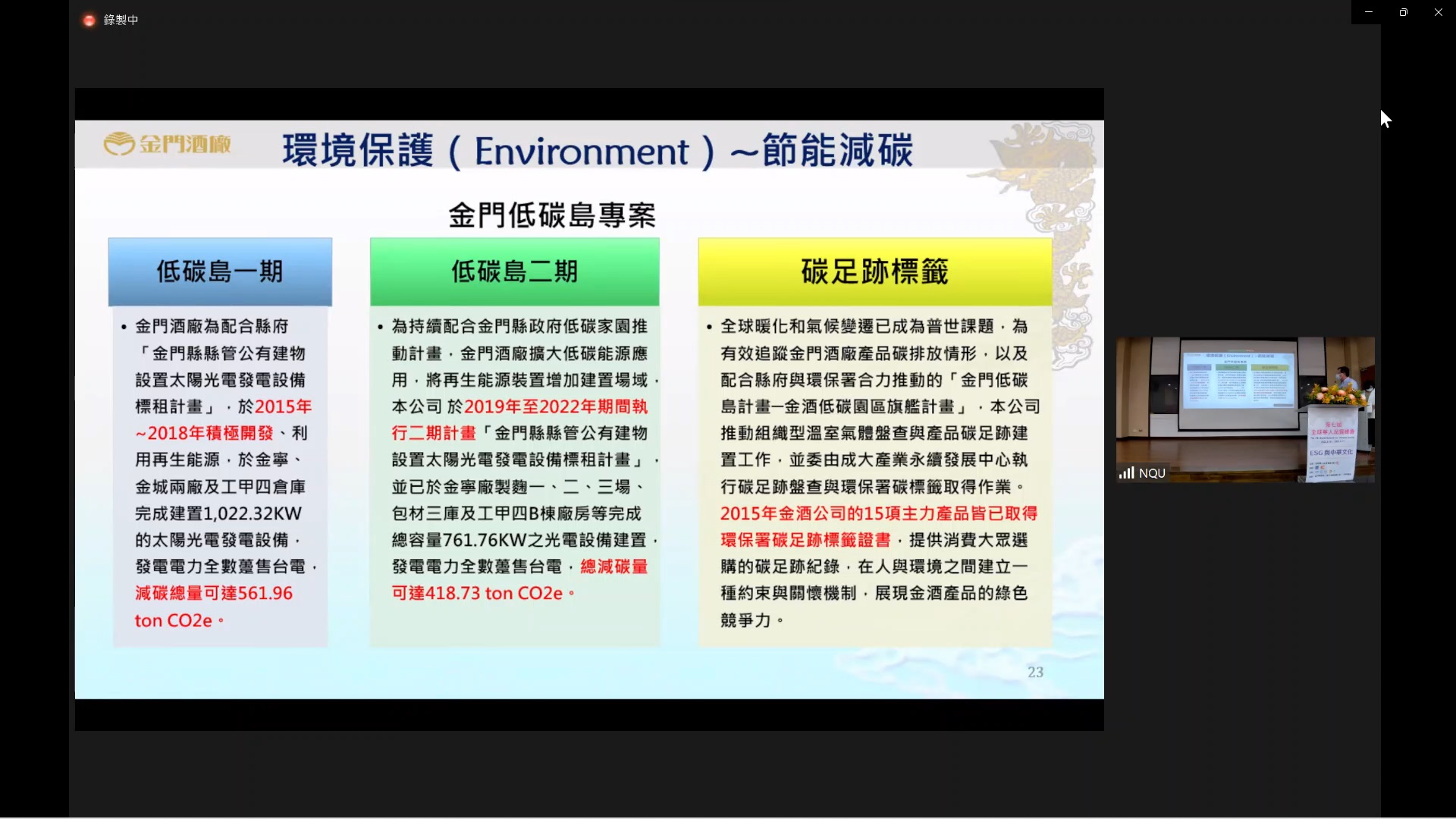
first speaker was Mr. Yang (楊駕人) (金門酒廠實業(股) 總經理) and
his topic named “Kinmen Winery Company sustainable development and social
responsibility” (金酒公司永續發展與社會責任). In
the beginning, Mr. Yang briefed the development history of his company and
mentioned their quality, technology and management. In quality management, they achieved ISO
9001, ISO 22000, HACCP, ISO 17025 and Quality Winery Certification.
Then he introduced their environment activities to match
Kinmen low carbon strategies including water usage reduction, reuse and waste
water treatment.
Finally, he introduced the social aspect such as
maintaining the Chinese wine culture. He also stated the governance to reduce
the risk and enhance the sustainable supply chain management. Lastly, he said
this year is 70th anniversary and they expect the next 70 years to
enhance their ESG unit sustainable development.
The second speaker was Mr. Li Yongsheng (李永生) (國家能源集團企管法律部(改革辦) 副主任) and
his topic named “Realizing the Truth, Goodness and Beauty of ESG through establishing
a World-Class Enterprise” (在建設世界一流企業中實現ESG的真善美).
Firstly, he introduced their group.
Mr. Li also mentioned the original of ESG in view of
Chinese Culture such as Tao Te Ching (道德經).
Then ESG could be traced back to BC1044 in China. And now China government is
focused on environmental protection and governance.
At the end, Mr. Li proposed several actions to achieve
ESG through Truth, Goodness and Beauty (真善美) in
different aspects including Industry, Investment, Management, Technology and
Responsibility.
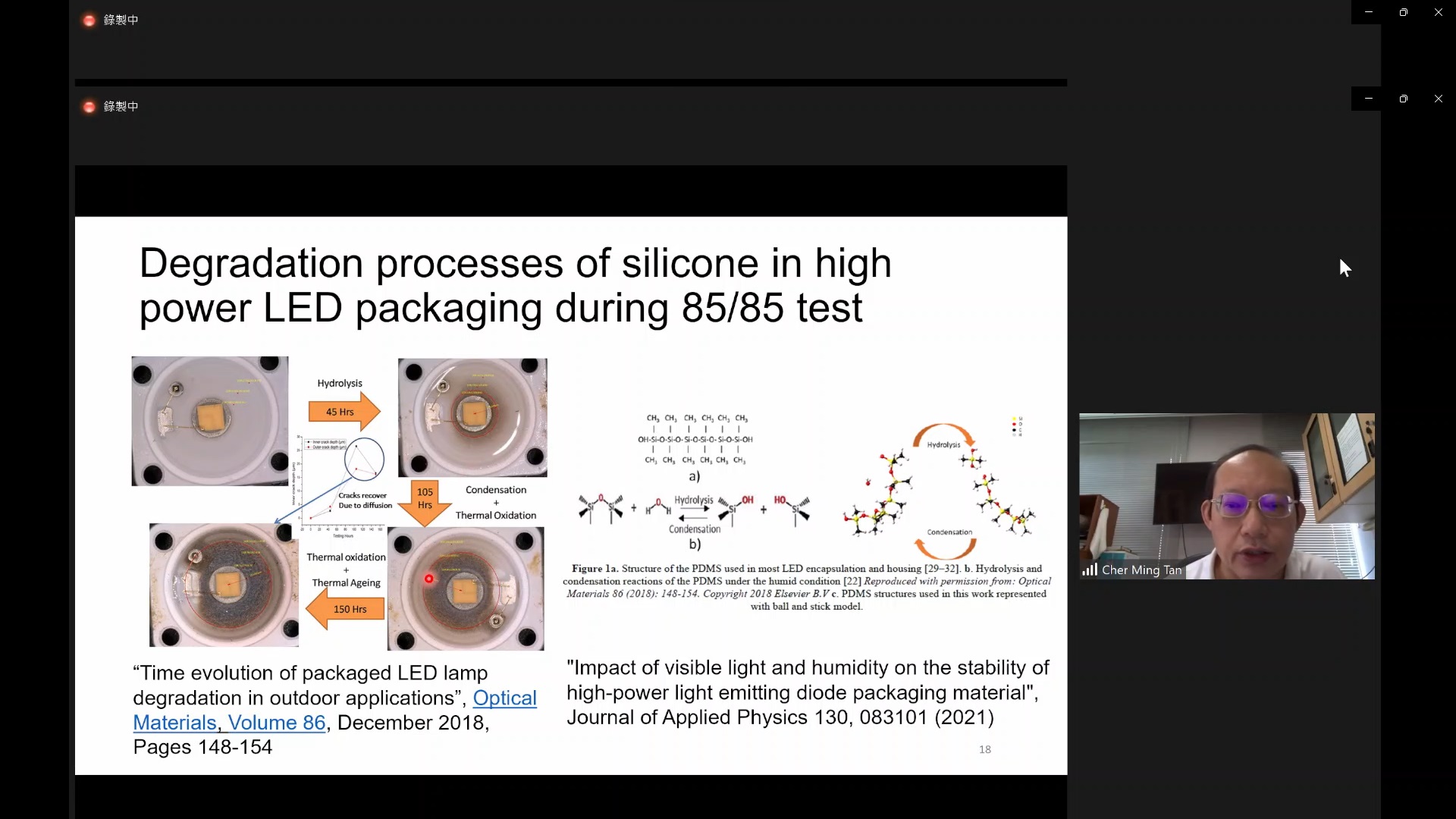
The third speaker was Prof. Tan Cher Ming (陳始明教授) and
his topic entitled “Lifetime Extrapolation from Accelerated Life Test Data and
its Challenges”. Firstly, he briefed the important of extrapolation for
lifetime prediction especially in electronic and semiconductor product. Accelerated life testing (ALT) was mentioned
that could help to save time and money for identifying design and manufacturing
deficiencies.
And then Prof. Tan introduced three common models
employed in ALT and they are Arrhenius Model, Peck Model and Coffin-Manson
Model.
Finally, Prof. Tan showed some case studies such as high
power LED packaging to explain how different model predicted their lifetime so
as to understand the physics of failure and to assess the model correctness or
derive a correct acceleration model.
The fourth speaker was Mr. Dominic Lam (林俊康) (香港中華廠商聯合會工業發展基金有限公司 (CMA檢定中心) 首席營運總監) and
his topic was “Commercialization of technology to help the industry transformation”
(科技商品化, 助業界轉型). Minda and I took a photo
during Dominic presentation for memory.
In the beginning, Mr. Lam introduced CMA Testing and CMA
plus, as well as, Hong Kong reindustrialization policy. Then he mentioned their
Technology Commercialization Platform. The pathway was introduced from
Screening to Reindustrialization (SOCCER).
Finally, Mr. Lam demonstrated some projects cooperated
with universities in Hong Kong and transferred their technology for
contributing to society such as mobile PCR car for Covid testing.
The fifth speaker was Mr. Wang-Chuan Juang (莊旺川) (臺灣醫療品質協會秘書長) and
his presentation title was “From the Wisdom of Ancestors, Deeply Cultivating
the Practice of Hospital Quality Control Promoters” (從老袓宗的智慧深耕醫院品管推動者的修練). Mr.
Wang considered organization culture in three dimension including Management,
Technical and Philosophy.
Then Mr.
Wang summarized the wisdom of “To be Water” and “Tao Te Ching”. Finally, he
purposed eight strategies as follows.
i)The highest good is like water, good for all things without fighting (水善利萬物而不爭)
ii)Do what everyone hates (處眾人之所惡)
iii)Deep Mind and Think Big (心善淵)
iv)Give and Resilience (與善仁)
v)Integrity (言善信)
vi)Good Governance such as ISO (政善治)
vii)Professional and Versatile (事善能)
viii)Face to resistant like water (動善時)
The last speaker was Mr. Shuh Chen(陳樹) (中華中道領導文化總會理事長) and
his presentation topic named “Middle Way (Zhongdao) Lead to Implement the Sustainable
Governance” (中道領導落實永續治理). He
said the effective way to solve problem of human being is “Zhongdao”(中道).
Then he briefed the relationship among leadership,
implementation and organization culture. Then he explained how to employ
“Zhongdao” from social, science, philosophy and self.
Lastly, Mr. Chen discussed the integration between
“Zhongdao” and Sustainable Governance.
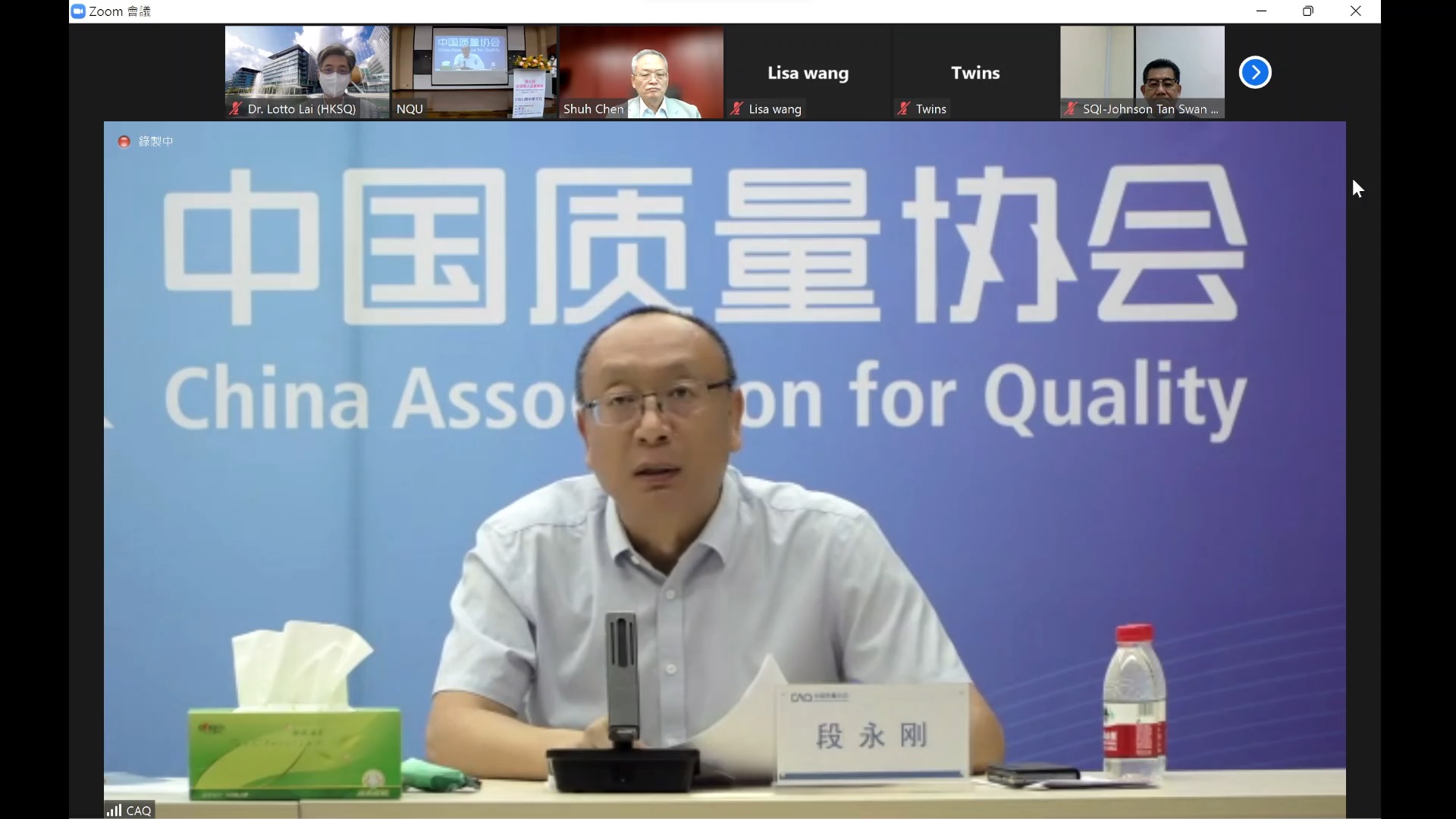
After keynote speech session, Dr. Duan Yonggang
(Vice-Chairman, CAQ) (段永剛博士 - 全球華人品質聯盟(籌)理事長、中國質量協會副會長兼秘書長) gave
speech and he appreciated all supporters to WACQ activities. Quality is
inseparable from cultural genes and WACQ focused on Chinese Culture. China
Quality magazine would do more jobs on Chinese Quality. Moreover, WACQ would expand
to individual member in future.
Before the end of summit, Mr. Johnson Tan Swan San
(Chairman, SQI) (陳川昌- 新加坡質量學院主席) introduced
the 8th World Summit for Chinese Quality in Singapore.
Then Mr. Tan showed a video to visit Singapore.
Finally, Mr. Tan showed a sing named “The Story of a
Small Town”
At the end, all participants took a group photo online and
onsite.
Then Minda and I had lunch in CityU. After that we joined
the afternoon paper presentation session.
Paper presentation session was for onsite only and video
presentation would be posted in CSQ website. My video topic named “Use Transformation
Bridge to analyze the Contradictions among different Anti-epidemic Methods to Enhance
the Decision Quality” (運用轉換橋分析不同抗疫方法之間的矛盾問題以提升決策質量).