2014年7月12日星期六

HKQAA Seminar on New Trend in IT Management

The Seminar entitled "Sustainability Management Series: The New Trend in IT Management" was organized by Hong Kong Quality Assurance Agency (HKQAA) on 11 July 2014. The seminar aimed to share the business continuity management, cloud computing and TRIZ in IT industry to achieve sustainable business development.

The first speaker was Mr. William Wong (Product Manager, HKQAA) and his topic was “Introduction to sustainable management and risk management system”. In the beginning, he briefed the benefits of Business Continuity Planning and Management and found that the most important was to better understanding of your business.


Mr. Wong mentioned Business Continuity Management (BCM) used to preserve critical business functions in the face of disastrous events. Disasters were separated into Natural, Man-made and Act of God. Disasters could be defined in terms of the business impact such as it harmed critical business processes (included time-based definition and probability of occurrence). The value of BCM was Business Impact Analysis (BIA).


For Information Security, Confidentiality, Integrity and Availability (CIA) were three key elements to be considered. However, Availability would be the main focus in BCM objectives (related to Maximum Acceptable Outage (MAO), Maximum Tolerable Period of Disruption (MTPD), Minimum Business Continuity Objective (MBCO), Recovery Point Objective (RPO) and Recovery Time Objective (RTO)). The following slide showed different recovery strategies for Data Centre included Hot Site, Warm Site, Cold Site, Mirror and Mobile).


Then Mr. Wong introduced the Business Continuity Management System (BCMS) Standard “ISO 22301” which was published in 2012. There were 6 key elements included “BIA/Risk Assessment”, “Resources/Planning”, “Testing & Exercise”, “Incident Response/Communications”, “Internal Audit/Corrective Actions” and “Management Review”. Mr. Wong said IT was to support business operation and BCM covered IT continuity.


The second speaker was Mr. Rex Kan (Corporate Sustainability Manager, Fuji Xerox (HK) Ltd.) and his topic named “Business Continuity & ISO 22301”. Mr. Kan briefed the history of Fuji Xerox which established in 1962.


Then Mr. Kan mentioned Fuji Xerox Good Company Concept which included three key elements “Strong”, “Kind” and “Interesting”.


After that Mr. Kan shared their risk management and got the ISO 22301 certificate from HKQAA in which combined three system named ISO 22301, Japanese Version of Sarbanes Oxley Act (J-SOX) and Hong Kong Authorized Economic Operator (AEO) from the Customs and Excise Department, HKSAR.


An example of Business Impact Assessment was shared. The key risk classification included “Human Resource”, “Legal/IP”, “Disaster/Accident”, “Accounting/Finance” and “Planning/R&D”.


The third speaker was Mr. John Kong (SAP Technical Manager, Compass) and his presentation was “Cloud Computing Application and New Technology”.


In the beginning, Mr. Kong introduced “What is Cloud / Cloud Computing?” Some popular cloud application in consumer market such as Dropbox, iCloud, Office 365 and Google Drive were mentioned.


Five cloud computing services were discussed and they were Infrastructure-as-a-Service (IaaS), Platform-as-a-Service (PaaS), Software-as-a-Service (SaaS), Content-as-a-Service (CaaS) and Process-as-a-Service (PaaS).


Finally, Mr. Kong said if occupation of Central or other disasters were happened, we needed to consider System Backup Management, Backup System, Disaster Recovery (DR) System & Plan, and Work Anytime & Anywhere. At the end, he pointed out four Business Intelligence included Cloud, Mobile, Big Data and In-Memory Computing which were the top 10 strategic technology trends for 2012 & 2013.

Dr. Michael Li (President, ISIHK) was the last speaker and his topic entitled “TRIZ – Fast and Effective Innovative Solution Method”. Firstly Dr. Li briefed TRIZ and its history. The full name of TRIZ in English was “Theory of Solving Problems Inventively). Dr. Li said “Innovation is to remove psychological barriers and inertia and to make systematic attempts to see a problem from a new prospective.”
 

The he mentioned five basic concept of TRIZ included “Function”, “Contradiction”, “Ideality”, “Resources” and “Technology Evolution”. The principles behind TRIZ were “Similar problems have similar attributes thus similar solutions and thus can be solved by similar procedures”. There were five levels of solution such as Routine solution (Level 1), Simple solution (Level 2), Multiple solution (Level 3), New solution (Level 4) and Extreme solution (Level 5). After that Dr. Li mentioned there were two types of innovation and they separated into Operation and Market. Samsung usually employed Operation Innovation.


Dr. Li then focused on information system and mentioned to optimize an information system at all levels, converting inputs into outputs in the most beneficial and least harmful way possible. He also said Improvement is equal to maximize existing resources to the FULLEST degree possible! He defined “Good System” should be converting inputs into outputs in the most beneficial and least harmful way possible, as well as, providing real value to people, organizations and society. For Information Technology (IT), it does not exist in isolation, does not function in isolation. So it is part of large systems involving many others things including people. It could be considered IT system to be based on system, time and space.


TRIZ is Burn people’s mind and Trigger people’s brain that it trains our brain connecting two previously unconnected thoughts (Left and Right Brain) to lead to a new insight. After mentioned 40 Inventive Principles, Dr. Li introduced a solution algorithm in four steps.
1. Define a problem
2. Ideal final result status
3. Determine contradiction
4. Resolution of contradiction


Finally, Dr. Li concluded Innovation using life words (In Chinese) which ideas come from meditation.
  • 創作不要怕錯,如果做任何事都要求不犯錯,會完全失去創意的空間。
  • 藝術創新無分好壞對錯,只有喜歡不喜歡。商業創新沒有喜歡不喜歡,要有好壞對錯。
  • 路遠肯起步,目標越來越近。路近不起步,永遠也不會到。
  • 只要過程中全力投入,不執著成果,結果往往不會太差。
  • 遇到問題,聰明人會想辦法逃避。有智慧的人會想辦法解決。
  • 每一個困難,都是學習和進步的機會。
  • 假如未試過失敗,即是未盡過全力。
  • “知道”不如“做到”。
  • 不斷練習,把它變成習慣,再進入潛意識內。
  • 寧可“短”,不可“斷”。
Reference:HKQAA - http://www.hkqaa.org
20121016: HKQAA Seminar on ISO 22301 Business Continuity Management System - http://qualityalchemist.blogspot.hk/2012/10/hkqaa-seminar-on-iso-22301-business.html
20140624: Service Process Innovation (TRIZ) Seminar - http://qualityalchemist.blogspot.hk/2014/06/service-process-innovation-triz-seminar.html


2014年7月9日星期三

HKSQ Dinner for Professor Shu YAMADA

HKSQ Ex-co members (Dr. Aaron Tong, Dr. K.S. Chin, Mr. Peter Fung, Dr. Zoie Wong, Ms. Minda Chiang and Dr. Lotto Lai), had dinner with Prof. Shu Yamada, on behalf of Hong Kong Society for Quality, at Shanghai Min, Tsim Sha Tsui, on 9 July 2014. The first time we had dinner with Prof. Yamada in 2009.

Photos
(Left: Lotto, Minda, Zoie, Yamada, KS and Peter)


(Left: Aaron, Lotto, Minda, Zoie, Yamada, KS and Peter)


Prof. Shu Yamada is Dean of Graduate School of Business Sciences (GSBS), University of Tsukuba. He attended an international conference at Kun Ming (昆明), China and then back to Japan via Hong Kong. We also visited Kun Ming through HKSQ Study Mission on Quality Management in 2010 (Details in reference)

Finally, Mr. Peter Fung present HKSQ souvenir to Dr. Yamada.


Reference:
20090216: Welcoming Dinner for Professor Shu YAMADA - http://qualityalchemist.blogspot.hk/2009/02/welcoming-dinner-for-professor-shu.html
20100624: HKSQ Study Mission on Quality Management 2010 - http://qualityalchemist.blogspot.hk/2010/06/hksq-study-mission-on-quality.html

2014年7月1日星期二

非理性的世界,不穩定的世代。

如本題所說,現今香港是在一個非理性的世界。己不可能是格林斯潘所說「我們的新世界」了。


「佔中公投」不代表我!支持普選不一定支持佔中。(不要犯非黑即白的謬誤。)因為「佔中」有很多問題未理順,我嘗試列出如下:

有關「佔中公投」問卷設定的問題:
(一) 偷換概念 - 這不是公投,根據维基百科的解釋:
公民投票(英語:referendum)簡稱公投,又稱複決、全民公決,是指公民就被提議之事案,表明贊成與否時所舉行之投票。公民投票是一種直接民主制的體現。
(二) 引導性問題(Leading questions) - 無論選什麼方案或棄權都是支持「佔中」
(三) 其他問卷調查的常見錯誤如:使用雙重否定、複合性和假設性問題等。

有關「佔中」正當性的問題:
(一) 不一致的謬誤(自相矛盾) - 佔中公投的方案是經二千多名簽了意向書的佔中支持者篩選出三個方案給公眾投票,來達到爭取沒篩選的普選。(三個方案都有公民提名,但公民提名被大律師公會及律師會認為是違反基本法。) 這等同用不義的手段去爭取正義的理念。這就會變一個不擇手段的社會。(如問卷(一)所犯的謬誤,不可說成民間全民投票而得到正當受權。)
(二) 因反對白皮書表態而投票者,自動變成佔中的支持者,沒有考慮到把一眾人(包括學生)推向佔中的危險。我不殺伯仁,伯仁却因我而死。
(三) 違反康德所提出的 “自由法則”,在不妨礙別人的自由這個前提下,我們可以盡量爭取我們的自由。
(四) VIIV24之公民抗命的一文中有分析,當時結論是香港的不公義程度未到達人民醒覺的門檻。(醒覺不是指投票及遊行,而是加入行動。)

香港新一代正處於不穩定的世代

由高鐵至東北發展,爭吵不休。在東北發展中,我個人看到立法會沒有足夠的程序公義利益申報。這是第一個激發點,令到佔中公投及七一人數增加。

第二個激發點是白皮書。但除了治港者主體效忠國家在香港法律界引起反彈,其他所說的都是事實。現在香港是只有如魔術師所說的三個選擇(留/進/逃)。

第三個激發點是黑客攻擊。本人對黑客攻擊是阿爺正在出手的論述很有懷疑。如果要破壞電子投票,應該不動聲色,在當天攻擊至投票時間完結。不會再給彈藥於泛民及給時間他們準備。互聯網有紀錄以來,最大規模的DDoS攻擊,發生在今年2月,規模達到每秒流量400Gb,從沒有說是中國當局的行為。但今次一度錄得每秒300Gb的攻擊,相等於全球超過10萬「殭屍電腦」。不能因逾三成來自中資機構電腦,而假設是中方所為。這只能正明中資機構電腦保安水平低。

第四個激發點是愛國定義的問題,看完白皮書應理解中方認為愛國是指效忠中華人民共和國,泛民認為愛國正如司徒華所說:『我認識到,真正的愛國,並不是愛一個政黨、一個政權、一個領導,而是愛自己的同胞,愛民族的傳統文化,愛祖國的大地山河,即是人民、文化、土地,這是我愛國的根本因素。』。但新一代是沒有愛國的概念,只有愛港及本土。

總結:
香港變成一個非理性的世界,有一羣不穩定的世代。傳媒有分造成今天的情況。(傳媒人無權公器私用。)
正如山中的文章「大衆的鴉片」中說:「香港「變成這樣」,不單是政府的問題,還有一大班人堅持不用知識、邏輯、證據、事實、科學去思考。一個蠻不講理的政權/政府,對面是另一班不知道理是何物的衝動派,我不知道哪一個是較少的惡。我衹知道歷史上有一班堅持不用知識、邏輯、證據、科學去思考實際問題,以爲說一些政治口號就能神奇地解決一些難題的人,他們叫做紅衛兵,當他們掌握社會輿論,他們就爲人類社會帶來了種種災難。

現在的政改談判,泛民沒有正視談判中六大常見錯誤其中三個如下:(參考碼頭工潮的談判策略分析
錯誤 1 - 忽視對方(中方)的問題
錯誤 3 - 讓立場(公民提名)趕走利益(合乎基本法的普選)
錯誤 5 - 無視破裂的後路

今次政改是硬著陸或軟著陸如果不依據基本法來爭取最大空間,而用佔中來達到公民提名,就像叫人從十樓跳下去,看看能不能軟著陸,而不是腿斷身亡!

參考:
李逆熵(2008)格物致知-思考與研究方法概要,經濟日報出版社。(第二部份第十章問卷調查的常見錯誤-95頁)
格林斯潘(2007)我們的新世界
不敗的魔術師(20140620)十個不投票的理由 及(20140507)無商無量,齊來實現2014假普選 及(20140301)留/進/逃
山中雜記(20140630)大衆的鴉片
20140604 - 傳媒的操守(Conduct of Media)
20140302 - 反暴力 ● 反佔中
20130604 - VIIV24之公民抗命(Civil Disobedience)
20130409 - 碼頭工潮的談判策略分析
20120604 - 華叔的智慧

2014年6月28日星期六

ESG Seminar - Cost Strategy (Secret Formula of Zara)

The Executive Study Group (ESG) seminar in Jun 2014 was “Cost Strategy – The Secret Formula behind Zara’s Cost Challenges” which was held by the ESG, Asia Pacific Institute for Strategy Limited (APISL) and the Hong Kong Science and Technology Parks Corp (HKSTPC) on 27 Jun 2014. I would like to summarize the seminar for sharing below.

In the beginning, Dr. Mark Lee (Research Director, APISL) introduced the content of seminar included "The Rise of a Legend”, “Industry Benchmarking”, “Secret Formulas behind Cost Challenges”, “Misconception about Core Competence”, “Strategic-Fit”, “Consistency and Reinforcement”, “Sustainable Competitive Advantages” and “Cross-Industry Sharing”.


Then Dr. Lee briefed how success of Zara in the fashion market. Zara (one brand of Inditex) sales and operating profits grew 25% per year over the period from 2000 to 2012. He quoted Pablo Isla (CEO, Inditex) statement “When you have a global presence, you have plenty of opportunities to open stores.”


After that Dr. Lee analyzed the top five sales apparel brands’ operation efficiency and found that Zara (Inditex) had 11 Inventory Turn!


Dr. Mark Lee started to explain the Zara secret formulas below.
i) Large Design Team
Zara employed around 200 designers and developed 12,000 different every year. Those designers tapped into Inditex’s sourcing specialists. (Professional segmentation) Store managers kept close track of shifts in consumer preference (Feedback from Sales) Their innovation didn’t follow seasonal collections.

ii) In-House Manufacturing
Zara maintained manufacturing capability for time-sensitive pieces; other less time-sensitive pieces were outsourced. They investment in machines assets to buy time.

iii) Global Supplier Network
Zara had 1,398 suppliers around the world but they reserved 85% of its in-house factories’ production capacity for in-season adjustments. Even though products sourced to Asia were estimated to be 20% cheaper to produce locally, time is much important than cost!

iv) Centralized Warehouse in Spain
All the brands followed the same central distribution center model (Efficiency!) and delivery the product within 24hr in Europe and 48hr anywhere else in the world.

v) Stores for Advertising
Zara had 1,925 stores and each store averaged 11,238 square feet. They didn’t budget for media advertisement but window displays were crucial for attracting customers. Those displays were updated every three weeks!

vi) Frequent Re-ordering
Store manager would select ~800 designs from the 2000 offered and feedback weekly to the design department on customer opinion. There were three store managers in the store separated into Men, Women and Child product lines. Centralized pricing cost was determined by adding the shipping cost to the market price in Spain.

vii) Regional Pricing Policy
They used shipping cost model so that the Japan price is 45% higher than the Spain. However, they didn’t afraid parallel import (水貨) because of time-sensitive collection. Since limited stock and most of pieces were full-price sales, so less discount would be employed.

viii) E-Commerce Synergy
Zara invested in e-commerce comparatively small than others but they only considered synergy between online and offline. It was because Zara shop was not for transaction but for customer experience.

Per Pablo Isla statement below, I only think one word “SPEED”! Everything Zara done is tailored to getting the latest styles into its stores fast.


I found interested in the coming topic “Misconception about Core Competence”. Dr. Lee said that you didn’t rely on core competence totally. It might be same core competences as everyone else in your industry and easier to be copied.


After that Dr. Lee introduced “Strategic-Fit” and he translated into Chinese term as “環環緊扣,相輔相成。”. It means that the whole matters more than any individual part and have synergy value when many parts together. Therefore, it is difficult to identify one or two core competences but the whole system. Nevertheless, their competitors are difficult to copy parts but the whole system.

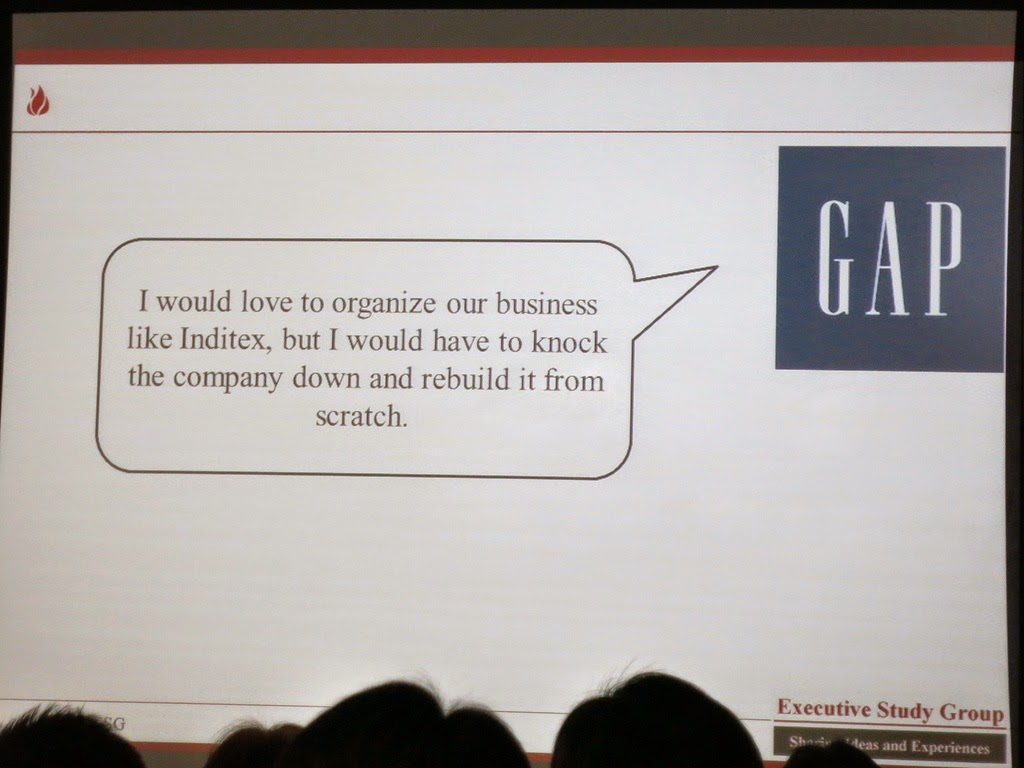
Dr. Lee explained the sustainable competitive advantages that the simpler the business model is, the more difficult the business model is copied. He quoted different examples included vetch, Tai Hing and also quoted Gap statement below.


Before the cross-Industry sharing, Dr. Lee gave us an exercise to find out two most and one least impressive functions of Zara. And then group discussion was performed.


Reference:
The Centre for Logistics Technologies and Supply Chain Optimization, CUHK - http://www.logitsco.cuhk.edu.hk/
HKSTP - www.hkstp.org
Information about Asia Pacific Institute for Strategy Limited (APISL) (亞太策略研究所有限公司)


2014年6月27日星期五

Visit to CityU Apps Lab

Mr. Gallen Leung and Ms. Minky Lau (Incubation Team (Incu-App) members, Hong Kong Science and Technology Park) and I visited to CityU Apps Lab (CAL) on 27 Jun 2014. I would like to thank Prof. XUE Quan (Associate Vice-President (Innovation Advancement and China Office); Deputy Director, CityU Shenzhen Research Institute and Chair Professor of Microwave Engineering, CityU) and Dr. David Ai (Director of Knowledge Transfer, Knowledge Transfer Office, CityU) referral that we recognized Dr. Ray Cheung (Director, CityU Apps Lab) for arranging this visit.


CityU Apps Lab aims to provide a collaborative platform for CityU students to build up creative mobile applications, supported by the CityU Incubator Scheme and Community of Practices CoP - Technology and Creativity Community. This area used for seminar/workshop venue, success cases show room and student Apps related activities.


Before visit their project, we took a group photo for memory.

(Left: CityU Student, Mr. Gallen Leung, Ms. Minky Lau, Dr. Lotto Lai, Mr. Carl Ip (Supervisor/Trainer, CAL), Mr. Van Ting (Deputy Director, CAL), Ms. Cecilia Tang (Development Manager, Development Office), Dr. Ray Cheung (Director, CAL) and Dr. Eric Chan (Education Development Officer, Office of Education Development and Gateway Education))


Then we visited the Cloud Computing Centre and observed some CityU students’ App projects such as CityU Helath Research manipulation robots App.


We took a group photo with all students in CityU Apps Lab group for memory.


After our discussion, we found a high synergy value to cooperate between Science Park Incu-App Program and CityU Apps Lab.

Reference:
HKSTP Incu-App Program - http://www.hkstp.org/en-US/Services-Programmes/Incubation-Programme/Incu-App/About-Incu-App-Programme.aspx#.U62UX_mSwhA
HKSTP Incu-App Centre - http://www.hkstp.org/en-US/Services-Programmes/Incubation-Programme/Incu-App/Incu-App-Centre.aspx
CityU Apps Lab - http://appslab.ee.cityu.edu.hk/index.html


2014年6月24日星期二

Service Process Innovation (TRIZ) Seminar

The Service Process Innovation (TRIZ) Seminar (【服務業流程創新TRIZ】研討會) was organized by Hong Kong Productivity Council (HKPC) and supported by Institute of Systematic Innovation, Hong Kong (ISIHK) on 23 Jun 2014. TRIZ usually employed in technical problem for hardware but this seminar introduced TRIZ in service section. The seminar is separated into two parts. The first part introduces Quick Response Manufacturing (QRM) and the second part briefs how TRIZ employed into service process.

Before the seminar, Dr. Michael Li and I took a photo for memory. I had arranged ten colleagues to attend MATRIZ Certification Level 1 Training in March 2014 and formed TSC TRIZ Team (3T) in Hong Kong Science Park to implement TRIZ into our laboratories.


The first speaker was Mr. Ken Lam (HKPC) and his topic focus on Quick Response Manufacturing (QRM) which was created by University of Wisconsin-Madison. In the beginning, Mr. Lam introduced the process optimization service in HKPC included Training, Visit, Management, KPI, Lean, TRIZ, etc.


He said only Lean to control the cost was not enough that it should add QRM to increase the speed of response. He pointed mobile market as example and explained the 43% increase of mobile from 2012 to 2013. Moreover, he found that Samsung increased upto 50% but Apple increased only 13%. Why? Mr. Lam said Samsung had launched 12 new model of mobile from Sep 2013 to Feb 2014!


Other example in different industries were also discussed. For Textile Industry, ZARA employed “Fast Fashion” strategy and launch new style every two week! For Food Industry, 85oC launched 2 to 3 new food per month. Speed response strategy employed in “Product / Service Development” and “Service / Production Process Response” were based on QRM. There are four concept included “Manufacturing Critical-path Time (MCT)”, “Rethink of Organization Structure”, “Understanding and Exploiting System Dynamics” and “Company-wide Implementation”


For organization rethinking, the following diagram compared the different between traditional organization and QRM organization.


Finally, Mr. Lam introduced a company named Quirky and it created a platform to collect creative idea. Once verified and product made, the idea submitter would be shared the benefit.


Dr. Michael Li (President, ISIHK) was the second speaker and his presentation was mainly on employing TRIZ in service process. Firstly, Dr. Li demonstrated different cases for service innovation included Hospital improvement for reducing infection, cleaning, beer fill cup, etc. Then he said “Innovation is Problem Solving!” There were separated into two innovations and problems that were Supply Chain and Market.


After that Dr. Li explained the reason to study Innovation Methodology was to increase the success rate. Everything is possible and you need to overcome your mind barrier. TRIZ Five concepts included Function Analysis, Contradiction, Ideal, Resource and Technology Trend, and 40 Inventive Principles were mentioned. (For more details, please see reference.)


Dr. Li briefed how to use the Contradiction Table to identify possible Inventive Principles that the problem to be solved. One example about food industry hygiene mask was valuable and value-added.


Dr. Li stated AWI Work improvement rule in five steps that were “Understanding the function”, “Trimming the unnecessary part”, “Solving the contradiction”, “Using the resource” and “Creating the innovation program”.


Finally, Dr. Li concluded Innovation using life words and I selected some of sentence for sharing.
i) Innovations don’t be fear Mistakes! Otherwise, no innovation spaces exist.
ii) Every difficulty is an opportunity for learning and improving.
iii) If you haven’t try fail, you haven’t made a concerted effort.
iv) “Done” is better than “Knew”.

Reference:
ISIHK - https://sites.google.com/site/iofsihk/our-mission
MA TRIZ Certification Level 1 Training 2014 - http://qualityalchemist.blogspot.hk/2014/03/ma-triz-certification-level-1-training.html
Seminar on Introduction to TRIZ - http://qualityalchemist.blogspot.hk/2011/12/seminar-on-introduction-to-triz.html


2014年6月22日星期日

ASQ InfVoices – The Professional Society’s Organization Excellence Journey

The topic of ASQ Influential Voices in June was initiated by Bill Troy (CEO of ASQ) and named “The Organization Excellence Journey – and ASQ”. Let’s welcome to ASQ’s new CEO – Bill Troy and congratulate ASQ awarded the Excellence level of achievement for the 2014 Wisconsin Forward Award (which is the state-level equivalent of the Malcom Baldrge National Quality Award in the U.S.). Since many quality awards in Hong Kong are reference to Malcom Baldrge National Quality Award, I would like to introduce Hong Kong Awards for Industry (HKIA) - Productivity and Quality and review the activities of Hong Kong Society for Quality (HKSQ) based on this award.


Hong Kong Awards for Industry (HKIA) (formerly named Governor’s Award for Industry) was initiated in 1989 by the Hong Kong Government. It was organized by a committee that was chaired by the Director-General of Trade and Industry with membership drawn from trade and industrial organizations and industrial support bodies in Hong Kong. It is the first award scheme in Hong Kong. Two of the most important awards in the scheme were the productivity category and the quality category which were merged since 2005. The award is based on Malcom Baldrge National Quality Award but modified the rating on criteria so as to fit the local situation.


The Domains/Items of each criterion are shown as following table and total score is 1000.


I try to review HKSQ management based on these criteria below.

1. Leadership & Strategic Planning
HKSQ has strategic meeting after AGM per year. It aims to set the direction and activities on the coming years. We have HKSQ exco meeting to monitor the activities deployment monthly.

2. Customer and Market Focus
We will select the most modern concern theory/practice on quality management into our strategic plan to provide seminars, workshops, and visits to our members. Each time, we will collect participants’ feedback through on-site survey for further activities arrangement.

3. Innovation & Creativity
HKSQ is planning to form sub-committee for Innovation in order to promote the transformation from Quality to Innovation.

4. Excellence Management & Improvement System
HKSQ has administration handbook to manage our routine activities such as budget for visit, promotion, etc. In AGM, performance review will be showed in the Chairman Report. For Knowledge Management, we will collect and post our guest speakers’ presentation into HKSQ website for sharing.

5. Resources Management
HR management is based on our HKSQ executive committee members; co-opt members and oversea representatives system. All above members are HKSQ voluntary staff. Facilities & Assets are virtually such as website, domain, email, mail box, … etc. Our strategic partners are HKSQ Corporate members (by invitation only).

6. Business Results
HKSQ has very good customer value results based on activities survey feedback. Moreover, our finance performance is very healthful and we keep the low membership fee (only HK$150 per year) and maintained more than 300 individual members. Actually, we have positive financial result because of our lean organization approach (i.e. no fix premises and no full time staff). Our activities are focus on contributing to society such as annual student project competition, World Quality Month activities, Chinese Quality Forum and Asia Network for Quality (ANQ) Congress.

7. Productivity & Quality Improvement Projects
The first project I would like to select is ANQ Congress 2012 which co-organized by HKSQ, CAQ & HKUST. HKSQ is chaired the organization committee and implemented the congress.
(http://www.hksq.org/anq2012/post_anq_news.html)

When an organization gets things right, it will be successful at every level. When things go wrong, it will have disastrous consequences of the bottom line, and more importantly the organization and brand image will suffer too. Thus, “Striving for Excellence through Product and Service Quality” as the theme of ANQ Congress 2012, has become a strategic issue in Asian economies for this decade.

The second project selected is HKSQ Company Based Student Project Competition.
(http://www.hksq.org/company_based_competition.htm )

The brief history is show as follows:
Hong Kong Society for Quality (HKSQ) Company Based Student Project Competition offers an opportunity for students to work on an actual industrial case and propose resolution. This allows them to gain experience of resolving an industrial problem. The previous program named "The Quality Management Student Project Competition" which sponsored by Bridgeport Prise in the UK from 1994 to 2000. Then HKSQ recognizes the value of continuing the meaningful event as a vehicle to further the interest of final year undergraduates in quality management and to emphasize its importance and relevance to local industry. Until 2005, HKSQ has changed the competition style from final year project to company based project to enhance student's industrial experience.

The student project competition offers Eligibility: University students in Industrial, Manufacturing, Quality or related disciplines. (Included HKU, CUHK, HKUST, PolyU and CityU). Each University can nominate a maximum of two teams with three to four students in a team, and one staff to provide coaching.
The sponsor company list is shown as follows:
2014 Competition-Woodley Agri-Service Company Limited, and Green Technology Consortium
2013 Competition-Techtronic Industries Co. Ltd.
2012 Competition-Vital-Health Livestock Development Limited
2011 Competition-TDK-EPC HK Ltd. (CA Plant)
2010 Competition-Techworld Industries Ltd
2009 Competition-SMT Ltd.
2008 Competition-ENW Electronics Ltd.
2007 Competition-Manufacturing Modes International Limited
2006 Competition-SAE Magnetics (Hong Kong) Ltd
2005 Competition-Holmes Group (Dongguan Factories: Esteem and Raider)

Reference:
A View from the Q - http://asq.org/blog/
HKSQ - http://www.hksq.org/
Hong Kong Awards for Industry (HKIA) - http://www.hkindustryaward.org/


2014年6月20日星期五

Distinguished Entrepreneur Series: Recipes for Success

The Distinguished Entrepreneur Series – Serial Entrepreneurs: Recipes for Success featured by MIT Enterprise Forum Hong Kong (MITEF) and Hong Kong Science and Technology Parks (HKSTP) on 20 Jun 2014 in Charles K. Kao Auditorium at Hong Kong Science Park. CityU Business & Industrial Club (CUBIC) was one of supporting organizations. MIT Enterprise Forum Hong Kong (MITEF) is a chapter within the MIT Enterprise Forum network, the global voice of entrepreneurship.


The Forum invited four panel speakers as follows: (From Left)
1) Simon Squibb (CEO, Nest Investments) who is Angel investor, founder of multi award-winning creative agency. (Hong Kong)
2) Jacob Hsu (CEO, Symbio) who is Investor, YGL of WEF, CEO of global product development and R&D service company. (Silicon Valley, USA)
3) Peng T. Ong (Director, Banean Holdings) who is Investor, Entrepreneurs, executive role in numerous multi-national corporations. (Singapore)
4) Chuck Cheng (CEO, AppoTech) who is an entrepreneur in technology (HK and Silicon Valley), numerous entrepreneurship award winners. (Hong Kong)


After introduced by the panelist themselves, Q&A session was performed about 1.5hr. I would like to summarize some points below for sharing.

Simon said Hong Kong is special that you can access the world in spot. He said Hong Kong had a lot of capital. Silicon valley is a mindset but not the place. Then he concerned company culture. For large company, their culture was focus on operation efficiency but not innovation.

Jacob Hsu told us that Entrepreneur concerned more on “How much they make the impact to the world” rather than “How much money they earn”. Moreover, he pointed out three factors included Passion (e.g. keep going), Resource (e.g. Capital) and Adaptability (e.g. Real time to Market / Change Business Model).

Peng T. Ong said that VC would consider the heart of Entrepreneur. He also said Entrepreneur didn’t act as employee but look forward the future.

Chuck Cheng told the advantages in Hong Kong included IP protection and door to China. Then he said the most important of entrepreneur was the TEAM! You needed to find the right partner.


Other Definition of Entrepreneur:
- People change the world in some ways and make the life different (By Peng T. Ong)
- Make something different and prove by himself (By Chuck Cheng)

At the end, I met Dr. David Ai (Director of Knowledge Transfer, Knowledge Transfer Office, CityU) and took a photo for memory.


Reference:
HKSTP - http://www.hkstp.org
MITEF HK - http://www.mitefhk.org/
CUBIC - http://www6.cityu.edu.hk/kto/index.aspx?id=PG-1200038


2014年6月15日星期日

HKSQ Dinner with John Hunter (Deming Institute)

Hong Kong Quality Assurance Agency (HKQAA) and The W. Edwards Deming Institute co-organized 2.5 day seminar named “The Deming Management Method for Owners and Executives” from 12th to 14th Jun 2014 for HKQAA 25th Anniversary Management Guru Seminar Series. We are honor to invite Mr. John Hunter (Senior Facilitator, The W. Edwards Deming Institute; President, Curious Cat Ltd.) to have dinner in City University of Hong Kong on 15 June 2014.

We went into the restaurant and took a photo from memory.
(Right: Minda Chiang (Hon. Secretary, HKSQ), Peter Fung (Vice Chairman, HKSQ), John Hunter and I (Former Chairman, HKSQ))


John was one of 12 people worldwide selected by the W. Edwards Deming Istitute to reconfigure Dr. Deming’s famous “Four Day Seminar” into the 2.5 day seminar “Out of the Crisis”. We knew each other through ASQ Influential Voices, John’s blogs and LinkedIn. After knowing him to have business trip in Hong Kong, we organized such meeting with HKSQ exco members for sharing John’s quality management experience in Deming’s way.


During the dinner, we discussed about Dr. Deming (Quality Guru), Dr. Russell Ackoff (American Organizational Theorist) and Taiichi Ohno (大野耐一) (father of the Toyota Production System)

After the discussion, I presented HKSQ the 25th Anniversary Year Book and souvenir to John.


We took a group photo with John Hunter and all HKSQ exco members who participated the dinner.
(Left: Dr. Albert Tsang (Former Chairman), Dr. Aaron Tong (Former Chairman), Ms. Minda Chiang (Hon. Secretary), Mr. John Hunter (HKSQ Guest), Dr. Lotto Lai (Former Chairman), and Mr. Peter Fung (Vice-chairman))


One surprise thing is Dr. Aaron Tong who attended Dr. Deming’s course in 1987!


Reference:
HKSQ - www.hksq.org
The W. Edwards Deming Institute - https://www.deming.org/
Curious Cat Ltd. - http://www.curiouscat.com/index.cfm
HKQAA eNewsletter “Deming’s Management Philosophy and Its Synergy with QMS
John Hunter's blog: Curious Cat Management Improvement Blog - http://management.curiouscatblog.net/

John Hunter combines technology with management expertise to improve the performance of organizations. He has served as an IT program manager for the Office of Secretary of Defense Quality Management Office, the White House Military Office and the American Society for Engineering Education. John authored Management Matters: Building Enterprise Capability. He has maintained one of the first and most popular management resources on the internet. His blog is widely recognized as a valuable resource for leaders and managers. Moreover, he manages The W. Edwards Deming Institute Blog and Twitter accounts and has contributed several published articles for the widely viewed Deming Files on the PEX Network.
(More info in http://www.johnhunter.com/)


LinkWithin

Related Posts with Thumbnails