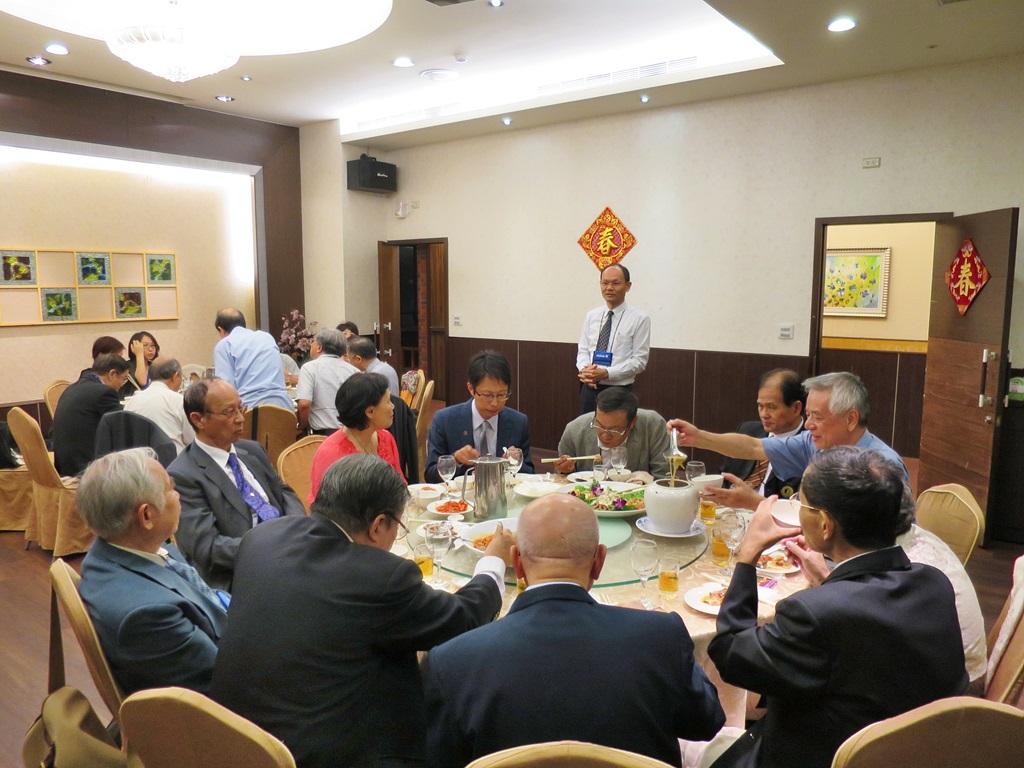
Several parallel sessions performed in the morning section. Dr. KS Chin and I joined the 4th IAQ/ANQ Symposium 2015 in Taipei and the frame was “Quality Education and the New UN Sustainable Development Agenda”. Before the meeting, we took a photo with Dr. Ngo Van Nhon (Chairman, VQAH).

Minda and I took a photo with Prof. Hiroshi Osada (Professor in Bunkyo University, and Professor Emeritus of Tokyo Institute of Technology).

In the beginning, Mr. Roland K. Jahnke (Academician & Vice President IAQ; Chairman, QiETT; and IAQ Representative at UNESCO Headquarters, Paris) briefed the background and agenda in this session. By 2015, neither of the goals of the Education for All Agenda” (UNESCO) had been achieved nor had the education-related Millennium Development Goals (MDGs) been achieved. More than 150 world leaders were expected to attend the UN Sustainable Development Summit from 25 to 27 Sep 2015 at UN headquarters in New York to formally adopt an ambitious new sustainable development agenda for next 15 years. Quality education would become a huge challenge of the new Sustainable Development Goals until 2030. IAQ QiETT cooperated with ANQ since 2012 to arrange IAQ/ANQ Symposium since 2012.

Prof. Hiroshi Osada gave opening remarks.

Prof. Yury Gusakov (Chairman, ANQ) gave opening remarks too.

Firstly, Mr. Roland K. Jahnke presented the “Global Quality Education in the heart of the New Sustainable Development Goals (SDGs) to 2030”. He shared global challenges of education sector and new challenges from 2030 Agenda for Sustainable Development.

For global challenges, approximately 61 million children did not attend school up-to-date and 13 million of them were not able to read! Then Roland shared the definition of “Concept of Sustainability” that “Humanity has the ability to make development sustainable to ensure that it meets the needs of the present without compromising the ability of future generations to meet their own needs.” Quality of Life was consisted three elements – Education, Industries and Government to form System Sustainability.

Then Roland introduced 5 priority actions from UNESCO and they were:
1. Advancing Policy
2. Transforming learning and training environments
3. Building capacities of educators and trainers
4. Empowering and mobilizing youth
5. Accelerating sustainable solutions at local level
After that Roland mentioned the new global IAQ collaboration with UNESCO and briefed this platform.

Roland said they paid more attention in Asia and stated pilot region of IAQ QiETT activities in Asia Oceania since 2012. The first symposium 2012 was held in City University of Hong Kong after ANQ Congress 2012 (parallel with technical visit session). And then held in Bangkok (2013), Singapore (2014), Taiwan (2015) and coming in Russia (2016). Roland concluded to increase the extent to which quality penetrated the education sector through ANQ Congresses.

The first speaker was Dr. KS Chin (Academician, IAQ; SEEM, CityU) and his topic entitled “Quality Management of High Education in Hong Kong – Juran Trilogy’s perspective”. Dr. Chin said Juran’s Triology included Quality Planning (QP), Quality Control (QC) and Quality Improvement (QI).

Then Dr. Chin introduced how CityU employed Juran’s Triology for Education that QP – Standards/Tasks; QC – Assessment/Corrections; and QI – Advancement/Innovation. In CityU, a constructive alignments tools included Intended Learning Outcomes (ILOs), Teaching and Learning Activities (TLAs) and Assessment Tasks (ATs). Dr. Chin discussed this QA framework that “The Quality Audit is an audit of an institution’s Fitness for Purpose in teaching and learning, where the Quality of Student Learning is the centrepiece (focus), with an emphasis on Quality Enhancement.”

The second speaker was Prof. Azat Abdrakhmanov (EOQ Quality Lead Auditor, EFQM Assessor) and his presentation named “Innovative Concept of Quality Management for Education Sector”. Prof. Azat briefed their Law on Education – Article 55 (effective on 07.21.2015) named “Quality Management of Education”.

Then he introduced their strategic plan of the Ministry of Education and Science of Kazakhstan for 2011-2015 in which had 5 strategic directions below:
1. Ensuring access to quality education
2. Providing access to quality schooling
3. Ensuring the availability of technical and professional education
4. Improving the quality and competitiveness of training of specialists, etc.
Finally, Prof. Azat shared how to be an innovative university through benchmarking, risk management, BPR, Feedback and recognition.

Prof. Kazuyuki Suzuki (University of Electro-Communications, Tokyo) was the third speaker and he shared Education in Japan and comparison with USA and Canada. He proposed Total Quality Education (TQE) and employ Ishikawa philosophy such as respect of humanity (spontaneity and creation) and self-enlightenment, as well as, mutual enlightenment.

I was the fourth speaker and my topic named “Quality Education in Hong Kong and Contribution to Hong Kong Qualifications Framework (HKQF)”. Firstly, I introduced HKSQ Vision, Mission and Values.

I shared HKSQ Quality Professional Development (QProfD) Model and HKSQ aimed to reduce gaps between education sector and industry sector. There are 6 gaps as follows:
Gap 1: Differences between Industry’s expectations of competent Quality Professionals, and Educational Institution’s perceptions of those expectations
Gap 2: Differences between Educational Institution’s perceptions of the requirement of Quality Professionals and the design of quality related study programs
Gap 3: Differences between Educational Institution Graduates’ ability and Industrial employment requirements for Quality Professionals
Gap 4: Differences between the abilities of Competence Quality Professionals required by industry and Quality Society recognition (e.g. HKSQ Certified Six Sigma Green Belt, HKSQ Certified Laboratory Quality Specialist, etc.)
Gap 5: Differences between Industry’s expectations of competent Quality Professionals and the average performance of practicing Quality Professional
Gap 6: Differences between the abilities of professionals recognized by Quality Society and Industrial employment requirements for Quality Professionals

Then I briefed HKSQ Certificates and Accreditation Courses, as well as, Company Based Student Project Competition. After that I introduced the HKQF which had been launched on 5 May 2008 which was a cross-sectoral hierarchy covering both academic and vocational qualifications with 7 levels hierarchy. I also mentioned HKQF Award Scheme for Learning Experiences of TIC industry.

There were 3 winners of HKQF Award Scheme for Learning Experiences and they attended ANQ Congress 2015 in Taipei.

Lastly, I concluded that HKQF would like to align with EQF in near future. The ideas of HKSQ and HKQF were very similar that both service local and think global.

Dr. Ngo Van Nhon (Chairman, VQAH) was fifth speaker and his presentation was “General Outlook about Educational Quality Assurance System in Vietnamese Higher-Education”. Dr. Ngo said Vietnam Educational QA consulted by VQAH because VQAH with colleagues from Institute for Quality Assessment and Development (IQAD) which was a training and consulting bodies combined technical consultancy and consulted over 30 universities in Vietnam since 2003 to applying ISO 9001, EFQM, ISO 26000, AUN, CDMO to set up QMS in universities.

The next speaker was Prof. Tatyana Shkarina (Far Eastern Federal University (FEFU), Russia) and she introduced her campus which would be held ANQ Congress 2016 in Vladivostok (海參崴).

The last speaker was Mr. Jeff Ryall (President-Elect of the Australian Organization for Quality; Managing Director, RelianSys) and he shared Australian education from pre-school to university.

Group photo with all panelists

Group photo with all participants

During lunch, I met Dr. Ling-Lang Tang (Asso. Professor of Technology Management, College of Management, Yuan Ze University) and we had met in the 6th International Conference on Systematic Innovation (ICSI 2015) on 15 July 2015 at HKUST.

In afternoon, my session named Innovation & Creation and my presentation entitled “Integration of Quality and Innovation Management System for Organization Innovation”. I introduced new version of ISO 9001 and the Innovation Management System based on PD CEN/TS 16555-1:2013. Lastly, I shared a TRIZ project implementation under this integrated approach.

The Integration of Quality and Innovation Management System (QIMS) was mentioned in which included ISO 9001 QMS process model plus Innovation funnel and five key element named “Strategic Intelligence Management”, “Innovation Thinking”, “IP Management”, “Collaboration Management” and “Creativity Management”.

Finally, I showed our metal tray enhancement case study in Reliability Laboratory as example to employ TRIZ Level One which contained six tools below:
Tool 1 – Multi-screen Thinking (The Nine Windows)
Tool 2 – Ideal Final Result (IFR) (IFR = All useful effects or functions / All harmful effects or functions)
Tool 3 – Functional Analysis (FA) (Component & Interaction Analysis and Function Modeling)
Tool 4 – Cause and Effect Chain Analysis (CECA)
Tool 5 – Trimming
Tool 6 – Technical Contradictions (39 Engineering Parameters & 40 Inventive Principles)

In Q&A, Prof. Azat gave his comments on the integration approach between Quality and Innovation Management System.

The next speaker in this session was Ms. Jen-Tsung Huang and her presentation topic was “Explaining Innovation Patterns of an IC Foundry Firm by Technological Regimes”. She mentioned to use Open Innovation in a flexible way with a large portfolio of innovation activities especially on technology company such as TSMC & UMC. One of her conclusions was that globally dispersed IC design and Electronic Design Automation (EDA) technologies allowed UMC utilizing the less costly to reach the targeted resources as much as possible.

Prof. Azat Abdrakhmanov (Member, IAQ and Accredited trainer and assessor of EFQM (Belgium)) was the fourth speaker and his topic entitled “Methodological and Practical Aspects for Implementation of Innovation Projects”. Prof. Azat would introduce the Total Innovation Management (TIM) and the awareness of the importance of creativity and innovation in organization.

Prof. Azat defined TIM as “The innovation synergy among technology, organization and culture and oriented to building up innovation competence to building up innovation competence and strategy for an organization.” Then he introduced Quality Innovation of the Year competition which aimed to increase the number of innovations created in participating countries and to raise the level of them and also to make good innovations publicly known.

At the same time, HKSQ member presented in the other session named Quality Practice. Ms. Jane Wai Kiu Wong (Sr. Manager, DEKRA HK) and her presentation title was “A Systematic Technology Roadmapping Approach for Testing and Certification Industry: A Case Study”. Her paper aimed to analyze the future trend of market and response of the company.

The last speaker was Mr. Denis J. Devos (Fellow, ASQ and President of Devos Associates Inc.) and his topic named “ISO 9001:2015 Implementing Risk Based Thinking”. Failure Modes and Effects Analysis (FMEA) and Risk Matrices were demonstrated. Devos introduced simpler and less quantitative check-sheet that could be used to assess and document risks according to the Ishikawa diagram categories of Man, Material, Machine, Method, Measurement, and Mother Nature.

Another two Hong Kong participants who were Prof. Philip Chan’s post-doc students presented in the other parallel sessions. I missed it but I met one of Prof. Chan’s post-doc graduate Dr. Sung Wei-Che (Branch President, Taiwan Asia-Pacific Health Management Association).


Prof. Kano mentioned the 20th Century was Quality for Cost (QfC) and 21st Century was Quality for Sales (QfS). The following diagram of QfC was recommended by Prof. Kano.

The overall hierarchical sales structure model (HSS Model) was demonstrated and explained that Q1 was past, Q2 was present and Q3 was future. Then Prof. Kano used a driver who would buy a new car as an example to explain the Q1, Q2 and Q3. Q1 could be separated into three parts such as Warranty Claim, Paid Service and Likes/Dislikes; Q2 could be Features and Q3 would be Safety and Reliability.

Dr. Chih-Han Wang (王治翰) (ANQ Honorary Board Directors) presented a certificate to Prof. Noriaki Kano.

Mr. Gregory H. Watson (IAQ) was the second keynote speaker and his topic was cooperated with his son Mr. Andrew D. Watson (Art Educator, Alexandria City Public Schools in Virginia) named “The Role of Artistic Thinking as an Innovation Stimulus to Increase Quality”.

Mr. Watson quoted Kano Model to describe the attractive quality which was represented by Japanese term for quality called miryokuteki (魅力) which was an aesthetic component that was delivered in the actual product or service. When miryokuteki was fulfilled, customer perceived this added value as aichaku (愛着) or “desirable to possess”. The situation that actual entity has been “designed to be wanted” as Steve Jobs told Apple designers to make a design of the iPhone buttons so that “people would want to eat them!” Mr. Watson compared the attractive quality and basic quality in the following table.

Then he mentioned “The Art of Scientific Investigation” and “The Art of Engineering Design”. Watson said “Science needs imagination to design experiments and Engineering needs intuition to design functions”. “The Art of Art” was discussed that “Developing an ‘imaginative understanding of customer needs’ is achieved by establishing ‘deep empathy’ in a potential customer niche.” So Kansei (感性) engineering refer to “sense / sensitivity engineering” for translating feelings and impressions into design parameters. Finally, Mr. Watson used Ten Natural Laws of Quality and Three Keys to Quality Mastery as conclusion.

During the break, Minda received CSQ book about Taiwan Quality Development History and she found the editor Dr. Wang to sign the book and took a photo together.

We took a group photo for attending the closing meeting.

The third keynote speaker was Mr. David Lee (Chairman, King Design Industrial Co., Ltd.) and his topic presented “Innovation vs Quality”. He said the topic was very suitable for him because of a dual profession as an inventor and a reliability equipment manufacturer.

Firstly, he explained the innovative product and service could promote and penetrate into market in different years. Then he mentioned IEC 60300 “Dependability Management”. The definition of Dependability was to describe the availability performance and its influence factors (including reliability performance, maintenance of effectiveness and maintenance support performance).


Then Dr. Yury stated 3 levels of CSR from “Quality of Products” to “Quality of Management” to “Quality of Sociality”.

The next session was presented ANQ Recognition for Excellence in Quality Promotion (ARE-QP) by Dr. Yury Gusakov (ANQ Chairman).
China UnionPay (CAQ), Jiangling Motor Company Limited (CAQ), Children’s Republican Clinical Hospital of Tatarstan Republic (ROQ), Niznevartovsk City Policlinics (ROQ), Organik Dalat JV Company (VQAH), Petrolimex Saigon, Co. Ltd. (VQAH),
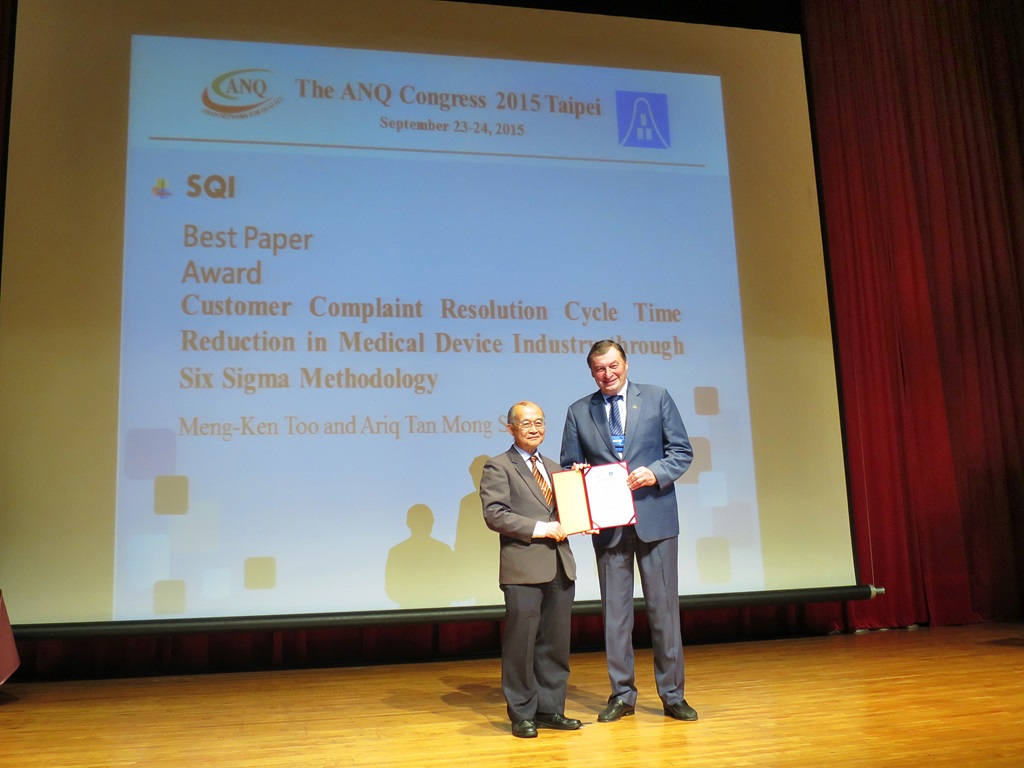
After that Dr. Yury Gusakov presented the Best Paper Award. Ms. MY Lin received the best paper award (HKSQ).

Our Singapore friend Mr. Meng-Ken Too also received the best paper award (SQI)
Dr. Yury Gusakov gave an invitation message for ANQ Congress 2016 in Far Eastern Federal University (FEFU), Vladivostok.

President of Russia also visited the FEFU.

The location of Vladivostok is very near ANQ members.

Before the end of congress, Prof. Noriaki Kano invited us to Dr. Kaoru Ishikawa Birth Centenary Commemoration.

The Tree of Prof. Kaoru Ishikawa was mentioned and the book “The Man and Quality Control” had been translated into English at http://www.juse.or.jp/english/archives/.

Lastly, Dr. Yury Gusakov reported ANQ 2015 congress details.
Totally, the congress had more than ~330 participants and received ~130 papers.
Reference:
Asian Network for Quality (ANQ) - http://www.anforq.org/
CSQ - http://www.csq.org.tw/
ANQ 2015 - http://www.anq2015.org/
HKSQ - http://www.hksq.org/index.asp