2015年9月23日星期三

ANQ Congress 2015 Taipei – Day 1

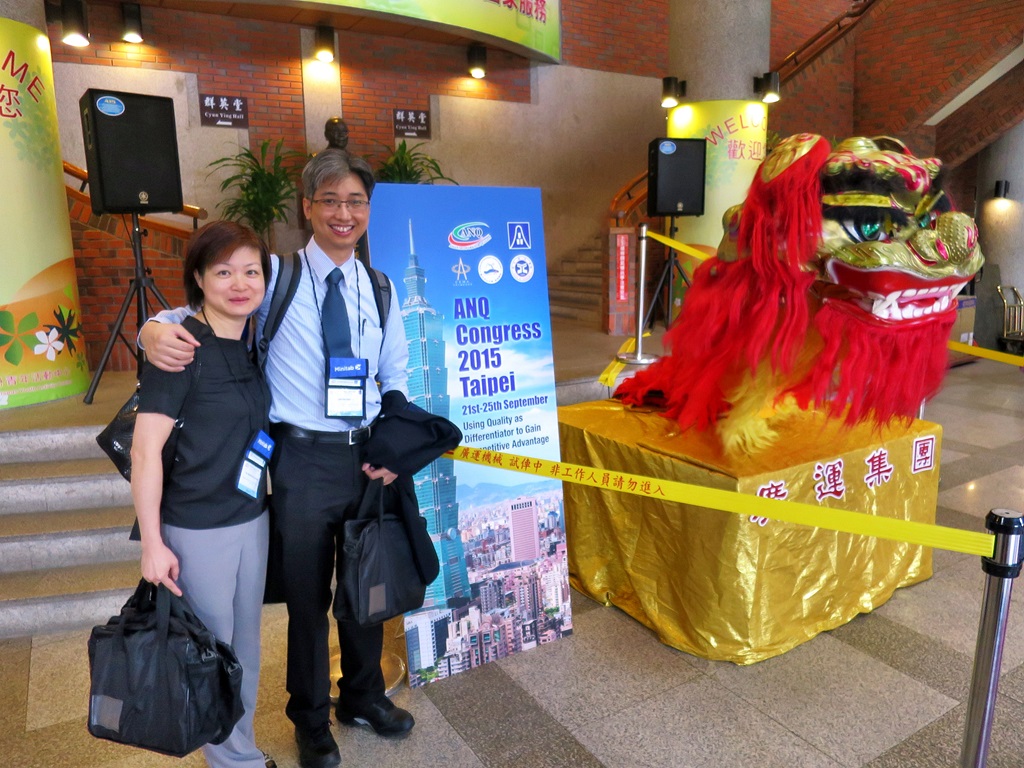
The first day of Asian Network for Quality (ANQ) Congress 2015 in Taipei was held on 23 Sep 2015. Minda and I took a photo with the robot Lion in the entry of Cyun Ying Hall of the Chientan Youth Activity Center.


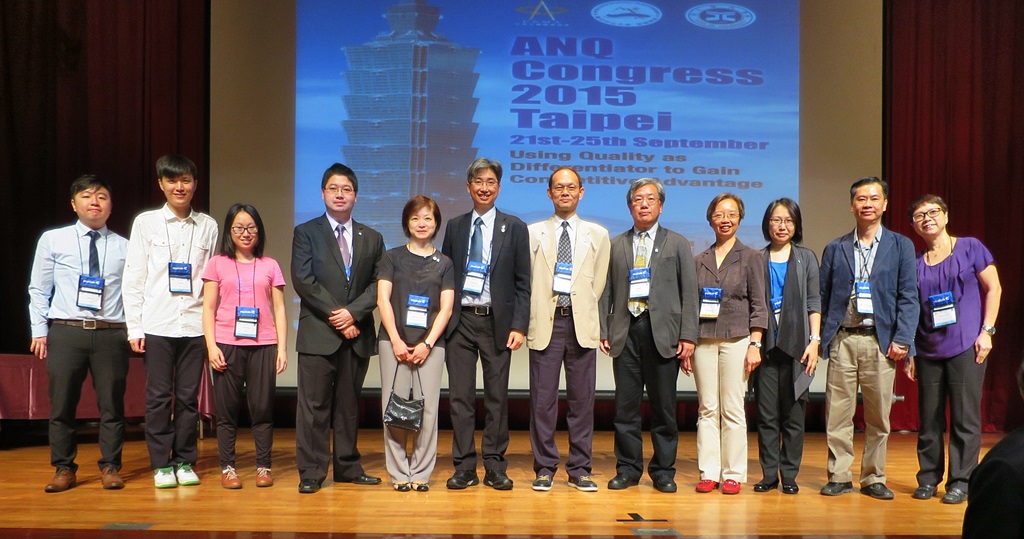
Then HKSQ group photo was taken inside the hall.
(Left: Mr. Litto Tam, Mr. Tony Ng and Mr. Sharon Wan, Mr. Ricky Suen, Ms. Minda Chiang, I, Mr. Peter Fung, Dr. KS Chin, Dr. Catherine Chan, Ms. Angela Wong, Mr. CY Lam and Ms. Jane Wong)

In the beginning, Dr. Yury Gusakov (Chairperson of ANQ) gave a welcome speech and he would like to thank keynote speakers, organization society and all participants. Then he brief ANQ history and its missions (ANQ Way).


Then Dr. Chih-Han Wang (Honor Chairperson, ANQ and Former Chairman of CSQ) gave a host welcome address to us. He gave his deepest appreciation to their organizing committee members as all of them were volunteers.


The first keynote speaker was Dr. Robert HS Chen (Chairman & CEO, Gloria Group) and his presentation topic entitled “Industry Innovation & Quality Management”. He briefed the outline of his talk included “Gloria Group Background”, “Regional Cluster Forming”, “Digitalization” and “Summary”.


Dr. Chen introduced their Aero Industry Supply Chain and its alliance. Their global Aircraft Supply Chain strategies would be centralized from OEM to the first Tier and then to sub-tier/Module.


After Gloria Group digital evolution from MIS (1996-1998) to ERP (1998-2002) to B2B (2002-2012) to ERP2.0 (2012-2013) to QR (2013-2015) to Digitizing (2015-2016), their Innovative Business Model became from Customer Collaboration Platform to Purchasing Platform to Material Management Platform and final to OTD Tally Platform.


Finally, Dr. Chen summarized that regional suppliers connection could give “Cohesive Power” and created their competitive advantage to link with OEMs. Moreover, e-commerice gave them more exposure and contacted their end users. After sales data collection and analysis, they could provide quick response and better service.

The second keynote speaker was Dr. Catherine Chan on behalf of her Master Prof. Yoji Akao (Chairlady of Hong Kong QFD Association) and her topic named “Introducing QFD to Taiwan”.


Firstly, Dr. Chan showed Akao’s message for apology that he was not able to join this time. Then she briefed the history of QFD since 1960s. QFD used the design approach to break down the objectives into segments and to identify specific means for achieving each segment and it was a system moving from upstream to downstream. Prof. Yoji Akao’s first book issued in 1978 and his first English book issued in 1994 (Remark: I have this book!!)


Then Dr. Chan told us the QFD to Taiwan started in 1982. Prof. Yoji Akao met two Taiwan’s friends and they were Prof. Tsong Chaw-Son (who invited Akao to conduct QFD lectures in 1982, 1984 & 1985) and Prof. Yang Ching-Chow (they met in ICIT conference in 2002, 2004 to 2007). Prof. Yang introduced QFD in his book (namely Management Tools Handbook) since 2009.


After the two keynotes speaking, Prof. Sue presented the ANQ Ishikawa-Kano Award (IKA) to the awardees. There were four awardees this year and they were Mr. Song Zhiping (Chairman of China National Building Materials Group Corporation) (CAQ), Prof. Dr. Nguyen Quang Toan (Former Chairman, Vietnam Quality Association of Ho Chi Minh City) (VQAH), Mr. Somchai Nirapathpongporn (CEO, SCI Corporation Co., Ltd.) (SQAT) and Prof. Tsong Chawson (Honorary Chairman, Association of Pioneer Quality Control Research (PQCRA)) (CSQ). The group photo with awardees was taken.
(Left: Prof. Suh, Yung-Ho (Chairman of IKA committee), Mr. Song Zhiping, Dr. Chih-Han Wang, Prof. Kano, Prof. Dr. Nguyen Quang Toan, Prof. Tsong Chawson and Dr. Yury Gusakov)


During the tea break and lunch, we took photos with friends from different societies for memory.
Prof. Fugee Tsung (HKSQ exco member) came late and we took a group photo in front of the hall again.
(Left upper: I, Ms. Jane Wong, Mr. Litto Tam, Ms. Minda Chiang, Mr. Sharon Wan and Mr. Tony Ng; Left lower: Prof. Fugee Tsung, Dr. KS Chin, Mr. Peter Fung, Ms. Angela Wong and Mr. Ricky Suen)


Photo with Prof. Tony KJ Chen (Fellow, CSQ)


Photo with Mr. Gregory H. Watson (Middle) and Dr. KS Chin (Left)


Photo with Dr. Catherine Chan and we signed the birthday card for Prof. Yoji Akao.


Photo with CAQ.
(Left: Ms. Minda Chiang, Ms. Fan Qing, Ms. Wang Li Lin (Director, International Exchange Dept.), Mr. Fan Tianshun (Deputy Secretary-general) and I)


Photo with Prof. Azat A. Abdrakhmanov (KOQIM)
(Left upper: Mr. Peter Fung, Ms. Minda Chiang and Ms. Angela Wong; Left lower: Ms. Gulbakhram Aitkhozhina (President, Intercert Consulting Central Asia) and Prof. Azat A. Abdrakhmanov (President, KOQIM))


HKSQ members took a photo with KSQM and CSQ
(Left: Prof. Yung-Ho Suh (KSQM), I, Ms. Minda Chiang, Dr. Chih-Han Wang (CSQ), Dr. KS Chin, Mr. Peter Fung, Ms. Angela Wong and Mr. Ricky Suen)


Photo with CSQ chairman and ANQ/ ROQ chairman
(Left: Ms. Minda Chiang, I, Prof. Ching-Chow Yang (CSQ), Dr. Yury Gusakov (Chairperson of ANQ; ROQ), Dr. Catherine Chan and Mr. Peter Fung)


Photo with Mr. Janak Mehta (ISQ)


Photo with Mr. Suzuki (JSQC).


Photo with Mr. Kenneth Liang (SQI) (Left) and Prof. Yung-Ho Suh (KSQM) (Right)


Photo with ISQ and VQAH
(Left: Mr. J. Ravikant (ISQ), Prof. Dr. Nguyen Quang Toan (Former Chairman, VQAH), Dr. Ngo Van Nhon (Chairman, VQAH), I and Mr. Kiran Deshmukh (Executive Vice Chairman, Sona Koyo Steering Systems Ltd.))


During lunch, our secretary took a photo with Mrs. Olga Gusakov and Dr. Yury Gusakov.


Afternoon, I joined the Prof. Kaoru Ishikawa Birth Centenary Commemoratory Session, Prof. Noriaki Kano was the first speaker in this session and he introduced Ishikawa Birth Centenary Commemoration and posted into the JUSE website at http://www.juse.or.jp/english/ishikawa/04.html.


Then Prof. Kano remembered his studies followed Ishikawa and he said he was a “unpromising student” and was supervised by Prof. Ishikawa totally 7.5 years from the undergraduate course until the Doctorate degree. He learnt “Process Control for the sake of Good Effect” rather than “Process Control for the sake of Process Control”. Prof. Kano briefed Ishikawa Philosophy from the viewpoint of QC Circles which was a challenge to Taylorism. Finally, Prof. Kano had sincere gratitude to Prof. Kaoru Ishikawa.


After that I joined Quality Management session. The speaker was Prof. Azat Abdrakhmanov (EOQ Quality Lead auditor, EFQM assessor) and his topic named “Certification of personel as a tool to improve the effectiveness of quality management system”. He introduced the certification of personnel based on ISO 17024:2012 requirement.


Prof. Azat mentioned the certification methodology for leaders and some achievements of Kazakhstan in implementation of Personnel Certification. The path to qualification such as EOC certification scheme was discussed and showed in the following diagram.


The second speaker in this session was Mr. Johnson Tan Swan San (SQI) and his topic was “How Do We Institute QA Practices in Our Quality Systems to Enhance Organization Capability in Achieving Quality?” He briefed the distinction between QC and QA and identified management and technical capability.
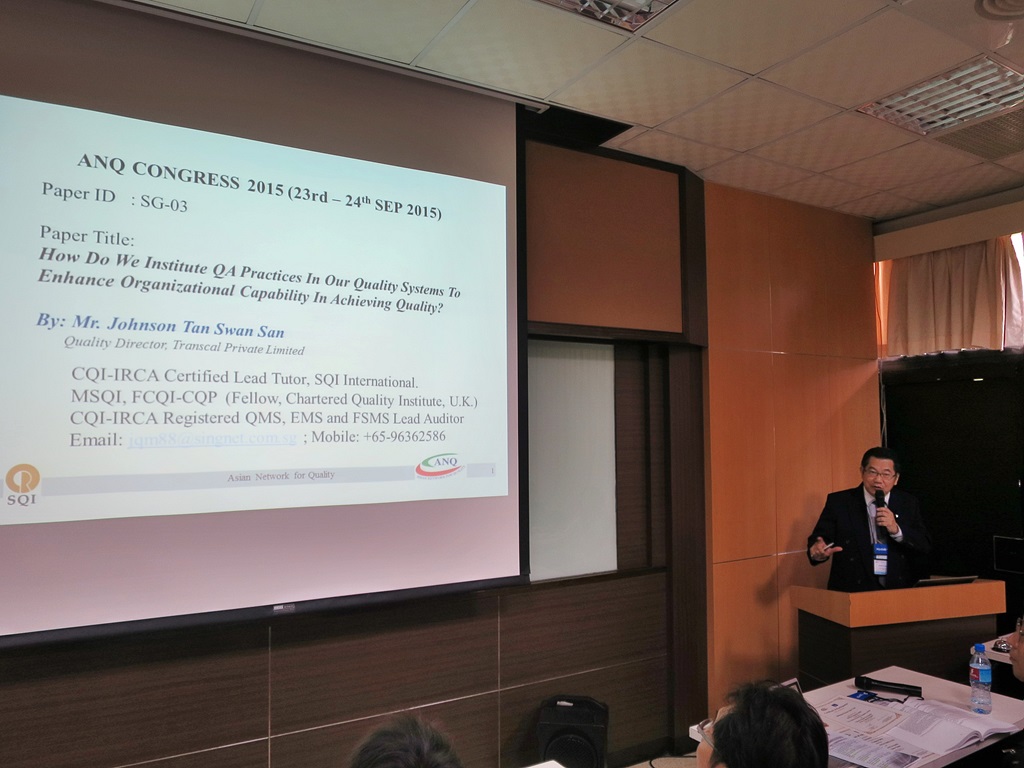

He focused on Technical Capability based on Calibration System in which using reference standard to detect and quantify Measurement Error (ME) and the associated Measurement Uncertainty (MU) based on ISO/IEC 17025:2005. Finally, he reminded that an ineffective audit on QA Practices would lead to loss of management resources, and opportunities for Productivity and Qualitative improvements.


Then I come back to the Ishikawa Birth Centenary Commemoratory Session, Mr. David Hutchins remembered Ishikawa conference in UK in 1975.

The voice of Ishikawa was demonstrated.


Finished this session, Fugee and I took a photo with Prof. Kano (Left 2nd) and Prof. Iuan-yuan Lu (National Sun Yat-sen University) (Right).


I then joined the session named Health Care & Safety. Mr. Peter Fung (HKSQ) was the session chair.


The first speaker was Mr. Yujing Qiao (Beijing Research Institute of Precise Mechatronics and Controls) and his topic entitled “Innovation and Practice of Error Prevention Working System for the Overall Process of Aerospace Servo Product Development”. He mentioned the application of Man-made Error-prevention Legend from 50 years’ experience, historical lessons plus skills methods.


Then Mr. Qiao showed the result that Design one-time pass rate enhanced to 100% and Manufacture one-time pass rate enhanced to 99.4% after application of that method. He concluded that error prevention working system and quality management mode transformation to ensure “zero defect” high quality servo products. Lastly, Mr. Peter Fung as session chair presented the certificate to Mr. Qiao.


The second speaker was Ms. MY Lin (Dr. KS Chin’s student in CityU) and her topic named “Care Service Quality Discussion on a Therapist Assignment and Routing Problem in Hong Kong”. In her talk, it included “Challenge in Home Health Care (HHC)”, “Objectives of HHC provides” and “Main Issues for HHC provides”.


Ms. Lin concluded that it proposed a sequential assignment and routing approaches under different continuity of care and forbidden overtime and analyzed their interactions. The traveling cost were affected based on the results of assignment model.


After finished the session, Prof. Ching-Chow Yang (Chairman, CSQ) presented a certificate of appreciation to Mr. Peter Fung (Chairman, HKSQ) for his contribution on that session.
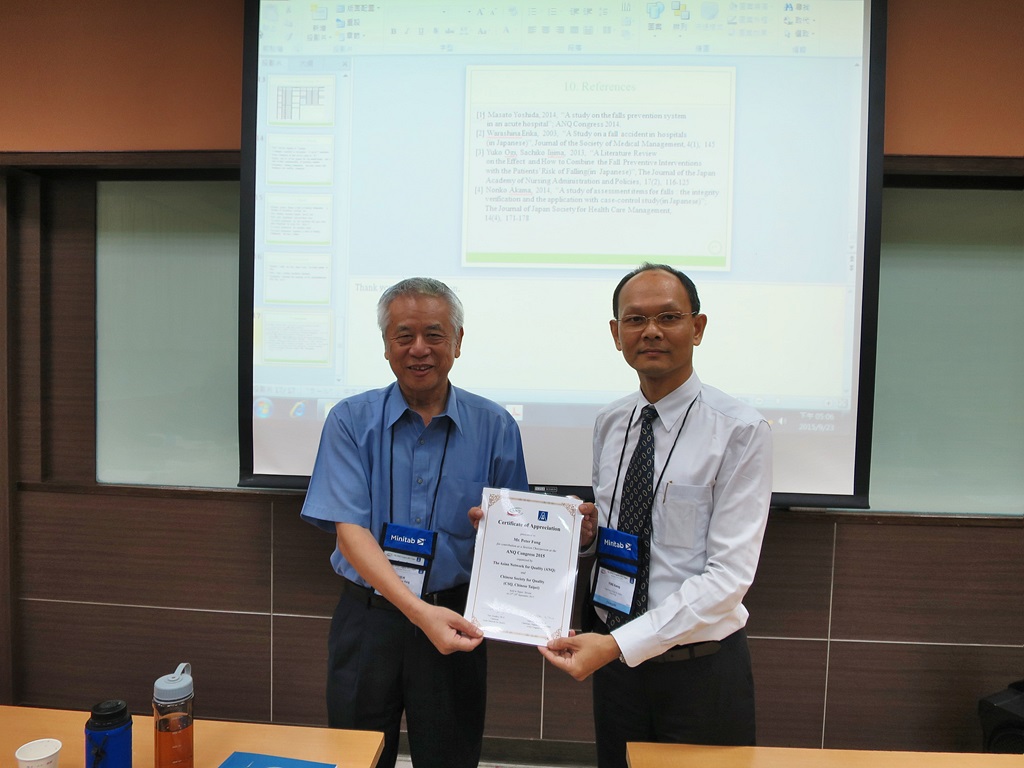

Then we took a group photo with Mr. Peter Fung to remember his worked as Session Chair.


I also took a photo with Prof. Ching-Chow Yang and Mr. Eric He (Assistant Manager, Research & Development Centre, Opto-Electronics Lab., Gloria Material Technology Corp.).


Back to the Prof. Kaoru Ishikawa Birth Centenary Commemoratory Session, Mr. Janak Mehta shared the contribution of Ishikawa’s philosophy in India.


Lastly, Mr. Janardan Ghimire (President, NQPCN) shared a talk named “Delayed entry of Ishikawa’s quality perspective in Nepal”.


He summarized Prof. Kaoru Ishikawa’s lifecycle (1915 – 1989).


At the end of Day 1 program, Hong Kong Society of Quality (HKSQ) team joined the pre-meeting for the 3rd Chinese Quality Forum to discuss the coming event in Bejing.

Reference:
Asian Network for Quality (ANQ) - http://www.anforq.org/
CSQ - http://www.csq.org.tw/
ANQ 2015 - http://www.anq2015.org/
HKSQ - http://www.hksq.org/index.asp


2015年9月22日星期二

HKSQ pre-ANQ Congress Visit to Pharmaceutical Co., Ltd.

A day before Asian Network for Quality (ANQ) Congress 2015 at Taipei, HKSQ was arranged pre-ANQ Congress Technical Visit to Purzer Pharmaceutical Co., Ltd. (Purzer) on 22 Sep 2015. Purzer was established in 1988. It has diversified product portfolio, manufactured and distributed products, including prescriptions (Rx), Over the Counter (OTC) products, dietary supplements and medical devices. Its products have been sold in Taiwan, Japan, Mainland China, Singapore, Malaysia, Vietnam, Myanmar, Hong Kong, Macao, Mauritius, etc. I would like to summarize our trip for sharing. In the morning, we gathered in the Taipei station.


When we arrived, Mr. Ming Der LIN (Vice General Manager & Pharmacist, Purzer) introduced the background to us. Purzer invested in expanding and upgrading its plant facilities to meet requirement of PIC/S GMP. In 2010, Purzer passed PIC/S GMP inspection by TFDA in Taiwan and got the approval of “Accreditation Certificate of Foreign Drug Manufacturer” by Minister of Health, Japan.


Mr. LIN mentioned “Excellence and Service” was Purzer’s mission to pursue excellent quality in production and business operation. Purzer believed that profit was based on high-quality products and excellent services. Moreover, 5 ideals were briefed including “Performance & Team Spirits”, “Training & Fostering”, “Creation & Communication”, “Quality Product and R&D”, and “Hardworking, Honesty & Wisdom”. Purzer’s goal was introduced to become a multinational pharmaceutical company, and contributes to people.


One things I learnt in their QA was “Qualification (6Q) (D/I/O/P/R/MQ)” stands for Design, Installation, Operational, Performance, Review and Maintenance. Then we visited the plant and studied how to change lab coat and hand washing under cleanroom. We took a group photo for memory outside the cleanroom. And then we visited the laboratories and R&D team.


After that Ms. Angela Wong (Vice-Chairman, HKSQ) presented a flag to Mr. Lin.


At the end, we took a group photo in front of the Purzer.


We booked a table in Orchard Park to have lunch with Mr. Lin.


Group photos:
(Left: I, Ms. LIN Meiyan, Ms. Minda Chiang, Ms. Angela Wong, Ms. Jane Wong (Sr. Mgr, Sales & Inspection, South China, DEKRA), Mr. Ming Der LIN, Dr. Catherine Chan (Chair, HKQFDA), Mr. CY Lam (Sr. Technical Training Mgr, Global Services, Coats Global Services), Dr. KS Chin and Mrs. Chin.)


Reference:
Asian Network for Quality (ANQ) - http://www.anforq.org/
HKSQ - http://www.hksq.org/index.asp

2015年9月16日星期三

CityU Research Seminar on “How to write a Good Grant Application”

CityU Research Seminar named “How to Write Good GRF and Other Grant Applications” was organized by College of Science and Engineering on 16th Sep 2015. The seminar invited three prominent researchers to share their experience in writing good General Research Fund (GRF) and other grant application such as panels’ decisions making, a good topic, application preparing and collaboration forming, etc.


The first speaker was Prof. CS Lee (Chair Professor of Material Science, Dept. of Physics and Materials Science, CityU) and his topic named “Some advices on preparing a successful GRF proposal”.


In the beginning, Prof. Lee explained what proposals are funded or what kind of proposals are higher success rate to be funded as followings.
- Proposals from young scientists with highly innovative ideas (The “Wow” Factor – no one imagine before).
- Proposal based on important preliminary results or recently published in prestigious journals. (Some preliminary published results as basic for next proposal)
- Proposals on really hot topics.
- Proposals in areas with small but mutually supportive communities. (Search keyword using Google)
- Proposals from those who have many friends.

Then Prof. Lee pointed out four sweeteners (summarized the above points) below:
1. Experimental plus Theoretical Collaboration
2. Real Collaboration
3. Preliminary Result
4. A Strong List of Publications

After that Prof. Lee advised us don’t make the following mistakes:
- Errors due to cut & paste (usually happened from using previous proposals)
- Not enough track records
- No or “hided” preliminary results
- Objectives are too ambitious
- Not enough explanation on “Why do these? And Why in these ways?”
- No backup plan for risky objectives
- No theoretical modeling
- Not enough novelty / new / innovation
- No animal experiment in bio-related projects, etc.

Finally, Prof. Lee suggested to provide solutions on the 5 key questions which reviewers needed to answer.
1. Please comment on the objective(s) of the proposal, and whether the research agenda adequately addresses the objective(s)?
2. Please comment on the Research Design and Methodology
3. Please comment on the feasibility of the proposed research.
4. What do your consider to be the most original or innovative aspect of the proposed research? What advances would the research result bring about to the related field if the proposed research is successful?
5. Please comment on the reasonableness of the proposed budget and manpower planning and project duration.
One more question was overall comments. In addition, Prof. Lee told us did not suggest 3 or less reviewers. It had better suggest 5 reviewers.

The second speaker was Prof. Li Hanxiong (SEEM Dept., CityU) and his topic was “Discussion for GRF Proposal”. 


Prof. Li introduced that Engineering Project was very difficult to present in the grant application. He would consider on Quality into three aspects including Material, Effort and Presentation.


Finally, he concluded that the problem selected should be suitable to your team. Presentation is key (Easy to follow - layman and difficult to understand – expert) and Logic is most important (Concise & Simple Structure; Difficult Details; and Figures/Tables can speak).


The last speaker was Prof. Zhou Dingxuan (Chair Professor of Mathematics, Dept., of Mathematics, CtiyU). Prof. Zhou shared his experience that we needed to perform self-evaluation and clear objectives. For example, he said his work related to machine learning, however, he was focused on analytics but not algorithm. Then he told us to think how to convince people to support your proposal such as suitable method to be used or suitable reference to be quoted. Think problem in different angles.


Q&A Session


Reference:
CityU College of Science and Engineering - http://www6.cityu.edu.hk/cse/cms/index.aspx?lang=en
General Research Fund (GRF) - http://www.ugc.edu.hk/eng/rgc/grf/grf.htm


2015年9月14日星期一

ASQ InfVoices – Mission in Hong Kong Science Park

September topic of ASQ Influential Voice is posted by Pat La Londe (ASQ Fellow and ASQ board chair) named “Does Mission Matter?” She analyzed ASQ’s mission and concluded that strong leadership is essential to developing and sustaining a culture of quality. Finally, she asked us to share “What is your organization’s mission? Do you update and refer to it on a regular basis?” Moreover, I am total agreed that “If an organization is seeking to improve its culture of quality, a closer look at the three areas —vision, values and leadership—is likely a good place to begin.”
I would like to share the history of Hong Kong Science and Technology Parks (HKSTP) Vision, Mission and Values since 2001. The milestone of HKSTP is shown in the following diagram.


2001-02
Vision
Hong Kong Science and Technology Parks Corporation is to play a leading role for Hong Kong to become a major centre of innovation and technology development in the focused clusters*, and a hub for high value-adding, skill-intensive manufacturing and service industry capacities.
Mission
To provide quality infrastructure and support facilities for innovation and technology development in the focused clusters* and the upgrading of manufacturing and service industry capabilities
To provide full-service incubation programme for technology start-ups
To foster partnership and collaboration between industry and universities / applied research institutes through consulting, training and research programmes
(* Focused clusters encompass electronics, biotechnology, precision engineering and information technology/telecommunications industries.)

2012-13
Vision
Transforming innovation and technological advancement into value creation that benefits Hong Kong, Mainland – and the world.
Mission
In propelling Hong Kong towards a world-class hub for selected technologies, we provide facilities, services and a dynamic environment that enable companies to nurture ideas, innovate and develop.
Values
Integrity, Excellence, Safety, Sustainability and Commitment


2014-15
Vision
Create a vibrant innovation and technology ecosystem to deliver social and economic benefits to Hong Kong and the region.
Mission
Connect stakeholders, facilitate knowledge transfer and nurture talents to accelerate technological innovation and commercialization.
Core Values
Proactive, Integrity, Enterprising, Collaborative and Excellence


We have updated the vision, mission and values which depended on environment change. The vision is observed to be expanding and more focus on innovation and technology (I&T) ecosystem that is not only I&T hub in Hong Kong. Mission observed from “local infrastructure and startup incubation” to “acceleration and commercialization”. Moreover, we try to implant core values into corporation since 2012.

Reference:
HKSTP - http://www.hkstp.org/
20140722: ASQ InfVoices – Clear Vision - http://qualityalchemist.blogspot.hk/2014/07/asq-infvoices-clear-vision.html
20120826: ASQ InfVoices - The Quality Culture in Hong Kong - http://qualityalchemist.blogspot.hk/2012/08/asq-infvoices-quality-culture-in-hong.html


2015年9月9日星期三

HKSTP TecONE Seminar on Business Model

The TecONE seminar named “Business Model” was organized by Hong Kong Science & Technology Parks Corporation (HKSTP) on 9th Sep 2015. TecONE, a one-stop service centre which starts operation in July 2014 sets to provide technology SMEs comprehensive advisory services in relation to public funding schemes, industry support programs, HKSTP support services, bank finance and angel investment.

The guest speaker was Mr. Eric Cheung (Consultant, IT & Business Management, HKPC) and he introduced the Business Model for smart startup. He told us two observations form his past projects below.
i) SMEs and startups are quicker in driving innovation, but lack brand presence in market.
ii) Large corporations’ strategic planning and market research takes months to complete, but the results are still “Hypothetical”.


Then Mr. Cheung briefed 5 steps of traditional Innovation process. There were two problems faced by enterprise during innovation:
i) Inertia and fear of change
ii) Long time for making decision
However, there are some opportunities included “Brand Identity”, “Incumbent in Market”, “Customer Relationship”, “Financial and Employee Resources”.


It observed a traditional approach as follows:
i) Market research or insight from senior management
ii) Develop an almost “ideal” product based on senior management’s view
iii) Market and promote the product
iv) Success or Fail
So that traditional corporate environment was not conducive to some type of innovation (Breakthrough)!


Mr. Cheung used Zappos (online shoe store) as example to analysis their Business Model using BMC. The Value Proposition has two Hypotheses:
i) Will people buy shoes without trying it on?
ii) Will people by shoes online with price same as in-shop?
It needed to test these hypotheses using Prototype that was no warehouses and measured if the visitors purchased the shoe online.


The following three key elements for quick hypothesis test were:
i) Hypothesis (Generation / Tune / Scrap)
ii) Build (Minimum Viable Product)
iii) Measure (Non-Vanity Metric - Data collected about a company or its users that should help entrepreneurs make decisions.)


Some cases were discussed below.
WebVan (fail): Lesson learnt that focus on attractive micro-segments & fix the business model before expanding
Dropbox (success): Using minimum viable product (MVP) to validate the assumption (e.g. video of prototype that product was not completed)
Kodak Gallery (fail): Don’t forget the big picture: Setting business hypothesis before testing
3M (success): Continuous supply of new ideas that 15% of all employee’s time is allowed to be on their pet projects (So called “3M Way”)
Zappos (success): Like a city and less like a bureaucratic corporation. They called their structure to be “Holacracy” that enable employees to act more like entrepreneurs and self-direct their work instead of reporting to a manager who tells them what to do.
Finally, Mr. Cheung showed their Smart Startup Model from Crazy Idea to Business Hypothesis, then DOE and Measurement with IT solution, as well as, Tune or Scrap to innovate and get the final target.


Q&A Session
During Q&A, Mr. Cheung answered lean was not only in process but also in innovation.


Lastly, he shared some project using Smart Startup Approach through 1. Set hypothesis; 2. Build minimum viable product (MVP) and 3. Learn by non-vanity measure.


Reference:
HKSTP - http://www.hkstp.org
TecONE - http://tecone.hkstp.org/t1_web/


2015年9月7日星期一

CityUES Seminar on “The Rise of China, One Belt and One Road, the China Dream”

CityU Eminence Society (CityUES) arranged a seminar named “The Rise of China, One Belt and One Road, to Realize the Chinese Dream (1945 to 2015)” (「中國崛起,一帶一路,圓中國夢(1945-2015)」) in the Eminence Galaxy Alumni Function Room on 7th Sep 2015. CityU Eminence Society (CES) has established on 31 Dec 2010. Our mission is “To unite senior alumni to proactively contribute their resources, expertise and networks to help advance the University and serve the community”. Before the seminar, I took a photo with Dr. George So (Founding VP, Hong Kong Greater China SME Alliance Association) for memory.


Firstly, Dr. George So explained the meaning of this topic that China is come back to the World but not the rise. One Belt and One Road is our key national strategies. Dream is separated into personal, national, and the world. Then Dr. So asked what do you think about the economy? He added such as Deflation, Toxic Debt, Crashing Commodities, Crashing Chinese economy and Stock Market and Major Geo-political Problem that all are occurring simultaneously! After that Dr. So reviewed the big issued in the past 70 years (Beginning from the end of WWII in 1945 to the Xi’s era and China Dream in 2013).


Dr. George So briefed the Money and Internet War because of “Money makes the world go round! Internet connects people around the globe!” He believed USA flight for US dollar dominant (especially US Dollar for oil exchange). He also reviewed the recently issues happened in China since 2012. It guessed US government would like to create Geo-political Problem / Unstable to let money flow back to US.


The following slide showed different big issues should be paid attention including One Belt & One Road, AIIB, Internet+, Industry 4.0, Low Carbon era, etc.


Dr. So explained the spirits of One Belt and One Road through 5 paths.
i) Political Communication
ii) Facility Connection
iii) Free Trade Path
iv) Currency Exchange
v) Culture Exchange
In the past, USA and Russia had raised a similar plan such as “New Silk Road Initiative” from USA and “Eurasian Union” from Russia to fight for the dominant power in that area.


Another important issue was China-led bank – Asian Infrastructure Investment Bank (AIIB). In Europe, UK joined first on 12 March 2015 and then Switzerland, France, Germany, Italy and Austria. Top 10 countries in terms of capital contribution to AIIB is shown as following table.


Dr. So then discussed the important of reserve currency which is money held in significant quantities as a means of international payments and settlements. He added “any change to the world’s reserve currencies quickly reverberates around the world, putting literally hundreds of billions of dollars into motion, in a matter of minutes”. Finally, Dr. So said “Interesting September” based on the Mystery of the Shemitan (安息年的奧秘) that something would happen every 7 years.


Lastly, Dr. So quoted the book from Stephen Roach named “Unbalanced the Codependency of America and China” and shared four points below.
1. US saves little and China saving too much
2. China is planning to reboot its economic growth by moving from export led model to one of the internal consumerism, with a new focus of consumerism.
3. US has no strategy only using short term reactive approach over a more coherent Chinese style planning framework.
4. The way out: What America could do to turn its own Economic fate around and position itself for a healthy Economic and political relationship with China
He used a diagram to conclude what happen between China and USA.


Q&A Session
Dr. Augustine Chow (our first EngD (EM) graduate) shared his economic experience and he would restructure his investment portfolio after this seminar.


EngD cohorts took a photo with Dr. Georgy So for memory.
(Left: I, Dr. So, Dr. Andy Wong and Dr. Rocky Lam)


(P.S. Dr. George So told us that he had just joined the ceremony of 海上絲綢之路協會 and back to CityU for this talk. Some news showed at http://www.hkamg.org/event/?_do=event_show&activity_id=2013 and http://news.takungpao.com/hkol/topnews/2015-09/3155511.html.)

Reference:
CityU Eminence Society - www.cityues.org
CityU EngD Society - http://www.engd.org/home.aspx

Other Related Seminar & Article:
20150820: HKIE Seminar on Industry 4.0: The 4th Industrial Revolution - http://qualityalchemist.blogspot.hk/2015/08/hkie-seminar-on-industry-40-4th.html
20130929: Asiaization is the Future of Quality - http://qualityalchemist.blogspot.hk/2013/09/asiaization-is-future-of-quality.html


2015年9月1日星期二

HKSTP Leadership Seminar – The 10 Innate Qualities of a Successful Leader

The Leadership Seminar Series: The 10 Innate Qualities of a Successful Leader was held by the Hong Kong Science and Technology Parks Corp (HKSTPC) on 1st Sep 2015. I would like to summarize the seminar for sharing below.

In the beginning, Ms. Freda Wu (COO, HKSTP) gave an introduction to our guest speaker and pointed out the relationship between leadership and innovation.


Mr. Tom Mehrmann (Chief Executive, Ocean Peak) was our guest speaker and shared his secret “The 10 Innate Qualities of a Successful Leader” with the topic named “Ocean Park: Sustainable Leadership”. Firstly, he asked how many participants had visited Ocean Peak and raised hands. Almost all of us had visited before. Then he asked us a question “How many of you desire SUCCESS?” as his talk opening.


Then Mr. Tom Mehrmann shared Ocean Peak vision in the past used “ASPIRES” to be a world leader and “Connecting People with Nature”. But the new one employed “WILL BE”. After that Tom mentioned their core values included “Fun”, “Service”, “Safety”, “Education and Conservation” and “Respect for People and Animals”.


Mr. Tom Mehrmann also stated how to enhance engagement of staff which relied on willing to “Say”, “Stay” and “Strive”. He raised “Employee Value Proposition” and managed their expectation. Tom also shared their internal survey that found out 8 Core Competencies and 5 Leadership Competencies below.

For 8 Core Competencies, they were:
- Planning & Organizing
- Team Work & Partnership
- Communicating Effectively
- Change Orientation / Flexibility
- Quality Orientation
- Goals / Performance Driven
- Problem Solving

For 5 Leadership Competencies, they were:
- Strategic Perspective
- Decision Making
- Innovation and Improvement Orientation
- Respect for Diversity
- Building People Capability

Mr. Tom Mehrmann demonstrated how he working with staff during Halloween last year. (Left hand side)


Finally, he explained Success Factors below.
1. Be Hungry for Change
2. Innovate Beyond Your Customers’ Imagination (I think that is great! Because quality professional focused on customer satisfaction and to excess their expectation (i.e. Kano Model). Tom’s success factor is one step more to Imagination.)
3. Be Disruptive by Nature
4. Be Genuine not just Generous (Tom said they reserved 5% revenue to be conservative fund for R&D use.)


Lastly, he told us the 10 Innate Qualities of Leaders as follows:
1. Curiosity (like Monkey)
2. Sense of Responsibility
3. Sense of Humor
4. Passion
5. Courage of Conviction
6. Initiative
7. Creativity / Innovative
8. Sense of Urgency
9. Persistence
10. Confidence


Q&A Session
During this session, Mr. Tom Mehrmann answered some participants that they have e-learning platform for staff named “Ocean Learning Program”. He would like to employ innovative ideas and products into Ocean Park through people in Science Park. Then I asked the last question about any cooperation with local universities such as School of Veterinary Medicine in CityU.


Reference:
HKSTP - www.hkstp.org
Ocean Park - http://www.oceanpark.com.hk/html/tc/home/
CityU Vet School - http://www.cityu.edu.hk/svm/en/index.html


LinkWithin

Related Posts with Thumbnails