2014年10月20日星期一

ICQ 2014 Tokyo – Day 1

The International Conference on Quality (ICQ) 2014 in Tokyo, Japan was held on 19-22 October 2014. Prof. Fugee Tsung, Mr. Ivan Ng and I as representatives of Hong Kong Society for Quality joined this conference.


Before the conference, I took some photos with quality professionals.
I met Dr. John Timmerman (Left 1), Mr. Gregory H. Watson (Left 2) and Mr. Jan Gillett (Right).


Then I took a photo with Thailand friends. (Left: Assoc. Prof. Dr. Pichit Sukchareonpong (VP for Research and Academic Services, Thai-Nichi Institute of Technology), Prof. Phulporn Saengbangpla (SQAT) and Assoc. Prof. Damrong Thawesaengskulthai (Executive Director & Director General, Technology Promotion Association (Thailand-Japan))


In the beginning, Mr. Shinichi Sasaki (Vice-Chairman, The Organizing Committee) gave an welcome address to us. He briefed the theme “Innovation through Quality – Creating New Value for the World!” and he was happy to receive as many as 1,000 participants in total, approximately 480 participants from more than 38 countries and regions and 520 from all corners of Japan.


The keynote speaker was Mr. Masahiro Sakane (Councilor, Komatsu; and Chairman, Union of Japanese Scientists and Engineers) and his topic entitled “Innovation through Quality – Creating New Value for the World”. His talk included “Introduction of Komatsu Ltd.”, “Assessment of Fundamental changes in the World” and “Komatsu’s Efforts”. Mr. Sakane mentioned that their “Construction and mining equipment” and “Industrial machinery and others” had No.1 & 2 market share in the world. 


Then he explained the global changes of market share.  After Japan’s massive bubble economy, China and Asia portion had increased.  He also said the population increased and urbanization, we would focus on Resource/Energy, Food/Water, and Global environment plus Medical treatment.  We went to Age Society.


Finally, Mr. Sakane introduced the creation of new corporate value through different degree of involvement. Komatsu’s Brand Management is equal to reassessment of relationship with customers. The Komatsu Way is to Share Values and Beliefs in Action.


Mr. Kan Trakulhoon (Group Chairman, Siam Cement Group) was the guest speaker to give us the special lecture 1 named “Quality Management in Siam Cement Group”. Mr. Trakulhoon briefed the background of SCG included Chemicals, Cement-Building material and Paper business.


Then he mentioned they introduced TQM from 1992 to 1997.  They set up Total Quality Promotion Centre, established TQM Policy, invited Dr. Kano as TQM Consultant Team Leader and performed pilot TQM implementation.  In Crisis Overcoming phase from 1998 to 2005, they took group-wide promotion of TQM and rigorous TQM implementation, so as to overcome the crisis with positive business performance.  Vision oriented TQM sustaining phase 2006 onwards were stated.  SCG as ASEAN sustainable business leader performed synergy of TQM & TPM for operational excellence and established a solid foundation to foster “Innovations”.


Mr. Trakulhoon mentioned that they committed in R&D such as establishment R&D System & Infrastructure, significantly R&D budget increased, higher number of specialists employed, as well as, promoting “Open & Challenge” Culture. He said “Sustaining competitiveness & growth needs well-throught-out people development framework”.


During the break, I met many quality professional friends and took photos for memory.
(Left: Mr. Stephen K. Hacker (ASQ Board Chair 2014), Mr. Janak Mehta (President, International Academy for Quality (IAQ) & Chairman, TQM International Pvt. Ltd. (TQMI)) and I)


Photo with Prof. Hiroshi Osada (Professor Emeritus, Tokyo Institute of Technology)


Photo with Dr. V. Swaminathan (National VP, National Institution for Quality & Reliability, India)


Photo with Mr. Kenneth Leung (Chairman, ANQ & SQI), Prof. Fugee Tsung and Mr. Yukihiro Ando (TQM Consultant))


Photo with Prof. Fugee Tsung (HKSQ), Ms. X.F. TANG (Executive Vice President of Shanghai Association for Quality (SAQ)), Mr. Feng PAN (Deputy Secretary General of SAQ) and Mr. Xuchun ZHOU (Director, On-Site Service Dept., SAQ)


Fugee and I took a photo with Prof. Kazuyuki Suzuki (Professor, Dept. of Informatics, University of Electro-Communications, Tokyo) (Middle)


Then we took a photo with Mr. Roland K. Jahnke (Academicaian, IAQ; Chairman, QiETT; and IAQ Representative at UNESCO Headquarters, Paris) and Dr. Charles A. Aubrey II (Chairman APQO/GPEA).


The second guest speaker was Dr. John Timmerman (Senior Strategist, Customer Experience & Innovation, Gallup) and his special lecture 2 named “Behavioral Economic Design of the Customer Experience”.  John introduced there were three pills like Matrix firm that were Processing, Perceptions and Potential. 


Then John mentioned Behavioral Economics that was about understanding economic behavior and its consequences. It’s also about understanding whether people make good or bad choices, and could be helped to make better choices. Then he did different experiment with participants. One of experiments named “Black Dots”. It implied that what you see might not be true.


After that he introduced there were two systems in our brain. The System 1 which operated automatically and quickly with little or no effort and no sense of voluntary control and the System 2 which allocated attention to the effortful mental activities that demanded it, including complex computations. John also said human decision only 30% rational but 70% non-rational. Finally, he stated VITAL Innovation Principles as follows:
Vision – Consider the broader framing beyond the obvious project goal.
Insights – Understand the customers unspoken requirements.
Test – Allow for evolving design changes & evaluate under complex conditions.
Alternatives – Identify souldtions that are scalable in collaboration with key stakeholders.
Learning – Incorporate feedback loops & iterative learning cycles in the design process.
Finally, John focused on Innovation Strengths and concluded into three points below.
1. Humans are mostly non-rational.
2. Emotions predict economic outcomes.
3. Focus on employee strengths.


Before lunch break, Fugee and I took a photo with Mr. William J. Troy (CEO, ASQ).


Then we went to poster session, Ivan and I took a photo with Dr. Ngo Van Nhon (Vietnam Quality Association of Ho Chi Minh City, VQAH) and his poster named “Applying ISO 26000 Standard for Sustainable Development and Enhancing Social Responsibility in Education”.


I took a photo with Dr. Masaaki KANEKO (Junior Associate Professor, Tokai University) (Left) and his student Mr. Tetsuya Kobayashi (Right).


We met Mr. Anil Sachdev and Mr. Kenneth Leung. We took a photo for memory.


 After that Ivan and I attended different concurrent sections below.
In Quality in Service session, Mr. Anil Sachdev (President, TQM International India) was the speaker to present the topic named “Challenges and Approach in implementation of TQM in Service Organizations”.  In the beginning, Mr. Sachdev briefed TQMI which was leading QM consultancy organization in India since 1992, where Mr. Janak Mehta is Chairman & Managing Director. 


Then Anil introduced the challenges in service sector such as invisible processes and outputs, error occur after used, lack of data or proper measure, etc. Then he introduced the typical path for problem solving in the following diagram. At the end, Anil concluded that TQM was a proven management approach and could implement in both manufacturing and service sectors. 


Then we went to the session “Top Management Panel Discussion” which chaired by Dr. Hiroshi Osada (Bunkyo University). Mr. Makoto Nakao (President & CEO, GC Corporation, Japan) presented a topic related to dentistry. 


He explained why dentistry important to society and customer.
1) Japan is the world’s fastest aging country
2) Aging world’s populations were compared
3) Link between the number of existing teeth and survival time was significant.

Finally, Mr. Nakao said we needed innovations for value creation so that each “GC Associate” must cope with changes!


Mr. T.V. Narendran (Managing Director of TATA Steel, India & SE Asia) shared his view on Innovation through Quality. Mr. Narendran introduced Tata Steel which was a global steel company uniquely positioned in developed and developing markets. Then he would share their TQM Journey that was the catalyst for improvement & innovation, as well as, innovation case study.


Mr. Narendran said TQM was a systematic approach to Improvements & Innovation, as well as, “Our Policy Management also creates scope for Innovations”. Moreover, they formed Innovation Council, identification of Innovent (consumer-in vehicle) and collaboration with student innovators to nuture Innovation, so as to achieve “Mind Over Matter”.


Back to the Quality in Service session, we attended Prof. Yoshninori lizuka (The University of Tokyo, Japan) and his presentation entitled “Quality Management Approach to Healthcare – Its Meaning and Significance”. Firstly, Prof. Iizuka asked us what did quality management approach mean. He said an excellent work system included Technology, Management, People and Organization Culture. Then he also asked us which was more important, “Technology” or “Management”? Prof. Iizuka believe Inherent Technology is more important. Moreover, the best approach on quality management was to understand the significance of management technology and applied it into the management of an organization.


Then he raised Healthcare as a Socio-Technology (HaaST) which was formed by sharing knowledge, built knowledge infrastructure and Implementation.  The details were stated in the following table.


In the session of Standardization and Daily Work Management, Jane Seddon and Jan Gillett (Chairman and co-founder, Process Management International) presented “The Deming Cycle: Everyday performance revolution”. Jan said many people had helped us “learn how to learn” included Aristotle, Newton, Shewhart, Deming, Juran, Taguchi, etc. He asked us to think about when we used the Deming Cycle (PDCA and PDSA).


Then Ms. Jane Seddon asked three import questions to employ PDSA.
1.     What are we trying to accomplish?
2.     How will we know that a change is an improvement?
3.     What changes can we make that will result in improvement?
Jane proposed to start with Study, then Plan with Theory and Prediction, Do which joint workshop to define these key processes; lastly, Act to taking the partner into the client’s confidence.
They concluded that PDSA / PDCA used in many cultures but the words start with different letters.


For Quality in Education session, Dr. Ngo Van Nhon (Vietnam Quality Association of Ho Chi Minh City, Vietnam) presented this study named “Applying ISO 26000 Standard for Sustainable Development and Ehancing Social Responsibility in Education”.


Dr. Ngo explained how to implement seven core subjects of ISO 26000 in education to us. Which included the responsibility with Organization Governance, Human Rights, Labor Practices, Environment, for Consumer Issues, Fair Operating Practices, Community Involvement and Development. Finally, Dr. Ngo concluded applying the ISO 26000:2010 could help college to improve the quality of education, enhance the effectiveness and efficiency of the management system and improve the credibility and accountability.
In Quality by Statistical Method session, Prof. Shu Yamada (University of Tsukuba, Japan) presented his paper “Application DOE to computer simulation at Development and Design stage”.  Prof. Yamada briefed the advantages of computer simulation such as reduction of time, better solution by repetition and sharing knowledge by describing a model. 


He would focus on exploring the feasible region of design factors.  He demonstrated one of examples using computer simulation on DOE with strategy for “Treasure Hunting”.  Then he also briefed the validating the developing model and one of examples was wire bonding in IC.


Finally, we attended Mr. Yukihiro Ando (TQM Consultant, Japan) speech and his talk was “Introduction to JSQC-Std 32001:2013 ‘Guidelines for Daily Management”. He stated the definition of Daily Management that all activities to effectively achieve the objectives with regard to the job that every job unit of the organization is charged with. (JSQC-Std. 00-001)


Mr. Ando briefed the Roles of Daily Management in TQM. In clause 4.3, Daily Management method employed SDCA cycle. Moreover, it had maturity evaluation in clause 4.7 in which separated into 5 levels from Level 1 (No idea & system), Level 2 (Not properly understood, Level 3 (Implemented but not effective), Level 4 (Effective) to Level 5 (Well customized and very effective).


After the day 1 program, Prof. Fugee Tsung and I arranged HKSQ network dinner to invite Dr. Ngo Van Nhon, Mr. and Mrs. Roland K. Jahnke (Academician, IAQ; Director Deutsche Post DHL).


Reference:
International Conference on Quality 2014 (ICQ'14), Tokyo - http://www.juse.or.jp/e/conventions/202/
Asian Network for Quality (ANQ) - http://www.anforq.org/ 
HKSQ - http://www.hksq.org/index.asp

2014年10月13日星期一

CityU Big Data Forum

As one of CityU 30th Anniversary celebration activities, the College of Science and Engineering organized the Celebration Lectures by World Renowned Scholars entitled “Big Data Forum: Development, Analysis and Utilization” on 13 October 2014. I was invited to attend the seminar but I had only joined 3 topics among 7 topics and summarized as follows.


The first speaker was Professor Way Kuo (President, CityU) and his presentation topic entitled “Big Data and Small Data”. Prof. Kuo said too many data points were just like too few data points to present the real solution to some of the problems encountered. In the beginning, Prof. Kuo showed a diagram with a straight line of three point and he said “Don’t draw conclusion in very limited of data. Then examples on safety of nuclear energy and the effectiveness of teaching were discussed.


Prof. Kuo showed the big data (ten years data) for scatter plot of course rating vs class size. It was also difficult to draw conclusion. The he demonstrated the rating by three class size set and no significant different was found. The next set of data was research productivity vs age of professors. It was found middle aged professors had higher research productivity (including paper, book, conference and funding) than senior one. Then the case of Fukushima nuclear accident was discussed. Even though fault tree analysis was employed in many nuclear power plants to analysis how likely it would be fail, some critical elements were not identified. Nuclear power plants control mechanism provided huge data but the crisis data were only three cases (1979 - Three Mile Island accident, 1986 - Chernobyl disaster and 2011 - Fukushima nuclear accident).


Finally, Prof. Kuo concluded Big Data benefit on agriculture, World cup winner – German and Cloud computing. However, many arguments in education were because of small data. On the other side, Philosophy attracted many followers without data!


The second speaker was Prof. Yunhe Pan (Member of Chinese Academy of Engineering) and his presentation named “Big Data and Knowledge Service”. He said the big data would become the “power” driving the economic development in the 21st century, like the petroleum in the 20th century. It was come from the United Nations white paper of “Big Data for Development: Challenges and Opportunities” on 10 July 2012.


Big Changes in the World were discussed below.
(I) Industrial revolution (The 3rd Industrial Revolution through converging the internet with renewable energies will lead to the big revolutions in production, living, society and economy.)
(II) Technological revolution (new manufacturing technologies, new energy sources and smart city)
(III) Economic revolution (e-Commerce booming in China and online trade)
(IV) New space in the world (among Cyber Space (C), Human Society (H) and Physical World (P) interactions)
(V) The view of President Xi Jinping about Information Industry


After that Prof. Pan introduced some new services of Information and Knowledge below.
Service 1: New Organization of CADAL Medical Bibliographies. The whole human body structure in the image and all photos, slides and books related each organ could be found after one click!
Service 2: Incident Prediction (e.g. GDP forecasting using enterprise (business) development index)
Service 3: Crowd-sourcing (e.g. attaching sensors to the mobile phones of residents would create millions of monitoring points)
Service 4: Planning Optimization
Service 5: Deepening of cognition (e.g. TCM Knowledge System)


Finally, Prof. Pan introduced China Knowledge Centre for Engineering Sciences and Technology by Chinese Academy of Engineering (CAE) which aimed to establish a knowledge platform. The age of big data is today and the age of big knowledge is tomorrow.

The third speaker was Prof. Hsiang-tsung Kung (Member of US National Academy of Engineering, and Academia Sinica) and his topic was “Big Data and Internet of Things”. These two subjects were highly related such as use of IoT devices in getting massive data for data analytics. Others might not be immediately obvious such as the use of IoT-device detected contextual information to enhance big data analytics.

The forth speaker was Prof. Deren Li (Member of Chinese Academy of Engineering, and Chinese Academy of Sciences) and his talk entitled “Big Data in Smart City”. The huge data collected by ubiquitous sensor networks of the smart city can be transferred to the cloud computing center for computation and understanding, providing intelligent service for economic development, city management and publics. Then our life can become “smart”.

The fifth speaker was Prof. Qiang Yang (Head of Huawei Noah’s Ark Laboratory, and Professor of HKUST) and his topic named “User Modeling in Social Media and Big Data”. High-quality user models could enable superior services and functions for end users. Prof. Yang briefed one billion user network transfer in Tencent QQ and Weibo in 2013.


Then he describe the research in modelling users’ information preferences on Microblogs using a novel user message model and discussed the work on extracting users’ daily activities (e.g. dinning and shopping). The following diagram showed location-based analysis in each hotspot area.


After that Prof. Yang mentioned the Heterogeneous Transfer Learning and he said using about 1000 words (text) to identify the image in English but only using 200 words (text) to identify the image in Chinese. Finally, he summarized to store, move and manage big data and to discover knowledge from it. User modeling research was employed O2O in Social Data and Mobile Data.


At the end, Prof. Yang showed a video “MoKA” which was their imagination future product using big data for your life from baby to elder.

The last speaker was Prof. King-ning Tu (Fellow of The Metallurgical Society (TMS), and Member of Academia Sinica) and his topic named “Statistical Analysis of Reliability Data in VLSI Interconnect Technology”. The analysis of reliability data in very-large-scale-integration (VLSI) of interconnects in silicon devices was reviewed. To complete the scan of an area of 1mm x 1mm on a silicon chip, typically over 1 million data was needed.

Reference:
CityU - http://www.cityu.edu.hk/
Renowned academicians discuss big data at CityU - http://wikisites.cityu.edu.hk/sites/newscentre/en/Pages/201410131340.aspx


2014年10月4日星期六

Public Forum on Gutter Oil (地溝油)

The public forum named “Gutter Oil: Technical, Trade, Heath and Regulatory Perspectives” was organized by Hong Kong Food and Science Technology Association (HKFSTA) and supported by Hong Kong Society for Quality (HKSQ) on 4th Oct 2014. Minda and I represented HKSQ attended the seminar and I would like to summarize the content for sharing.

In the beginning, Dr. Jennifer Wan (Chairlady, HKFSTA) briefed the missions of HKFSTA and she showed a video named “The Making Of Gutter Oil” as introduction.


The first speaker was Mr. Stephen Choi (HKFSTA) and his topic named “Gutter Oil Incident from History to Legislation”. Firstly, he defined what is Gutter Oil as below:
i) Illicit Cooking Oil which has been recycled from waste oil from drains and gutters near to restaurants which is later treated and resold to businesses and consumers.
ii) Discarded Animal Parts (Lard) is another version of gutter oil which uses discarded animal parts, animal fat and skins, internal organs, and expired or otherwise low-quality meat which is then cooked in large vats in order to extract the oil.


Then Mr. Choi mentioned the reprocessing techniques included very rudimentary Filtration to Boiling to Refining to Removal of Adulterant and then Package & Sold. After that Mr. Choi briefed the history of gutter oil as follows:
- In 1960, Japanese businessman cooperated with Taiwanese businessman to sold gutter oil into Taiwan.
- In 1985, Taiwan found the first self-development of gutter oil and sold upto 2.2 Million ton within 10 years.
- In 1986, 22 people were charged for this illegal production.
- In 2010, Chinese expert estimated about 1 to 10 of editable oil was come from gutter oil. It estimated animal and plant oil used to be 22.5 Million ton in 2010 but the production amount was only 20 Million ton.
- In 2011, gutter oil was found in Shenzhen government canteen.
- In Aug 2012, a company in Shenzhen was found to use gutter oil as raw material for medicine!
- In 4th Sep 2014, Taiwan found 200 ton of gutter oil got into the market from Taiwan famous oil supplier in which some industrial grade oil was from Hong Kong.

The following diagrams showed China Standard for edible oil such as GB2716-2005, NY5306-2005 & GB10146-2005 against Codex; as well as Taiwan’s test standard. However, it was not able to guarantee that oil passing the test was safe.


Taiwan standard requirement


China standard requirement


Mr. Choi concluded that there was no scientific method to identify the gutter oil in Hong Kong this moment, even though Benzo(a)pyrene was tested internationally. (Limited of Benzo(a)pyrene in HK & China is 10mg/kg = 10ppm)

The second speaker was Dr. Albert Chiu and his presentation entitled “Edible Oil Processing & Quality Control Practices”. He explained the processing of edible oils from Oil Bearing Tissue (Process: 1 – dehulling, 2 – flaking; 3 – heat conditioning; and 4 – mechanical pressing) to Oil Cake + Crude Oil; then through solvent extraction (n-hexan) followed by desolventization to Crude Oil. Or Animal Tissue is directly through heat rendering to Crude Oil.
 

Then Dr. Chiu explained the chemical refining of Crude Oil which was a complex process. He also introduced different downstream processes included Winterization, Fractionation and Hydrogenation / Interesterification.


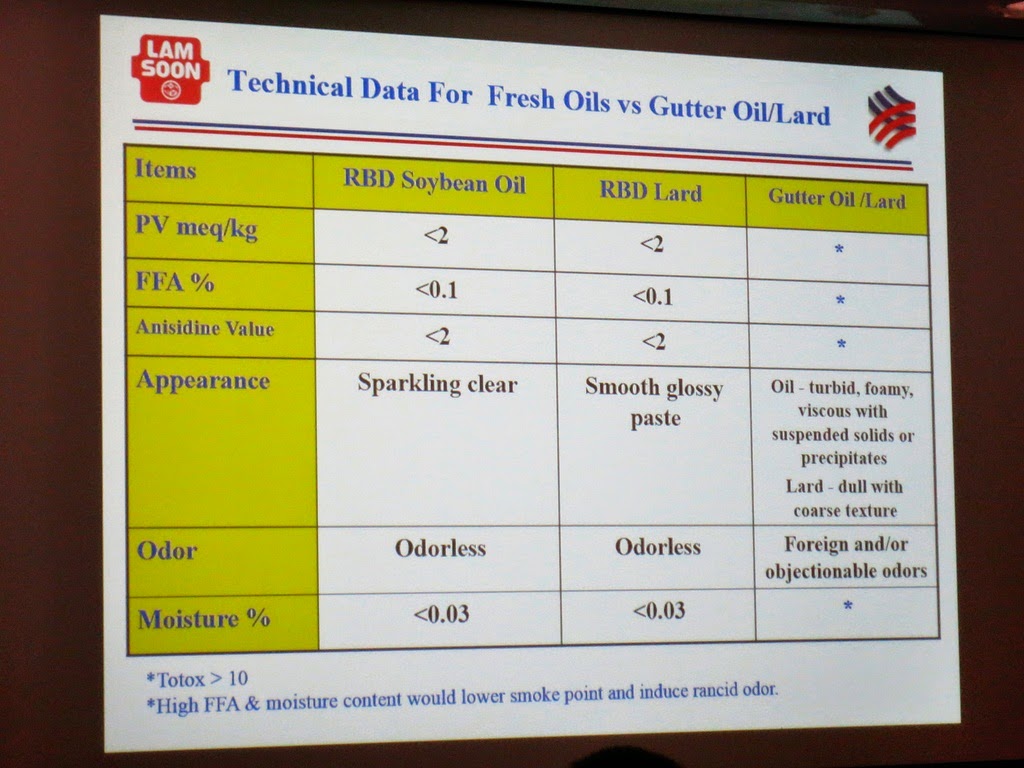
After that Dr. Chiu mentioned quality assurance through Free Fatty Acid (FFA) test, Peroxide Value (PV) test and Anisidine Value (AV) test. Therefore, Total toxic (Totox) = AV + 2PV. Totox is more relevant to test oil freshness. Totox of fresh oil should be less than 10 (<10). The following tables are shown technical data of different parameter among Soybean Oil, RBD Lard and Gutter Oil.


The third speaker was Dr. Ka-Sing Leung (Visiting Associate Professor, ABCT Dept., PolyU) and his presentation was “Overview of Used Cooking Oil”. Firstly, he introduced edible fats and oils which defined in Codex and also mentioned the standard GB/T 8973-2006.


Then Dr. Leung said the edible oil upon cooking would be the following process: Degradation (change Triglycerides to free fatty acids that increasing acid value and decreasing smoke point), Oxidation (formation of H2O2), Polymerization (polymerized triglycerides) and possible contaminants (e.g. food residues and charred particles, as well as, Polycyclic Aromatic Hydrocarbons (PAHs)). We needed to disposal and recycling of used cooking oil but not as edible oil. Even though health risk was low, it still got public concern because of quality issues. Dr. Leung concluded that the most important action was to establish traceability and control mechanism.


Dr.Jennifer Wan (Chairlady, HKFSTA; Associated Professor, SBS, HKU) was the last speaker and her topic entitled “Gutter Oil the Health Aspect”. She said PAH and Benzo(a)pyrene was by-products which was a dangerous organic pollutant capable of causing cancer with long-term consumption.


Dr. Wan added another lipid auto-oxidation by-products and toxic substances (e.g. free radicals) would be produced through rancidity, oxidation and decomposition of gutter oil. The short term and long term effects of consuming gutter oils were briefed as following diagram.


She mentioned quality control at food supply chains were important. Current Chinese law (2012) states that industrial animal fat is not allowed for use in food products because it doesn’t meet basic hygiene standards and contains high levels of potentially toxic chemical substances. However, there are not any nationwide standards in place to assist with this process at present.

After the seminar, Dr. Edmund Li (Associate Professor, SBS, HKU) chaired the discussion panel.
 

Albert said CSR was very important to avoid this kind of contamination. During the audit, they would consider documentation and operation traceability. Stephen said auditor might not have oil process knowledge that could be missing some important points such as additive and ingredient ratio. I asked there were not chemical indicator to identify the gutter oil even though we were able to use ecotoxicology test to find the total toxicity of oil. Moreover, I also stated“HKQAA - Hong Kong Cooking Oil Registration” Scheme to be one of solution to raise consumers’ confidence.

Reference:
HKFSTA - http://www.hkfsta.com.hk/index.html
HKSQ - http://www.hksq.org/


LinkWithin

Related Posts with Thumbnails