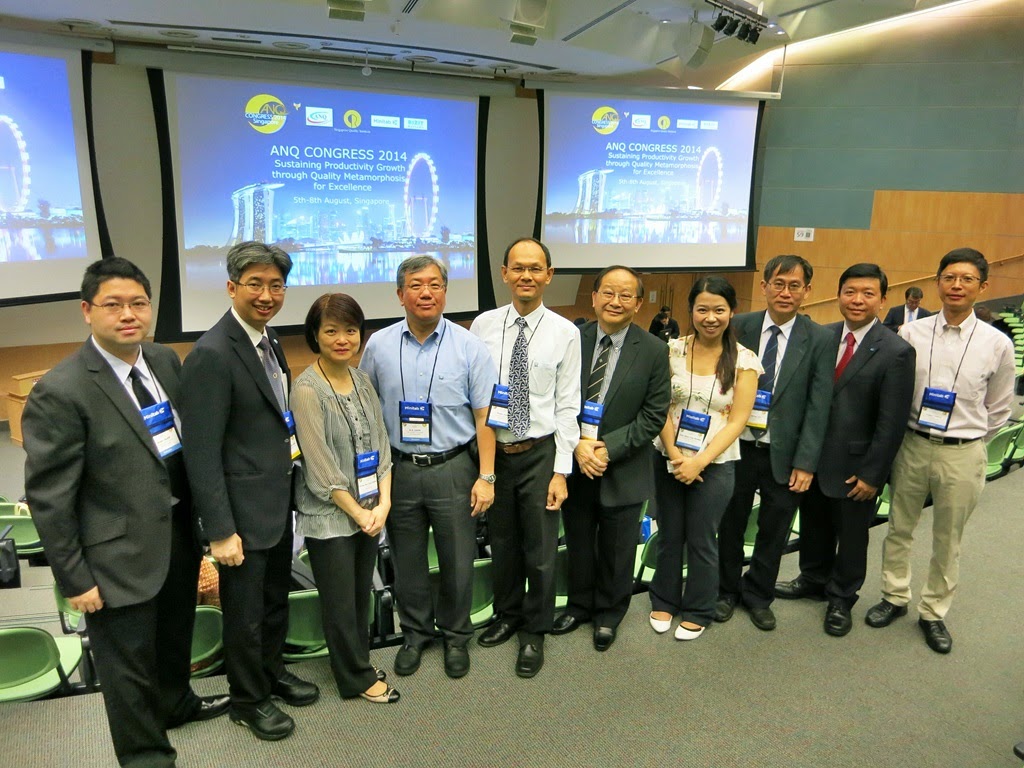
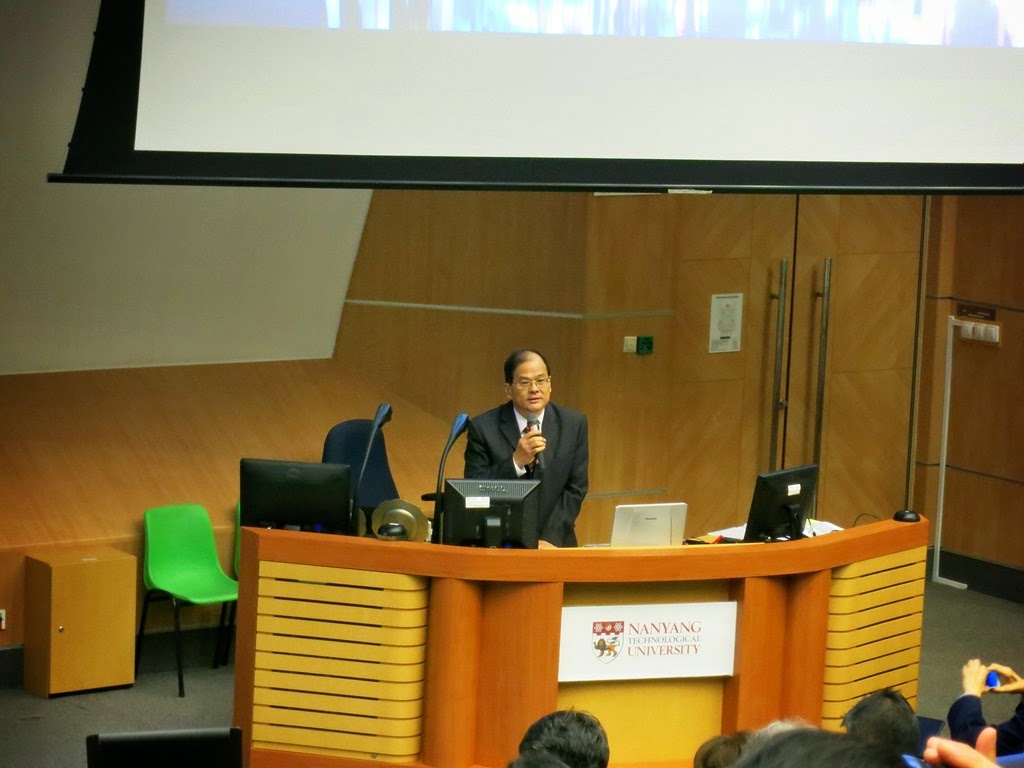
I was one of parallel sessions chair in the morning section. My session named QP2-2 Quality Practice III. This session participants were from Japan and most of papers were related to statistical model and design of experiment.

The first two presenters were students of Prof. Yoshikazu OJIMA (Tokyo University of Science). The first one was Mr. Yuhei YAEGAKI and his presentation title was “Practical Decipher of Generalized Resolution, Minimum G Aberration and Minimum G2 Aberration. It aimed to enhance Taguchi method.

The second speaker was Mr. Issei WAKATSUKI and his topic named “Prediction Intervals of Simple Linear Regression for Interval-Valued Data”. Interval-valued data were easily affected by the distribution of classical data. Thus, Issei and his supervisor’s team developed a method of regression analysis of interval-valued data which was not affected by distribution of classical data.

The third speaker was Mr. Kazuhiro IMOTO and he presented the topic “Study of Probability Distribution in Paired Comparison. Mr. IMOTO employed different probability distribution for studying winner comparison which was able to use in sport. For example, there are three players. When three wins and one loss in player2 is player1 and three wins and one loss in player3 is player2, by using the new probability distribution and probability distribution of existing (normal distribution, logistic distribution, uniform distribution), we verify winning percentage of player 1 against players 3.

Mr. Kensuke GOTO was the fourth speaker and his topic entitled “Interaction Analysis with Covariate of Noise Factor”. It was found out that the preceding studies were not able to detect which noise factors had influence on the control factors. However, the proposed method was able to detect the interaction for each noise factor by distinguishing noise factors

Ms. Rena Nagano was the fifth speaker and her presentation title named “A Study of Improvement on Inverse Probability Weighting (IPW) Estimator”. Three kinds of methods: (1) modified IPW estimator by adding a small value to the propensity scores, (2) modified IPW estimator by deleting the data of which the propensity scores are close to zero or one, and (3) modified IPW estimator by taking the logarithm of propensity term were proposed. She found that estimation accuracies of the causal effect by adding constant with very small value would be better, but it was very arbitrary, and its value depended on the data.

The last speaker was Mr. Takumi ITOH and his topic was “Augmentation Designs for the Orthogonal Array in the Simulation”. They proposed the additional experimental designs by using Shinin’s method and the modified Shinin method as a countermeasure to the lack of reproducibility.

During the break, I told a photo with Mr. Lap Yin TANG (member of HKSQ) who was the winner of HKQF Testing and Certification participant award 2014.

We also took a photo with Mr. Wang Chih-Han (Honorary Board Director of ANQ; CSQ).
(Left: Mr. Peter Fung, Mr. Wang Chih-Han (CSQ), Ms. Minda Chiang and Dr. Lotto Lai)

Then I attended Prof. Sangbok REE (Professor, IE Dept., Seokyeong University; Elected President, KSQM) presentation and his topic entitled “An Emprical Study and Factor Analysis of Start-up Quality for Senior’s Successful Start-up.

Prof. REE found that there was a need for a proactive response to the rapidly changing environment and organizational changes Founder personal ability. Moreover, Social infrastructure should be well built and strong, founder should use it. In addition, the more stress the quality of the products was successful, so that quality was important in all areas of start-up. Finally, competitive business attraction business attraction has a positive influence on both business suitability and the success of startup.

The next session speaker was Mr. Devashish Nandi (Chief Manager, Innovation, Outbound Process, Branding & Marketing, Reliance Capital Ltd.) and his topic was “Innovation Council – Intrapreneurial”. He introduced that Reliance Commercial Finance (RCF) was a late entrant in the lending space with severe competition from banks and other Non-Banking Financial Company (NBFC). One thing I surprised was that a part of their profit (i.e.10% of profit after tax) was shared with each of the Innovators who managed to deliver business of 1 billion and above.

And then I attended the session named QP2-4 Quality Practice V. Ms. Galina KUEENZI (National University of Science and Technology, RUSSIA) who is student of Dr. Yury ADLER and her presentation topic was “Alternative to the Balanced Scorecard”. She concluded that the application of generalized parameter gives advantages included keeping the strengths of the BSS – multi-criteria business evaluation; allowing to minimize or fully avoid the target manipulation; and making the simplification of business performance monitoring.

Dr. Liu FAN (Shandong University of Science and Technology, CHINA) was the last speaker in this session and her topic named “Factors Affecting User’s Switching Intention from Social Network Sites to Micro-Blogs”. I knew Dr. Liu FAN during ANQ Congress 2007 in Korea. In that time, she studied in Korea and assisted KSQM.

Dr. Liu FAN investigated the factors affecting users’ switching intention from social networking sites to micro-blogs in China. The results indicated that users’ switching intention was determined by their dissatisfaction with the system quality and the availability of attractiveness of a social networking service (SNS).

Mr. Peter Fung (Chairman, HKSQ) was the last parallel session chair in RL2-2 Reliability II.

The next session I attended was chaired by Prof. Yamada which named PM2-2 Process Management. The first speaker was Mr. Rajecsh SEHGAL (Wipro BPO Ltd., INDIA) and his presentation entitled “Enhancing Customer Analytics with Big Data Integration”. Mr. SEHGAL said that their data were primarily made up of two major categories: structured customer data and unstructured customer verbatim/comments for the complaints queue. He concluded the outcome both in terms of information gain (that in addition of big data bought forth) and the dependency and cost savings achieved by building in-house expertise on platforms.

In session OB2-2 Other Business, I attended Mr. Venkatesh RAMACHANDRAN presentation with the title called “Risk Management Evolution for Business and Operations”. He said business face uncertainty and the challenge for the management is to determine how much uncertainty to accept.

He focused on the core concepts of Risk Management with business integration and value creation. Finally, he proposed systematic & harmonized approach for integrated risk handling and showed in the following risk reporting structure.

Before the closing session, I took some photos with my friends and keynote speakers.
(Left: Mr. Denis J. DEVOS (Founder of Devos Associates; Fellow, ASQ and QMD of ASQ), Dr. Alan Samuel (PhD researcher of Massey University; member of ANOQ) and I)

(Left: Mr. Peter Fung, Mr. Simon Feary (Chief Executive, CQI) and I)

Photo taken for keynote speakers included Mr. Simon Feary, Ms. Patricia C. La Londe (2015 ASQ Chair-Elect), Mr. Yeow Chern Han (Director, aAdvantage Consulting) and Prof. Noriaki Kano.

In the closing session, the first keynote speaker was Ms. Patricia C. La Londe (2015 ASQ Chair-Elect) and her topic entitled “Culture of Quality – Accelerating Growth and Performance in the Enterprise”. Firstly, she introduced ASQ Global State of Quality Research – spotlight reports in 2013 to us. She said culture of quality benefited Innovation, technologies and optimization of risk-taking. Forbes Insights survey had 1010 responses and Concurrent ASQ member survey had 1281 responses. There were four key findings below:
a) C-suite and senior leadership often have a more positive outlook of their quality program than those with quality-focused titles.
b) Customers’ demands are a main driver of quality programs, but executives contend with other factors, like quality’s role in profitability
c) There were only 60% of respondents replied their quality vision and values were clearly stated which are key elements to a successful quality culture.
d) More than half of the respondents planned to increase investment in quality in the next 18 months.
One interested findings in the involvement of customers in quality between Forbes Respondents (C-suit) and ASQ Respondents (Quality professional). The response of C-suit had higher applicable involving customer than quality professionals. For more information, the whitepaper “Culture of Quality” would be available at cultureofquality.org in August 2014.

The second keynote speaker was Mr. Yeow Chern Han (Director, aAdvantage Consulting) and his topic named “Developing a High Performance Culture”. In the beginning, he led an exercise with all participants in order to refresh our mind. In his presentation, he introduced three key points including cultural capital, measurement matters and cultural transformation. He said “Culture is a Key Foundation to High Performance.” Culture is the way we work included our collective mindset, principles, attitudes, beliefs and values. For culture transformation, Mr. Yeow introduced "Cultural Values Assessment (CVA)" or "Leadership Values Assessments (LVA)" through a video about Barrett's 7 Level of Consciousness.

The final keynote speaker was Mr. Simon Feary (Chief Executive, CQI) and his presentation entitled “Quality: a matter of life and death”. He said a quality profession contributed its true potential to economies and to society. Then he pointed out many issues and its consequences included people death, reputation compromised and financial loss. Then Simon pointed out that we must change for the profession, for society and for business & economies. Simon also quoted John Oakland that we should learn business first, then learn quality. Successful leadership competencies are at the heart of the model: Advocacy, Coaching, Motivating, and Collaborating.

After all speaking, Mr. Kenneth Leung (Chairman of ANQ, SQI) presented the lucky draw and the prize was Minitab new product. Dr. Eddie Liu was so lucky to win the prize!

Then Prof. Shu Yamada led ANQ Recognition for Excellence in Quality Promotion (ARE-QP) award presentation and Mr. Too Meng Ken led Best Paper Award Presentation. My paper named “Investigation on the Measurement Uncertainty of Scanning Electron & Acoustic Microscopy under HOKLAS scheme” won one of best paper awards. I developed an uncertainty model for advance equipment such as SEM and SAM for accuracy measurement of electronic components. There is only one laboratory got both SEM and SAM HOKLAS accreditation in Hong Kong.

Mr. Wang Chih-Han (Honor chairperson of ANQ; CSQ) gave an invitation to ANQ Congress 2015 in Taipei from 21st to 25th September 2015.

Prof. Noriaki Kano also invited us to atten International Conference on Quality (ICQ’14 – Tokyo) from 19 to 22 October 2014.

Lastly, Dr. Tan Cher Ming (SQI) reported ANQ 2014 congress details. Totally, the congress received 165 papers.

After that Kenneth led the ANQ general assembly for all ANQ members.

New chairman of ANQ was announced to be Prof. Dr. Yuri Gusakov. Dr Yury Gusakov is Managing Director of Gost-Asia Pte Ltd. In addition to the post, Dr Yury Gusakov is also a Professor in Economic Sciences, and is currently the President of the Russian Association of Testing Laboratories and Certification Bodies. Dr Gusakov has a wide experience in Standardization, Certification, Metrology and Quality Management Systems. He had worked with the Russian (USSR) Scientific and Research Institute for Standardization and Certification (VNIIS), Moscow, Russia for 30 years and his last held position was Deputy Director. Prior to that, he worked in the State Committee for Standardization and Metrology of Russian Federation, and the Russian Organization for Quality where he held the post of Vice President at both organisations. (http://www.sbf.org.sg/public/eventsvc/otherevents/events20090617.jsp )

Reference:
Asian Network for Quality (ANQ) - http://www.anforq.org/
SQI - http://www.sqi.org.sg/
ANQ 2014 - http://anq2014.org/
HKSQ - http://www.hksq.org/index.asp