2013年3月23日星期六

Seminar on Quality Table of QFD

The seminar named "Quality Table of QFD" was organized by Hong Kong Society for Quality (HKSQ) and co-organized by Hong Kong Quality Fuction Deployment Association (HKQFDA) on 22 Mar 2013. There are the third seminar of QFD co-organized by HKSQ & HKQFDA. Quality Table, commonly known as House of Quality (HOQ), is the basic format for QFD operation. This seminar aimed to explain the logic and the way of constructing the quality table with the focus on how QFD assisted in strategy formulation.

Dr. Catherine Chan (President, HKQFDA) gave an introduction of QFD. QFD had been developed since 1960. It aimed to complete a quality system from design to product.


She introduced her teacher Prof. Yoji Akao and quoted his statement about the way QFD works.


Then she discussed the core elements of the Quality Table.


1. The left hand side table named "Demanded Quality Deployment Table" and used to extract, organize and work out the degree of importance for qualities that demanded by customers.

2. Then it convert demanded qualities into quality items (PUSH) and then organize into quality elements (See middle upper rectangular table in purple color). It called "Quality Element Deployment Table".

3. Determine degree of correlation between each pair of demanded quality and quality element in Quality Chart (See middle center table)

4. Analyze performance and formulate strategy in the Quality Planning Table (See right hand side table)

5. The triangle was Roof which used to review the degree of contradiction between quality elements.

6. The ranking of each quality elements were shown at the end of the table (In green color row under Quality Chart (no. 3)) used to identify the importance on each quality element.


The deployment of HOQs could be in different directions. It was not necessary to follow the sequence: Phase 1 - Conceive, Phase 2 - Develop, Phase 3 - Manufacture and Phase 4 - Deliver.


Catherine said there were two strategies for quality planning of QFD. They were Quality Level and Selling Tactics. If the planned quality level is 5 (high level), but the satisfaction with company's performance was 3 (ranked by customer). The calculated improvement rate should be 5/3 = 1.67. The allocated Sales Points would be either 1.5 or 1.2. (Why 1.5 or 1.2, Catherine quoted Prof. Akao that was his experience.) Overall weight of each demanded quality formula was shown as follow.


At the end, Catherine briefed an example of applying QFD on Understanding Patients' Satisfaction with Surgery. This research was done by Japanese student. The case illustrated that customers' needs are thoroughly studied through creating the demanded quality table. Quality elements are systematically derived from the demanded qualities.


Q&A Session.


Dr. Albert Tsang (Former Chairman, HKSQ) presented souvenir to Dr. Catherine Chan.


Reference:
HKSQ - www.hksq.org
Hong Kong Quality Function Deployment Association (HKQFDA) - http://www.qfdhk.org/

Previous QFD Seminar series:
Seminar I on "Quality Function Deployment (QFD)" - http://qualityalchemist.blogspot.hk/2011/08/seminar-on-quality-function-deployment.html
Seminar II on "Voice of Customer" through QFD - http://qualityalchemist.blogspot.hk/2011/12/seminar-on-voice-of-customer-through.html

ESG Negotiation Strategy Seminar - How to Structure a Negotiation towards Your Advantage

The March topic of Executive Study Group (ESG) named “Negotiation Strategy – How to Structure a Negotiation towards Your Advantage” which was held by the Executive Study Group (ESG), Chinese University of Hong Kong (CUHK) and the Hong Kong Science and Technology Parks Corp (HKSTPC) on 22 March 2013. I would like to summarize the seminar for sharing below.

Dr. Mark Lee introduced the seminar included three strategies (Power, Process and Appreciative), Further Study and Group Discussion.


In the beginning, Dr. Mark Lee explained "What is Shadow Negotiation?". He said Shadow Negotiation was the complex and subtle game people played before they got to the table and continued to play after they arrived. It was not to determine the "what" of the discussion but the "how". He quoted Prof. Deborah M. Kolb (Executive Director of Negotiation Program at Harvard Law School) statement "Some negotiations stall or, worse, never get off the ground. Why? ... The answers lie in a dynamic we have come to call the shadow negotiation".


Then Dr. Lee introduced the Three Strategic Lighthouses's Directions.
Power Strategy - To bring him/her to the table
Process Strategy - To reshape the negotiation's structure
Appreciative Strategy - To alter the tone or atmosphere

The next slide showed the actions of three strategic Lighthouses.


The Power Strategy:
Dr. Lee quoted Prof. Kolb that "Creating value and making it visible are key power moves in the shadow negotiation. A bargainer can't leave it up to the other party to puzzle throught the possibilities."


I) Offer Explicit Incentives
- Foster mutual needs
Dr. Lee told a story about Teddy Roosevelt's Presidential Campaign which stated in January seminar.

II) Put a price on inaction
The story Instagram was told that why Facebook used about US$ 1 billion for acquisition. It needed to consider "What happens if Google Buys Instagram".

III) Build Alliance
- Crucial in establishing Credibility
Dr. Lee quoted the case "Anti-Iraq Coalition" that US skipped Israel to have kept numerous Arab states from joining alliance.


The Process Strategy:
Dr. Lee discussed how to influence others' receptivity to opinions such as pre-negotiation groundwork, sequence in which ideas and people were heard.

I) Seed ideas early
A bargainer can use process moves to build receptivity. Once the seeds of an idea have been planted, they will influence how others view a situation regardless of how firmly attached they are to their own beliefs and ideas.
Dr. Lee quoted Mr. Alfred Chan (Managing Director, The Hong Kong and China Gas Co. Ltd.) that almost 50% of his time and effort was spent gaining an understanding of the market, stakeholders and other parties.


II) Re-sequence the process
Dr. Lee quoted Prof. James K. Sebenius Harvard Law School that "When the probability or value of success on one front is gratly enhance by success elsewhere, focus elsewhere first." Then he used WebTV as case study to explain how to get investors support after re-sequence (e.g. To gain Sony and Philips support first and then focus on venture capital firms/angel investors).

III) Build consensus
- Momentum creation by bringing others on board
- The growing support isolates the blockers

The Appreciative Strategy:
Dr. Lee quoted Prof. Kolb again that "Appreciative moves allow opportunities for i) additional information to surface, ii) afford the other side more time to rethink ideas and iii) adjust initial predilections."

I) Help others save face
- Image is a concern for everyone.
"Most deals are 50% emotion and 50% economics (price)." said by Mr. Felix Rohatyn (Former Managing Partner, Lazard Freres Investment Bank).


II) Keep the dialogue going
- Right Time, No Pushing and Foster Opportunities to Think
Johnson Electric Case about choice SAP or Oracle for ERP was mentioned. They used switching Role Play to debate.
III) Solicit new perspectives
- Different Opinions are important

Prof. Kolb said "By creating opportunities to discover something new and unexpected, appreciative moves can break a stalemate. As understanding deepens on both sides, reaching a mutual resolution becomes increasingly possible."

Formal Negotiation (Stated in ESG Negotiation Strategy Seminar - How to Get What You Want by Effective Negotiation at http://qualityalchemist.blogspot.hk/2013/01/esg-negotiation-strategy-seminar-how-to.html ) vs Shadow Negotiation


Before the group discussion, Dr. Lee used NLP method to give us an exercise to choose Two of the most difficult actions and One of the easiest action.


Reference:
The Centre for Logistics Technologies and Supply Chain Optimization, CUHK - http://www.logitsco.cuhk.edu.hk/
HKSTP - www.hkstp.org

2013年3月22日星期五

Briefing on the New Edition of ISO 15189:2012 Medical Laboratory

The Seminar named "Briefing on the New Edition of the International Standard ISO 15189:2012 Medical Laboratory - Requirement for Quality and Competence" was organized by the Hong Kong Accreditation Service (HKAS) on 21 March 2013. Mr. John James (Convenor, ISO Technical Committee 212 Working Group 1) was the guest speaker.

In the beginning, Mr. John James explained the new edition aimed to keep it up to date and relevant to working practices, including requirements appropriate to genetic testing laboratories. ISO 15189 is a sector-specific variant of ISO/IEC 17025, approved as such by ISO CASCO. It is voluntary to use nationally and regionally. John said the content compared of old and new editions was 90% the same but more "user-friendly" elements added.


In the standard, Annex B - Table B.1 showed the Comparison of ISO 15189:2007 to ISO 15189:2012 and found that more elaborated in the sub-sections.


Then John briefed the relationship of ISO 15189 with ISO/IEC 17025 and ISO 9001. ISO/IEC 17025:2005 is a NORMATIVE REFERENCE in ISO 15189. ISO 9001 is listed in the Bibliography. The management system requirements in ISO 15189 are written in a language relevant to a medical laboratory's operations and meet the principles of ISO 9001:2008 Quality Management Systems - Requirements, and are aligned with its pertinent requirement. Details are in ISO 15189:2012 Annex A.


After that John told us the history of creating ISO 15189. This vision became a Reality in 1994 with ISO Technical Committee for the Medical Laboratory Standards (ISO TC 212) and its first meeting was in May/June 1995. There were experts from 20 countries included Australia, Belgium, Canada, China, Czech Republic, Denmark, Finland, France, Germany, Iran, Ireland, Italy, Japan, Netherlands, New Zealand, Singapore, Sweden, Switzerland, United Kingdom and United States.

The following were summary of Changes to note in the new edition.
i) Normative references (Deleted References to ISO 9001 & ISO 31 and Added ISO/IEC 17000 - Conformity assessment - Vocabulary and general principles)
ii) Some definitions are specific to medical laboratories and had to be defined for the Standard (e.g. Examination, Alert interval, Biological reference interval, etc.)
iii) Section 4 Management Requirements has been substantially re-drafted, importing, for example, “Ethics” as a section rather than being an Annex (now Section 4.1.1.3 “Ethical conduct”)
iv) New sections in 4.1.2.1 to 4.1.2.6, 4.4.1, 4.14.2 to 4.14.8, 5.4.2, 5.4.6,
v) Major addition section was 5.10 - Laboratory Information System

Finally, John summarized that text had been moved to fit contextually, where logic determines in the new edition. Section sub headings helped "user-friendliness" and ISO TC 212 had produced a revised Standard that would contribute to continual improvement in medical laboratory quality and performance.
John mentioned the Internal Auditing and raised several questions for our thinking below.
Why do we need to demonstrate all processes meet the needs & requirements of users?
How do we demonstrate all processes meet the needs & requirements of users?
How do we quantify the observations?

Why do we need to ensure conformity of the QC management system?
How do we ensure conformity of the QC management system?
How do we quantify or codify the observations?

Why do we need to continually improve the effectiveness of the QC system?
How do we continually improve the effectiveness of the QC system?
How do we quantify the observations?


At the end of seminar, John discussed the certification and accreditation. He said this standard was not intended to be used for the purposes of certification but indicated technical competence and consistent delivery of technically valid results. During Accreditation, grading of non-conformities were classified "Very serious indeed", "Quite significant" and "Minor or isolated".

Reference:
HKAS - http://www.itc.gov.hk/en/quality/hkas/about.htm

2013年3月20日星期三

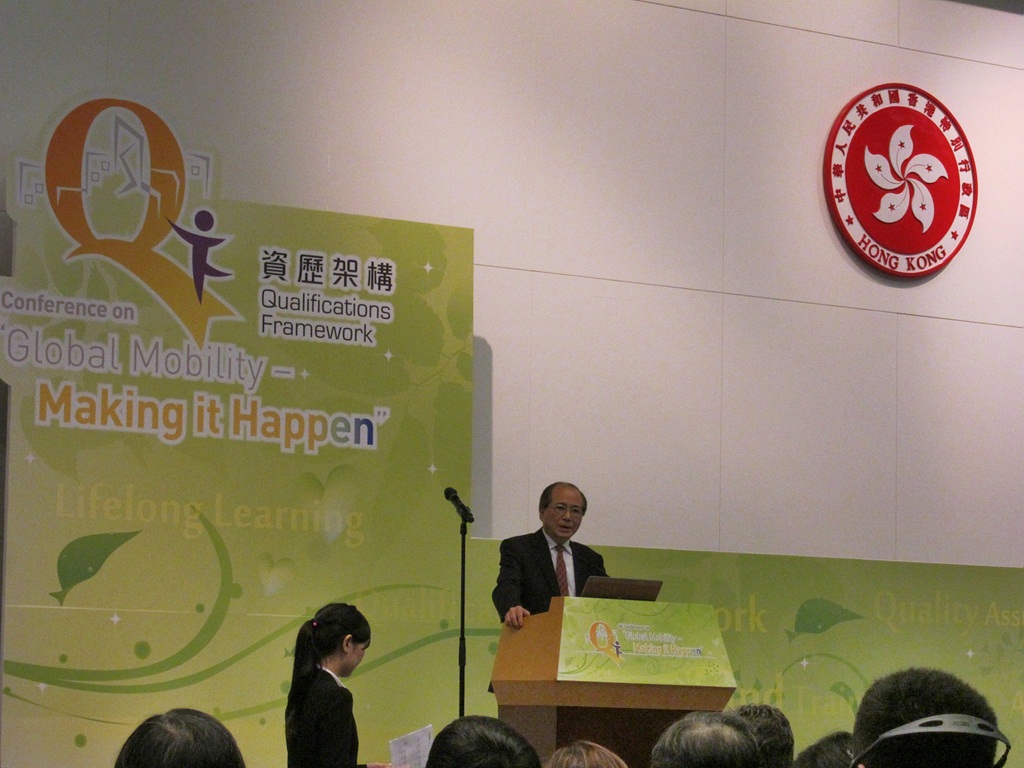
QF Conference on "Global Mobility - Making it Happen"

The QF Conference on "Global Mobility - Making it Happen" was co-organized by Education Bureau (EDB) of the Government of the HKSAR and Qualifications Framework Secretariat (QFS) of Hong Kong, and Scottish Credit and Qualifications Framework Partnership (SCQFP) of Scotland from 18 to 19 March 2013. Hong Kong Council for Accreditation of Academic and Vocational Qualifications (HKCAAVQ) was a partner organization. The conference aims to share best practices in the development and implementation of QFs globally; to explore the merits and feasibility of referencing or alignment of QFs with the aim of facilitating learner mobility and articulation; and to examine the role of quality assurance in promoting mutual trust and recognition.

The conference separated into two days. Day 1 was the keynotes and panel discussion; and Day 2 was the concurrent workshops.

Dr. Yeung (Co-op member, HKSQ) and I (Former Chairman, HKSQ) were invited to attend the conference.


Day 1 (18 Mar 2013)
In the beginning, Mr. Eddie NG, SBS, JP (Secretary for Education, HKSAR Government) gave a welcoming address.


Then Sir Andrew CUBIE, CBE, FRSE (Chairman, SCQFP, Scotland) gave a keynote speech.


Group photo


The first speaker was Mrs. Cherry TSE, JP (Permanent Secretary for Education) and her presentation named "Hong Kong Qualifications Framework: Major Milestones and the Way Forward".


Mrs. Tse briefed the background of globalization, knowledge-based society and talent grooming needs. Therefore, Qualifications Framework had established since May 2008. There was a seven-level hierarchy with robust quality assurance mechanism. Until now, there were about 210 education and training providers registered. Industries join the QF by setting up Industry Training Advisory Committees (ITACs) to draw up Specification of Competency Standards (SCS).


There were three major uses of SCS included "Vocational Education & Training", "Basis for Progression Pathways" and "Human Resources Development & Management". Then Mrs. Tse introduced the use of QF credit that 1 QF credit was equal to 10 notional learning hours. She pointed the Credit Accumulation and Transfer (CAT), Networking with SCQFP, QSTA Guangdong and other QF authorities to be future development of QF.

The second speakers were Dr. Mike COLES (International Consultant (Qualification Systems) and UK Representative, European QF) and Ms. Andrea BATEMAN (International Consultant (Qualification Systems), Australia) and their presentation was "International Referencing of QFs: Sharing Experiences in the European and Asian Contexts".


Dr. Coles briefed the European Qualifications Framework (EQF) which was collaborated with 32 countries of the European Union and Economic Area. The EQF was not regulatory but voluntary. Then the Association of South East Asian Nations (ASEAN) Qualifications Reference Framework (AQRF) were introduced. The ASEAN members included Brunei Darussalam, Cambodia, Indonesia, Lao PDR, Malaysia, Myanmar, Philippines, Singapore, Thailand and Vietnam. Both EQF and AQRF had regional quality assurance frameworks. Components of this regional frameworks included "Voluntary code of practice", "Agreed levels and descriptors", "Agreed range of functions", "Quality assurance arrangement", "Referencing process", "Collaborative management" and "Monitoring arrangements".


The EQF has 8 levels which defined through learning outcomes included knowledge, skills and competence. The EQF portal and comparison with other QF were mentioned ( http://ec.europa.eu/eqf/compare_en.htm ).


Then Ms. BATEMAN described ASEAN Qualification Reference Framework (AQRF) that it would function as a translation device to enable comparisons of qualifications across member countries and address all education sectors. She also briefed the 5 key principles which were Transparency, Accountability, Continuous Improvement Approach, Flexibility and Responsiveness, as well as, Comparability.


After tea break, Plenary Session was performed and its topic entitled "Quality Assurance: The Cornerstone to Transnational Alignment of QFs".

Mr. Robert FEARNSIDE (Deputy Executive Director, HKCAAVQ, HKSAR) was the session facilitator.


Dr. Janet BROWN (Chief Executive, Scottish Qualifications Authority (SQA), Scotland) was the first panelist and presented her topic "Why Quality Assurance Matters". Dr. Brown stated key messages on the importance of QA in QFs and framework alignment. For quality assurance, it needed Standards, Trusted by ALL and Benefits through Recognition, Comparability, Benchmarking and Portabilty. Then the Scottish Credit and Qualitfications Framework was explained more details.


The second panelist was Prof. Mala SINGH (Independent Consultant, South Africa, and Council Member, HKCAAVQ) and her presentation named "The Qualifications Framework and Quality Assurance in South Africa". The 1st generation SA QFs legislated in 1995 and revised QF in 2008. There was 10 levels with descriptors.


The third panelist was Prof. Zita Mohd FAHMI (Deputy Chief Executive Officer (Quality Assurance), Malaysian Qualifications Agency (MQA), Malaysia) and her topic entitled "The Cornerstone to Transnational Alignment of Qualifications Framework - The Malaysian Experience - SOC".


Prof. Fahmi briefed the Malaysia QF which applied to all higher education programmes.


Ms. Ann DOOLETTE (Executive Director, Australian Qualifications Framework Council (AQFC), Australia, and Council Member, HKCAAVQ) was the last panelist and her presentation named "The Cornerstone to Transnational Alignment of Qualifications Framework - The Australia Experience"


Ms. Doolette mentioned the global mobility phenomenon such as Australian travelled overseas for work and large consumer of skilled migrants whose qualifications needed to be recognized in Australia. The Australia's Comprehensive National Qualifications Framework (AQF) were introduced.


Day 2 (19 Mar 2013)
There were three concurrent Workshops. Workshop A entitled "Building Articulation Pathways Across Sectors". Workshop B named "Linking Education and Training with Industry" and Workshop C was "QF: A Platform for Lifelong Learning". I attended the Workshop B and summarized as follows.

In Workshop B, the facilitator was Ms. Andrea HOPE (Associate Academic Vice-President, Hong Kong Shue Yan University, HKSAR).


The first speaker was Ms. Jeanette ALLEN (CEO, Service Skills Australia, Australia) and her topic named "Discuss, Display, Do: a model for recognising skills". She discussed what did industry want such as job-ready graduates, multi-skilled workers and education and training system that met industry needs.


Then the Discuss, Display, Do Skills Assessment model was mentioned.


The second speaker was Prof. Zita Mohd FAHMI (Deputy CEO (Quality Assurance), MQA, Malaysia) and her topic was "Improvement of Higher Education Quality-Linking Education and Training with industry".


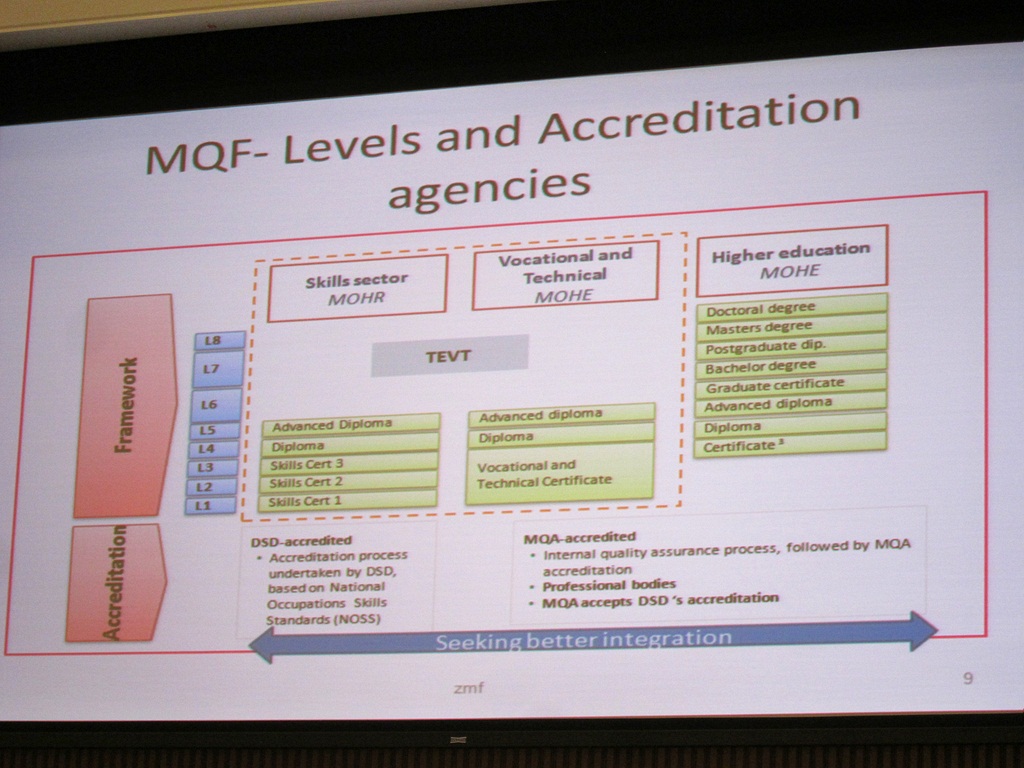
Prof. Fahmi mentioned the challenges such as up-grading and up skilling of workforce to support economic growth that needed to improve the linkage between higher education and industry. There were 29 sectors with 1690 National Occupational Skill Standards (NOSS) in Malaysia. Then MQF model was showed and discussed.


Ir. Alkin KWONG, JP (President, Hong Kong Association of Property Management Companies, HKSAR) was the third speaker and his presentation entitled "Linking Education and Training with Industry".


Mr. Kwong introduced how QF help to link education & training with the Property Management Industry (PMI). The solution was to set up clear competency standards for recruitment and promotion and assisted practitioners in attaining various QF levels by recognizing their past experience, knowledge and skills. The SCS of Property Management Industry was discussed. Finally, Mr. Kwong concluded "Overall, QF has helped a lot in meeting the education and training requirements of the PMI and has laid a solid foundation and provide a suitable framework for the continuous professional development of the practitioners to meet future manpower needs in the industry.

Then Ms. Suzi Tang (Senior Customer Services Executive, Chow Sang Sang) shared her experience from an employee embarking on SCS-based courses in jewellery retailing industry.


Ms. Suzi introduced the certificate in Jewellery Retailing which was 2-year course with QF level 2. She said it was a 360-degree learning style included classroom lecture, self-assignments and shop attachment.


After tea break, Plenary Session was performed and its topic entitled "Use of Credit and Credit Accumulation and Transfer (CAT): Experience Sharing form SCQF and HKQF".

Mr. Anthony CHAN (Project Coordinator (Further Education), Education Bureau, HKSAR Government) was facilitator in this session. (Left 1)


Ms Aileen PONTON (Executive Director, Australian Qualifications Framework Council (AQFC), Australia, and Council Member, HKCAAVQ) was the first panelist to present the topic named "Global Mobility - Making it Happen Use of Credit and CAT".

SCQF aimed to assist people of all ages and circumstances to access appropriate education and training over their lifetime to fulfil their personal, social and economic potential. All mainstream qualification in the Framework and SCQF level descriptors firmly embedded within institutional curriculum planning. It was successful to increase articulation in student numbers and a range of formal agreements between institutions.


Prof. Reggie KWAN (Convenor, Working Group of Pilot Exercise on Use of Credit, HKSAR) was the second panelist and his presentation entitled "Qualifications Framework: Use of Credit - Form pilot exercise to implementation".


Prof. Kwan briefed QF level and award title scheme (ATS), as well as pilot exercise on the use of credit (e.g. 10 providers with 15 programmes at levels 2 to 4 of the QF). The Key concept demonstrated in the following picture.


The estimation of notional learning hours were depended on seven elements such as Lectures, Tutorials, Labs, Assessment, Seminar, Internship and Online. The following table showed the ratio of contact hours to self-study hours. Moreover, there were five higher education institutes signed collaboration agreement for Credit Transfer and Student Exchange. They were The Open University of Hong Kong, Caritas Institute of Higher Education, Tung Wah College, Hang Seng Management College and Chu Hai College of Higher Education.


The last panelist was Dr. Richard ARMOUR (Secretary-General, University Grants Committee, HKSAR Government) and his topic named "Credit Accumulation and Transfer System (CATS) in Hong Kong - A Suggested Implementation Framework".
 

Dr. Armour briefed the HER Report (Aspirations for the Higher Education System in Hong Kong) which published in December 2010. The UGC proposed to develop vertical CATS to facilitate articulation from sub-degree programmes to senior year of undergraduate studies. CATS would bring the benefits included "Lifelong learning", "Widening participation", "Flexibility", "Efficiency" and "Transparency".

Panel facilitators of different workshops gave a summary report.


Sir Andrew CUBIE, CBE, FRSE (Chairman, SCQFP, Scotland) gave concluding remarks.


Finally, Ms. Michelle LI, JP (Deputy Secretary for Education, HKSAR Government) concluded the gain from this conference.


Reference:
Hong Kong Qualifications Framework (HKQF) - http://www.hkqf.gov.hk/guie/home.asp
Scottish Credit and Qualifications Framework (SCQF) - http://www.scqf.co.uk/
Information of the QF Conference - http://www.hkqf.gov.hk/guie/RC_evt_20130318.asp


LinkWithin

Related Posts with Thumbnails