2011年8月26日星期五

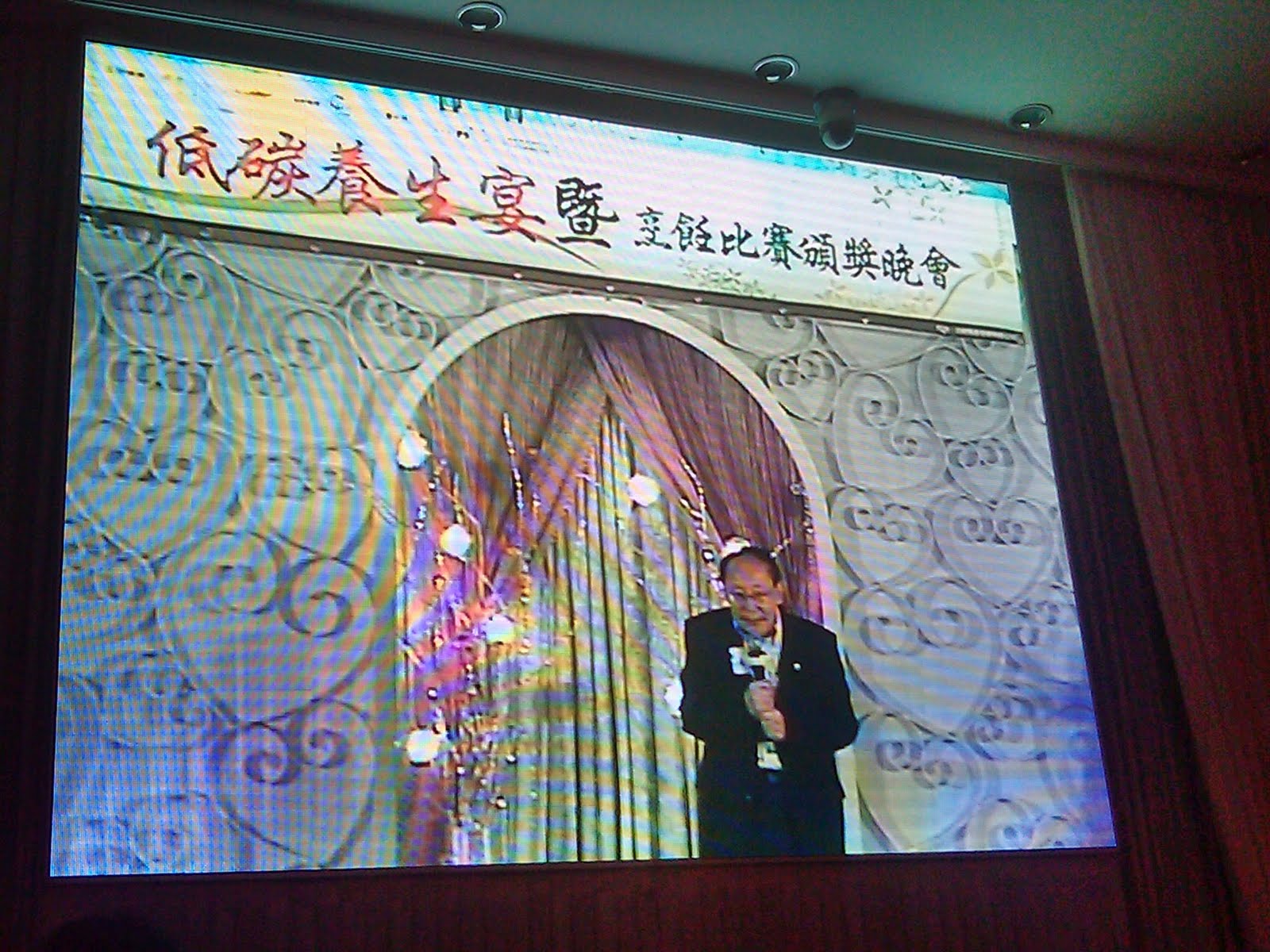
2011 Local Healthy Agricultural Food Dinner (本地健康農產品養生宴)

Tonight, my wife and I were invited by Mr. Leo Yuen (Founding Chairman of HKFSTA and Advisor of Healthy Choices Association) to have local healthy agricultural produce dinner. The dinner was organized by Hong Kong Food Science and Technology Association Limited (HKFSTA) and Healthy Choices Association. Vital-Health Livestock Development Limited was the sponsor organization.


In the beginning, Prof. Peter Yu gave an introduction of healthy food.

Some Legislative Council Members were also joined this dinner.

Before the dinner, awards of cooking competition was presented.

Mr. Leo Yuen is one of award presenters.

After that some experts explained the coming different kind of foods. The following photos showed local healthy agricultural produce foods including chicken, pork and vegetable (In Chinese Name).

康和五寶


客家炆健營豬伴蝴蝶餅


清燉鮮韓人參釀老雞湯

鮮胡椒吊燒健營雞

In the middle, organizer played a game with participants about food knowledge.

陳皮紫蘇欖豉蒸釀烏頭魚

祛濕薏米粥泡有機菜

降血杏菇菌雞肉蒸餃子

At the end, a group photo was taken.

The food source is good and I like kamei chicken (嘉美雞) very much.

Reference:
Hong Kong Food Science and Technology Association Limited (HKFSTA) - http://www.hkfsta.com.hk/
Healthy Choices Association - http://www.healthychoicehk.com/
Vital-Health Livestock Development Limited - http://www.kameihonbochicken.com.hk/

2011年8月16日星期二

Seminar on "Service Gauge"

A seminar entitled "Service Gauge" was organized by Hong Kong Quality Assurance Agency (HKQAA) on 16 Aug 2011. It was a very informative seminar not only theoretical part included, but also practical experience sharing.


In the beginning, HKQAA background and service were briefed.


Several new services, included Service Gauge Mystery Shopper Assessment, Sales Gauge Mystery Shopper Assessment, and Service Quality Management (SQM) Certification Scheme, were mentioned.


The speaker was Mr. Billy Man (General Manager, Market Research Business) and his first topic was "Establishing Service Culture".


He said Service and Selling needed to perform together and both related to Dollar ($). Moreover, he said that Change of Service Culture needed time (~3yrs). The Service Culture included four elements and they were:

A) Establishing Service Standard

B) Positive Communication

C) Breakdown the Barrier of Bureaucracy

D) Continuous Improvement


A) Mr. Man reminded that the standard should be written humanly. The whole service flow should be studied carefully.

B) Positive Communication should be established by, including top management support, service strategy, benefit and experience sharing, importance of internal customer, etc.

C) Art Of War By Sun Zi (孫子兵法) was employed for Alignment.

D) Vision, Mission and Value should be set, as well as service badge / agreement. Setup service culture team and orientation were important.


After the break, Mr. Man introduced the "Service Gauge". It is an open system for front line and back end. The theory is shown as the following figure.


Mr. Man also mentioned that satisfied customer may not be the loyal customer. There were four key elements of customer loyalty.

- Customer satisfaction

- Repeat procurement

- Willing to pay premium

- Willing to introduce your product to others (Word of mouth)


Then Sales competence was discussed. Two key elements were Sales Passion and Sales Technique.

Probing technique called 6P and 2Q were introduced.

6P: Price, Product, Period, People, Purpose and Place

2Q: Quantity and Quality


The seminar is found very useful and it is valuable to consider how to employ these services into different industries.


Reference:

HKQAA Service Gauge Mystery Shopper Assessment - http://www.hkqaa.org/en_srservice.php?catid=3


2011年8月13日星期六

The International Conference & Exhibition of the Modernization of Chinese Medicine & Health Products (ICMCM)

The International Conference & Exhibition of the Modernization of Chinese Medicine & Health Products (ICMCM) is organized by the HKTDC and the Modernized Chinese Medicine International Association Ltd (MCMIA) takes place at the HKCEC from 11 to 15 Aug 2011, providing a leading global platform for the latest traditional Chinese medicine, health-care products and services. I joined the ICMCM today and would like to share some booths below.


Hong Kong Science and Technology Parks Corporation (HKSTPC) had a booth. I took a photo in front of that booth.


Inside the booth, some information about HKSTPC such as its service and support were briefed. One of aims is "Making Hong Kong a Global Biotechnology Hub".


In the testing corner, Hong Kong Council for Testing and Certification (HKCTC) booth was found.


HKCTC encouraged "Tested in Hong Kong, Certified in Hong Kong".


Other testing and certification related bodies had booths in this corner.


University corner was found. Photo is the booth of Hong Kong Institute of Biotechnology Ltd.


I met Mr. Tomson Lee (Manager, CityU Business & Industrial Club - Knowledge Transfer Office) and discussed some R&D project in City University of Hong Kong.


International Society for Chinese Medicine was come from Macau (also located in the University of Macau).


A visitor discussed with staff of Hong Kong Jockey Club Institute of Chinese Medicine (HKJCICM).


A concurrent event named "Food Expo" was performed in the same place.


Reference:


2011年8月3日星期三

Seminar on SCS-based Courses and HKQF Support Scheme

Hong Kong Qualifications Framework (HKQF) organized a seminar entitled “Specifications of Competency Standards (SCS)-based Course and HKQF Support Scheme” on 3 Aug 2011. The content was summarized below for sharing.


In the beginning, Ms. Linda gave a welcome speech.


The first speaker was Dr. Cheng (鄭綺華) and her presentation aimed to introduce SCS-based Course.
Dr. Cheng explained how to establish SCS and develop SCS-based course which aimed to focus the vocational education. So it could be provided a path for study and career ladder. (進修之道->進修有道->進修階梯)


There were 12 industries’ SCS completed.


The other 6 industries’ SCS were in progress.


There were three usages of SCS including HR, education and training, and industry standard.


The requirement of SCS-based course was mentioned in which 60% of content should follow SCS.


The table of guideline was shown as follows.


Some SCS-based course’s tools and support were introduced.


The second and third speakers were Mr. Chow (周允成) and Ms. Liao (廖倩玲), respectively. They shared the experience of employing SCS-based course in Chow Sang Sang (CSS).

Firstly, Mr. Chow briefed the background of CSS in which had over 4500 staff. Training is one of important elements. Mr. Chow said SCS-based course could attract talent and increasing the company image because of recognition, as well as enhancing service quality.


Then Ms. Liao introduced their SCS-based course which related to sale technique.


She selected “Sale” to be the first SCS-based course because of 70% staff in front line. The overall functions were shown in the following diagram.


In the beginning, she focused on level 2 course. She said it could be increased levels to fulfill future development.


Finally, Mr. Chow concluded that SCS-based course was benefit in both employee and employer. For employee, they had standard for self-evaluation and clear career path. For employer, they had clear position competence requirement and easy to arrange the training for different level staff.

HKQF presented souvenirs to Mr. Chow and Ms. Liao.


After break, the fourth speaker was Ms. Cheng (鄭建瑩, Education Dept.) and her topic was “The New development of HKQF support scheme”.


There were 5 items in the scheme.


We focused on the development of SCS-based course. It had sponsorship for developing SCS-based course in each organization.


Details please see the reference and following links.


Last speakers were from Hong Kong Council for Accreditation of Academic & Vocational Qualifications (HKCAAVQ) and they introduced the path for SCS-based course assessment.


Four stages quality assurance procedures were mentioned.


They had five principles including “Meet Objective”, “Fact-based”, “Peer Evaluation”, “Basic Standard” and “Transparency”.


Q&A session
One interested question was that could mainland staff apply the assessment through HKQF after studied the SCS-based course which organized in the company? Mr. Pang said he could but he needed to give the evident of his working experience.


Reference:
Qualifications Register (QR) - http://www.hkqr.edu.hk/hkqr/welcome.do
Qualifications Framework Support Schemes (QFSS) - http://www.hkqf.gov.hk/guie/QFSS.asp


LinkWithin

Related Posts with Thumbnails