2015年8月20日星期四

HKIE Seminar on Industry 4.0: The 4th Industrial Revolution

The Hong Kong Institution of Engineers (HKIE) – Manufacturing & Industrial Division and The Institution of Engineering and Technology (IET) co-organized the seminar named “Industry 4.0: The Fourth Industrial Revolution” on 20th Aug 2015. Industry 4.0 is a vision of tomorrow’s manufacturing. Under this platform, products have finding their way independently through the product process. In intelligent factories, machines and products communicate with each other, cooperatively driving production. Before the seminar, I (HKSQ) took a photo with my old friend Ir. Dr. YC Chau.


Firstly, Ir. Dr. Jackson Tang (HKIE-MIE committee member) as MC introduced our guest speaker Ir. Dr. YC Chau. Ir. Dr. Chau has been working in TDK (Tokyo Denki Kagaku) Corporation since 1988, where he is currently the vice president of China operation improvement group. His PhD degree received from CityU in 2012.


In the beginning, Ir. Dr. YC Chau (Vice President, China Operation Improvement Group, TDK) presented what is Industry 4.0. He introduced previous three times of industry revolution form the 1st (Power Generation Mechanical Automation) to 2nd (Industrialization) and then to 3rd (Electronic Automation). In 2015, the 4th industry revolution (Smart Automation) is equal to Industry 4.0.


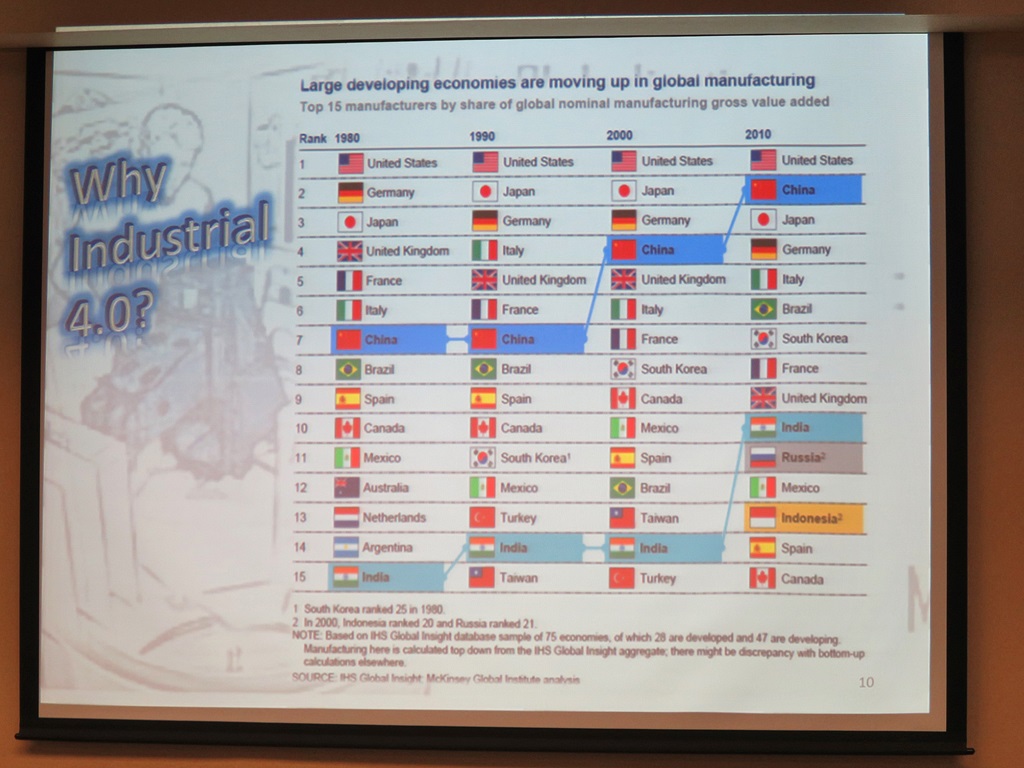
Then Dr. Chau briefed USA stated White House SMART Manufacturing, Japan mentioned Factories Connected Together, China has talking about Made in China 2025, and Germany promoted German Manufacturing DNA. The following diagram showed that China and India enhancing their global nominal manufacturing gross value added continuously. That’s why Germany initiated Industrial 4.0. This term was first used in 2011 at the Hanover Fair. Then the working group on Industry 4.0 which chaired by Siegfried Dais (Robert Bosch GmbH) and Kagermann (acatech) presented a set of Industry 4.0 implementation recommendations to the German federal government in October 2012. The final report of the working group Industry 4.0 was presented at the Hanover Fair on 8 April 2013.

Dr. Chau agreed with SIEMENS Vision of Industry 4.0 that “A vision of tomorrow’s manufacturing: Products finding their way independently through the production process. In intelligent factories, machines and products communicate with each other, cooperatively driving production.” After that he introduced three Key Technology of Industry 4.0 and they were Big Data, Internet of Things (IoT) and Cybert Physical Systems (CPS).


For Big Data, Dr. Chau discussed its usage from “within Workshop” to “within Factory” and then extended to “within Supply Chain”. Then he showed us some videos about Big Data (See reference). He also said Big Data analysis could create predictable model
For IoT, it connected among Users, Enterprise, Partner and Things. Video of Intel’s Vision of IoT was showed.


For Cyber Physical System (CPS), 3C model of CPS was mentioned where 3C for Computation, Communication and Control. Dr. Chow said employing CPS was very expensive and one example was MTR Operations Control Centre. He told us MTR should be no need to have driver actually but citizen had not ready to accept it.


Dr. Chau said from the integration of Big Data, IoT and CPS, we got from Industrial 4.0 was “4S” where 4S stands for Smart Factory, Smart Products, Smart Process and Smart Services. He raised some companies as example and told us Germany company had highly standardization which could help them to transfer to Industrial 4.0. (e.g. IKEA has two standardization factors – DIY & Flat Packing.) Dr. Chow concluded that Industrial 4.0 created addition value and business opportunity.


Finally, Dr. Chau introduced China’s “Internet +” that means some extra value added on something through internet but not something plus internet “+ Internet”! Moreover, Make in China 2025 strategy was briefed. China planned to use next 30 years to achieve a leading position in the world (in 2045). So the first step was set to be big manufacturing country in 2025. Then next step was China to be strong manufacturing country in 2035. The following diagram demonstrated the 5 key engineering areas and 10 key fields to be developed in near future. However, Make in China 2025 and Germany Industry 4.0 had a big gap (see the video in reference).


Ir. SC Ho (Chairman, HKIE-MID) presented an appreciation certificates to Ir. Dr. YC Chow.


Ricky Wu (Representative, IET) presented a souvenir to Ir. Dr. YC Chau.


Reference:
HKIE-MI Division – http://mi.hkie.org.hk/
IET-HK – http://mycommunity.theiet.org/communities/home/246
What is Big Data? Pizza example (In Chinese) - https://www.youtube.com/watch?v=bSANNsqfy6E
Intel’s Vision “Transform Manufacturing with the Internet of Things” - https://www.youtube.com/watch?v=5OQQZ9eWF-4
Hong Kong MTR Operations Control Centre (TVB Program) - https://www.youtube.com/watch?v=lUpJFy-pOmg
Industry 4.0: Integrated Industry reaches the next level - www.youtube.com/watch?v=ccB6e18VwsQ
Differences between made in China & made in Germany - https://www.youtube.com/watch?v=RepARd6db7c
Recommendations for implementing the strategic initiative INDUSTRIE 4.0 (2013) - http://www.acatech.de/fileadmin/user_upload/Baumstruktur_nach_Website/Acatech/root/de/Material_fuer_Sonderseiten/Industrie_4.0/Final_report__Industrie_4.0_accessible.pdf


2015年8月14日星期五

HKSQ Seminar on Strategic Energy Management (ISO 50001)

Hong Kong Society for Quality (HKSQ), SEEM Dept., CityU, HKIE – MID, TQM and BSI co-organized the seminar named “Strategic Energy Management” on 14th Aug 2015. The Government has announced a new target for all government buildings to achieve a 5% saving in electricity consumption under comparable operating conditions in the coming five year in the 2015 Policy Address. This seminar aimed to share the strategic management approach for conserving energy and reducing cost through facilities operations and energy management leaders. Before the seminar, we took a photo with all guest speakers and organizers.
(Left: Dr. Ken Yau (CityU, HKSQ), Dr. KS Chin (CityU, HKSQ), Mr. Peter Fung (HKSQ), Mr. TO Lee (WSD), Dr. Aaron Tong (HKIE, TQM), Mr. Vincent Cheng (TQM, HKSQ), Mr. Stephen Yu (BSI) and I (HKSQ))


In the beginning, Dr. Aaron Tong (Former Chairman, HKSQ & HKIE-MIE; Managing Director of TQM) presented the appreciation certificates to our guest speakers and took a group photo.
(Left: Dr. Patricia Cheung, Mr. TO Lee, Dr. Aaron Tong, Mr. Vincent Cheng and Mr. Stephen Yu)


The first speaker was Ir. Dr. Aaron Tong (Managing Director & Principal Consultant, TQM) and his presentation topic was “Highlighted on HK Energy Saving Initiatives”. Dr. Tong reviewed the rising of energy cost and climate change. He said that both consumers and citizens were increasingly environmentally conscious. Then Government formulated the Buildings Energy Efficiency Ordinance (Cap. 610) to promote energy efficiency. So that implementation of Energy Audit and Energy Management would be a trend.


Then Dr. Aaron Tong introduced the Cap 176 in Policy Address that Government set a new target of achieving a 5% saving in electricity consumption for government buildings and energy audits would be conducted for major government buildings, as well as, fostering a low-carbon and livable built environment so as to reduce Hong Kong’s overall electricity demand. Three steps to reduce energy consumption were: i) Energy Audit on EnMS, ii) Implementing Solution of Energy Saving and iii) Save Energy, Save Cost.


The second speaker was Mr. TO Lee (Chief Engineer, Water Supplies Department, HKSAR) and his topic entitled “Experience Sharing: Energy Management System (EnMS) in Water Supplies Department”. Firstly, Mr. Lee introduced two key objectives of WSD below:
i) To align WSD’s energy management system with the international best practices.
ii) To formalize and rationalize our existing energy management strategies and practices to further improve our energy efficiency, save energy cost and reduce carbon emission.


Then Mr. Lee introduced their energy management jour to us since 1998 because they were top 3 electricity consumer in Hong Kong and the highest among government departments (In 2013/14, about 25% of the total consumption of HKSARG). The following chart demonstrated the top usage of energy was related to water pumping (upto ~91%).


Before the ISO 50001 implementation, they formed Energy Management Committee (EMC) in 1998 and then transferred to Energy and Emission Management Committee (EEMC) in 2008. Last year, they achieved ISO 50001 certification. Their EnMS structure was shown in the following diagram.


After the analysis the energy usage distribution, Mr. Lee initiated several energy saving measures.
i) Promotion of water conservation in the community
ii) Timely maintenance and replacement of M&E equipment
iii) Life-cycle costing methodology for planning, design and procurement
iv) Close monitoring of plant conditions and energy performance
v) Use of energy efficient M&E equipment
vi) Energy auditing for major assets and green housekeeping offices and installations
So far, WSD achieve to save 13.2% per unit electricity consumption and 7.0% per capita electricity consumption.


Some Energy Performance Indicators, Energy Baseline and Energy Target were discussed. Mr. Lee said the baseline development was referred to the past ten years and selected the worse performance year as baseline. Finally, he shared three successful factors included “Senior Management Commitment”, “Energy Data Collection and Analysis” and “Making Energy Saving a Culture”. At the end, he quoted from anonymous author statement as conclusion that “Every accomplishment starts with the decision to try”.


The third speaker was Mr. Vincent Cheng (Consultant, TQM Consultants Co., Ltd.) and his presentation named “Setting up an Effective Energy Management System”. In the beginning, Mr. Vincent Cheng briefed us how to start EnMS and he suggested to seek top management commitment. There were several factors attracting top management such as reduction of carbon emission, good corporate citizen, improving corporate image, but the most important was saving money.


Then Vincent briefed to build a team included team leader and members. One new concept introduced was “Energy Warden”. The concept was transferred from Fire Warden who is a person employed to prevent or extinguish fires. Therefore, Energy Warden is a person employed to prevent wasting the energy (save energy).

In order to establish EnMS, Energy Policy should be defined first. The second thing was review legal and other requirements. Some energy related legislations in HKSAR were shown below:
- Cap 610 – Building Energy Efficiency Ordinance
- EMSD Code of Practice for Energy Efficiency (2005 Edition and 2007 Edition)
- Cap 598 – Energy Efficiency (Labelling of Products) Ordinance
- Cap 51 – Gas Safety Ordinance
- Cap 311L – Air Pollution Control (Motor Vehicle Fuel) Regulation
- Cap 311Y – Air Pollution Control (Marine Light Fuel) Regulation
- Technical Circular on Green Government Building (DevB TC 2/2015, EB 3/2015)

The most important part of ISO 50001 was Energy Review. It needed to identify energy sources (e.g. electricity, towngas, diesel, gasoline, etc.) and use (e.g. Lighting, Air Con, HVAC, etc.) and then formed the Energy Baseline. After review, we needed to identify the Significant Energy Use (SEU) included facilities, equipment, systems processes, personnel to be affected, as well as relevant variables (e.g. weather) and current energy performance related to SEUs. The following diagram demonstrated some examples of Energy Performance Indicators (EnPIs).


Vincent also showed some examples of Energy Objectives and Targets that Objectives could be qualitative but Targets should be quantitative. At the end, Vincent concluded that “Climate change is the biggest challenge to human being. Let’s do something for our next generations rather than leaving a broken earth for them to heal.”


The last speaker was Ir. Stephen Yu (Client Manager cum Compliance & Risk Manager, BSI) and his presentation topic was “Sharing the ISO 50001 Certification Process”. Firstly, he quoted the humanity’s top ten problems for next 50 years in which Energy was ranked number ONE. (Sequence: Energy, Water, Food, Environment, Poverty, Terrorism & War, Disease, Education, Democracy, and Population)


The summary of BS ISO 50001 EnMS and its Model were briefed and showed in the following diagram.


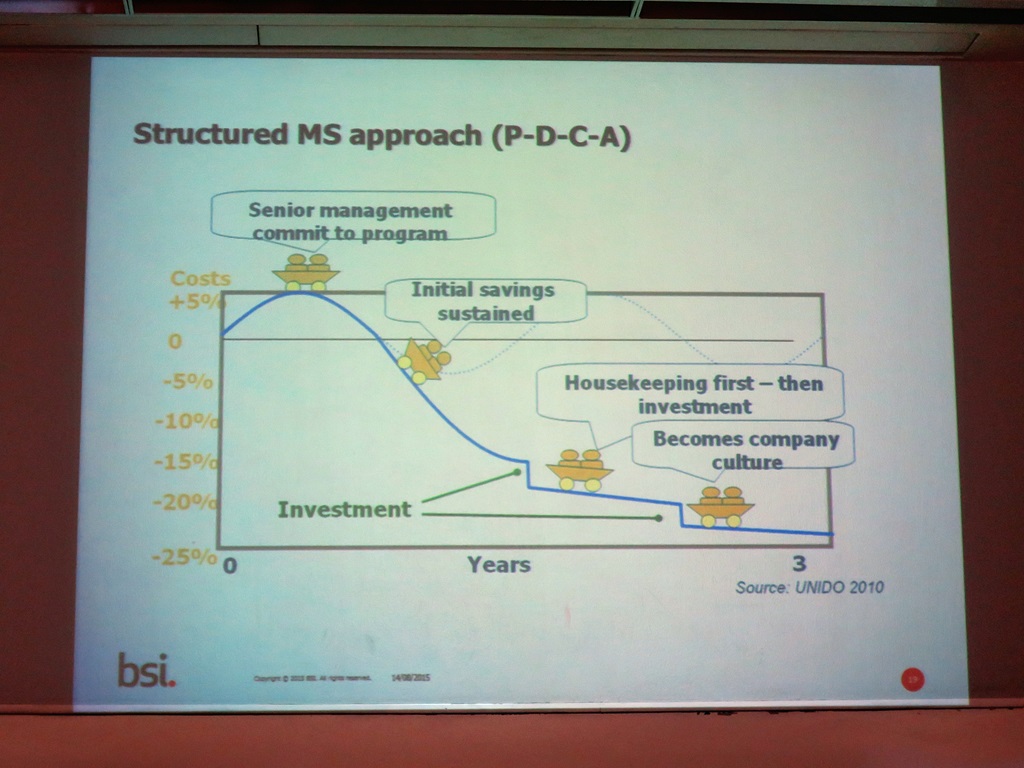
Then Stephen shared some technical challenges he met before such as Chillers running at low efficiency, procurement for energy policy insufficient implemented, method of verification of energy objectives & target unclear, etc. A structured EnMS approach under PDCA could continual improve energy performance and built the company culture on energy management. Finally, he summarized that certification of ISO 50001 enabled these organizations to demonstrate their commitment to energy management best practice.


Q&A Session


Reference:
HKSQ - www.hksq.org
SEEM, CityU – http://www.cityu.edu.hk/seem/
HKIE-MI Division – http://mi.hkie.org.hk/

ISO 50001 related seminars:
20140224: HKCTC Seminar on ISO 50001 EnMS and Certification - http://qualityalchemist.blogspot.hk/2014/02/hkctc-seminar-on-iso-50001-enms-and.html
20130808: HKQAA Seminar on Application of ISO 50001 in Construction Projects - http://qualityalchemist.blogspot.hk/2013/08/hkqaa-seminar-on-application-of-iso.html
20120709: ISO 50001 Energy Management System (EnMS) Awareness Training - http://qualityalchemist.blogspot.hk/2012/07/iso-50001-energy-management-system-enms.html
20120811: HKQAA Seminar - Laterest Developments in Energy Efficiency Enhancement - http://qualityalchemist.blogspot.hk/2012/08/hkqaa-seminar-laterest-developments-in.html
20120413: Seminar on Low Carbon Trends in Hong Kong Construction Industry - http://qualityalchemist.blogspot.hk/2012/04/seminar-on-low-carbon-trends-in-hong.html
20101114: Introduction of Upcoming Energy Management System Development - http://qualityalchemist.blogspot.hk/2010/11/introduction-of-upcoming-energy.html


2015年8月13日星期四

HKSQ Seminar on ISO 9001:2015 & ISO 14001:2014 – Executive Overview

The seminar named “ISO 9001:2015 & ISO 14001:2015 – Executive Overview” was organized by Hong Kong Society for Quality (HKSQ) and co-organized with SEEM Dept., CityU & HKIE – MID and held on 13th Aug 2015. Since FDIS of ISO 9001:2015 & ISO 14001:2015 has been issued, the seminar aimed to share the view from ISO expert and certification body to senior executive, management representatives and quality management professionals. In the beginning, Mr. Peter Fung (Chairman, HKSQ) presented the appreciation certificates to our guest speakers.
(Left: Mr. Cliff Poon, Mr. Peter Fung and Dr. Aaron Tong)


The first speaker was Ir. Dr. Aaron Tong (Managing Director & Principal Consultant, TQM) and he shared the Changes and Challenges of ISO 9001:2015 & ISO 14001:2015. In the beginning, he briefed his ISO background included the 1st one obtained ISO 9001 in Hong Kong & PRC in 1991; TC-176 Hong Kong Observer, Past Chairman of HKIE-MIE Division, Former Chairman of HKSQ and ASQ trainer for Six Sigma Black Belt, etc.


Then Dr. Aaron Tong introduced the journey of ISO 9001 from 1987 to 2015. He said the critical change was the 3rd Edition in 2000 in which introduced the management model based on PDCA. He added the key of model management was “close-loop feedback system”.


ISO 14001 Journey also mentioned from 1996 to 2015. Both standards were transferred by BS that BS 5750 to ISO 9001 and BS 7750 to ISO 14001. Aaron said the top number of certificate on ISO 9001 and ISO 14001 was China which granted 337033 and 104735 in 2013, respectively.


The process approach was discussed and he explained the different of continuous improvement and continual improvement. He said continuous improvement was “Today better than Yesterday” for short period of time. However, we couldn’t ensure improvement every time. So “Continual improvement” was used for longer period of time such as quarterly or yearly.


After that Aaron described the process approach model of ISO 9001:2015 & ISO 14001:2015 and shared the major changes below:

For ISO 9001,
i) Adopt New High Level Structure (HLS)
ii) Leadership insert “Management Responsibility”. However, Aaron disagree this change because leader and manager was in different role. No mention on MR. He discussed the right person for MR who should be GM rather than QA.
iii) Context of the Organization stated interested parties
iv) Focus on Internal and External forces
v) Remove Preventive Actions. Aaron said preventive action was different to verify and ISO 9001 standard is designed for audit assessment which avoid subjective in nature.
vi) Risk-Based Thinking was adopt from other standards such as ISO 14001 (Environmental Aspect)
vii) Documented Information (where Manual is no longer necessary and more flexible)
viii) Organization knowledge. Aaron said it may be referred from Malcolm Baldrige National Quality Award (MBNQA) model.
ix) Separated Products and Services again
x) External Providers insert Suppliers
xi) Externally Provided Products and Services insert Purchased Products
For ISO 14001,
i) Environmental Performance such as determine criteria to evaluate it using appropriate indicators
ii) Focus on Protection of Environment rather than prevention of pollution
iii) Life Cycle and Value Chain Perspective was added.


Finally, Aaron said the name of ISO 9001 – Quality Management System was not appropriate. It could be better named “Management System’s Quality”.

The second speaker was Mr. Cliff Poon (SGS Certification Manager) and he shared the transition to ISO 9001:2015 & ISO 14001:2015 in Certification Body perspectives.


In the beginning, he introduced the Annex SL and High Level Structure (HLS), which consisted of 4 appendices and proposes 10 clauses in Management Systems development, issued in 2012. Unitl new, there were four standards followed this HLS included ISO 22301:2012, ISO/IEC 27001:2013, ISO 9001 (FDIS) and ISO 14001 (FDIS). There were several benefits using Annex SL below:
i) Based on the same format
ii) Have the same structure, core text, terms and conditions
iii) Have discipline specific requirements
iv) Will be consistent
v) Smoother integration of standards


Then Mr. Cliff Poon shared the changes in external audit such as top management involvement and leadership demonstration, risk based consideration and probably lesser reliance on system documentation. About Risk-Based Thinking, it could go through the standards in the following clauses. PDCA was also found Plan (Clause 6), Do (Clause 8), Check (Clause 9), Act (Clause 10); Clause 7 is Support to the whole process.


After that Cliff stated there was 3 years transition from official publication of the international standards (ISO 9001 and ISO 14001). Some transition arrangements were mentioned such as “ISO 9001:2008 + ISO 9001:2015” and “ISO 14001:2004 + ISO 14001:2015”. The “To-Do-List” for preparation of transition was shared.


Finally, he shared the “Guidance for Preparation of Transition Arrangement” from IAF ID09 and ID 10:2015 as follows:
i) Identify organization gaps which need to be addressed to meet new requirements
ii) Develop an implementation plan
iii) Provide appropriate training and awareness for all parties that have an impact on the effectiveness of the organization
iv) Update the existing management systems (QMS & EMS) to meet the revised requirements and provide verification of effectiveness
v) Liaise with SGS for transition arrangements

Q&A Session:
I asked how many items from risk management to be enough for new ISO 9001 standard. Cliff said there was no passing level for enough or not. It depended on organization processes. Aaron added he would observe company’s customer complaint and defect rate to verify their risk assessment to be effective or not.
Cliff had mentioned their new training series of Management Skill for Top Management such as “2-Days Empowering Leadership in Management Systems and Standard”. I queried that C-suite could only expense (not invest) half or one hour for ISO new requirement. Eventhough second level of top management, I estimated that they would like to attend only half-day seminar. Cliff would consider my suggestion if any executive summary of such training.


At end of the seminar, HKSQ exco took a group photo with guest speakers.
(Left: Mr. Peter Fung, Dr. Aaron Tong, Mr. Chiff Poon and I)


Reference:
HKSQ - www.hksq.org
HKIE-MI Division – http://mi.hkie.org.hk/ 

Other related seminars:
20120519: HKQAA Seminar on the next version of ISO 9001:2015 - http://qualityalchemist.blogspot.hk/2012/05/hkqaa-seminar-on-next-version-of-iso.html
20141201: HKQAA Seminar on ISO 9001 & ISO 14001 Revisions - http://qualityalchemist.blogspot.hk/2014/12/hkqaa-seminar-on-iso-9001-iso-14001.html
20150529: HKQAA Symposium 2015 (Part 1) - http://qualityalchemist.blogspot.hk/2015/05/hkqaa-symposium-2015-part-1.html
20150529: HKQAA Symposium 2015 (Part 2) - http://qualityalchemist.blogspot.hk/2015/05/hkqaa-symposium-2015-part-2.html
20150710: HKQAA Seminar on the Next Generation of Management System Standards (ISO 9001:2015) - http://qualityalchemist.blogspot.hk/2015/07/hkqaa-seminar-on-next-generation-of.html


2015年8月12日星期三

Visit to Hong Kong Precious Metals Assay Centre under CGSE

I was honor to be invited by Mr. Dicky Lo (CEO, The Chinese Gold & Silver Exchange Society) to visit their laboratory named Hong Kong Precious Metals Assay Centre Ltd. (HKPMAC) today. Ms. Kathy Fu (Laboratory Manager, HKPMAC) led me to visit the facilities and introduced their service to me. We took a photo in the laboratory for memory.

(Left: Ms. Kathy Fu, Mr. Dicky Lo and I)


HKPMAC is an independent testing laboratory that established in 2010 by The Chinese Gold & Silver Exchange Society (CGSE). In order to tie in with the internationalized standards and requirements of precious metal industry, HKPMAC was set up and obtained the qualification of accredited laboratory under "Hong Kong Laboratory Accreditation Scheme" of the Hong Kong Accreditation Service. The testing scopes are included Fire Assay – Cupellation Method and Difference Method by ICP-OES. Apart from gold fineness testing, they would like to expand their service to jewellery industry in future.

I took a photo with Ms. Kathy Fu in front to the laboratory and they performed good physical security.


The Chinese Gold & Silver Exchange Society (CGSE) founded in 1910 and is the sole exchange in Hong Kong which trades physical gold and silver, and operates in pursuance of section 3 of Chapter 82 of Laws of Hong Kong, under which its operation as a commodity exchange is legally exempted.
It is the first time I visit their office and laboratory. Moreover, I joined the dinner of the Joint Ceremony to Celebrate the Inauguration of the 44th Term Executive & Supervisory Committees of CGSE, the 105th Anniversary of CGSE and the Launch of “Shanghai-Hong Kong Gold Connect” on 10 July 2015.


Additional information:
i) Gold Purity


ii) Gold Weight


Reference:
20150710: Ceremony Dinner for the Launch of “Shanghai-Hong Kong Gold Connect” - http://qualityalchemist.blogspot.hk/2015/07/ceremony-dinner-for-launch-of-shanghai.html
CGSE - http://www.cgse.com.hk/en/about_01.php
Hong Kong Precious Metals Assay Centre Limited (HOKLAS 234) - http://www.itc.gov.hk/en/quality/hkas/doc/scopes/234.pdf


2015年8月4日星期二

The 1st Focus Group Meeting on Evaluating Impact of HKQF

The 1st Focus Group meeting entitled “Pilot Project on Evaluating Impact of HKQF” organized by Hong Kong Qualification Framework (HKQF) and held on 4th and 5th Aug 2015. I was honor to be invited as one of members represented Professional Body to participate this exercise. I took a photo with consultant Ms. Julie Cavanagh (Manager, Scottish Credit and Qualifications Framework (SCQF)) and Mr. Patrick Pang (GM, Qualification Framework Secretariat) for memory.


The HKQF is a seven-level hierarchy covering qualifications in the academic, vocational and continuing education sectors. The HKQF was officially launched 5 May 2008. Successful development and implementation of the HKQF owes a lot to the support of various stakeholder groups, including employers, employees, education and training providers, professional organizations, quality assurance and regulatory bodies, as well as the general public.

In the beginning, Ms. Julie Cavanagh briefed the background of HKQF and then to explain the study which focused on following questions:
i) What difference is this making to the skills of the workforce and Hong Kong’s economy?
ii) What difference is this making to the education and training in Hong Kong?
iii) What difference is this making to support lifelong learning in Hong Kong?

Their methods employed survey questionnaires (quantitative data) and focus groups (qualitative data), as well as, individual interviews. This focus group aimed to review the toolkit included Survey Questionnaire and Questions for focus group and interviews.

Our part was mainly related to professional body and status body. We reviewed the questionnaires and gave many ideas from different perspectives. The evaluation strategy would be produced in Q4 2015.

We are all looking forward the HKQF to be enhanced the recognition in Hong Kong and the world in near future.
Reference:
HKQF - http://www.hkqf.gov.hk/guie/home.asp
SCQF - http://scqf.org.uk/
Testing, Inspection and Certification Industry Training Advisory Committee (ITAC) - http://www.hkqf.gov.hk/ind/en/tic.aspx
Members of Testing, Inspection and Certification Industry Training Advisory Committee (ITAC) at http://www.hkqf.gov.hk/guie/com_ITAClist_TIC.asp
20150302: Focus Group Meeting for alignment of HKQF & EQF - http://qualityalchemist.blogspot.hk/2015/03/focus-group-meeting-for-alignment-of.html


2015年8月1日星期六

HKQAA Risk Management Experience Sharing Talk

I was honor to be invited by Hong Kong Quality Assurance Agency (HKQAA) to share Risk Management (RM) Experience to their auditors on 1st August 2015. Firstly, Mr. PC Chan (Chief Operating Officer, HKQAA) gave a welcome speech.


In the beginning, I introduced the background of Hong Kong Science and Technology Parks (HKSTP) and Hong Kong Society for Quality (HKSQ). After that I briefed the History of Risk Management (See reference) and reviewed different Risk Management Standards.


The earliest national standard was AS/NZS 4360:1995 “Risk management” and I briefed its structure. I also reviewed other standards included ISO/IEC Guide 73 (Terminology of RM); AIRMIC, ALARM, IRM: 2002; ISO 27005:2008; BS 31100:2008 & 2011; ISO 31000:2009


Then I discussed different RM tools which stated in BS 31100. The RM tools selection criteria were based on the characteristics of the user, task, tool and RM within the organization. In our company, I selected FMEA to be the RM tools because (1) Users had competence, (2) Tool considered as semi-quantitative method, (3) enough information of tool provided and (4) FMEA had well established in the organization.


During the case study, I introduced the InfoSec FMEA circle which combined PDCA and FMEA for continual improvement on the level of security. The result had been published in 2014 (Lai, Lotto KH & KS Chin, (2014)). The Risk Priority Number (RPN) is the product of Severity (S, 1-10), Occurrence (O, 1-10) and Detection (D, 1-10) rankings. RPN full mark is 10x10x10 = 1000. We set the acceptable level of RPN to 100. If an RPN larger than 100 which could occur in three situations with possible happen:
i) Catastrophic Failure and Semi-auto Detection, when S=10, O=2 and D=5;
ii) Routine Low Risk but Manual Handling, when S=1, O=10 and D=10; and
iii) Middle Situation, when S=4, O=5 and D=5.


Lastly, we took a group photo for memory. It is seldom to have ~40 auditors together on Saturday. It is HKQAA routine strategy meeting plus ISO 9001:2015 translation internal training. For this new ISO standard, it focuses on Risk-based Thinking.


Reference:
HKQAA - http://www.hkqaa.org
HKSQ - http://www.hksq.org/
Kloman, F. (2002) A short history of risk management: 1900-2002. Risk Management Reports, http://riskjournal.blogspot.hk/2009/02/short-history-of-risk-management.html
Lai, Lotto K.H. and K.S. Chin (2014) “Development of a Failure Mode and Effects Analysis Based Risk Assessment Tool for Information Security”, Industrial Engineering & Management Systems, Vol 13, No. 1, pp.88-101.


LinkWithin

Related Posts with Thumbnails