The opening ceremony of ANQ 2008 was held on 29 Oct 2008 in the hotel named “Swissotel Le Concorde” in Bangkok, Thailand. I had met many friends and taken some photos for memory.
Minda and I in the hall


Take a photo with ANQ friends
 From Left: Bala Ram Shrestha (Nepal), Minda & I, Azat Abdrakhmanov (Tashkent), Nadeem Ishaq (Pakistan)
The first keynote speaker was Mr. Kan Trakulhoon (President & CEO, The Siam Cement Public Co., Ltd.) and his topic was “Quality People, Key to Excellence”.

Some key points by Kan’s presentation I had recorded down below.
· People are not your most important Asset – The Right people are.
· Self-disciplined people don’t need to be managed.
· Corporate Values will help guide business direction and people behaviors.
Key to Excellence is:
· Selecting the right people
· Continuously developing people with competence and integrity
· Enabling them to grow with the company
 Finally, it was concluded that “The Key to Excellence = Quality People”.

Some key points by Kan’s presentation I had recorded down below.
· People are not your most important Asset – The Right people are.
· Self-disciplined people don’t need to be managed.
· Corporate Values will help guide business direction and people behaviors.
Key to Excellence is:
· Selecting the right people
· Continuously developing people with competence and integrity
· Enabling them to grow with the company
Long term commitment form top leader is the key to talent development.
 Finally, it was concluded that “The Key to Excellence = Quality People”.
The second keynote speaker was Dr. Chitrapongse Kwangsukstith (CEO, Upstream Petroleum and Gas Business Group, PTT Public Co., Ltd.) and the topic was “Achievement to Workforce Excellence”. He said that the PPT Group value is SPIRIT. It stands for Synergy, Performance Excellence, Innovation, Responsibility, Integrity & Ethics, as well as, Trust & Respect.

At least, the key to excellence was summarized in the company’s name “PTT” which means a High Performance Organization, TQA Management System, and TPM Activities.

“Review and Prospect of Statistical Quality Methods” was presented by the third keynote speaker Dr. Shu-Kai S. Fan (Dept of Industrial Engineering & Management, Yua Ze University, Taiwan).
His talk reviewed statistical process control (SPC), engineering process control (EPC), design of experiments (DOE) and response surface methodology (RSM).

Prof. Yoshinori Iizuka (School of Engineering, the University of Tokyo) was the forth keynote speaker. His topic was “Meditation on “Quality” – Being fascinated by its profound concept.

He took about Doughnut symptom that Quality Control without Quality and rethinking why “Quality = Customer Satisfaction”. He summarized three important quality concepts as Customer Satisfaction, External Criterion and Purpose Oriented.
There may be two interpretations of “quality management”: “management for quality” and “quality of management”. Prof. Iizuka preferred “management for quality”, that is a management for providing good quality of products/services.


Prof. Iizuka concluded that “Quality management makes people and organization wise”.
The last keynote speaker in the opening ceremony was Mr. Kaphong Choi (Chairman & CEO, Korean Standards Association) and his talk entitled “Environmental Changes and Development Strategies of Quality Management”.
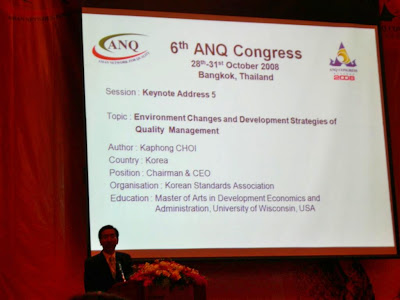
He discussed creative quality management focusing on customer values and focused on global “D” (Digital) generation has been emerging as a new customer group with enormous purchasing power. He also agreed “Key to Excellence = Quality People”.
After that the speaker reviewed 40 years of the Korean economy from quality inspection to six sigma. Since the middle of 1990s, a variety of management innovation tools have been implemented in Korea such as reengineering, benchmarking, restructuring, outsourcing, customer satisfaction management, TPM, TPS, CRM, BPR, SCM and blue ocean strategies, etc.
After the opening ceremony and keynotes topics, we had taken a group photo of all ANQ members.

The first technical presentation session was started in afternoon. I had attended the session called “Quality People – valuing and development” and I was the last speaker in this session. Dr. Pirom Chamsai was the session chair.

The first speaker (C. Sivakumar – CEO, Prabha Engineers) shared the topic – Quality Through Inclusion: Creating a “Happiness Cult”. The Prabha code for quality come from two sources: one is “a culture of inclusive growth” and the other is a series of initiatives that engender “a cult of happiness”.

He described “People Way” in three components as follows:
i) Internal Enabler
· Opening shot
· Trigger
· Fun@work
· Training thro’ magic
· Training thro’ theatre
· Outbound training
· Sports Day
· Yoga, etc.
ii) External Enabler
· Parent letter
· Parents Day
· Spouse Training
· Generation Next
iii) Consistency Culture
· Problem Solving
· Celebrating failure
· Inclusive growth
And then he concluded that “We manufacture Happiness”.
Mr. Loo Choon Chwi was the second speaker and his topic was “Jobs Organization – The First Tool of People Motivation and Commitment”.

He said that the lack or poor “Jobs Organization” resulted in conflict, confusion, frustration, motivational and commitment problems within the organization amongst the employees. Employees Job descriptions, hiring, deployment, development, performance mentoring, measurement, appraisal affected their motivation and commitment and thus were related to job organization.


There were six points for Job Organization:
1) Define needed processes covering business scope
2) Define business needs vs hierarchy
3) Define business needs vs personnel dimensions hierarchy
4) Job description – key motivating tools
5) Job description content
6) Job interview
The third speaker (Mr. James Lee, SQI) and his talk entitled “Implementing Human Resource Strategies to achieve Business Competitiveness and Sustainability”.
The three key recommendations by the Tripartite were:
1) Implement variable bonus linked to key performance indicators (KPI)
2) Introduce the Monthly Variable Component (MVC) in Wage Restructure
3) Narrow the maximum – minimum salary ratio for the majority of their employees to an average of 1.5 or less.
Dr. Yang-Kyun Kim (Dept. Of Health Services Management, Kyung Hee University) was the forth speaker for the topic “A Study on Organizational Loyalty of Hospital Employees; focusing on Overall Members at a University Medical Center in Seoul Metropolitan Area”.

The study observed the following key points:
1) Clear-cut organization vision and mission established by the top management
2) Teamwork in reference to the relationship amongst team members
3) Autonomy for job performance and related empowerment
4) Fairness in wages and promotion
I was the last speaker in this session and my topic was “A Conceptual Model on Development of Quality Professionals”.


The various gaps in the Quality Professional Gap Analysis Model were introduced
Gap 1: Differences between Industry’s expectations of competent Quality Professionals, and Educational Institution’s perceptions of those expectations
Gap 2: Differences between Educational Institution’s perceptions of the requirement of Quality Professionals and the design of quality related study programs
Gap 3: Differences between Educational Institution Graduates’ ability and Industrial employment requirements for Quality Professionals
Gap 4: Differences between the abilities of Competence Quality Professionals required by industry and Quality Society recognition (e.g. HKSQ Certified Six Sigma Green Belt, HKSQ Certified Laboratory Quality Specialist, etc.)
Gap 5: Differences between Industry’s expectations of competent Quality Professionals and the average performance of practicing Quality Professional
Gap 6: Differences between the abilities of professionals recognized by Quality Society and Industrial employment requirements for Quality Professionals

Then, I presented the case study among HKSTP, HKSQ and CityU for explaining the model.
Dr. Pirom Chamsai presented the certificate to me.

After all technical session, we enjoyed “Welcome Reception – Swimming Pool Dinner”.
Some Thai traditional music and dancing were performed.


My wife was taken photo with one of dancers.

We had taken a group photo for memory.
 From Left: Dr. Kano and his wife, Dr. Wang, Mind and I, Dr. Chang

At least, the key to excellence was summarized in the company’s name “PTT” which means a High Performance Organization, TQA Management System, and TPM Activities.

“Review and Prospect of Statistical Quality Methods” was presented by the third keynote speaker Dr. Shu-Kai S. Fan (Dept of Industrial Engineering & Management, Yua Ze University, Taiwan).
His talk reviewed statistical process control (SPC), engineering process control (EPC), design of experiments (DOE) and response surface methodology (RSM).

Prof. Yoshinori Iizuka (School of Engineering, the University of Tokyo) was the forth keynote speaker. His topic was “Meditation on “Quality” – Being fascinated by its profound concept.

He took about Doughnut symptom that Quality Control without Quality and rethinking why “Quality = Customer Satisfaction”. He summarized three important quality concepts as Customer Satisfaction, External Criterion and Purpose Oriented.
There may be two interpretations of “quality management”: “management for quality” and “quality of management”. Prof. Iizuka preferred “management for quality”, that is a management for providing good quality of products/services.


Prof. Iizuka concluded that “Quality management makes people and organization wise”.
The last keynote speaker in the opening ceremony was Mr. Kaphong Choi (Chairman & CEO, Korean Standards Association) and his talk entitled “Environmental Changes and Development Strategies of Quality Management”.

He discussed creative quality management focusing on customer values and focused on global “D” (Digital) generation has been emerging as a new customer group with enormous purchasing power. He also agreed “Key to Excellence = Quality People”.
After that the speaker reviewed 40 years of the Korean economy from quality inspection to six sigma. Since the middle of 1990s, a variety of management innovation tools have been implemented in Korea such as reengineering, benchmarking, restructuring, outsourcing, customer satisfaction management, TPM, TPS, CRM, BPR, SCM and blue ocean strategies, etc.
After the opening ceremony and keynotes topics, we had taken a group photo of all ANQ members.

The first technical presentation session was started in afternoon. I had attended the session called “Quality People – valuing and development” and I was the last speaker in this session. Dr. Pirom Chamsai was the session chair.

The first speaker (C. Sivakumar – CEO, Prabha Engineers) shared the topic – Quality Through Inclusion: Creating a “Happiness Cult”. The Prabha code for quality come from two sources: one is “a culture of inclusive growth” and the other is a series of initiatives that engender “a cult of happiness”.

He described “People Way” in three components as follows:
i) Internal Enabler
· Opening shot
· Trigger
· Fun@work
· Training thro’ magic
· Training thro’ theatre
· Outbound training
· Sports Day
· Yoga, etc.
ii) External Enabler
· Parent letter
· Parents Day
· Spouse Training
· Generation Next
iii) Consistency Culture
· Problem Solving
· Celebrating failure
· Inclusive growth
And then he concluded that “We manufacture Happiness”.
Mr. Loo Choon Chwi was the second speaker and his topic was “Jobs Organization – The First Tool of People Motivation and Commitment”.

He said that the lack or poor “Jobs Organization” resulted in conflict, confusion, frustration, motivational and commitment problems within the organization amongst the employees. Employees Job descriptions, hiring, deployment, development, performance mentoring, measurement, appraisal affected their motivation and commitment and thus were related to job organization.


There were six points for Job Organization:
1) Define needed processes covering business scope
2) Define business needs vs hierarchy
3) Define business needs vs personnel dimensions hierarchy
4) Job description – key motivating tools
5) Job description content
6) Job interview
The third speaker (Mr. James Lee, SQI) and his talk entitled “Implementing Human Resource Strategies to achieve Business Competitiveness and Sustainability”.
The three key recommendations by the Tripartite were:
1) Implement variable bonus linked to key performance indicators (KPI)
2) Introduce the Monthly Variable Component (MVC) in Wage Restructure
3) Narrow the maximum – minimum salary ratio for the majority of their employees to an average of 1.5 or less.
Dr. Yang-Kyun Kim (Dept. Of Health Services Management, Kyung Hee University) was the forth speaker for the topic “A Study on Organizational Loyalty of Hospital Employees; focusing on Overall Members at a University Medical Center in Seoul Metropolitan Area”.

The study observed the following key points:
1) Clear-cut organization vision and mission established by the top management
2) Teamwork in reference to the relationship amongst team members
3) Autonomy for job performance and related empowerment
4) Fairness in wages and promotion
I was the last speaker in this session and my topic was “A Conceptual Model on Development of Quality Professionals”.


The various gaps in the Quality Professional Gap Analysis Model were introduced
Gap 1: Differences between Industry’s expectations of competent Quality Professionals, and Educational Institution’s perceptions of those expectations
Gap 2: Differences between Educational Institution’s perceptions of the requirement of Quality Professionals and the design of quality related study programs
Gap 3: Differences between Educational Institution Graduates’ ability and Industrial employment requirements for Quality Professionals
Gap 4: Differences between the abilities of Competence Quality Professionals required by industry and Quality Society recognition (e.g. HKSQ Certified Six Sigma Green Belt, HKSQ Certified Laboratory Quality Specialist, etc.)
Gap 5: Differences between Industry’s expectations of competent Quality Professionals and the average performance of practicing Quality Professional
Gap 6: Differences between the abilities of professionals recognized by Quality Society and Industrial employment requirements for Quality Professionals

Then, I presented the case study among HKSTP, HKSQ and CityU for explaining the model.
Dr. Pirom Chamsai presented the certificate to me.

After all technical session, we enjoyed “Welcome Reception – Swimming Pool Dinner”.
Some Thai traditional music and dancing were performed.


My wife was taken photo with one of dancers.

We had taken a group photo for memory.
 From Left: Dr. Kano and his wife, Dr. Wang, Mind and I, Dr. Chang


