In the beginning, Mr. Gregory Leung (Convener, Panel on Promoting Testing and Certification Services in Food Trade, HKCTC) gave a welcoming remark. He said public concerned the contamination of food; it was not only on food safety but also on healthy life for food consumption.

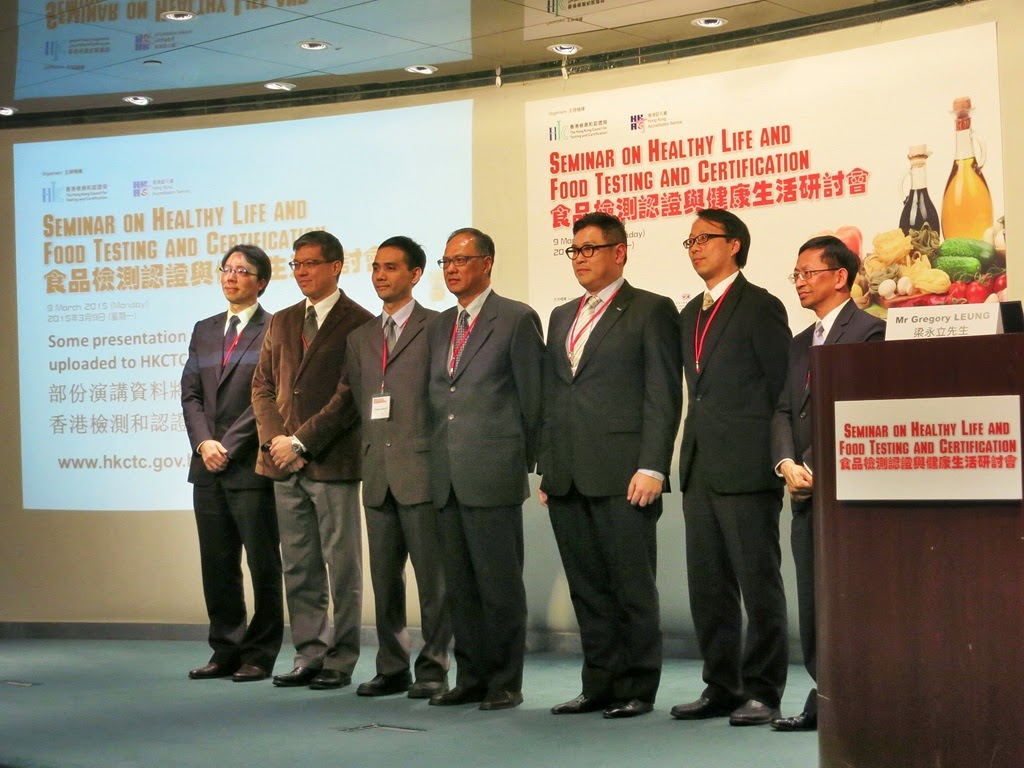
All guest speakers took a group photo.
The first speaker was Dr. Allen Chan (Senior Medical Officer (Risk Assessment), Centre for Food Safety, Food and Environmental Hygiene Department) and his topic entitled “Protect Child Health and Enhance Breastfeeding – Regulation for Formula Products and Foods for Infants and Young Children”. Dr. Chan briefed the background of the Food and Drugs (Composition and Labelling) (Amendment) (No.2) Regulation 2014; and proposed Regulatory Framework for Nutrition and Health Claims in Formula Products and Prepackaged Foods for Infants and Young Children.

Food and Drugs (Composition and Labelling) Regulations (Cap 132W) included Nutrition Labelling (“NL”) Scheme but did not cover formula products and prepackaged food for infants and young children. The key features of the Amendment Regulation included Nutritional Composition requirement for infant formula (IF) and Nutrition Labelling requirement for infant formula (IF), follow-up formula (FF) and prepackaged food for infants and young children (IYC).

The following diagrams showed the Nutrition labelling requirement for IF and FF.
IF: 1+29 for Nutrition Label

FF: 1+25 for Nutrition Label

IYC food must label the energy value and contents of 4 nutrients namely protein, fat, carbohydrates and sodium (i.e. “1+4”), as well as vitamin A and vitamin D if they are added to the food.
Proposed Regulatory Framework Nutrition and Health Claims aimed to better protect the health of IYC under the age of 36 months; and to facilitate effective regulatory control over nutrition and health claims on formula products and IYC foods. There were 5 principles to be considered as follows.

The type of claim and approaches were summarized in the following table.

Finally, Dr Allen Chan discussed Nutrient Reference Values (NRV) used in nutrition labelling. They met the problem that local NRVs did not exist and Mainland China also did not have NRVs for children under the age of 36 months.
The second speaker was Mr. Jacky Lo Tim-lun (Senior Manager, Castco Testing Centre) and his presentation was “Food Nutrition Label Tests Help Consumers to Make Choice”. Mr. Lo briefed the Nutrition Label in the supermarket.

In Hong Kong, 1+7 Nutrition Label was required under Food and Drugs (Composition and Labeling) Regulations (Cap 132W) 2008. In US Nutrition Label was 1+13. The comparison table was showed as follows.

1+7 Nutrition Label included Energy + 7 core nutrients (Protein, Carbohydrates, Total Fat, Sat. Fatty Acids, Trans Fatty Acids, Na & Sugar). Summary of testing methods of 1+7 were discussed.
The type of claim and approaches were summarized in the following table.
Finally, Dr Allen Chan discussed Nutrient Reference Values (NRV) used in nutrition labelling. They met the problem that local NRVs did not exist and Mainland China also did not have NRVs for children under the age of 36 months.
The second speaker was Mr. Jacky Lo Tim-lun (Senior Manager, Castco Testing Centre) and his presentation was “Food Nutrition Label Tests Help Consumers to Make Choice”. Mr. Lo briefed the Nutrition Label in the supermarket.
In Hong Kong, 1+7 Nutrition Label was required under Food and Drugs (Composition and Labeling) Regulations (Cap 132W) 2008. In US Nutrition Label was 1+13. The comparison table was showed as follows.
1+7 Nutrition Label included Energy + 7 core nutrients (Protein, Carbohydrates, Total Fat, Sat. Fatty Acids, Trans Fatty Acids, Na & Sugar). Summary of testing methods of 1+7 were discussed.
(For more info about 1+7 testing, please visit Jacky’s talk in Technical Seminar on Product Testing and Certification 2012.)

The third speaker was Mr. Richard Fung (General Manager – Greater China & Hong Kong, ALS) and their presentation topic named “Pesticide Residues Tests and Food Safety”. He briefed the new regulation (Pesticide Residues in Food Regulation, Cap 132CM) had been enforced on Aug 2014; and total of 360 Pesticides would be controlled.

According to FEHD, 46 volition had been reported below. The following Pesticide Residues were found:
- Carbofuran
- Cypermethrin
- Cyhalothrin
- Chlorpyrifos (short half life)
- Dimethoate (short half life)
- Methamidophos (short half life: 5 days)
- Methomyl

The Richard mentioned the sample preparation such as QuEChERS (Multi-pesticide residue extractions) and instrumentation included LC-MS/MS, GC-MS/MS, etc.

Richard discussed the testing approach that a lot of argument in Europe on Screening. He recommended the Hong Kong practical approach that was Screening plus Specific & Target-oriented Pesticide.
Mr. Andrew Chang (Senior Manager (QMD), Federation of Hong Kong Industries) was the fourth speaker and his topic entitled “Product Certification for Sauce”. He said Hong Kong Q-Mark Council had established by the Federation of Hong Kong Industries (FHKI) since 1978.

Then he briefed the objective of Q-Mark Council was to promote management system and product certification so as to enhance the trusted voice for consumer protection. They had four schemes showed as following table. The distribution of Q-Mark Certified Product included 45% of Food and Beverages; 13% of Kitchen and Household Products; 9% of Textile, Garment and Accessories; 9% of Spectacle Frames; 5% of Construction Materials and 4% of Watches, as well as, 15% of Others.

Mr. Andrew Chang introduced their new schemes for ISO 17065 accreditation. They focused on “Ready to eat food”. For this accreditation, Q-Mark Council had Safeguard Committee and Technical Committee. The organization chart was shared below. Until now, Q-Mark Council had Sauce scheme accredited by HKAS and then they would extend the scheme to Bakery and Preserved Meat.

Mr. Bryan Peng (Assistant Director, Manufacturing and Services, HKQAA) was the fifth speaker and his presentation was “Hong Kong Cooking Oil Registration Scheme”. In the beginning, Bryan briefed the gutter oil scandal in Hong Kong last year.

Details of scheme had recorded in the HKQAA Seminar on New Standard of Food Safety held on 26 Nov 2014. The Hong Kong Cooking Oil Registration Scheme Launching Ceremony cum Pilot Programme Presentation Ceremony held on 15 Dec 2014.

The last speaker was Prof. Jonathan Wong (Director, Hong Kong Organic Resource Centre Certification, Hong Kong Baptist University) and his topic named “Development of Organic Food Products Certification in Hong Kong”. Prof. Wong’s talk content included “Introduction to Hong Kong Organic Resource Centre Certification Limited”, “Organic Standard, Scope of Certification & Certification procedure” and “HKORC’s role in building trust on organic”.

Hong Kong Organic Resource Centre Certification Limited (HKORC-Cert) was established in Mar 2003. Its structure for integrity was showed as follows. HKORC-Cert is the first organization to be accredited by IFOAM under ISO65 in Hong Kong.

HKORC-Cert had three voluntary certifications such as Crop Production, Aquaculture and Processing Food. Prof. Wong said there were 244 organic farms in Hong Kong where 140 were certified. They built trust through control system of HKORC-Cert and all organic inspectors were registered by (Independent Organic Inspectors Association (IOIA)).

Prof. Wong said there were too many foreign organic labels in the market which was very confusing. But, HKORC recognition from public was the highest coverage in Hong Kong. In order to develop unilateral product acceptance service, they would raise the no. of organic import with HKORC-Cert seal and to increase HOKLAS-Cert seal exposure and consumers’ confidence.

Q&A Session

I met several friends and took a photo for memory.
Mr. Leo Yuen (Founding Chairman, HKFSTA) and I

(Left: I, Mr. Richard Fung (ALS), Ms. Joyce Chan (VTC), Ms. Crystal Liang (CityU) and Ms. Christine Fan (VTC))

Reference:
HKCTC - http://www.hkctc.gov.hk/en/home.html
HKCTC Seminar presentation file - http://www.hkctc.gov.hk/en/work_seminars.html#b44
HKAS - http://www.itc.gov.hk/en/quality/hkas/about.htm
The third speaker was Mr. Richard Fung (General Manager – Greater China & Hong Kong, ALS) and their presentation topic named “Pesticide Residues Tests and Food Safety”. He briefed the new regulation (Pesticide Residues in Food Regulation, Cap 132CM) had been enforced on Aug 2014; and total of 360 Pesticides would be controlled.
According to FEHD, 46 volition had been reported below. The following Pesticide Residues were found:
- Carbofuran
- Cypermethrin
- Cyhalothrin
- Chlorpyrifos (short half life)
- Dimethoate (short half life)
- Methamidophos (short half life: 5 days)
- Methomyl
The Richard mentioned the sample preparation such as QuEChERS (Multi-pesticide residue extractions) and instrumentation included LC-MS/MS, GC-MS/MS, etc.
Richard discussed the testing approach that a lot of argument in Europe on Screening. He recommended the Hong Kong practical approach that was Screening plus Specific & Target-oriented Pesticide.
Mr. Andrew Chang (Senior Manager (QMD), Federation of Hong Kong Industries) was the fourth speaker and his topic entitled “Product Certification for Sauce”. He said Hong Kong Q-Mark Council had established by the Federation of Hong Kong Industries (FHKI) since 1978.
Then he briefed the objective of Q-Mark Council was to promote management system and product certification so as to enhance the trusted voice for consumer protection. They had four schemes showed as following table. The distribution of Q-Mark Certified Product included 45% of Food and Beverages; 13% of Kitchen and Household Products; 9% of Textile, Garment and Accessories; 9% of Spectacle Frames; 5% of Construction Materials and 4% of Watches, as well as, 15% of Others.
Mr. Andrew Chang introduced their new schemes for ISO 17065 accreditation. They focused on “Ready to eat food”. For this accreditation, Q-Mark Council had Safeguard Committee and Technical Committee. The organization chart was shared below. Until now, Q-Mark Council had Sauce scheme accredited by HKAS and then they would extend the scheme to Bakery and Preserved Meat.
Mr. Bryan Peng (Assistant Director, Manufacturing and Services, HKQAA) was the fifth speaker and his presentation was “Hong Kong Cooking Oil Registration Scheme”. In the beginning, Bryan briefed the gutter oil scandal in Hong Kong last year.
Details of scheme had recorded in the HKQAA Seminar on New Standard of Food Safety held on 26 Nov 2014. The Hong Kong Cooking Oil Registration Scheme Launching Ceremony cum Pilot Programme Presentation Ceremony held on 15 Dec 2014.
The last speaker was Prof. Jonathan Wong (Director, Hong Kong Organic Resource Centre Certification, Hong Kong Baptist University) and his topic named “Development of Organic Food Products Certification in Hong Kong”. Prof. Wong’s talk content included “Introduction to Hong Kong Organic Resource Centre Certification Limited”, “Organic Standard, Scope of Certification & Certification procedure” and “HKORC’s role in building trust on organic”.
Hong Kong Organic Resource Centre Certification Limited (HKORC-Cert) was established in Mar 2003. Its structure for integrity was showed as follows. HKORC-Cert is the first organization to be accredited by IFOAM under ISO65 in Hong Kong.
HKORC-Cert had three voluntary certifications such as Crop Production, Aquaculture and Processing Food. Prof. Wong said there were 244 organic farms in Hong Kong where 140 were certified. They built trust through control system of HKORC-Cert and all organic inspectors were registered by (Independent Organic Inspectors Association (IOIA)).
Prof. Wong said there were too many foreign organic labels in the market which was very confusing. But, HKORC recognition from public was the highest coverage in Hong Kong. In order to develop unilateral product acceptance service, they would raise the no. of organic import with HKORC-Cert seal and to increase HOKLAS-Cert seal exposure and consumers’ confidence.
Q&A Session
I met several friends and took a photo for memory.
Mr. Leo Yuen (Founding Chairman, HKFSTA) and I
(Left: I, Mr. Richard Fung (ALS), Ms. Joyce Chan (VTC), Ms. Crystal Liang (CityU) and Ms. Christine Fan (VTC))
Reference:
HKCTC - http://www.hkctc.gov.hk/en/home.html
HKCTC Seminar presentation file - http://www.hkctc.gov.hk/en/work_seminars.html#b44
HKAS - http://www.itc.gov.hk/en/quality/hkas/about.htm


