2015年2月6日星期五

HKSQ Student Project Competition 2015 – GP Plant Visit

The HKSQ Company Based Student Project Competition offers an opportunity for students to work on an actual industrial case and propose resolution annually. It aims to give opportunity for student to gain experience of resolving an industrial problem. The competition included three sessions. The first session was problems selection which problems were designed and explained by sponsor company (e.g. GP Batteries International Limited (GP Battery) in 2015). The second session was factory visit and the last session was presentation of their suggested solutions.

The second session - plant visit was held on 6 Feb 2015. Mr. Peter Fung (Chairman, HKSQ) led the visit and briefing the rule of that visit.


Ms. Angela Wong (Vice-Chairman, HKSQ) registered and checked the attendance. The participants were come from CUHK, HKUST, PolyU and CityU).


Then Mr. Simon Tong (Coop member, HKSQ) led us to go to the travel bus. I was reporter of this event.


In the conference room, Mr. Larry Lee (Customer Services & Compliance Quality Manager) briefed GP Battery history. He said Dongguan Chao Ba Batteries Co., Ltd. established in 1993 and products included Cylindrical, Button Cell and Prismatic Cell and monthly plant capacity up to 16M (Million pieces).


Then we separated into two groups to visit GP Battery plant. Their representative explained different processes to students.


After the visit, we went back to the conference room for discussion.


We had lunch in the staff canteen and let students feel working life in China factory.


Simon and I took a photo in canteen.


Food waste was collected for recycle since GP had certified ISO 26000 CSR.


In afternoon session, we separated students into three groups for discussing their competition topics.
The topic one is “Traffic Lamp for suppliers’ risk assessment”.


The topic two is “On-going reliability test & leakage cells’ life time prediction of modeling”.


The topic three is “Out-going QA PPM & Repeated Defect Modes Gating Model to Secure Customer Satisfaction”.


At the end, Mr. Percy Chan (Quality Director) gave closing remarks.


We took a group photo for memory before leave.


Photo was taken during return.


Reference:
HKSQ Company Based Student Project Competition - http://www.hksq.org/company_based_competition.htm
GP Batteries International Limited - http://www.gpbatteries.com/INT/
20141120: HKSQ Student Project Competition 2015 – Pre-visit GP - http://qualityalchemist.blogspot.hk/2014/11/hksq-student-project-competition-2015.html
20150123: HKSQ Student Project Competition 2015 - Briefing - http://qualityalchemist.blogspot.hk/2015/01/the-hksq-company-based-student-project.html


2015年2月5日星期四

HKCTC & HKAS Seminar on Greenhouse Gas Validation & Verification

The Hong Kong Council for Testing and Certification (HKCTC) and Hong Kong Accreditation Service coorganized a seminar entitled “Greenhouse Gas Validation and Verification” on 4 Feb 2015. In order to tackle climate change, initiatives to limit Greenhouse Gas (GHG) concentrations in the atmosphere were implemented in many places around the world. The seminar aims to introduce a GHG validation and verification through the sharing from representatives from the Construction Industry Council and the HKAS, as well as, users of relevant services. The summary was shown below.

In the beginning, Prof. Paul Lam (Convener, Panel on Promoting Testing and Certification Services in Environmental Protection Trade, HKCTC) gave a welcoming remark. He briefed the six GHGs covered by the Kyoto Protocol which were Carbon dioxid (CO2), Methane (CH4), Nitrous Oxide (NO2), Hydrofluorocarbons (HFCs), Perfluorocarbons (PFCs) and Sulpur hexafluoride (SF6). Then Prof. Lam mentioned ISO/TS 14067 carbon footprint would be a global trend and HKAS provided the service for ISO 14064.


All guest speakers took a group photo.


The first speaker was Ir. Julian Lee (Manager – Research, Construction Industry Council (CIC)) and his topic entitled “Moving Towards Low Carbon Building Design and Construction – From Rhetoric to Reality”.


Then Ir. Julian Lee introduced CIC Carbon Labelling Scheme which aimed to provide verifiable and accurate information on the carbon footprint of construction materials for users to make informed decision thereby to combat the climate change in which materials covered Cement, Rebar, Structural Steel and Ready-mixed Concrete first. The scheme is a voluntary eco-labelling programme with independent third-party verification reference to ISO/TS 14067:2013 (GHG – Carbon Footprint of Products – Requirement and Guidelines for Quantification and Communication) and ISO 14025:2006 (Environmental Labels and Declarations – Type III Environmental Declarations – Principles and Procedures).


Ir. Julian Lee also mentioned the certification process included manufacturer, certified carbon auditor, GHG Validation & Verification and Zero Carbon Building (ZCB). The scheme implementation framework included Training (by ZCB), Auditing (by Accredited GHG Verification Bodies) and Certification (by ZCB).


Finally, Mr. Lee summarized CIC work done and processing application in the different product categories. The participants were form different regions such as Japan, Chian, Taiwan, Macau and HK. They had lobbying different key stakeholders to participate this scheme successfully. For future development, they did not only focus on Low Carbon Materials and Sellection of Green Materials, but also encourage Low Carbon Design and Green Culture.


The second speaker was Mr. Eddie Tse (Senior Environmental Manager, Gammon Construction Limited) and his presentation named “Greenhouse Gas Management – A Contractor’s Perspective”. Mr. Tse told us their sustainability perspective (Environment & Society) was closely linked with Safety, Money, Time, Quality and Resources.


Mr. Tse pointed out the business drivers for GHG / Carbon Managment. They were Corporation Social Responsibility (CSR), Cost Saving and Competitive Advantage (increasing customers’ demand for demonstrable carbon accounting and saving activities). Then he introduced their Carbon Taskforce through the following diagram.


The structure of GHG Management included Corporate GHG Inventory, GHG Assessment, Energy Management and Product Carbon Label.


Mr. Tse briefed the scope and boundary where Scope 1 was Direct Emissions, Scope 2 was Indirect Emission and Scope 3 was Other Indirect Emission (Upstream & Downstream). He said they were lucky because of strong finance and procurement departments which consolidated all data and no need to collect in each site.


During the tea break, I took a photo with Prof. Paul Lam (Middle) and my classmate (HD) Mr. Ivan Leung (Left).


The third & forth speakers were Ir. Joseph Lo (Chief Engineer – Regal Airport Hotel, Regal Hotels International Limited) and Mr. Kevin Man (Chief Engineer – Regal Riverside Hotel, Regal Hotels International Limited) and their presentation topic was “Case Study on Greenhouse Gas Emission based on ISO 14064-1”. Firstly, Ir. Joseph Lo explained “What is a Carbon Footprint?” – The amount of GHG emitted that your organization is responsible for, expressed in units of Carbon Dioxide equivalent (CO2e) (usually in tonnes emitted annually).


Then Ir. Joseph Lo briefed 6 steps for GHG Reporting below.
1. Identify the Boundary
2. Identify all Emission Sources (Scope 1 – Direct; Scope 2 – Indirect; Scope 3 – Indirect & Optional)
3. Data Collection
4. Application the Calculation
5. Finding the Deduction
6. Summary and Conclusion the Result
The following example demonstrated how to identify the emission sources based on their scop


After that Ir. Kevin Man shared different cases on GHG calculation.


Those cases included special emission factor from Diethylene Glycol (Gel Fuel), LPG gas container volume to verify the amount of gas emission, emissions from the mobile sources (Transportation), HFC and PFC emissions from Refrigeration / Air-conditioning Equipment, etc. (Even though WD40 should be counted!)


Finally, he shared their 15 ways to reduce GHG emission.


The last speaker was Mr. Wilson Shum (Senior Accreditation Officer, HKAS) and his topic named “Accreditation Services for Greenhouse Gas Validation and Verification”. Mr. Shum mentioned the GHG Quantification was based on ISO 14064-1 (for organization); ISO 14064-2 (for GHG emission reduction/removal enhancement project) and ISO/TS 14067 (for product carbon footprint).


The following diagram showed ISO 14064-1:2006 structure. The benefits to implement this standard were improving awareness, creating a baseline, identifying areas of high GHG emissions and implementing action or project to reduce GHG emission.


The following diagram showed ISO/TS 14067:2003 process to quantify the carbon footprint of a product (CFP) based on life cycle assessment.


The relationship among accreditation body, verification body and GHG information were discussed.


Q&A Session
During discussion, speakers explained the reduction of GHG did not necessary saving money. It depended on policy or technology readiness. They agreed people was most important so the awareness training was needed and top management should be invited to attend as well.


Reference:
HKCTC - http://www.hkctc.gov.hk/en/home.html
HKCTC Seminar presentation file - http://www.hkctc.gov.hk/en/work_seminars.html#b44
HKAS - http://www.itc.gov.hk/en/quality/hkas/about.htm


2015年2月3日星期二

HKSQ Support Shenzhen Quality City Promotion Association AGM 2015

We received the invitation from Shenzhen Quality City Promotion Association (深圳市質量強市促進會) by Ms. Cheung Man (張文) (General Secretary) to support the AGM 2015. Our Former Chairman Dr. Aaron Tong and Coop member Mr. Simon Tong represented Hong Kong Society for Quality to attend the meeting.


Innovation works as a Drive; Quality works as a Guide; and Standard works as a Supporter.


Awards presentation


Dr. Aaron Tong posted photo and wrote the article in his facebook below.

深圳市品質強市促進會聯會 生產值猛增83%
深圳市品質強市促進會聯會於2015年2月舉辦第二屆「全國品質強市示範城市」頒獎典禮,我以前會長身份代表香港品質學會出席,恭賀得獎企業。

國務院參事張綱到會發表感言祝賀深圳市取得的品質成就。9位企業家榮獲第二屆「深圳市品質強市金質獎章」,另有58家企業被新認定為「深圳市品質強市骨幹企業」。深圳市市長許勤、深圳市副市長陳彪, 、深圳市品質強市促進會會長馬蔚華皆認為「品質成就未來」是深圳市品質精神,發展理念。

新思路、新舉措。2015年是深圳市品質強市促進會的「品牌建設年」,著力提升深圳品質,以品質打造深圳品牌,以品牌鑄就深圳信譽,促進深圳經濟社會發展率先走向「品質時代」,其未來的品質建設也讓我們翹首以盼。

我與深圳市品質強市促進會會長馬蔚華(右2),深圳市品質強市促進會秘書長張文(左1)等合照。


The content of invitation letter was recorded as follows.


Reference:HKSQ - www.hksq.org
深圳市質量強市促進會 - http://www.szqc.org.cn/about/?107.html
深圳市質量強市促進會微博 - http://www.weibo.com/u/3225217763


Innovative Thinking Workshop – Thinkertoys

LMI academy was invited to provide an Innovative Thinking Workshop using Thinkertoys for in-house training. I was one of participants and would like to summarize some tools we learnt from the workshop.  Mr. Dick Yip (Principal Consultant, LMI) was our trainer and the workshop named “Thinkertoys Innovative and Creative Thinking”. The whole workshop should be two days with 9 tools. We attended the first day for four tools.


The creator of Thinkertoys was Michael Michalko. Then Mr. Dick Yip briefed some cases about New Product / Service and Operation / Cost Saving, as well as, Cross-Industry Innovation.


Then Mr. Dick Yip quoted Charles H. Duell (Director of US Patent Office, 1899) statement that “Everything that can be invented has been invented.” This statement let me remember Murphy's Law stated “Anything that can go wrong will go wrong.”


The tools from Thinkertoys were introduced. The first tool named “Time & Space”. It was similar to 9 Window. In our exercise, we only consider the “Present” and “Past”, neglected “Future”.


We used Disney issue as example and employed this tool.


Then Mr. Yip explained “Quality of our thinking is restricted by the ASSUMPTIONS we made” by using a tricky game. The second tool named “False Faces” which based on Reversing Assumptions.


The next tool Mr. Yip introduced to us was “Idea Box”. It pointed out several attributes and then combined it to be a new idea.


The most obviously example was Cart noodle “車仔麵”. You could combine what food you like.


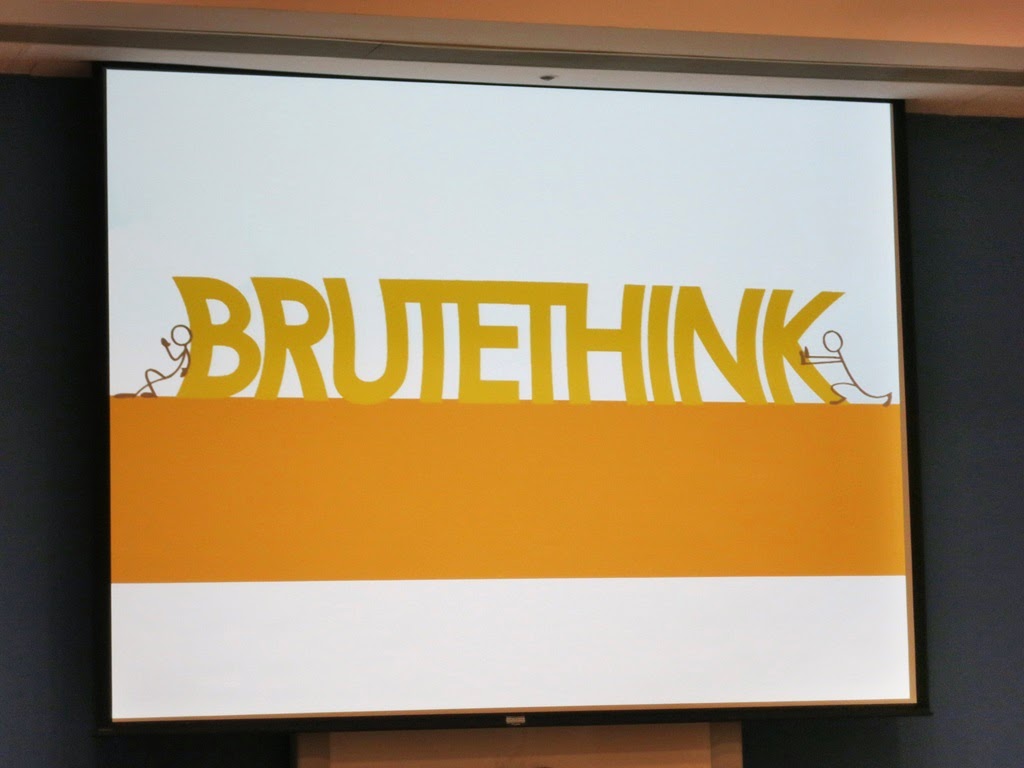
The last tool named “BruteThink” (隨意聯想法). Mr. Yip introduced two methods. One was idea walk or Take a walk (散步) and the other was randomly to pick a word and make associations to the solution you were seeking. We called this method in Cantonese “九唔搭八”.


Today, we learnt and exercised four innovative tools below.


2015年2月2日星期一

An Evening with Jack Ma (馬雲與青年有約)

An Evening with Jack Ma (馬雲) was organized by Our Hong Kong Foundation (團結香港基金) on 2 Feb 2015. The topic named “Jack Ma and Youth: From Dream to Success Startup.”「馬雲與青年有約:從夢想到成功創業」 I joined the event and took a photo in the main entry.


Mr. Stephen C.W. Chan (陳志雲,綽號「志雲大師」) was the MC and he introduced the organizer and guests.


In the beginning, Mr. Chee-hwa Tung (董建華) (First CE, HKSAR) gave a welcome speech. He appreciated Mr. Jack Ma’s contribution to share his experience and to invest 1000M fund for youth in Hong Kong, so as to excite youth chasing dream in startup. Mr. Tung also expected Hong Kong to be harmony society with innovative startup ecology system. Finally, we could together realize the Dream of China.


Mr. Jack Ma went into the stage and shared his journey of startup. He told us that he asked 24 friends about his startup idea on 15 years ago, 23 friends did not support to him but he insisted. He also said someone did not have good academic result; he was willing to do startup. (讀書不好,反助創業。) Then he explained what is Dream (夢想) and Ideal (理想). Dream is “Insistent”(堅持) and “Action”(行動); Ideal is “Team”(團隊). He said it is no good for MBA because the most courses studied the success cases but seldom studied the failure cases.


Mr. Ma always mentioned to adjust your mind (改變心態). He said many success business men had the similar characteristics below.
1. Optimistic
2. Fail happened and found problem from himself first (Change himself)
3. Do not complain (不抱怨) (Because chance become from people’s complain)
4. Insistent and Think
Mr. Ma encouraged youth that many chances in Hong Kong. The first industry revolution released man power. The second industry revolution (IT) also released man power. The next wave would release brain power. However, action is important. He said many people dream in night and forget after wake up. (晚上想想千條路,朝早起來走原路。)


The next session was sharing with youth startup. Some important points were summarized below.
- Jack Ma said Data era would be come after 10 or 20 years.
- Jack Ma’s view on social responsibility that ego in IT era was passed. The Data Technology (DT) era is altruism (利他) and focused on responsibility.
- Industry Mind and Business Skill (工業的心態,商業的手段。) Reminder that Don’t Reverse!
- Without create Value, Free is equal to Suicide!
- Alibaba is a Data company. In manufacturing, it is B2C and the best is standardization and lean. In future, it is C2B that means small amount, unique and characterized, self-maker.
- Change Ourselves, Change Future!
- If you have technology and capital first, your startup must be failed. A success startup must lack of resource.


The last session was Q&A. Mr. Stephen C.W. Chan asked Mr. Jack Ma several questions from audiences through Apps.
Do youth apply the Alibaba fund if he/she joined Umbrella Movement? Jack replied “Why Not?”
If youth applied your fund but he was not able to return China, how do you help him? Jack replied that every youth had done wrong. His father had not allowed him to do many things in the past. He thought that “Discipline is needed”. However, youth would overcome himself (走出自己) once he applied the fund successfully.
Sometime, you needed to think every people had their difficulty.
Stephen questioned a fake university to sell certificates in Taobao.com (淘寶網). Jacky replied that they must handle it once received complaint. They had 3000 people team to monitor and control it. However, people must complaint to them otherwise it is difficult to find it out because of huge products in Taobao platform.
Finally, Mr. Jack Ma said team was important for startup. They should have same Spirit and Trust. The ideal team is Journey to the West (唐僧團隊).


It is a very good talk and I enjoy very much tonight. However, I would like to add “Quality” into their core values which is not only for Alibaba itself but using their influential power to change the quality concept in other China shops under different Alibaba platforms. I met Dr. Aaron Tong (Former Chairman, HKSQ) and Dr. Rocky Lam (Chairman, CityU EngD Society) and took photos for memory.

(Dr. Aaron Tong)
 (Left: Dr. Rocky Lam & I)

At the end, I think about Quality in China. The Chinese translation of Quality was different between China and Hong Kong. However, the Chinese words of Quality could be combined as follows.
In China, Quality (質量) means Quantity (量) and Good Nature (質)
In Hong Kong, Quality (品質) means Good Nature (質) and Brand (品)
So that I called Quality in Chinese (品質量) indicated Quantity (量) and Good Nature (質) and Brand (品). I hope Alibaba could lead China business to the Quality Way in near future.

Reference:
Alibaba Group - http://www.alibabagroup.com/
Alibaba Hong Kong Facebook - https://zh-hk.facebook.com/pages/Alibabacom-Hong-Kong/546468715385599?sk=info&tab=page_info
Alibaba.com - http://www.alibaba.com/
Our Hong Kong Foundation - http://www.ourhkfoundation.com/
20150129 – HKSTP & Alibaba Seminar on B2B Export E-commerce Business Tips and Successful Case Sharing - http://qualityalchemist.blogspot.hk/2015/01/hkstp-alibaba-b2b-export-e-commerce.html
20141212 - HKSQ Technical Visit to Alibaba Hong Kong - http://qualityalchemist.blogspot.hk/2014/12/hksq-technical-visit-to-alibaba-hong.html


LinkWithin

Related Posts with Thumbnails