2013年8月24日星期六

Hong Kong IT Talent Development Seminar

A Seminar entitled "Hong Kong IT Talent Development (香港資訊科技界人才發展)" was organized by Mr. Charles Mok (Legislative Council Member (IT Functional Constituency)) on 23 Aug 2013. Many IT related organizations and associations supported the seminar. Recently, IT industry development is in a good direction included Data Centre, Cloud Computing and Information Security. So IT human resource is focused. The seminar aims to discuss how to attract student more IT talent in the industry.


In the beginning, Mr. Charles Mok (Legislative Council Member (IT Functional Constituency)) gave an introduction speech. He said many IT companies faced a problem on employment both quality and quantity. He also suggested to focus on primary and secondary school students; as well as, to attract them to study IT subject in university.


Group photos with speakers and supporting organizations


Mr. Daniel Lai (賴錫璋) (The Office of the Government Chief Information Officer ) was the guest speaker and he gave an opening remark. He said Hong Kong had a outstanding ICT infrastructure and the IT participants increased from about 66700 to about 78700 in the period from 2009 to 2013. Moreover, he introduced some programmes such as iCity for Form 3 to Form 6 students and 7 TV programmes, etc.


The first speaker was Prof. Kar Yan Tam (Associate Provost, Dean of Students, Chair Professor of Information Systems, Business Statistics and Operations Management, HKUST) and his topic named "Hong Kong IT Manpower Development".


Prof. Tam introduced VTC bi-annual IT Manpower Survey since 2001. The top three Job Categories were IT Software Development (37%), Operation Services (22%) and Field Support (11.7%). There were 1806 vacancies in May 2012. The following diagram showed the distribution of IT employees by Sector.


The percentage share of IT employees in the Labour Force from 2000 to 2012 were discussed. It was found that the ratio increase from about 1.8 to 2.1 since 2000.


After that Prof. Tam discussed the supply and demand of IT graduates. Total headcount of the 7 UGC funded institutions form Engineering/IT-related disciplines was 14,650. But only few of them serviced in IT industry (see diagram below).


Finally, Prof. Tam pointed out four potential growth areas in IT field included "Movie and Entertainment (e.g. Computer animation)", "Finance (e.g. Quantitative modeling)", "Legal (e.g. Data Center, Cloud Computing and Big Data Service)" and "Intellectual Capability (Research centre for large consumer electronic)".

The second speaker was Mr. Michael K M Leung (FHKCS, Senior Vice President & CIO, China Construction Bank (Asia) Corporation Limited) and his presentation entitled "Market Demand of IT Professionals".


Mr. Leung briefed the IT value proposition included "Localization of solutions from overseas and Globalization of local ones", "Business-cum-IT knowledge & skills", "Higher-value jobs (e.g. system architect & decision science analyst)", "Innovation" and "Cross-border collaboration (e.g. HK's software advantage - legal system, management)". The following diagram demonstrated different IT job categories.


Then Mr. Leung pointed out some important IT skills in demand included ".NET, Java & Hypertext Preprocessor (PHP) programmers", "Data analysts / Decision Scientists", "System Architects" and "IT Auditors & Compliance Specialists".

Mr. Leung said HKCS performed IT Man Power Market Survey and the results would be announce in next week.

Discussion Forum then performed.


Dr. Edith Mok (Director, The Hong Kong Institute for IT Professional Certification (HKITPC)) was the third speaker and her speech was "Towards Professional Certification for IT Professionals (IT 從業員的專業認證)"


Dr. Mok introduced the roadmap of the certification through HKQF. The CPIT certification scheme included Project Director, Systems Architect, QA Managers, Associate Project Manager, InfoSec Officer and Business Analyst.


The following diagram showed the details of IT Career Roadmap.


Then Dr. Mok explained the reasons for selective certification included "Identifying needs", "Setting the standards", "Differentiation", "Collaboration" and "Complementary effort".

The forth speaker was Mr. Raymond Woo (Chairman, The British Computer Society - Hong Kong Section) and his topic named "IT Manpower Forum".


Firstly, Mr. Woo discussed the IT Manpower Gap and questioned "If it is NOT broken, don't fix it!". He explained that Broken implied "Lack or poor technical competence", "Lack of the skills demanded by the market", "Job NOT well done", "No requirements" and "Professional Conducts". He concerned if Hong Kong went forth with own ICT Professional Registration which would increase Cost and Time spent.

Then he discussed how to improve the ICT Ecosystem for HK ICT SMEs. Could the public and private sectors consider "Local ICT First"? Finally, Mr. Woo concluded his talk by following statement. "What matters ... Is to do the most needed thing at the need time for the greatest benefits of the stakeholders, i.e. ICT Practitioners, Public and Private Sectors, and the Community as a whole."

The fifth speaker was Ir. Dr. C. L. Chan (Chairman, Information Technology Division, Hong Kong Institution of Engineers) and he shared his view on IT Manpower and Chartered Engineer in ID Division through HKIE.
 

Dr. Angus CHEUNG (Chairman, The IET HK) was the final speaker and his presentation title was "ICT Professional Registration through the IET". He introduced IET professional registration included Chartered Engineer (CEng), Incorporated Engineer (IEng), Engineering Technician (EngTech), ICT Technician (ICT Tech) and Chartered IT Professional (CITP).


The competence and underpinning knowledge and understanding of each registration were discussed. The level of competence for ICT Tech and CITP were created by the industry and adopted SFIA Skills Framework (http://www.sfia-online.org/)


Q&A session:
One of participants questioned how to attract people study IT? Many young people thought IT is difficult to study, to do and to survive (難讀、難做、難生存).
Some participants questioned professional certificates were no use. Another said it should depend on demand and supply. Somebody worried the scope of certification examination was not able to catch the fast change ICT environment.
SME bosses were feedback difficult to employ right IT people.


Reference:
IT人才發展有前景 - http://www.skypost.hk/column/莫乃光/007001004041/IT人才發展有前景/106636
Leaflet - http://www.hkcs.org.hk/whatsnew/20130814/files/IT_Manpower_eFlyer6.pdf


2013年8月17日星期六

Business Win at Service Culture

I attended the seminar entitled "Business Win at Service Culture (成功企業贏在服務文化)" organized by Mansfield Consulting Limited on 16 Aug 2013 and I would like to share below.

The speaker was Mr. Billy Man (Managing Director, Mansfield). He is a professional in service quality and had been invited by HKSQ for providing us a Service Quality Seminar for World Quality Month in Nov 2011. It is an golden opportunity for me to refresh my knowledge.


Before the seminar, Mr. Billy Man briefed some services of Marketing Survey and Research in Mansfield Consulting Limited. I found interested in SELLability Assessment and Focus Group. And then an interesting game called "Dim Sum (點心)" was performed for participants rehearsal. The name included "Heart (心)" indicating that "Service is from the Heart".


After that Billy asked why Customer Service to us and shared some research data of local industries . In 2013, there were 72.1% in Service Industry, 3.9% in Manufacturing Industry and 24% for others in Hong Kong. However, the staff turnover rate in retail was up to 30%.


Then he shared some views on customer service below:
1. One complaint means 23 customer loss
2. One complaint will affect 12 potential customer
3. There are about 20% customer loss per year (Harvard Business Review)
4. One new customer cost more than 5 time to reserve for existing customer.
5. One satisfied customer will bring 3 new customers.
In addition, Billy calculated the actual target and budget based the above viewpoints and found that customer satisfaction was very important to achieve the target and budget.


Billy introduced the four Incentives for business success included "Business Performance", "Customer Expectation", "Marketing Trend" and "Management Effectiveness". He also said that Establishing Service Culture needed at least THREE years in which needed Money, Effort and Time (MET). The Service Culture included four elements:
A) Service Standard (服務標準)
B) Promotion Strategy (推廣策略)
C) Management System (管理制度)
D) Team Work (上下一心)


In order to initiate a service culture program, Billy pointed out "First Who?" and "Then What". He quoted a book "Good to Great" by Jim Collins that Get the right people on the bus, then figure out where to go. He pointed out bosses were important to be Role Model.


Finally Billy shared several local cases to explain how to establish service culture through different reward schemes.


Reference:
Mansfield Consulting Limited - http://www.mansfieldhk.com/
Service Quality Seminar organized by Hong Kong Society for Quality (HKSQ) on 4 Nov 2011
http://qualityalchemist.blogspot.hk/2011/11/service-quality-seminar.html


2013年8月14日星期三

OUHK Seminar on Overview of US CPSC & Update of Consumer Products from China

The Open University of Hong Kong (OUHK) organized a Professional Seminar entitled "Overview of U.S. Consumer Product Safety Commission (CPSC) / Update of Consumer Products from China" on 13 Aug 2013. The seminar aims to overview and update on imports of Consumer Products from China (including Hong Kong) and to discuss China's share of total imports of toys, apparel, and electrical/electronic products. The guest speaker was Mr. John Golden. He serves as the Section Chief/Regional Product Safety Officer in the East Asia - Pacific Region for the United States Consumer Product Safety Commission. I am honor to took a photo with Mr. John Golden.


Hong Kong Society for Quality (HKSQ) was one of supporting organizations and about ten HKSQ members participated the seminar. We took a group photo before the seminar.


In the beginning, Prof. KC Ho (Dean, School of Science & Technology, OUHK) gave an opening remark and presented a souvenir to guest speaker.


Group photo was taken with OUHK professors.


Section 1: Overview of CPSC
Mr. John Golden (Attaché, US CPSC) introduced the U.S. Consumer Product Safety Commission (CPSC) Overview firstly. CPSC is an independent federal agency which has established since 1973. CPSC is responsible for consumer product safety function of the federal government. Then Mr. John Golden briefed their mission that "Protecting the public against unreasonable risks of injury from consumer products through education, safety standards activities, regulation, and enforcement."


The organization of CPSC was introduced and Mr. John Golden was belongs to Education, Global Outreach, and Small Business Ombudsman. Then he mentioned US estimated annual losses asociated with Consumer Porducts upto USD 1 Trillion in Societal Costs (where 34,500 Deaths and 36 Million Injuries cases).


The definition of Consumer Product is "... Any article, or component part thereof, produced or distributed (i) for sale to a consumer for use in or around a permanent or temporary household or residence, a school, in recreation, or otherwise, or (ii) for the personal use, consumption or enjoyment of a consumer in or around a permanent or temporary household or residence, a school, in recreation, or otherwise...".
(Section 3(a)(5) of the Consumer Product Safety Act, 15 USC 2052(a)(5))
Some Consumer Products were excluded from CPSC and showed in the following diagram.


Then John described different ways CPSC to prevent injuries and deaths through "Regulations", "Voluntary Standards", "Identifies, Monitors, Analyzes Trends", "Conducts Risk Assessments", "Conducts Research", "Education on manufacturing for safety", "Educates on Safety Use", "Surveillance: Retail, Internet, Ports" and "Investigations, Recall, Compliance". The follow diagram showed the CPSC Voluntary Standards Monitoring.


For Import Surveillance, John introduced Importer Self-Assessment Program in which CPSC staff were working with Customs & Border Protection (CBP) to implement a program that allowed companies to apply for a "low-risk" status. However, the data of CPSC Recalls by Product Origin demonstrated the high port of Recalls come from China. The CPSA provided for three remedies in the case of the recall of a product such as Repair, Replacement and Refund of Purchases Price.


During discussed Best Manufacturing Practices, I was interested in Testing and summarized below.
- Even when testing and certification is not mandated by CPSC, importers and suppliers should make sure that products meet all requirements.
- To avoid problems, samples should be tested randomly, early and often.
- The cost of testing is a tiny fraction of the costs associated with recalls and violations.

Section 2: CPSC requirements for adult and children's clothing
Mr. John Golden introduced Flammable Fabrics Act (FFA) through different regulations included Clothing Textiles (16 CFR Part 1610), Vinyl Plastic Film (16 CFR Part 1611), Children's Sleep wear (16 CFR Part 1615/1616), Carpets and Rugs (16 CFR Part 1630/1631), Mattresses and Mattress Pads (16 CFR Part 16132), and Mattress Sets (16 CFR Part 1633). The testing summary was shown in the diagram below.


Drawstrings are considered a substantial product hazard. It applied to drawstrings on upper out wear, jackets and sweatshirts. In order to avoid entry problems with the US government (Customs and CPSC), foreign manufacturers should comply with both CPSC Regulation (mandatory) and Private Sector Standards (consensus voluntary standards).


Section 3: CPSC requirements for children's products and certification & testing for non-children's products
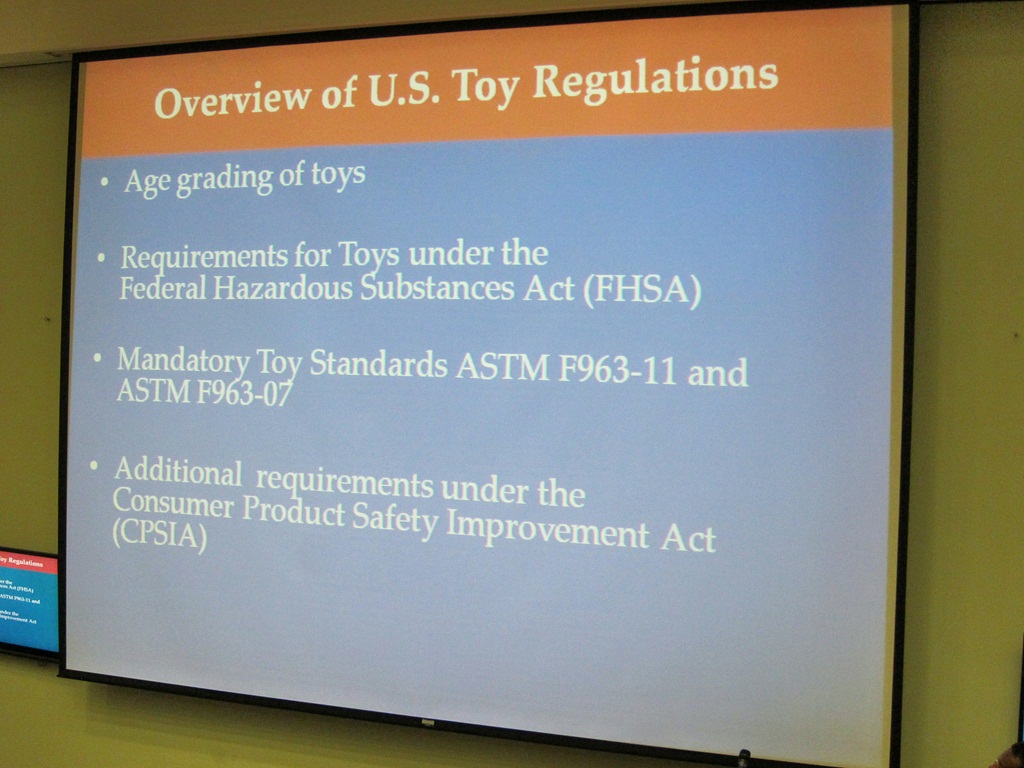
Mr. John Golden pointed out four types of product safety concerns included Product fails to comply with a mandatory safety standard or ban under the Acts, Product fails to comply with voluntary standards relied upon by the Commission, Product contain a defect which could create a "substantial product hazard", and Product creates an "unreasonable risk" of serious injury or death. The overview of US Toy Regulations were discussed:
- Age grading of toys
- Requirements for Toys under the Federal Hazardous Substances Act (FHSA)
- Mandatory Toy Standards ASTM F963-11 (updated and effective on June 12, 2012) and ASTM F963-07
- Additional requirements under the Consumer Product Safety Improvement Act (CPSIA)


The following diagram showed different limits on Lead, Phthalates, etc in Children's toys and clothes.


There are four types of third party testing which are accepted by the CPSC to conduct testing on consumer products using approved test methods in accordance with established federal safety standards:
- Initial third party testing (also called certification testing);
- Component part testing;
- Material change testing; and
- Periodic testing for continued production
John said all non-exempt materials must be third party tested by a CPSC-accepted laboratory (on a test-by-test basis). (www.cpsc.gov/labsearch)


Section 4: Imports of Consumer Product Under CPSC Jurisdiction 
John shared many import data from 2003 to 2012. China import is dominant.


Q&A Section


Reference:OUHK - http://www.ouhk.edu.hk/WCM/?FUELAP_TEMPLATENAME=tcSingPage&lang=eng
HKSQ - http://www.hksq.org/
CPSC - http://www.cpsc.gov/cpsia
For New Certification, Testing, and Other Requirements - http://www.cpsc.gov/en/Business--Manufacturing/International/English/


2013年8月11日星期日

Professional Certification Scheme in Testing & Certification Industry

Hong Kong Association for Testing, Inspection and Certification Ltd. (HKTIC) held a seminar of the Professional Certification Scheme for Testing Personnel (PCSTP) on 10 Aug 2013. I attended the seminar after my Invigilation Duty Assignments for HKSQ accredited course in CityU named "SEEM 3068 - Quality Management for Laboratory Operation". HKSQ had another professional certification scheme for Testing & Certification Industry named "Certified Laboratory Quality Specialist (CLabQS)" based on different accredited courses in different universities included PolyU, CityU, HKUST, HKBU and OUHK. (http://www.hksq.org/acourselist.htm)

Dr. Eric Sze represented HKTIC to present PCSTP. He introduced the scheme objectives included recognition and prestige for individual and create a competitive advantage over non-certified individuals in the same field; to enhance employment opportunities; and to establish a professional image for individual in a particular testing field.


Dr. Sze mentioned the PCSTP Phase I included Chemical & Microbiological Testing (C&M), Construction Material Testing (CMT), Electrical Products Testing (EPT), Toys & Hardlines Testing (THT) and Textiles & Garments Testing (TGT) was launched on 26 Sep 2011 and Phase II included Food & Environmental Testing (FET) and Quality & Calibration (Q&C) on 19 Jun 2013


After briefing the background and application information, Dr. Sze mentioned the examination results that was only ~40% pass rate.


However, there are several paths to achieve Certified Testing Technician and Professional included examination, completed training courses or relevant experience (>= 15yrs); and through professional interview.

A good news that the fees of new scheme (i.e. FET and Q&C) would be waive till 28 Februray 2014. It means the deadline of application for this free examination on 31 Aug 2013.

More information:
HKTIC Professional Certification Scheme for Testing Personnel (PCSTP) - http://www.hktic.org/template?series=4
HKSQ Certified Professional Scheme - Certified Laboratory Quality Specialist (CLabQS) - http://qualityalchemist.blogspot.hk/2011/07/hksq-certified-professional-scheme.html


2013年8月8日星期四

HKQAA Seminar on Application of ISO 50001 in Construction Projects

The Seminar entitled "HKQAA Seminar on Application of ISO 50001 in Construction Projects" was organized by Hong Kong Quality Assurance Agency (HKQAA) on 8 Aug 2013. ISO 50001 standard was published in 2011 and then Hong Kong government introduced the "Buildings Energy Efficiency Ordinance" which came into effect in Sep 2012. The seminar aimed to give an overview of the Housing Department's latest initiates in energy management.

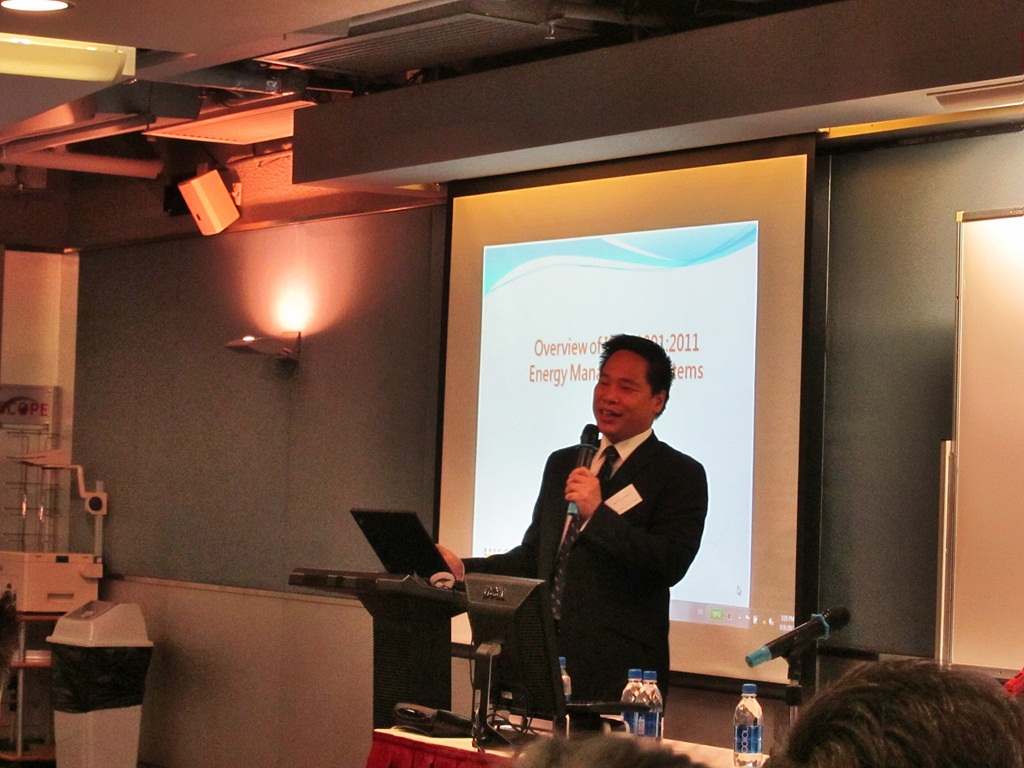
Mr. P.C. Chan (Chief Operating Officer, HKQAA) was the first speaker and his topic entitled "Overview of ISO 50001:2011 Energy Management Systems". In the beginning, Mr. Chan introduced the HKQAA which has been established by Hong Kong Government since 1989. Then he use the photo of Cocooned trees in Pakistan (source from National Geographic 2011) to explain the impact of climate change (GHG & flooding) which clause to development several environmental related standards include ISO 50001. Moreover, Mr. Chan quoted recent news in China that extreme high temperature in Shanghai.


After that Mr. Chan explained ISO 50001:2011 standard which included specifies requirements for establishing, implementing, maintaining and improving an energy management systems (EnMS). The purpose of the standard is to follow a systematic approach in achieving continual improvement of energy performance. ISO 50001 followed Plan-Do-Check-Act (PDCA) continual improvement structure that a guideline was issued by US Department of Energy in 2011.


Energy Planning Process was mentioned by Mr. Chan. It is the most important part of ISO 50001 implementation because the planning outputs include Energy Baseline, Energy Performance Indicators (EnPIs), Objectives, Targets and Action Plans.


The second speaker was Dr. Mckey Ho (Manager (Quality Management), Housing Department, HKSAR) and his presentation named "Implementation of ISO 50001 EnMS in Public Housing and Construction Sites". Firstly, Dr. Ho introduced two types of Energy in Public Housing Development (Type 1 - 1/3 and Type 2 - 2/3).
1) Energy in Use - Energy used once the building is occupied
2) Embodied Energy - Energy used to extract & process the raw materials, in transporting materials & components to site, during construction and during demolition.


Dr. Ho introduced their Scope of ISO 50001 certification that Planning, design, project administration and contract administration for the construction of public housing development. (where Contract Administration refers to the contract administration processes for ensuring that all installed energy systems, products and the associated testing and commissioning are in compliance with the contract requirements.) Then the Boundary of the certification is that Confined to communal area of domestic building blocks of both public rental housing and new Home Ownership Scheme.

Dr. Ho briefed the analysis of energy use and consumption included Lighting, Lift, Security, Communal Aerial Broadcast Distribution (CABD), Air Conditioning & Mechanical Ventilation (ACMV), Fire Services, Water Supply and Electrical Installation. The apportionment of Energy Consumption was shown in the follow diagram. Lighting was identified as "Significant Energy Use (SEU)". Variables affecting SEU included length of daylight, estate management practices, legal requirements, cost and energy efficiency of lighting products.

There are three means for improving energy performance:
1. Use of energy efficiency products
2. Administrative procedures
3. Optimize the energy source (e.g. Use of energy optimizer)


The example of energy baseline was demonstrated using the average energy consumption of building services installations in communal area of domestic block where a single parameter in "kWh" Consumption per Area used as energy performance indicator (EnPI).


The objective, Target and Action Plan in Housing Dept. were briefed. In addition, Dr. Ho said to use separate meters to measure the consumption of each energy use which could easier to identify the improvement point. The meter / measuring equipment should be calibrated after installed.

Dr. Ho mentioned the implementation of ISO 50001 EnMS in Construction Sites that the scope must cover the construction processes of public housing construction (not only confined to the headquarter or the site offices). Energy Baseline should account for the majority of energy use/consumption for the construction processes but there are many other possible approaches/combinations.

Finally, Dr. Ho gave several examples of Energy Performance Indicator (EnPI) as follows:
- Energy consumption per typical floor
- Energy consumption per construction floor area
- Energy consumption per construction floor area for a particular range of building storeys
- Energy consumption per each type of piles
- Energy consumption per each type of piles for a particular range of pile depth

During Panel Discussion, Mr. Yau Chun Kau (Quality Manager, Tysan Foundation Limit) (Photo: Right first) briefed Tysan ISO 50001 experience. Some discussion points are summarized below.


Dr. Ho said they used energy efficiency products (e.g. from T8 to T5, then LED) for improving energy performance in lighting. Moreover, administrative procedures were also found effective.

During discussion of EnPI, Mr. Chan said the standard was not specific the degree of EnPIs use but no more and no less he commended. However, EnPI would affect the data collection and it was only reference point. In addition, Mr. Chan mentioned the Boundary stated in ISO 50006 (Draft) included Physical, System and Organization. Lastly, Mr. Chan explained "Continual Improvement" which did not limit to the result but could be process or management capability improvement.

Reference:
HKQAA - http://www.hkqaa.org
PDCA Components of ISO 50001 (US Energy Dept.) - https://ecenter.ee.doe.gov/EM/SPM/Documents/PDCA%20Components%20of%20ISO%2050001.pdf


2013年8月4日星期日

HKQF Award Scheme for Learning Experiences of Testing, Inspection & Certification Industry

Hong Kong Government budgeted $10 million per year from the 2013-14 financial year onwards to support the Industry Training Advisory Committees (ITACs) set up under the Hong Kong Qualifications Framework (HKQF) to launch new initiatives to further enhance the knowledge and skills of practitioners in the industries and their competitiveness in the labour market. The Award Scheme for Learning Experiences is one of the new initiatives. The Award Scheme aims to encourage outstanding or emerging practitioners to engage in learning activities in different places around the world with a view to broadening their horizons and developing network with industry partners in and outside Hong Kong. The learning activities for each industries endorsed by the concerned ITACs are listed in the respective industry-specific webpages.

I represented Hong Kong Society for Quality (HKSQ) to support Hong Kong Council for Testing and Certification (HKCTC) through HKSQ summary of views and suggestions report on 12 Januray 2010; and HKSQ Certified Professional Scheme - Certified Laboratory Quality Specialist (CLabQS) has developed since 2009 which followed the HKSQ course entitled “Quality Management for Laboratory” launched in 2005. After that I was invited by HKQF to be a member of Testing, Inspection and Certification (TIC) Industry Training Advisory Committee (ITAC) since 2010. Based on my experience, I proposed two international conferences and endorsed by the ITAC for the Award Scheme for 2013-14. They were:
1. Asian Network for Quality (ANQ) Congress
2. American Society for Quality (ASQ) World Conference on Quality and Improvement (WCQI)

I have participated ANQ Congress for 10 years and ASQ WCQI for 2 years (in 60th and 65th Anniversary). Because TIC is a part of quality fields, I recommend TIC professionals to participate that famous congress/conference.


ITAC members’ photo was taken during the Qualification Framework Cocktail Reception on 3 Jan 2011.


Reference:
Award Scheme for Learning Experiences (TIC) - http://www.hkqf.gov.hk/ind/en/tic.aspx?Tab=AwardSch
Testing, Inspection & Certification Industry Training Advisory Committee - http://www.hkqf.gov.hk/guie/com_ITAClist_TIC.asp
HKSQ's suggestions to the testing & certification industry - http://www.hksq.org/HKSQ_Suggestion_to_HKCTC_20100112.pdf
HKSQ Certified Professional Scheme - Certified Laboratory Quality Specialist (CLabQS) - http://qualityalchemist.blogspot.hk/2011/07/hksq-certified-professional-scheme.html
Qualifications Framework Cocktail Reception 2011 - http://qualityalchemist.blogspot.hk/2011/01/qualifications-framework-cocktail.html


LinkWithin

Related Posts with Thumbnails