顯示包含「HKQFDA」標籤的文章。顯示所有文章

2022年3月19日星期六

HKSQ Webinar on A Framework of Use for QFD

The Hong Kong Society for Quality (HKSQ) organized a webinar on “A Framework of Use for QFD” on 19th March 2022. The webinar aimed to introduce a framework for addressing the issue of “use” in a more holistic manner so that QFD teams could draw up well-thought-out plans to collect data and customer/user voices when making projects with product and service development. Dr. Catherine Y.P. Chan was the guest speaker and she is president of Hong Kong QFD Association and also HKSQ exco member, as well as, 2019 Akao Prize®Recipient. 


Firstly, Dr. Catherine Chan briefed the importance of comprehensiveness of need list and introduced two fundamental steps for operating the interpretation deployment of QFD as i) Draw up the list of explored needs and ii) Find out the importance of the explored needs.
Then she identified the need list through user, co-user and non-user.


And then Dr. Chan proposed the framework of QFD included four level and they are Product, Market, Society and Globe.


After that she explained each level in details and major forms of voice of collect using Observation and Listening. Some companies would use free web forum and mounted video recording that ensure to quantity of data and efficiency of collection.  However, dialoguing with customers could ensure the quality of data and effectiveness of collection.


For society level, she mentioned to manage Co-User and introduced two major forms of Co-User that are sequential form (e.g. Bike sharing) and simultaneous form (e.g. Urban rail).


Finally, Dr. Chan discussed views of product level to market level to society level and then to globe level. She explained the manufacturer-customer relationship that supply chain and consumption chain joined in a loop like circular economy. Lastly, Dr. Catherine Chan concluded that four aspects of the framework were not independent but intertwined.


Q&A session performed at the end.

Reference:

HKSQ - http://www.hksq.org

QFD related activities:

20180510: ISSC Asia Quality Management Symposium 2018 cum Annual Dinner - https://qualityalchemist.blogspot.com/2018/05/issc-asia-quality-management-symposium.html

20170419: Seminar on Service Quality & QFD for Corporate Service Responsibility - https://qualityalchemist.blogspot.com/2017/04/seminar-on-service-quality-qfd-for.html

20161217: Hong Kong QFD Symposium 2016 - https://qualityalchemist.blogspot.com/2016/12/hong-kong-qfd-symposium-2016.html

20161029: Remember Prof. Yoji Akao - Father of Quality Function Deployment (QFD) - https://qualityalchemist.blogspot.com/2016/10/remember-prof-yoji-akao-father-of.html

20160812: HKSQ AGM 2016 and QFD Seminar - https://qualityalchemist.blogspot.com/2016/08/hksq-agm-2016-and-qfd-seminar.html

20130323: Seminar on Quality Table of QFD - https://qualityalchemist.blogspot.com/2013/03/seminar-on-quality-table-of-qfd.html

20120222: Seminar on QFD and Service Quality - https://qualityalchemist.blogspot.com/2012/02/seminar-on-qfd-and-service-quality.html

20120115: Hong Kong QFD Symposium 2012 - https://qualityalchemist.blogspot.com/2012/01/hong-kong-qfd-symposium-2012.html

20111222: Upcoming Event: Hong Kong QFD Symposium 2012 - https://qualityalchemist.blogspot.com/2011/12/upcoming-event-hong-kong-qfd-symposium.html

20111217: Seminar on "Voice of Customer" through QFD - https://qualityalchemist.blogspot.com/2011/12/seminar-on-voice-of-customer-through.html

20110827: Seminar on "Quality Function Deployment (QFD)" - https://qualityalchemist.blogspot.com/2011/08/seminar-on-quality-function-deployment.html

20110419: Lunch with Prof. Yoji Akao - https://qualityalchemist.blogspot.com/2011/04/lunch-with-prof-yoji-akao.html

20110418: QFD for Product Development - https://qualityalchemist.blogspot.com/2011/04/qfd-for-product-development.html


2017年4月19日星期三

Seminar on Service Quality & QFD for Corporate Service Responsibility

The seminar on "Service Quality & QFD for Corporate Service Responsibility (CSR)" was hosted by Hong Kong Quality Fuction Deployment Association (HKQFDA) and co-organized by Spanish Association for Quality (AEC), SEEM Dept., CityU and Hong Kong Society for Quality (HKSQ) on 19th April 2017. QFD is a product development methodology originated in Japan since 1960.  All speakers and supporting organizations representatives took a group photo for memory.

(Left: HKQFDA member, Prof. Sam Ho (Founder, HK5SA), Dr. Palmira Lopez-Fresno (AEC), Ms. Yolanda Chow (HKSQ), Ms. Gaylie SK So (Marketing, Exco, ISSC), Dr. Aaron Tong (HKSQ) and I (HKSQ & SEEM, CityU))

2016年12月17日星期六

Hong Kong QFD Symposium 2016

Hong Kong QFD Symposium 2016 was organized by Hong Kong Quality Function Deployment Association (HKQFDA) and co-organized by Asia Quality Function Deployment Association, Hong Kong Society for Quality (HKSQ), System Engineering and Engineering Management (SEEM), CityU on 17 Dec 2016.  Prof. Yoji Akao had first suggested QFD in Japan in 1966.  So the symposium aimed to celebrate the important milestone of 50th Anniversary of QFD and it was also the 2nd time held in Hong Kong.  Before the symposium, Minda and I took a photo in front of banner – 50 years of QFD.


2016年12月12日星期一

HKSQ Seminar on Industry 4.0 – Taiwan Experience

The HKSQ seminar named “Industry 4.0 – Taiwan Experience” co-organized by Hong Kong Society for Quality (HKSQ) and System Engineering and Engineering Management (SEEM) Department, CityU on 12 Dec 2016.  Industry 4.0 is the trend of future manufacturing. Taiwan is one of the first movers on Industry 4.0 research and application in Asia Pacific, and enterprises adopted the result and prepared for the new wave of smart manufacturing. Since there are many common features of Taiwan and Hong Kong manufacturing industry in terms of geographic operations, management systems and customer scope, this is an opportunity to Quality Professionals to learn from their experience of the development roadmap.  After HKSQ Study Mission for Industry 4.0 in Taiwan from 16 to 20 Nov 2016, we invited Prof. Ching-Chow Yang (楊錦洲教授) to share his view on Industry 4.0 through his professional consultancy experience.  Before the talk, I took a photo with Prof. Yang for memory.  


2016年10月29日星期六

Remember Prof. Yoji Akao - Father of Quality Function Deployment (QFD)

This is very sad news about Prof. Yoji Akao who was the founder of Quality Function Deployment (QFD), passed away at 88 years old on 24 Oct 2014.  We, Hong Kong Society for Quality (HKSQ), expressed hearty condolences to Prof. Yoji Akao 's family, friends and colleagues.  Prof. Yoji Akao is the first winner of the Ishikawa-Kano Award (IKA) in ANQ Congress Delhi 2010 (from 19-20 Oct 2010).  


Moreover, Prof. Yoji Akao got the Deming Prize for Individuals by JUSE in 1978. (https://www.juse.or.jp/upload/files/list_Deming_Prize_for_Individuals2016.pdf)

We met Prof. Yoji Akao many times in different conference.  I would like to share our meeting to remember Akao – Quality Guru. 
My first time met Prof. Yoji Akao in ASQ World Conference on Quality and Improvement (WCQI) 2006.


2013年3月23日星期六

Seminar on Quality Table of QFD

The seminar named "Quality Table of QFD" was organized by Hong Kong Society for Quality (HKSQ) and co-organized by Hong Kong Quality Fuction Deployment Association (HKQFDA) on 22 Mar 2013. There are the third seminar of QFD co-organized by HKSQ & HKQFDA. Quality Table, commonly known as House of Quality (HOQ), is the basic format for QFD operation. This seminar aimed to explain the logic and the way of constructing the quality table with the focus on how QFD assisted in strategy formulation.

Dr. Catherine Chan (President, HKQFDA) gave an introduction of QFD. QFD had been developed since 1960. It aimed to complete a quality system from design to product.


She introduced her teacher Prof. Yoji Akao and quoted his statement about the way QFD works.


Then she discussed the core elements of the Quality Table.


1. The left hand side table named "Demanded Quality Deployment Table" and used to extract, organize and work out the degree of importance for qualities that demanded by customers.

2. Then it convert demanded qualities into quality items (PUSH) and then organize into quality elements (See middle upper rectangular table in purple color). It called "Quality Element Deployment Table".

3. Determine degree of correlation between each pair of demanded quality and quality element in Quality Chart (See middle center table)

4. Analyze performance and formulate strategy in the Quality Planning Table (See right hand side table)

5. The triangle was Roof which used to review the degree of contradiction between quality elements.

6. The ranking of each quality elements were shown at the end of the table (In green color row under Quality Chart (no. 3)) used to identify the importance on each quality element.


The deployment of HOQs could be in different directions. It was not necessary to follow the sequence: Phase 1 - Conceive, Phase 2 - Develop, Phase 3 - Manufacture and Phase 4 - Deliver.


Catherine said there were two strategies for quality planning of QFD. They were Quality Level and Selling Tactics. If the planned quality level is 5 (high level), but the satisfaction with company's performance was 3 (ranked by customer). The calculated improvement rate should be 5/3 = 1.67. The allocated Sales Points would be either 1.5 or 1.2. (Why 1.5 or 1.2, Catherine quoted Prof. Akao that was his experience.) Overall weight of each demanded quality formula was shown as follow.


At the end, Catherine briefed an example of applying QFD on Understanding Patients' Satisfaction with Surgery. This research was done by Japanese student. The case illustrated that customers' needs are thoroughly studied through creating the demanded quality table. Quality elements are systematically derived from the demanded qualities.


Q&A Session.


Dr. Albert Tsang (Former Chairman, HKSQ) presented souvenir to Dr. Catherine Chan.


Reference:
HKSQ - www.hksq.org
Hong Kong Quality Function Deployment Association (HKQFDA) - http://www.qfdhk.org/

Previous QFD Seminar series:
Seminar I on "Quality Function Deployment (QFD)" - http://qualityalchemist.blogspot.hk/2011/08/seminar-on-quality-function-deployment.html
Seminar II on "Voice of Customer" through QFD - http://qualityalchemist.blogspot.hk/2011/12/seminar-on-voice-of-customer-through.html

2012年2月22日星期三

Seminar on QFD and Service Quality

The seminar on "QFD and Service Quality" was hosted by Hong Kong Quality Fuction Deployment Association (HKQFDA) and Spanish Association for Quality (AEC) on 21st Feb 2012. QFD is a product development methodology originated in Japan since 1960. QFD has quickly spread to the servicing industry such as banking, insurance, logistics, tourism, hotel and medical in the 1980s.


Dr. Catherine Chan (President, HKQFDA) gave an introduction of QFD. QFD had been developed since 1960. It aimed to assure quality from design to product.


Founders of QFD (Prof. Shigeru Mizuno and Prof. Yoji Akao) were introduced.


Then the main use of QFD in quality planning, product/service development and process improvement were discussed. The following organizations in service industry were employed QFD.


Then Catherine introduced the second speaker - Dr. Palmira Lopez-Fresno who established Spain QFD Association in 2011.


Dr. Palmira Lopez-Fresno (Vice President of AEC and President, Service Quality Committee of AEC) presentation topic was "QFD & Service Quality".


Firstly, Dr. Palmira introduced the concept of quality. On of famous descriptions of quality was "Meeting and/or exceeding customers expectations", which was quoted from Parasuraman, Zeithaml and Berry (1985). The following diagram showed the service quality in term of Moments of Truth.


Customer satisfaction and loyalty are related to the organziations' ability to meet or exceed customer needs and expectations in a consistent, sustainable and trusting way. The following model demonstration the relationship between customer and organziation. The strategy to employ QFD from expected quality to objective quality was mentioned.


There were two dimensions in service quality that one was procedures and the other was people. For procedures dimension, "Do the right things" (Effectiveness) and "Do the things right" (Efficiency) were both important. It could be combined to be "Do the right things right"! (Effectiveness & Efficiency). For people dimension, it included attitudes, behaviors and skills.

Then Dr. Palmira introduced Service Quality Management using PDCA circle as diagram below.


Service quality management included the following elements:

- Customer (internal and external) oriented

- Good knowledge of customer needs and expectations

- Good planning on strategic and operative

- Good deployment and alignment of objectives and specifications

- Effective and efficient processes

- Continuous improvement and innovation

- Consistency of service quality throughout service channels

- Take care of all tangible and intangible details

- Effective reaction to fails


She concluded that planning was a critical step to assure service quality and QFD assisted organziation to identify and understand customer needs and expectations and translate them into product specifications.

Lastly, She quoted Steve Jobs statement to conclude the important of decision on new product.


Dr. Catherine Chan gave the last talk entitled "An Example of Applying QFD on Understanding Patients' Satisfaction with Surgery".

The study was conducted by Ms. Yukie Kozawa (Akao's PhD student) at a hospital in Japan and reported at the International Conference on ISO9000 & TQM at Shanghai in 2005.


Understanding of patients' needs (not only being cured but also treatment) were important. QFD was employed to define the qualities demanded by patients for surgery services, and then to translate the demanded qualities of patients into the quality elements of surgery services.


There were 7 steps in this project.

1. Extract Demanded Qualities from VOC

2. Create Demanded Quality Table

3. Identify Important Demanded Qualities

4. Do Quality Planning

5. Translate Demanded Qualities into Quality Elements

6. Create Quality Element Deployment Table

7. Prepare Quality Table


Demanded Quality Table (Step 2)


Quality Planning (Step 4)


Translate Demanded Qualities into Quality Elements (Step 5)


Quality Element Deployment Table (Step 6)


Prepare Quality Table (Step 7)


Finally, She concluded that QFD was able to assist us to think thoroughly and plan systematically to provide service quality.


Q&A Session.


Reference:

Hong Kong Quality Function Deployment Association (HKQFDA) - http://www.qfdhk.org/

Spanish Association for Quality (AEC) - http://www.aec.es/web/guest/aec/quienes-somos

Palmira Lopez-Fresno - http://www.palmiralopezfresno.com/


2012年1月15日星期日

Hong Kong QFD Symposium 2012

Hong Kong QFD Symposium 2012 was organized by Hong Kong Quality Function Deployment Association (HKQFDA) and supported by Six Sigma Institute (SSI), Hong Kong Society for Quality (HKSQ), The Institute of Purchasing & Supply of Hong Kong (IPSHK) and Hong Kong 5-S Association (HK5SA) on 14 Jan 2012. The aim of the symposium is to introduce Quality Function Deployment (QFD) to Hong Kong enterprises. The contents were summarized below for sharing.


In the beginning, Dr. Catherine Chan (President, HKQFDA) gave a welcome speech. She said that QFD had been widely applied in various industries for doing product and service development all over the world and it was a Japan-originated methodology. Then she introduced Prof. Yoji Akao who is the founder of QFD.


Prof. Sam Ho (Founder, HK5SA) was invited to be a Facilitator for the whole symposium. Moreover, he presented his magic for fun.


Mr. Glenn Mazur (Honorary President, HKQFDA) gave an opening speech and he said QFD was a strategy in organization. Moreover, he told us that he studied Japanese in 1969. Then he become Prof. Yoji Akao's interpreter and learnt QFD from him.


The first speaker was Prof. Yoji Akao (father of QFD) and his presentation entitled "Historical Development of QFD".

Prof. Akao said that QFD originated in the latter half of the 1960s in Japan. It aimed companies on doing product development. Recently, two major achievement were demonstrated as below.

1) In 2003, the "Guidelines for Quality Function Deployment" was included into JIS Q9025.

2) Microsoft has launched Visio-QFD Tool and "MindManager DS"made the construction of deployment table by Excel.


Then Prof. Akao shared his opinion on the accident of Fukushima Nuclear Power Plant. The nuclear reactor was built with many components and each component consists of a hug number of elements ranged from functional equipment, parts and processes. Those components were very important to the "quality of the system". Since QFD was able to visualize the enormous network and to locate the critical points of the network, all the demanded qualities (tacit knowledge), both the existing and hidden qualities, had to be extracted from the voice of the customer of each of the stakeholders. Therefore, he recommended to use QFD to view the "quality of the system" to secure the safety, including the location, for nuclear power plants.


After that Prof. Akao introduced the birth of QFD.

In 1960, companies started to pay attention to design the product to achieve quality.

In 1966, Oshiumi of Bridgestone Tire proposed a chart as "true quality was converted into substitute characteristics and connected to process parameters of production".

Prof. Akao had the idea of "viewpoint of quality design" when conducting a consultancy project at Fuji Automobile; and then he started the development of Quality Deployment (QD).

The first application of QD was conducted by Ueda, Nakamure and Watanuki; then the case was presented at the QC Congress in 1968.

After the project in Kobe Shipyard of Mitsubishi Heavy Industries Co. on "What is the design quality for a ship?" QFD was developed for determining design quality.


During Q&A session, the most important parts was discussed to be "understanding what customer want". One interested question was "how to force government to use this concept?"


The second speaker was Dr. K.S. Chin (Associate Director, Centre of Systems Informatics and Engineering, SEEM Dept., CityU) and his topic named "QFD and Product Development". His talk included Lean Product Development (Lean PD), Customer-oriented PD, as well as, QFD and Lean PD.


Lean PD included Customer Focus, Design for Quality, Design for Cost and Time to Market to enhance the effective and efficient of Quality, Cost & Delivery (QCD).


The following diagram showed Lean PD by customer focus and demonstrated the waste that the product characteristics did not met customer requirements.


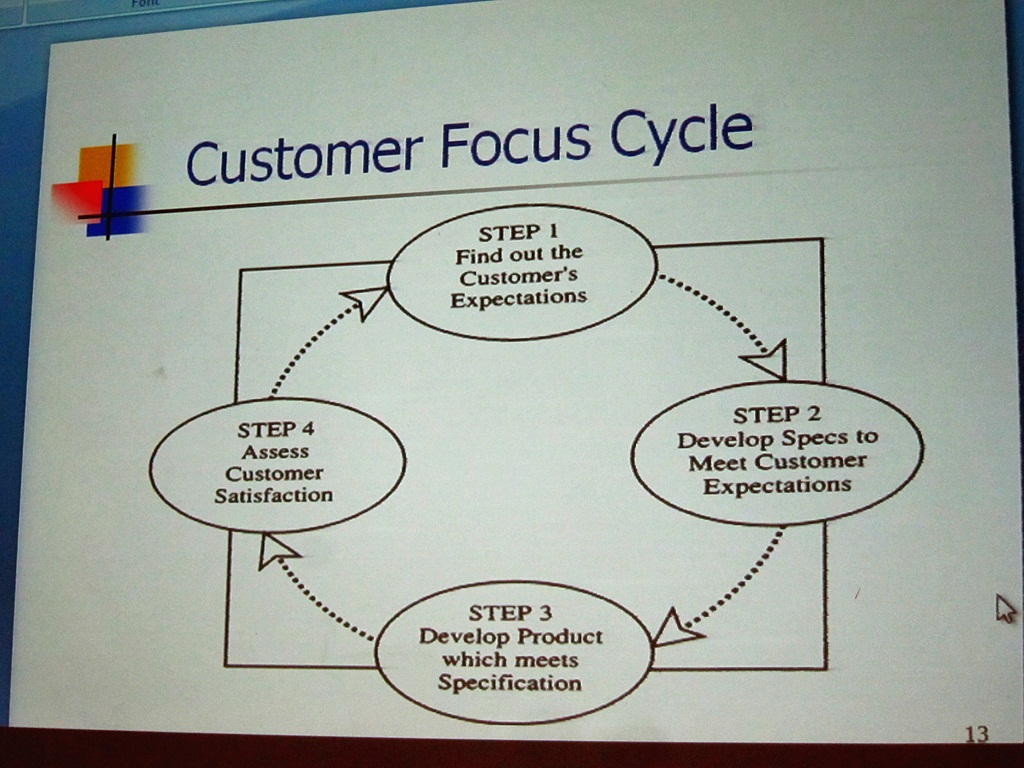
Customer Focus Cycle was introduced for Customer-oriented PD. QFD was employed in the step 2.


The whole process of Customer-oriented PD was showed in the following diagram.

Then Dr. Chin shared two case studies for QFD application experiences included software company and product with technological features. At the end he concluded that "QFD is not an easy process. It takes leadership and determination on the part of many people to dedicate the time and energy needed. But that effort pales in comparison to the effort expended in a poorly planned project."


The third speaker was Dr. Y.K. Chan (Chairman, Six Sigma Institute) and his presentation named "Application of Six Sigma in QFD Projects". Firstly, Dr. Chan introduced the concept of Six Sigma.


Then he briefed the Design for Six Sigma (DFSS) which used to design the product and process to eliminate defects before they occurred. Its structure framework was DMADV (Define, Measure, Analyze, Design and Verify). Moreover, he identified the QFD's position for Business Growth.


After that Dr. Chan introduced the combination of QFD and DFSS through different steps as following diagrams. QFD would be started after the Define Phase of DFSS.


QFD Phase 1 and DFSS Measure Phase: Voice of the customer was tied with measurable solution-independent critical customer requirements into design process.


QFD Phase 2 and DFSS Analyze Phase: Identify product characteristics related to critical customer requirements and then establish relationships, priority and targets of that requirements.


QFD Phase 3 and DFSS Design Phase: The highest priority process characteristics relating to key characteristics of the product design would have been identified and would be focus on any manufacturing process design work.


QFD Phase 4 and DFSS Verify Phase: The key controllable elements relating to the manufacturing process would have been identified and it would be the input of the process control plan.


Dr. Y.K. Chan concluded that QFD translated customer needs and expectations into appropriate design requirements and the results of being customer-driven would achieve total quality excellence.


Dr. Catherine Chan (QFD Black Belt & President, HKQFDA) was the fourth speaker and her topic called "Total Quality Management and QFD".


Firstly, she introduced different TQM approaches included Guru's Advocate, QCC activities, and application of QC & QM tools.


ISO 9001 certification, quality awards and model application were also a common TQM approaches.


Then she briefed three important issues of QFD included:

1. Shifts quality assurance from production planning to product development

2. Attains competitiveness by achieving customer satisfaction

3. Skillfully applies TQM principles and tools

Based on those issues and QFD characteristics such as logically alignment, Vertical & Horizontal Communication, and implementation via projects, she had a confident that QFD could support TQM on meeting today's challenges through innovation.

Finally, Dr. Catherine Chan concluded that QFD was a strategy for sustaining survival and attaining prosperity


Mr. Glenn Mazur (QFD Red Belt, Honorary President, HKQFDA) was the last speaker and his presentation named "Jurassic QFD". It was a very interesting topic.


This talk was related to the movie "Jurassic Park". The aim was to build the most realistic dinosaur ever seen. However, it was met many challenges.


Gemba (現場), observation in the real place, was employed for this project. It was found that 70% of the interaction between small children and animals is at the head and eye contact was essential.


It employed QFD to collect Voice of Customer (VOC) as follow table.


Mr. Mazur said that project was very successful and obtained different awards. One important term emphasized by Mr. Mazur in this topic was "Emotion Quality"!


After presentation of appreciation certificates to speakers, we took a group photo.


HKSQ members took a photo with Prof. Akao.


I took a photo in front of the symposum banner for memory.


Reference:

Hong Kong Quality Function Deployment Association (HKQFDA) - http://www.qfdhk.org/

Six Sigma Institute (SSI) - http://www.sixsigmainstitute.org/

Hong Kong Society for Quality (HKSQ) - http://www.hksq.org/index.asp

The Institute of Purchasing & Supply of Hong Kong (IPSHK) - http://www.ipshk.org/

Hong Kong 5-S Association (HK5SA) - http://www.hk5sa.com/hk5sa/hk5sa.htm


LinkWithin

Related Posts with Thumbnails