顯示包含「ISO 50001」標籤的文章。顯示所有文章

2018年10月26日星期五

HKQAA Seminar on ISO 50001:2018 Energy Management Systems

Hong Kong Quality Assurance Agency (HKQAA) organized the seminar named “ISO 50001:2018 Energy Management System” on 26th Oct 2018. The new version of ISO 50001 Energy Management System (EnMS) standard was released in Aug 2018.  The seminar aimed to discuss how to transite from ISO 50001:2011 to 2018 version and its major difference between these two standards. In addition, guest speaker was invited to share the good practice of energy management so as to enhance sustainability performance.  Before the seminar, I took a photo with Mr. Jacky Yeung who is my old friend in HKQAA more than 15 years!


I also meet Mr. Richard Tse (Former Chairman, MI Division HKIE; Director, Allied Rich Asia Limited) and took a photo for memory too.  Now, he is a professional consultant providing multi-discipline management systems consultancy service.


The first speaker was Ms. Ivy Leung (Manager, Market & Technology, HKQAA) and her topic named “Major Changes and transition to ISO 50001:2018”.  


Firstly she mentioned the model - PDCA Cycle of ISO 50001:2018 in the new version of standard which was similar to ISO 9001:2015 and ISO14001:2015.  The new version of ISO 50001 was followed ISO High-Level Structure. Then Ivy mentioned the change of “Terms and Definition”.  There were 5 old terms removed and 5 new terms added in 2018 version.


2016年2月4日星期四

HKAS ISO 50001 Seminar for Certification Bodies

Hong Kong Accreditation Service (HKAS) organized a training entitled “HKAS ISO 50001 Seminar for Certification Bodies” on 4th Feb 2016. The International Organization for Standardization (ISO) related the international standard ISO 50001 for energy management system (EnMS) as a globally accepted framework for energy management in 2011. In 2014, ISO also released the ISO 50003 on “Requirement for bodies providing audit and certification of energy management systems”.  Before the seminar, we took a group photo with speaker Ms. Deann Desai (Project Manager, Georgia Institute of Technology, USA) and Dr. M.K. Kwok (Senior Accreditation Officer, HKAS).


Dr. M.K. Kwok (Senior Accreditation Officer, HKAS) gave an opening remark and introduced our guest speaker Ms. Deann Desai (Project Manager, Georgia Institute of Technology, USA). Ms. Desai currently served as the administrator and secretary and as an expert for the U.S. Technical Advisory Group for Technical Committee 242 and 257.


In the beginning, Ms. Deann Desai briefed the history of ISO 50001:2011 Energy Management System which had been published on 15 June 2011.  It expected to influence up to 60% of the world’s energy use by energy planning and efficiency.  ISO 50001 is important because of reducing “environmental and societal costs” and enhancing “Energy performance”, “Green House Gas impact”, “Positive contributions toward reducing depletion of energy resources”.


Then Ms. Desai said ISO 50001 provided a framework for energy management using data-driven decision making.  This ISO standard was requested by the United Nations Industrial Development Organization (UNIDO) which had recognized industry’s need to mount an effective response to climate change and to the proliferation of national energy management standards. Then she briefed the summary of ISO Survey 2014 and found that ISO 50001 increase 40% from 2013 to 2014.


Some definitions were reviewed below.
Scope – decisions, activities, and facilities, which are going to be included in the EnMS. (note: can include multiple boundaries)
Boundary – physical, site, or other organizational limits associated with the scope.
Energy consumption – quantity of energy applied (consumed)
Energy use – manner or kind of application of energy (note: ventilation, lighting, heating, cooling, transportation, processes, production lines, etc.)

Continual improvement – recurring process which results in enhancement of energy performance and the energy management system (note: achieve in overall energy performance, consistent with energy policy)


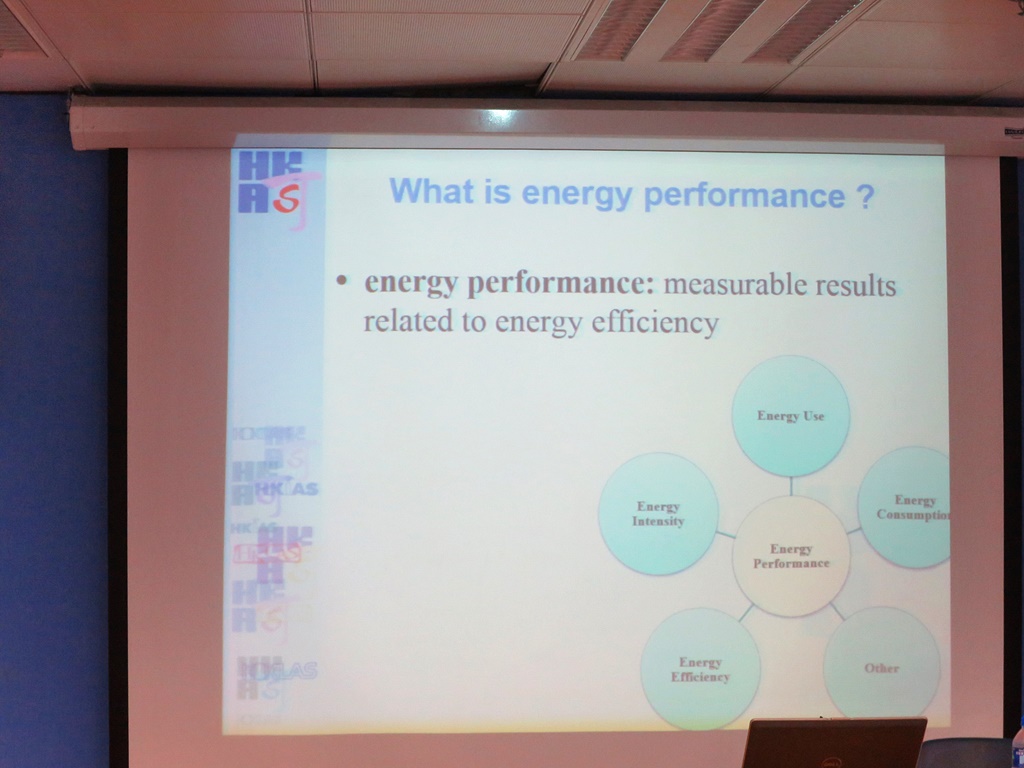
Energy performance – measurable results related to energy efficiency, energy use and energy consumption.

Ms. Desai told me that Energy Intensity was different in different industry and some would use Energy Output / Energy Input or Energy Input / Energy Output or or Energy Use / Product.  For automotive industry, people would ask how many energy consume to build a car.


After that Ms. Desai briefed the ISO 50000 family and their relationship as following diagram.


Some barriers to industrial energy efficiency were showed in the following diagram.  The only solution was that top management need to engaged in the management of energy on an ongoing basis.  Energy efficiency should be integrated into daily management and operational practices.


The core values of Energy Management System were separated into Management System and Energy Performance in diagram below.


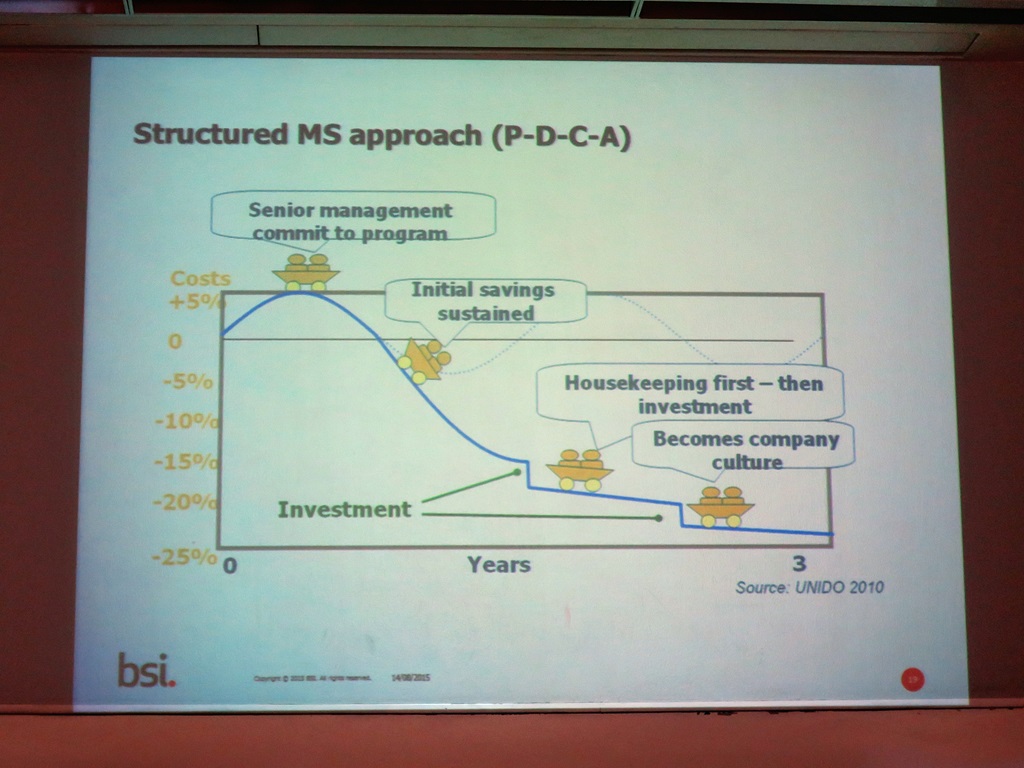
The following diagram showed that the great improvement was found initially but become steady afterward.  However, it could be continual improvement after energy save culture created in the organization.


Energy Planning process included “Legal and Other Requirement”, “Energy Review”, “Baseline”, “EnPI”, “Objectives, Targets, Action Plans” and “Review and Update”.


She said the measurement plan based on “What kind of data I expected to see?” Key characteristics of Energy Performance were briefed.


Finally, she briefed the draft standard of ISO 50002 for Energy Audit and ISO 50003:2014 for requirements for bodies providing audit and certification of EnMS.  Lastly, Ms. Desai introduced ISO 50001 Global Impacts Research Network (ISO 50001 GIRN) and Energy Management Working Group (EMWG) to us.
  
Reference:


2015年8月14日星期五

HKSQ Seminar on Strategic Energy Management (ISO 50001)

Hong Kong Society for Quality (HKSQ), SEEM Dept., CityU, HKIE – MID, TQM and BSI co-organized the seminar named “Strategic Energy Management” on 14th Aug 2015. The Government has announced a new target for all government buildings to achieve a 5% saving in electricity consumption under comparable operating conditions in the coming five year in the 2015 Policy Address. This seminar aimed to share the strategic management approach for conserving energy and reducing cost through facilities operations and energy management leaders. Before the seminar, we took a photo with all guest speakers and organizers.
(Left: Dr. Ken Yau (CityU, HKSQ), Dr. KS Chin (CityU, HKSQ), Mr. Peter Fung (HKSQ), Mr. TO Lee (WSD), Dr. Aaron Tong (HKIE, TQM), Mr. Vincent Cheng (TQM, HKSQ), Mr. Stephen Yu (BSI) and I (HKSQ))


In the beginning, Dr. Aaron Tong (Former Chairman, HKSQ & HKIE-MIE; Managing Director of TQM) presented the appreciation certificates to our guest speakers and took a group photo.
(Left: Dr. Patricia Cheung, Mr. TO Lee, Dr. Aaron Tong, Mr. Vincent Cheng and Mr. Stephen Yu)


The first speaker was Ir. Dr. Aaron Tong (Managing Director & Principal Consultant, TQM) and his presentation topic was “Highlighted on HK Energy Saving Initiatives”. Dr. Tong reviewed the rising of energy cost and climate change. He said that both consumers and citizens were increasingly environmentally conscious. Then Government formulated the Buildings Energy Efficiency Ordinance (Cap. 610) to promote energy efficiency. So that implementation of Energy Audit and Energy Management would be a trend.


Then Dr. Aaron Tong introduced the Cap 176 in Policy Address that Government set a new target of achieving a 5% saving in electricity consumption for government buildings and energy audits would be conducted for major government buildings, as well as, fostering a low-carbon and livable built environment so as to reduce Hong Kong’s overall electricity demand. Three steps to reduce energy consumption were: i) Energy Audit on EnMS, ii) Implementing Solution of Energy Saving and iii) Save Energy, Save Cost.


The second speaker was Mr. TO Lee (Chief Engineer, Water Supplies Department, HKSAR) and his topic entitled “Experience Sharing: Energy Management System (EnMS) in Water Supplies Department”. Firstly, Mr. Lee introduced two key objectives of WSD below:
i) To align WSD’s energy management system with the international best practices.
ii) To formalize and rationalize our existing energy management strategies and practices to further improve our energy efficiency, save energy cost and reduce carbon emission.


Then Mr. Lee introduced their energy management jour to us since 1998 because they were top 3 electricity consumer in Hong Kong and the highest among government departments (In 2013/14, about 25% of the total consumption of HKSARG). The following chart demonstrated the top usage of energy was related to water pumping (upto ~91%).


Before the ISO 50001 implementation, they formed Energy Management Committee (EMC) in 1998 and then transferred to Energy and Emission Management Committee (EEMC) in 2008. Last year, they achieved ISO 50001 certification. Their EnMS structure was shown in the following diagram.


After the analysis the energy usage distribution, Mr. Lee initiated several energy saving measures.
i) Promotion of water conservation in the community
ii) Timely maintenance and replacement of M&E equipment
iii) Life-cycle costing methodology for planning, design and procurement
iv) Close monitoring of plant conditions and energy performance
v) Use of energy efficient M&E equipment
vi) Energy auditing for major assets and green housekeeping offices and installations
So far, WSD achieve to save 13.2% per unit electricity consumption and 7.0% per capita electricity consumption.


Some Energy Performance Indicators, Energy Baseline and Energy Target were discussed. Mr. Lee said the baseline development was referred to the past ten years and selected the worse performance year as baseline. Finally, he shared three successful factors included “Senior Management Commitment”, “Energy Data Collection and Analysis” and “Making Energy Saving a Culture”. At the end, he quoted from anonymous author statement as conclusion that “Every accomplishment starts with the decision to try”.


The third speaker was Mr. Vincent Cheng (Consultant, TQM Consultants Co., Ltd.) and his presentation named “Setting up an Effective Energy Management System”. In the beginning, Mr. Vincent Cheng briefed us how to start EnMS and he suggested to seek top management commitment. There were several factors attracting top management such as reduction of carbon emission, good corporate citizen, improving corporate image, but the most important was saving money.


Then Vincent briefed to build a team included team leader and members. One new concept introduced was “Energy Warden”. The concept was transferred from Fire Warden who is a person employed to prevent or extinguish fires. Therefore, Energy Warden is a person employed to prevent wasting the energy (save energy).

In order to establish EnMS, Energy Policy should be defined first. The second thing was review legal and other requirements. Some energy related legislations in HKSAR were shown below:
- Cap 610 – Building Energy Efficiency Ordinance
- EMSD Code of Practice for Energy Efficiency (2005 Edition and 2007 Edition)
- Cap 598 – Energy Efficiency (Labelling of Products) Ordinance
- Cap 51 – Gas Safety Ordinance
- Cap 311L – Air Pollution Control (Motor Vehicle Fuel) Regulation
- Cap 311Y – Air Pollution Control (Marine Light Fuel) Regulation
- Technical Circular on Green Government Building (DevB TC 2/2015, EB 3/2015)

The most important part of ISO 50001 was Energy Review. It needed to identify energy sources (e.g. electricity, towngas, diesel, gasoline, etc.) and use (e.g. Lighting, Air Con, HVAC, etc.) and then formed the Energy Baseline. After review, we needed to identify the Significant Energy Use (SEU) included facilities, equipment, systems processes, personnel to be affected, as well as relevant variables (e.g. weather) and current energy performance related to SEUs. The following diagram demonstrated some examples of Energy Performance Indicators (EnPIs).


Vincent also showed some examples of Energy Objectives and Targets that Objectives could be qualitative but Targets should be quantitative. At the end, Vincent concluded that “Climate change is the biggest challenge to human being. Let’s do something for our next generations rather than leaving a broken earth for them to heal.”


The last speaker was Ir. Stephen Yu (Client Manager cum Compliance & Risk Manager, BSI) and his presentation topic was “Sharing the ISO 50001 Certification Process”. Firstly, he quoted the humanity’s top ten problems for next 50 years in which Energy was ranked number ONE. (Sequence: Energy, Water, Food, Environment, Poverty, Terrorism & War, Disease, Education, Democracy, and Population)


The summary of BS ISO 50001 EnMS and its Model were briefed and showed in the following diagram.


Then Stephen shared some technical challenges he met before such as Chillers running at low efficiency, procurement for energy policy insufficient implemented, method of verification of energy objectives & target unclear, etc. A structured EnMS approach under PDCA could continual improve energy performance and built the company culture on energy management. Finally, he summarized that certification of ISO 50001 enabled these organizations to demonstrate their commitment to energy management best practice.


Q&A Session


Reference:
HKSQ - www.hksq.org
SEEM, CityU – http://www.cityu.edu.hk/seem/
HKIE-MI Division – http://mi.hkie.org.hk/

ISO 50001 related seminars:
20140224: HKCTC Seminar on ISO 50001 EnMS and Certification - http://qualityalchemist.blogspot.hk/2014/02/hkctc-seminar-on-iso-50001-enms-and.html
20130808: HKQAA Seminar on Application of ISO 50001 in Construction Projects - http://qualityalchemist.blogspot.hk/2013/08/hkqaa-seminar-on-application-of-iso.html
20120709: ISO 50001 Energy Management System (EnMS) Awareness Training - http://qualityalchemist.blogspot.hk/2012/07/iso-50001-energy-management-system-enms.html
20120811: HKQAA Seminar - Laterest Developments in Energy Efficiency Enhancement - http://qualityalchemist.blogspot.hk/2012/08/hkqaa-seminar-laterest-developments-in.html
20120413: Seminar on Low Carbon Trends in Hong Kong Construction Industry - http://qualityalchemist.blogspot.hk/2012/04/seminar-on-low-carbon-trends-in-hong.html
20101114: Introduction of Upcoming Energy Management System Development - http://qualityalchemist.blogspot.hk/2010/11/introduction-of-upcoming-energy.html


2014年2月25日星期二

HKCTC Seminar on ISO 50001 EnMS and Certification

The Seminar on ISO 50001 Energy Management System (EnMS) and Certification was co-organized by the Hong Kong Council for Testing and Certification (HKCTC) and Hong Kong Accreditation Service (HKAS) on 25 Feb 2014. This seminar aimed to share the concepts of ISO 50001 EnMS and relevant certification as well as some success stories in Housing Department and Science Park.

In the beginning, Prof. Paul Lam (Convener, Panel on Promoting Testing and Certification Services in Environmental Protection Trade, HKCTC) gave an welcome remarks. Prof. Paul Lam briefed how important of energy saving and mentioned ISO 50001 which was compatible with ISO 9001 and ISO 14001.


Then a group photo was taken.


The first speaker was Ms. Jessica Chan (Senior Consultant, HKPC) and her presentation topic named “Enhancing Energy Efficiency within an Organization: Setup of ISO 50001 Energy Management System”. The content included "Why Energy Management", "Overview of ISO 50001 Standard" and "Key steps and tips of setting up an EnMS".


Jessica explained the different between Energy Conservation and Energy Management. Energy Conservation was a project-by-project approach but Energy Management was continual improvement system in energy performance. ISO 50001 published in June 2011 and designed maximum compatibility with ISO 9001 and ISO 14001 common elements. The following diagram showed the latest trend of ISO 50001. Hong Kong has 4 certificates until 2012. (It should be more now.)


Then Jessica introduced the PDCA Cycle and its tips on implementation below:
For Energy Planning, energy profile should be developed through comprehensive energy audit and determined the evaluation period. After analysis, it identified current energy sources. Then it should create a detailed equipment list with energy loads breakdown for identifying the areas of Significant Energy Use (SEU) and prioritizing opportunities for improving energy performance.
For Implementation and Operation, Staff competence should be ensured through training on energy management and assessment. And then formulating criteria in the procurement of energy services, products, equipment and energy.
For Checking, it should define an energy measurement plan and periodically review.
(Details in the "Guidebook for ISO 50001 Energy Management System" and recommended to use the Self Evaluation Checklisk)

The second speaker was Ir. Vincent C.Y. Kong (Sustainability Manager of Global Products and Services, SGS Hong Kong) and his presentation entitled “ISO 50001 Energy Management System and Certification”. He explained the benefits of EnMS such as cost control & saving on energy use, improving energy use & efficiency, reduction of GHG emission & environmental impact, etc.


Ir. Vincent Kong said ISO 50001 separated into Management and Technical elements in each stage of PDCA cycle. For Energy Planning Process, energy review was critical and some examples were demonstrate such as energy use register and prioritization ranking. After that energy objectives, targets and action plan were identified.


Finally, he briefed a series of ISO 50001 standard under ISO/TC242 (Energy Management) development included ISO/DIS 500-02/-03/-04/-06/-15.

The third speaker was Dr. Kwok Moon-keung (Senior Accreditation Officer, HKAS) and his presentation was “HKAS - How its Services Help you?”. Firstly, Dr. Kwok introduced "What is Certification and Accreditation?"


Then Dr. Kwok mentioned the ISO 50001 Plan-Do-Check-Act model as following diagram. Until now, six companies were certified ISO 50001 in Hong Kong and they were "Hong Kong Science and Technology Parks Corporation (HKSTPC)", "Housing Department, Development and Construction Division", "International Commerce Centre (ICC), Hong Kong", "Fuji Xerox, Hong Kong", "SOCAM Development Ltd." and "Vermont Marine Bunkering Ltd.".


After that Dr. Kwok introduced HKAS, their system and international cooperation. HKAS has 86 MRA/MLA partners in 68 economies that certification bodies were benefits through HKAS accreditation.


During the break, I took a photo with Prof. Paul Lam and two students for memory. Mr. Tony Chung and Ms. Fay Lo were BSc in Environmental Science and Management in CityU and they had attended my course named "Quality Management for Laboratory" in 2005. In addition, we all were Prof. Paul Lam's student.

(Left: Mr. Tony Chung (Env Mgr, Gammon), Prof. Paul Lam, Ms. Fay Lo (Ass Mgr, EHS, Inchcape) and I)


The forth speaker was Dr. Mckey Ho (Structural Engineer, Housing Department) and his topic entitled "ISO 50001 EnMS and Certification: Application in Public Housing and Construction Sites". Firstly, Dr. Ho introduced two types of Energy in Public Housing Development and they were "Energy in Use" and "Embodied Energy" (process, transporting, during construction and demolition).


Dr. Ho told us to focus on the scope and boundary of ISO 50001 certification. Then he demonstrated their boundary statement "Confined to communal area of domestic building blocks of both public rental housing and new Home Ownership Scheme". After analyzed energy use and consumption (See diagram below), they identified "Significant Energy Use" (SEU) that was Lighting.


Then Dr. Ho explained three means for improving energy performance:
1. Use of energy efficiency products
2. Administrative procedures
3. Optimize the energy source
After that he showed the energy baseline calculation and obtained 30kWh/m2/Annum in 2011. He also shared the target to be set 10% reduction of 2011 energy base line value by 2014. They planned to use LED bulkheads in 2012 but the light intensity would be decay upto 30% after a year use. Therefore, they revised action plan such as optimizing the number of lighting fittings, adopting regenerative power for lift motors and more energy-efficient gearless type lift system, so as to achieve their target in 2014.


Finally, Dr. Ho mentioned ISO 50001 certification requirements for HA listed contractors included Buildings (New Works Category) and Piling Contractors. The requirement was effective on 1 January 2014 and the grace period for existing listed contractors was 2 year (upto 31 Dec 2015).

The final speaker was Mr. Nelson S.L. Ho (Senior Manager, Facilities Management, HKSTPC) and his presentation was "Profit from Energy Management through ISO 50001 Certification - Experience Sharing by HKSTPC". He introduced HKSTPC achieved the first ISO 50001 certification in Hong Kong in 2011.

Nelson said before ISO 50001 certification, their energy saving upto 18% since 2005. Therefore, the saving target was very difficult to set high during implementation of ISO 50001. In the beginning, the scope was set in the headquarter - Bio-Informatics Centre.


Then Nelson showed the comparison of Actual consumption against Energy Baseline for Building Services from Apr 2011 to Mar 2012. It was found that energy saving in headquarter building was upto 9.5% reduction! For other building, those in Phase 1 was saving 2.42% and Phase 2 was saving 1.93% energy from 2010/11 to 2011/12.


After that the ISO 50001 scope was extended to another Building (namely Green 18) in 2012 and to be certified another two buildings in 2014. The ultimate goal was to certify the whole Park with ISO 50001. The energy reduction roadmap from 2013 to 2030 were briefed.


Q&A session


Reference:HKCTC - http://www.hkctc.gov.hk/en/about.html
HKAS - http://www.itc.gov.hk/en/quality/hkas/about.htm
HKSTP - http://www.hkstp.org/

ISO 50001 related seminars:
20130808: HKQAA Seminar on Application of ISO 50001 in Construction Projects - http://qualityalchemist.blogspot.hk/2013/08/hkqaa-seminar-on-application-of-iso.html
20120709: ISO 50001 Energy Management System (EnMS) Awareness Training - http://qualityalchemist.blogspot.hk/2012/07/iso-50001-energy-management-system-enms.html
20120811: HKQAA Seminar - Laterest Developments in Energy Efficiency Enhancement - http://qualityalchemist.blogspot.hk/2012/08/hkqaa-seminar-laterest-developments-in.html
20120413: Seminar on Low Carbon Trends in Hong Kong Construction Industry - http://qualityalchemist.blogspot.hk/2012/04/seminar-on-low-carbon-trends-in-hong.html
20101114: Introduction of Upcoming Energy Management System Development - http://qualityalchemist.blogspot.hk/2010/11/introduction-of-upcoming-energy.html


LinkWithin

Related Posts with Thumbnails