2020年9月9日星期三

Chartered Quality Institute (CQI) AGM 2020

"Chartered Quality Institute AGM 2020 " was held on 9th Sep 2020. In the beginning, Mr. Vincent Desmond introduced Mr. Ian Mitchell (Chair of the Board of Trustees) to lead the AGM.

Mr. Ian Mitchell briefed the AGM agenda and rules of AGM. 
1.      To receive the minutes of the 13th AGM held on 11 September 2019.
2.      To receive the annual accounts for the year ending 31 December 2019.
3.      To receive and adopt the annual report of the Board of Trustees for the year ending 31 December 2019
4.      To confirm the appointment of the Institute’s auditors until the next AGM and to authorize the Board to fix their remuneration.

Then Ms. Hannah Kingsley continued the remaining agenda items.  She concluded that it was a successful financial year in 2019. 


Q&A Session
Mr. Ian Mitchell briefed CQI continual improvement such as member portal in 2019. Then he mentioned the challenge of COVID-19.  For example, they developed online member platform.
Mr. Vincent Desmond described CQI continuity plan including online audit.  And he discussed about Quality 4.0 that could be related to digitalization.


Reference:
CQI-HK - http://www.thecqi.org.hk/
CQI-UK - http://www.thecqi.org/
20121106: CQI Seminar on "Life after Quality" - https://qualityalchemist.blogspot.com/2012/11/cqi-seminar-on-life-after-quality.html
20130708: CQI Seminar "Quality is a Matter of Life or Death" - https://qualityalchemist.blogspot.com/2013/07/cqi-seminar-quality-is-matter-of-life.html
20140714: IRCA & CQI Seminar on Risk Based Audit - https://qualityalchemist.blogspot.com/2014/07/irca-cqi-seminar-on-risk-based-audit.html
20140426: CQI Site Visit to HK-ZhuHai-Macao Bridge - Reclamation Work - https://qualityalchemist.blogspot.com/2014/04/cqi-site-visit-to-hk-zhuhai-macao.html
20150608: Seminar on Enhancing Brands for Overseas Markets - https://qualityalchemist.blogspot.com/2015/06/seminar-on-enhancing-brands-for.html
20160531: IuPDI Seminar on SME O2O Business Transformation - https://qualityalchemist.blogspot.com/2016/05/iupdi-seminar-on-sme-o2o-business.html
20160514: The International Academy for Quality (IAQ) General Meeting and Dinner - https://qualityalchemist.blogspot.com/2016/05/the-international-academy-for-quality.html
20200714: CQI Webinar - Risks ain't wot they used t'be - https://qualityalchemist.blogspot.com/2020/07/cqi-webinar-risks-aint-wot-they-used-tbe.html
20200728: CQI Webinar – Dare to think: guidelines for the effective quality manager - https://qualityalchemist.blogspot.com/2020/07/cqi-webinar-dare-to-think-guidelines.html

2020年9月6日星期日

Extenics Channel: Class 30 – Superiority Evaluation Method

Extenics Channel is a new YouTube Channel for promoting Extenics and issued on 12th Feb 2020. It separated into three video list for Cantonese, English and Mandarin.  Class video will be uploaded at least once per week. Each video contains one article of my book to promote the Extenics and Extension Innovation Method. 

可拓頻道 Extenics Channel (English)

Class 30 Superiority Evaluation Method

Introduction to the last step of 4-steps Extension Innovation Method - Superiority Evaluation Method

https://www.youtube.com/watch?v=5UBiJzay2Cc

可拓頻道 Extenics Channel (Cantonese)

第三十集 優勝劣敗

介紹可拓創新四步法的第四步:優度評價方法

https://www.youtube.com/watch?v=IxtlI0XNCWE

可拓頻道 Extenics Channel (Mandarin)

第三十集 优胜劣败

介绍可拓创新四步法的第步:优度评价方法

https://www.youtube.com/watch?v=wIQupgyc_a0

可拓頻道 Extenics Channel – Video Play List

https://www.youtube.com/channel/UC6S_oALZVBluJ7cnbE6ub0A/playlists

2020年9月4日星期五

SGS Lunch-and-Learn Webinar - Agile Organization

SGS cooperated with InfoWorks Institute to run lunch-and-learn series which aimed to share the business transformation trend of the future of work.  Dr. David Mui was the speaker and shared the topic “Agile Organization”. It is the third class of Management Shift for Industrial 4.0 Series.  The content included Agility Organization, Agile Culture and Work Practices.


Firstly, Dr. Mui briefed some companies employed agile approach such as Netfix, Cisco, Payme and Lego.  Then he described Lego case and its benefits on implementing Agile included fast decision making, transparency, empowerment, identifying dependencies & complexity, and socializing.


So that Dr. Mui summarized the end results of business agility such as deep understanding of customer requirement, create values for customer, repid execution and product development … etc.


And then he introduced the Agile Organizations with Agile Team, Scrum Master and Product Owner (mentioned in last webinar).  Product manager to be product owner and communicated with other teams. Many different terms could describe Agile Organization such as Adaptive, Flexible, Nimble, Swift, Responsive, Lean, Athletic, Energetic, Frisky, Limber, Lithe, Lively, Quick, Rapid, Sharp, Spirited, etc.


After that Dr. Mui discussed organizational design for Agile that should be Customer Centric.  He compared the characteristics of Traditional and Agile Organizations in the following table. There are some successful factors and they are:
-          Visualization
-          Co-location or high connectivity of the team
-          Storytelling
-          Flexible office setting
-          Lean in all
-          Elimination or automation of administration activities


For Organizational Culture, Dr. Mui stated four functions including Sens Making Device, Organizational Identity, Collective Commitment and Social System Stability.  Then he showed the Agile Culture Elements.


Finally, Dr. Mui introduced Four Agile Manifesto Value and 12 Principles.  The four values are showed as follows:
-          Individual and interactions over processes and tools
-          Working software over comprehensive documentation
-          Customer collaboration over contract negotiation
-          Responding to change over following a plan
12 Principles of Agile demonstrated in the following diagram.


Lastly, Dr. Mui introduced 12 Agile Cultural Attributes and they were Personal Agility, Customer Focused, Simplicity, Flexibility, People-Centric, Honest & Direct Communication, Collaboration, Retrospective, Quality Throughout, Fast Execution, Swarming and Continuous Learning.


At the end, he proposed a roadmap to established Agile Organization and started from Visualize Strategic Intent to Co-create Possible Solutions to Ecosystems Partnerships to Sequencing and Organizing for Delivery to Continuous Value Creation and then to Strategic Organizational Retrospective.


Reference:
20200821: SGS Lunch-and-Learn Webinar - Management Shift for Industrial 4.0 Series - https://qualityalchemist.blogspot.com/2020/08/sgs-lunch-and-learn-webinar-management.html
2020828: SGS Lunch-and-Learn Webinar - Agile Approach to Business - https://qualityalchemist.blogspot.com/2020/08/sgs-lunch-and-learn-webinar-agile.html

2020年9月3日星期四

Extenics Channel: Class 29 – Conjugate Transformation

Extenics Channel is a new YouTube Channel for promoting Extenics and issued on 12th Feb 2020. It separated into three video list for Cantonese, English and Mandarin.  Class video will be uploaded at least once per week. Each video contains one article of my book to promote the Extenics and Extension Innovation Method. 

可拓頻道 Extenics Channel (English)
Class 29 Conjugate Transformation
Introduction to the third step of 4-steps Extension Innovation Method - Conjugate Transformation


可拓頻道 Extenics Channel (Cantonese)
第二十九集 太極轉關
介紹可拓創新四步法的第三步:共軛變換


可拓頻道 Extenics Channel (Mandarin)
第二十九集 太极转关
介绍可拓创新四步法的第三步:共轭变换


可拓頻道 Extenics Channel – Video Play List

2020年9月2日星期三

ESG Online Seminar – The Strategy of Experimentation – Motivating Your Teams for Innovation and Ownership

The Executive Study Group (ESG) online seminar named “The Strategy of Experimentation – Motivating Your Teams for Innovation and Ownership” was held by the ESG, Asia Pacific Institute for Strategy Limited (APIFS) on 2nd Sep 2020. It is first time I attended the ESG online seminar during COVID-19 period.  In the beginning, Dr. Mark Lee briefed that this year is the 10th anniversary of Asia Pacific Institute for Strategy Limited (APIFS). Then he briefed the history and goal of APIFS.


Dr. Mark Lee briefed the content including “The Strategy of Experimentation”, “Ownership & Strategy”, “Risk and Experimentation”, “Entrepreneur Mindset” and “Execution Strategies”.  I summarized some key points for sharing below.


Firstly, Dr. Lee briefed how success of Amazon (based on their rapid increase of stock market price) and then described how Amazon become the world’s most innovative company because they encouraged relentless bottom-up experimentation.


Then he quoted Jeff Bezos definition on experiments that “If you know in advance something is going to work, it’s not an experiment.”   Moreover, Jeff said their success depended on how many experiments they did per year, month, week and day.  One of example is showed on their package of good named “Amazon Frustration-Free Package” that is more environmental and convenience for customer.


Dr. Lee raised a first poll and got the result that most company seldom conduct business experiment.


Another example he raised was junior staff opinion was not accepted by VP in Marketing.  Greg Linden was that staff in the past and then joined Amazon.  His experiment based on data to offer every customer an assortment of items uniquely tailored to their preferences that got very success in Amazon.  Then Poll 2 survey the senior management believed on tradition way or data way. It was found more event distribution.


2020年8月30日星期日

CAAI Chinese Congress on Artificial Intelligence 2020 (中国人工智能大会) - Day 2

The 6th Chinese Congress on Artificial Intelligence (CCAI2020) which was led by Chinese Association for Artificial Intelligence (CAAI), was held on Aug 29-30, 2020, in Nanjing, China. Since COVID-19 affected globally, the Congress was run both online and offline. The frame of congress named Intellectual Know for Everything (智周万物).  I was committee member of the CAAI Extenics Professional Committee (中國人工智能學會可拓學專業委員會) attended the congress online in this time.  


Day 2 (30 Aug 2020):
In the beginning, Prof. Yang Qiang (杨强 - CAAI名誉副理事长,微众银行首席AI) chaired the Morning session for keynotes.  


The first speaker was Prof. Yolanda Gil (人工智能促进会现任主席,南加州大学信息科学研究所科研副主任) and her topic was “Thoughtful Artificial Intelligence: Forging a New Partnership for Data Science and Scientific Discovery”. Firstly, she briefed AI application had separated into Data Thread and Knowledge Thread.  


Prof. Gil discussed four main points in this talk including Knowledge Technology, AI and its interdisciplinary frontiers and Thought AI. 


Then she mentioned the Thoughtful AI using the photo of Freestyle Chess Champion Anson Williams and quoted Gary Kasparov (2010) statement that “Weak human + machine + better process was superior to a strong computer alone and, more remarkably, superior to a strong human + machine + inferior process.”  And then she explained seven Thoughtful AI principles. 
i)                    Rationality Principle – From knowledge to behavior
ii)                  Context Principle – Capture the purpose and significance of tasks
iii)                Initiative Principle – Self-driven learning from the scientific record or through independent inquiry
iv)                Network Principle – Seek resources from a knowledge web of the scientific record
v)                  Articulation Principle – Communicating findings to different audiences and respond but also ask and discuss.
vi)                Ethical Principle – Behavior that conveys awareness of scope and limitations
vii)              Systems Principle – Compositionality, abstraction, connectivity


At the end, Prof. Yolanda Gil gave conclusion on Thoughtful AI in the following four points:
i)                    Knowledge technologies are increasing important.
ii)                  AI offers systematic, correct, unbiased approaches and rigorous reporting.
iii)                AI will excel at assembling fragmented knowledge about complex systems and pursue interdisciplinary frontiers.
iv)                Thoughtful AI will exploit knowledge technologies for effective human-AI partnerships.


The second speaker was Dr. Ming Zhou (周明 - 微软亚洲研究院副院长) and his presentation was “Pre-trained Models in Multi-Lingual and Multi-Modality Tasks” (预训练模型在多语言、多模态任务的进展). 


Firstly, Dr. Zhou explained the pre-trained model concept and its application such as for text, auto-encoding, classification, question-answering … etc.  Then he explained why pre-trained models need as follows:
i)                    Pre-trained models embed task-agnostic general knowledge.
ii)                  Pre-trained models transfer learnt knowledge to downstream tasks.
iii)                Pre-trained models supports almost all NLP tasks with state-of-the-art results.
iv)                Provide a scalable solution to various applications.


After that he briefed pre-trained models in multi-lingual tasks and multi-modality tasks.  And they got a good evaluation results.


Finally, Dr. Zhou summarized their future works included pre-trained models in NN-NLP and explore new tasks, model architectures and empowered with interpretation mechanisms to NN-NLP.


2020年8月29日星期六

CAAI Chinese Congress on Artificial Intelligence 2020 (中国人工智能大会) - Day 1

The 6th Chinese Congress on Artificial Intelligence (CCAI2020) which was led by Chinese Association for Artificial Intelligence (CAAI), was held on Aug 29-30, 2020, in Nanjing, China. Since COVID-19 affected globally, the Congress was run both online and offline. The frame of congress named Intellectual Know for Everything (智周万物).  I was committee member of the CAAI Extenics Professional Committee (中國人工智能學會可拓學專業委員會) attended the congress online in this time.  


Before the congress, a video was played to introduce the CCAI 2020 (https://youtu.be/Yqk9YSY0rH8). 


Day 1 (29 Aug 2020): (Opening Session)
In the beginning, Prof. Zhou Zhihua (周志华 – CAAI副理事长, 南京大学计算机系主任, 人工智能学院院长) chaired this session and he introduced today’s guest speakers.  


Prof. Dai Qionghai (戴琼海 - CAAI理事长,中国工程院院士,清华大学信息学院院长) gave guest speech.  Prof. Dai said CCAI 2020 as one of the largest official AI conferences in China, CCAI has been held annually to promote the advancement of artificial intelligence globally.  He appreciated all co-organizers and supporting organizations.  


 Mr. Xu Chunsheng (徐春生江苏省科学技术协会副主席) gave a guest speech and he said Jiangsu Province enhanced the development on AI including industry and education. He expected they could achieve the AI demonstration province in 2025.


Mr. Liang Aiguo (梁爱国 - 南京市建邺区副书记) gave a guest speech.  He welcome all guests in Jianye District, Nanjing.  CCAI as AI platform would enhance AI development in Jianye District.  


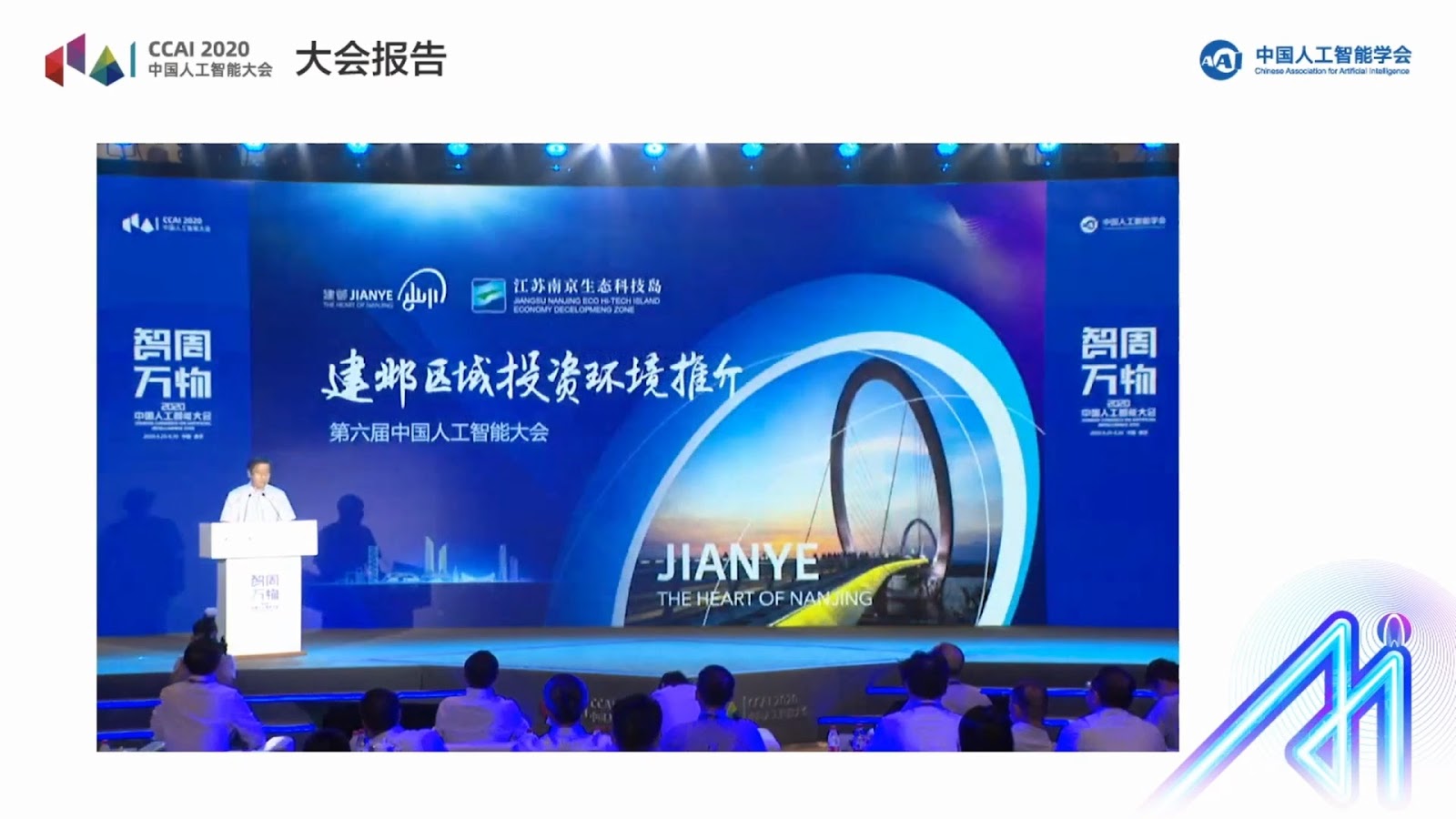
Then Mr. Yang Bo (杨波 南京市建邺区政府副区长, 建邺高新区党工委书记) gave an introduction speech for investment and environment in Jianye District, Nanjing.  Jiangsu Nanjing Eco Hi-Tech Island Economy Development Zone (江苏南京生态科技岛) was introduced at the end. 


After that Prof. Ye Jieping (叶杰平滴滴出行副总裁, 滴滴AI Labs 负责人, 密西根大学教授) chaired the keynotes session.


The first speaker was Prof. Yoshua Bengio (加拿大蒙特利尔大学教授,2018年图灵奖获得者,蒙特利尔学习算法研究) and his topic entitled “Deep Learning: from System 1 to System 2”.  Firstly, Prof. Bengio briefed the neural net approach to AI including Brain-inspired.  He said not copy brain but inspired by brain to AI.


Then he quoted the concept of System 1 and System 2 in the book “Thinking, Fast and Slow” to explain the cognition. 


And then he continued to explain all items inspired by human cognition one by one.  Prof. Bengio added consciousness from humans reporting such as high-level representation (e.g. language) and high-level concepts (e.g. tie system 1&2) and needed to understand grounded language learning (e.g. BabyAI).  


Finally, Prof. Bengio concluded we have a responsibility that ML going out of labs, into society and considered society impact.


The second speaker was Prof. Yang Qiang (杨强 - CAAI名誉副理事长,微众银行首席AI) and his topic named “The latest development of Federated Learning” (联邦学习最新进展).  He said AI power come from Big Data that increasing of Data caused error reducing and accuracy increasing every year. 


Then Prof. Yang Qiang said many small data as an island which were not able to contribute for AI model.  Therefore, Federated Learning could overcome this problem to consolidate those small data without losing their privacy information (e.g. GDPR violations).  He added that Data did not move but model move!


And then he briefed the data privacy development in Shenzhen that those rules become strict. 


2020年8月28日星期五

SGS Lunch-and-Learn Webinar - Agile Approach to Business

SGS cooperated with InfoWorks Institute to run lunch-and-learn series which aimed to share the business transformation trend of the future of work.  Dr. David Mui was the speaker and shared the topic “Agile Approach to Business”. It is the second class of Management Shift for Industrial 4.0 Series.  The content included Business Agility Domains, Agile Team and Agile Leadership.


Firstly, Dr. Mui introduced 5 Business Agility Domains from Business Agility Institute.  He quoted the statement to explain that “The purpose of this model is to show you what to strive for and how to get started. These are essential building blocks for agile organizations.”


Then Dr. Mui explain domains one by one below.
Domain 1 – The Core is Customer.
Domain 2 – Relationship: Board, Partners and Workforce.
Domain 3 – Leadership: Strategic Agility, One Team and People Management.
Domain 4 – Individuals: Ownership & Accountability, Growth Mindset and Graft Excellence.
Domain 5 – Operations: Structural Agility, Enterprise Agility and Process Agility.
And then he stated different phases of Agility Adoption from personal to one team to one function to multiple function to organization and finally become organization DNA.  He added “Startups have an advantage of agility adoption.”


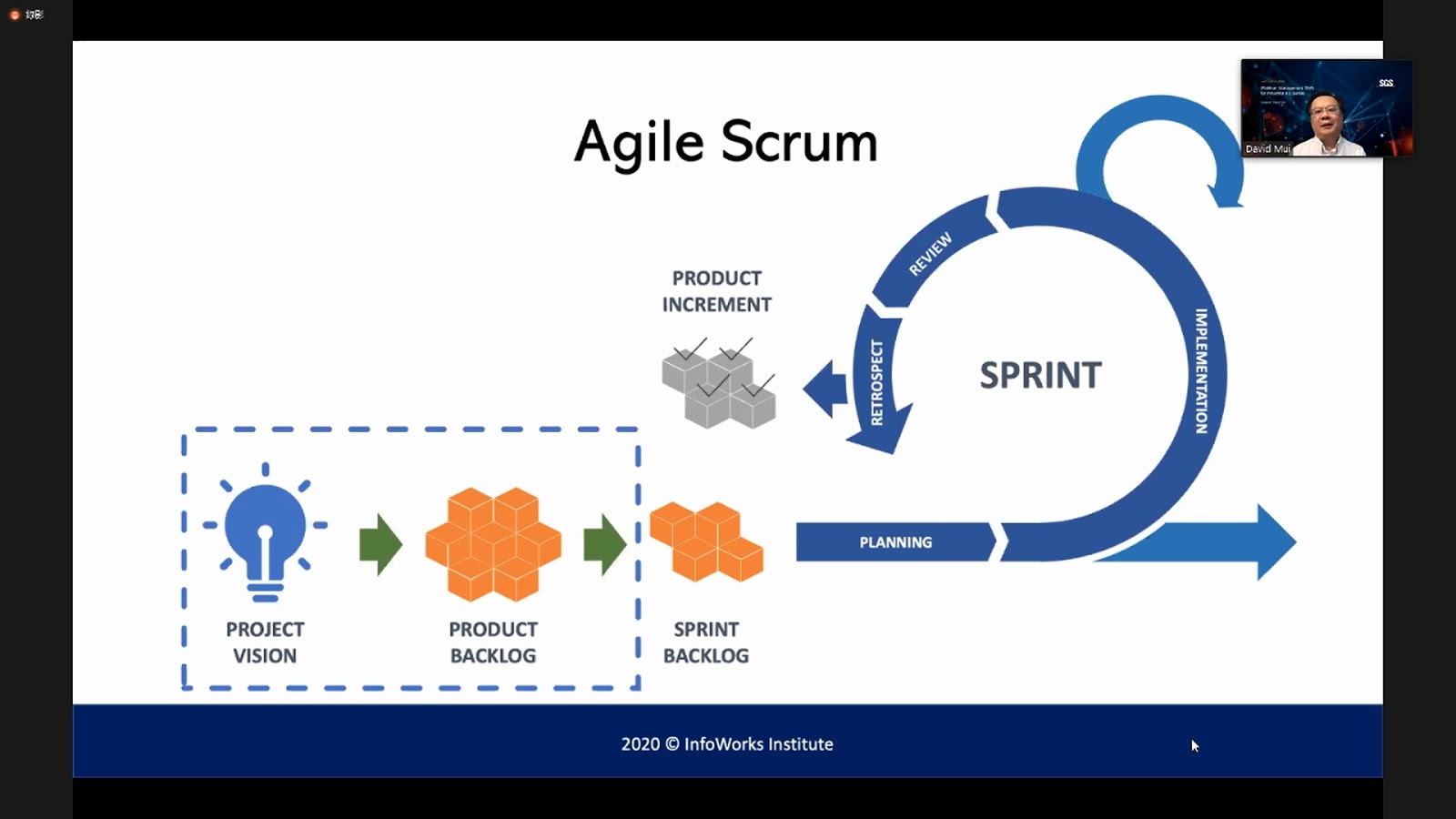
After that he introduced Agile Team that team would employ Agile Scrum process.  The core of Scrum team that separated jobs into small tasks under Sprint (task short cycle to create prototype). Sprint cycle usually defined as 2 week for IT project.


The role of Agile Team included Team members, Scrum Master and Product Owner.  Where Scrum Master worked as coacher / facilitator in the team.


Dr. Mui compared the different between tradition team and Agile team in the following table. 


Finally, Dr. Mui introduced Agile Leadership and its different roles.


The comparison between Traditional Leadership and Agile Leadership was showed and it obviously changed from top-down approach to bottom-up approach.


Q&A Session:
I asked what is the different between Agile and traditional QA such as Scrum Master vs Quality Facilitator, Sprint vs PDCA.  Dr. David Mui said Scrum Master was focused on coaching and Sprint was similar to PDCA but using new terms for organization transformation / change.


Reference:
20200821: SGS Lunch-and-Learn Webinar - Management Shift for Industrial 4.0 Series - https://qualityalchemist.blogspot.com/2020/08/sgs-lunch-and-learn-webinar-management.html

LinkWithin

Related Posts with Thumbnails