2011年4月21日星期四

CAQ & HKSQ meeting in HKUST

China Association for Quality (CAQ) and Hong Kong Society for Quality (HKSQ) held a meeting in Hong Kong University of Science and Technology (HKUST) for discussing the arrangement of “Asia Network for Quality (ANQ) Congress 2012” on 20th April 2011. CAQ aims to understand the congress location, transportation and other arrangement for the coming ANQ board meeting.


CAQ representatives:
Mr. Qi Weiming (Vice President & Secretary General)
Mr. Tian Tongkun (International Department)
Ms. Fan Qing (Project Manager, International Liaison Department)

HKSQ representatives:
Dr. Lotto Lai (Chairman of HKSQ & Quality Manager of HKSTP)
Prof. Fugee Tsung (Ex-co member of HKSQ & Professor of HKUST)
Dr. K.S. Chin (Ex-Chairman of HKSQ & Associate Professor of CityU)
Dr. Albert Tsang (Ex-Chairman of HKSQ & Principle Lecturer of PolyU)
Dr. Richard Cheung (Ex-co member of HKSQ & Associate Professor of CityU)
Mr. Peter Fung (Ex-co member of HKSQ & Quality Consultant)

In the beginning, we discussed HKSQ proposal for ANQ 2012 and then we visited the conference hall.


We took a photo for the main hall of HKUST which was capable for 400 participants. Moreover, 4 to 5 middle halls would be assigned for parallel session of presentation.


After visited the canteens, we visited the board meeting room.


At the end, we exchanged quality idea between China and Hong Kong and had a dinner in HKUST restaurant. We wise everything success for ANQ 2012.

(Left: Mr. Peter Fung, Dr. Albert Tsang, Ms. Fan Qing, Dr. Lotto Lai, Mr. Qi Weiming, Prof. Fugee Tsung, Mr. Tian Tongkun, Dr. Richard Cheung and Dr. K.S. Chin)


2011年4月19日星期二

Shenzhen Association for Quality (SZAQ) visit to HKSTP

We are pleasure that Shenzhen Association for Quality (SZAQ) and their members visited to Hong Kong Science and Technology Parks (HKSTP) on 19 April 2011.

After the introduction of HKSTP, we took a photo in front of Enterprise Centre.

(Left: Dr. Lotto Lai (Quality Manager, HKSTP and Chairman – HKSQ), Member of SZAQ, Mr. Wong (DWPH), Mr. Lee (ChairmanSZAQ), Dr. Gavin Chau (Chairman – HKQMA), Ms. Teresa Ng (Managing Director, IBC Group Ltd.) and Ms. Madelaine Tsung (CEO, IBC Capital Ltd.))

Then we visited different laboratories in HKSTP. At the end, we took a photo in front of the Auditorium.


Mr. Lee (李榕) (ChairmanSZAQ) said that many industrialists were SZAQ members and it was valuable to introduce HKSTP and its laboratories’ service to their members.


Reference:

SZAQ – www.szaq.org.cn

HKSQ – www.hksq.org

HKSTP – www.hkstp.org

HKSTP – laboratories – www.lab.hkstp.org


Lunch with Prof. Yoji Akao

Today, Dr. KS Chin, Dr. Zoie Wong and I on behalf of Hong Kong Society for Quality (HKSQ) invite Prof. Yoji Akao and Mrs. Akao to have lunch. Prof. Akao student Dr. Catherine Chan, Dr. Richard Fung (Associate Professor, MEEM, CityU) and Dr. YK Chan (Managing Director, Sigma Breakthrough Technoliges International) were together.

Photo 1: Prof. Yoji Akao and Mrs. Akao with HKSQ representatives.
(First Line Left: Mr.s Akao, Prof. Yoji Akao and Dr. KS Chin (ex-chairman, HKSQ))
(Second Line Left: Dr. Lotto Lai (Chairman, HKSQ) and Dr. Zoie Wong (Ex-co member, HKSQ)


Photo2: Prof. Yoji Akao and Mrs. Akao with all friends
(First Line Left: Dr. Richard Fung, Mr.s Akao, Prof. Yoji Akao and Dr. KS Chin)
(Second Line Left: Dr. Catherine Chan, Dr. Lotto Lai, Dr. Zoie Wong and Dr. YK Chan)


Information about Prof. Akao:
Prof. Akao graduated and received his PhD from Tokyo Institute of Technology in 1948 and 1964 respectively. He developed and introduced Quality Function Deployment (QFD) together with late Prof. Shigeru Mizuno in the 1960s. The enormous contribution of QFD to the success of the Japan industries made him to be one of the few in receiving the prestigious Deming Prize Individual Prize in 1978. He received many different awards included Quality Control Literature Prize of Nippon Keizai, Shinbun-Sha, in 1960 and 1978, Vision Award of GOAL/QPC in 1990, Best of Quality Award of International Academy for Quality in 1993, Distinguished Service Medal of American Society for Quality (ASQ) and Distinguished Service Medal of Japanese Society of Mechanical Engineers in 2001, Shainin Medal of ASQ in 2007, and Honorary Member from ASQ in 2010.

At present, Prof. Akao is the Chairman of the International Council for QFD and the senior advisor of the QFD Institute. He is also the Honorary Consultant of the Association for Quality Function Deployment of China and the Honorary President of the Hong Kong Quality Function Deployment Association (HKQFDA).

Reference:
Prof. Yoji Akao - http://www.yojiakao.net/
HKSQ – www.hksq.org
HKQFDA – www.qfdhk.org


2011年4月18日星期一

QFD for Product Development

My wife and I joined the seminar entitled “QFD for Product Development” which organized by Hong Kong Quality Function Deployment Association (HKQFDA) and Institute of Textiles & Clothing, Hong Kong Polytechnic University (PolyU) on 18 April 2011.

Firstly, Ms. Gail Taylor (Associate Professor, Institute of Textiles & Clothing) gave an opening speech and introduced Prof. Yoji Akao (Founder of QFD).


Prof. Yoji Akao (Founder of Quality Function Deployment (QFD); Chairman of International Council for QFD and 1978 Deming Prize Individual Prize Winner) was the speaker. In the photo, Akao’s left hand side was his student Dr. Catherine Chan and his right hand side was Japanese interpreter.

In the beginning of the seminar, Prof. Akao explained the definition of QFD below:
Quality Deployment (QD)
To convert the user quality requirements into counterpart characteristics to determine design quality for the finished product, and, based on the counterpart characteristics, systematically deploy the correlations among the quality of each functional component and that of the individual parts as well as each of the process elements.
Work Function Deployment, Narrowly-defined QFD
To deploy, in detail, the jobs or business functions that are concerned with building up quality in an end-means system by steps.


Prof. Akao then discussed a case study on the development of a folding bicycle.

“Nonaka’s SECI model + QFD” approach was introduced. According to Professor Ikujiro Nonaka, knowledge creation is a spiraling process of interactions between explicit and tacit knowledge. It was related to knowledge management. QFD could transfer “Voice of Customer” (Tacit knowledge) into “Demanded Quality”.

Voice of Customer (VoC) conversion sheet was briefed. Prof. Akao suggested to start the conversion from “Scene”. Then it could be extracted demanded items. Finally, demanded quality was identified.

After then Affinity Diagram was employed to group the demanded quality. The next steps were to compute “Demanded Quality Weight” and establish “Planned Quality”.

Extraction of “Quality Elements” from “Demanded Quality”, the Quality Table was formed.

Finally, all elements were reviewed through Dendrogram (RD).

New product was proposed according to the analysis.

Ms. Gail Taylor presented a souvenir to Prof. Akao.

It is our honor to take a photo with Prof. Akao.

Reference:
Institute of Textiles & Clothing, PolyU - http://www.itc.polyu.edu.hk/en/about/
Prof. Yoji Akao - http://www.yojiakao.net/
Hong Kong Quality Function Deployment Association - http://www.qfdhk.org/


2011年4月17日星期日

Tea Culture Seminar - from Tea to Business Philosophy (由茶道到商道)

A Tea Culture Seminar entitled “From Tea to Business Philosophy” (由茶道到商道), which organized by EngD Society, MEEM Dept. of The City University of Hong Kong on 16 April 2011. Hong Kong Society for Quality (HKSQ) was one of supporting organizations.

In the beginning, Mr. Walter Fung (Vice-chairman, EngD Society) introduced speakers of the seminar.


The first speaker was Dr. Hongy Sun (Associate Professor, MEEM of CityU) and this presentation was “Tea Culture and Innovation”.


Dr. Sun discussed the relationship between Chinese Culture and Creativity. Usually, it was from one to many (Multifunction). He introduced the relationship as follows:

Culture to Innovation (Technology and Management) to Competitive Power and Economic improvement included Resource and Efficiency.


Dr. Sun compared the knife in China and West Countries. It was observed no much variation of Chinese knife. But kind of tea cup was opposite. There were so many different creative type of Chinese tea cup.


It may be the culture of Tea induced Tea Cup and Leave Innovation.


The second speaker was Prof. Cheng, Pei-kai (Director of Chinese Civilisation Centre, CityU) and his topic named “Chinese Tea Culture and Social Economics”.


Firstly, Prof. Cheng introduced the history of Tea. Mr. Luk (陸羽) was called “God of Tea” in China because he was the first people study the tea systematically and he wrote the first book of tea called “茶經” in Tang Dynasty (唐朝).


Prof. Cheng introduced three type of tea drinking.


Even though many people know Way of Tea (茶道) from Japan, actually Mr. Luk created the Way of Tea (茶道) since Tang Dynasty and it was more popular in Song Dynasty (宋朝).


Then Prof. Cheng briefed many different types of tea tools.


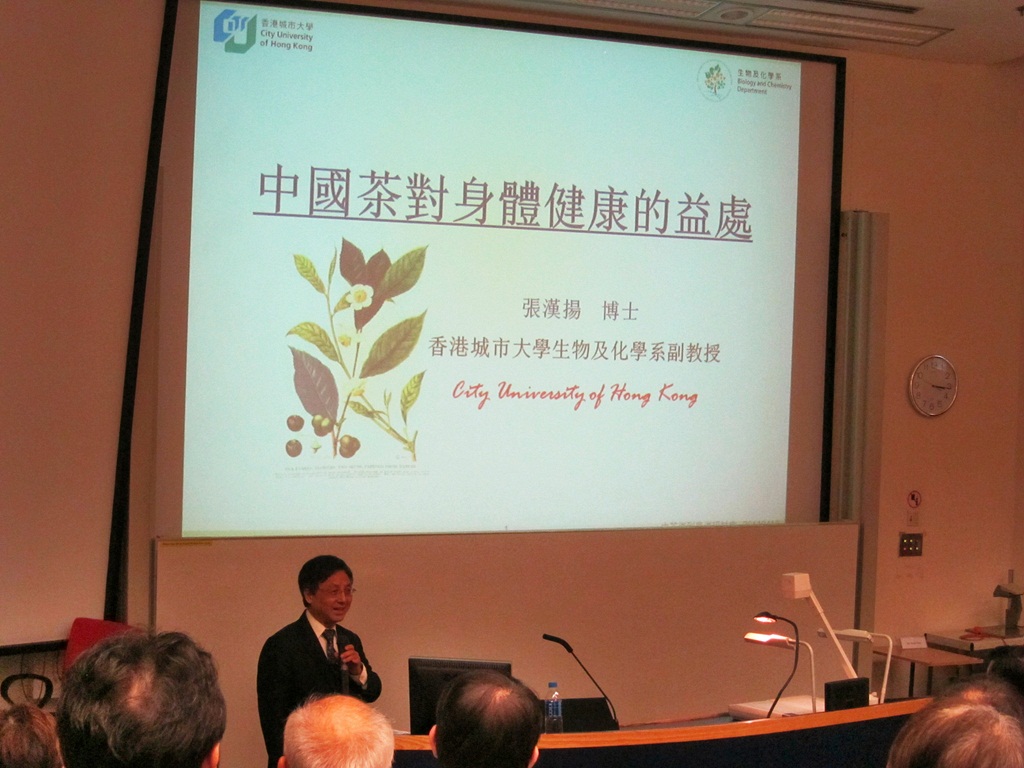
The third speaker was Dr. HY Cheung (Associate Professor, BCH Dept. of CityU) and his topic entitled “The benefit of Chinese Tea on Health”.


Dr. Cheung introduced the different compositions of the tea which passed through different manufacturing process. It focused on Catechin (兒茶素), Theaflavins (茶黃素) and Thearubigins (茶紅素).


The following table showed the composition of Chinese Tea.


Catechin (兒茶素) is a natural phenol antioxidant plant secondary. Green tea contained 70% of Catechin.


Dr. Cheung demonstrated that the tea contained much more antioxidant (抗氧化物) than other drinks.


Then he explained the mechanism how Chinese Tea against Cancer in six dimensions.

l Cell proliferation & differentiation

l Cell Cycle Arrest

l Antioxidant

l Enzyme induction & inhibition

l Modulate Gene Expression

l Apoptosis


The Oolong tea (Polyphenol extract) was found to inhibit the cancer cell growth (anti-cancer).


Dr. Cheung introduced some publication from his research team.


Award obtained from Lee On Ki.


(Left: Ms. Lee On Ki, Dr. HY Cheung and Dr. Hongy Sun)


The last speaker was Ms. Katherine Yu (Operation Manager / Tea Master, Heritage Tea House) and she shared her experience in studying tea in past 16 years.


The she demonstrated the process of tea preparation.


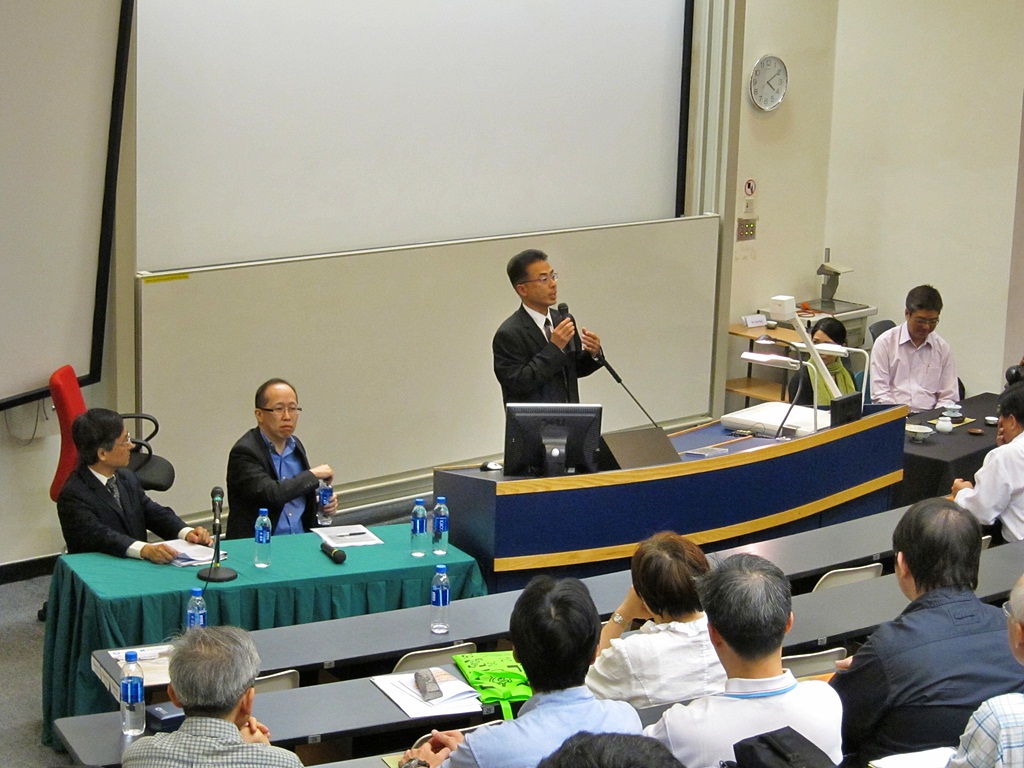
After that Mr. Rocky Lam (Chairman, EngD Society) was chaired the discussion forum. Each speakers were discussed the relationship among tea, research and business.


Ms. Katherine Yu identified four dimension of tea culture as follows:

(Harmonious) - 中和之道.

(Quiet) – 冷靜下來

(Please) 欣賞別人的貢獻

(True) 質量好, 沒有虛假.


At the end, we had a tea outside the lecture theater.

Dr. Cheung is my teacher since 1989. We took a photo for memory.


Reference:

Chinese Civilisation Centre, CityU - http://www.cciv.cityu.edu.hk/cciv.php

Heritage Tea House – http://www.hkhth.com/tc/teaIntro/index.html

Engineering Doctorate (Engineering Management), MEEM Dept, CityUHK - http://www.cityu.edu.hk/me/prg-engd.htm


2011年4月14日星期四

HKU Quality Management Student Forum


I am glad to be invited by Dr. Victor Lo to participate HKU Quality Management Student Forum on 13 April 2011. The forum is part of IELM6042 Quality management under MSc(Eng) in Industrial Engineering and Logistics Management.


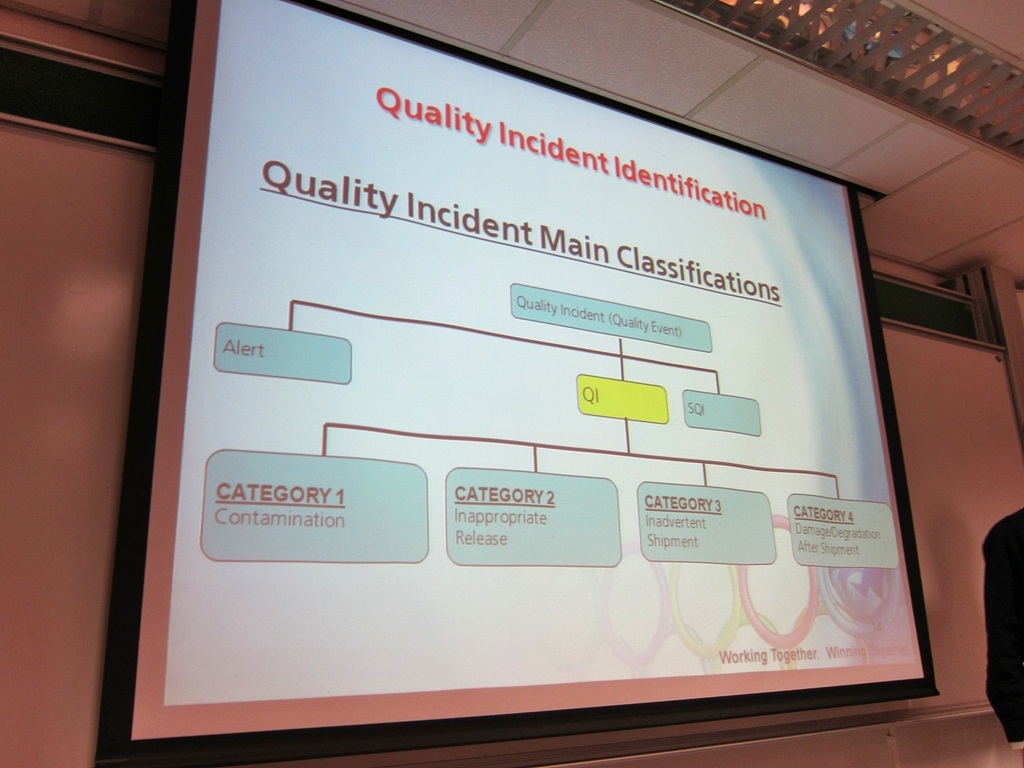
The first speaker was Mr. Clay Zhang (Quality Assurance Manager, Product Supply, Procter & Gamble HK Ltd.) who was one of MSc students to share his experience and his topic was "Sharing on P&G Quality System". Mr. Zhang described QA scope included R&D, manufacturing, testing, storage, distribution and marketing.


He said that P&G employed Scorecard for warehouse and introduced the quality incident identification. There were different Quality Incident (QI) and Significant QI (SQI). The QI separated into four categories including Contamination, Inappropriate Release, Inadvertent Shipment, and Damage Degradation After Shipment.


One of interested problem was overlabelling. Mr. Zhang explained customer would like to know what information hinded behind the label.


The second speaker team included Mr. TC Lam, Mr. HK Ho and Mr. WW Fung (CSD Officers, HKSAR) and their presentation entitled "Quality Improvement with TRIZ - case presentation".

Mr. Lam introduced the Laundry Service and their Section named "Industries & Vocational Training (I&VT) Section which aimed to provide Rehabilitation & Social Reintegration service.


Then he introduced the Laundry Process Flow including Sorting, Washing, Drying, Calendering, Pressing, Folding and Packing & Dispatching. He said that the folding was identified by client assessment that it needed to be improved.


Mr. Fung briefed the cause and effective diagram to measure the problem.


The common defects of folding were identified.


Mr. Ho found 13 Improvement methods throught TRIZ Flash Card and two of methods were come from Benchmarking to McDonald's Quality Manual (Photo Demonstration of Uniform Folding) and tools assistant (Folding Board).


TRIZ Flash Card game was showed.


Three officers shared the experience on employing TRIZ methodology. Dr. Victor Lo was the mentor in this project.


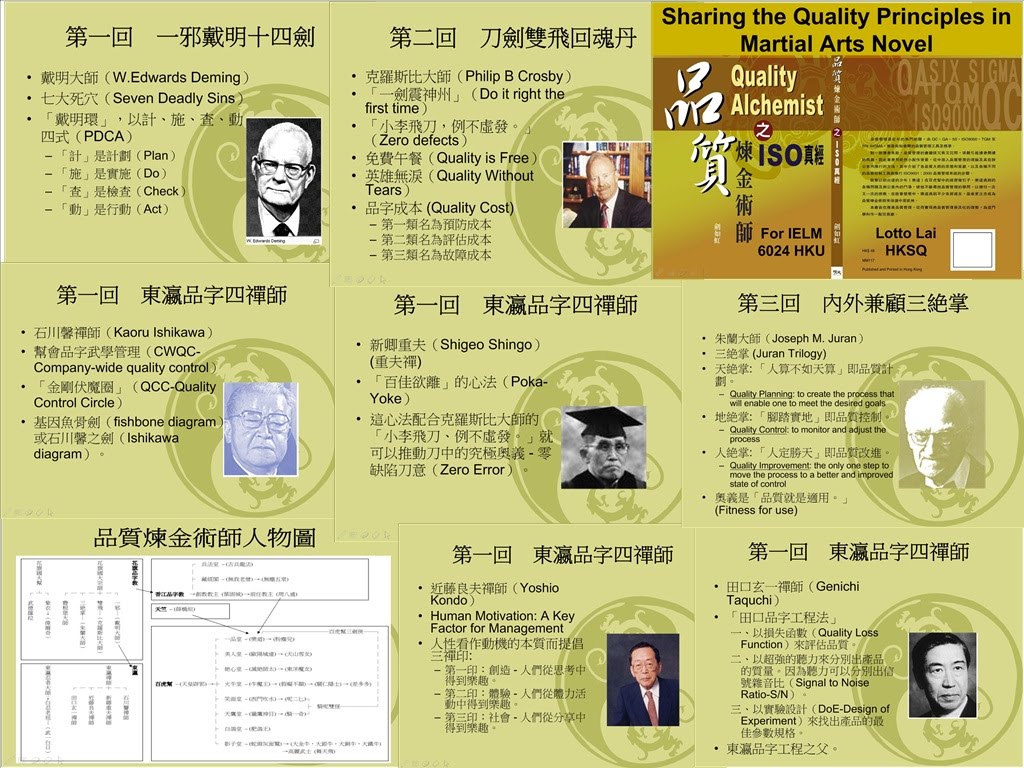
I was the third speaker and my topic named "Sharing the Quality Principles in Martial Arts Novel". My first Martial Arts Novel published in 2006 and I posted in my blog (See Left handside).


The novel introduced different quality gurus and their principles in terms of Ku Fung. The Quality Gurus included Dr. W. Edwards Deming, Dr. Joseph Juran, Philip Crosby, Armand V. Feigenbaum, Dr. Kaoru Ishikawa, Shigeo Shingo, Yoshio Kondo and Dr. Genichi Taguchi, etc.


The last speaker was Dr. Frankie Law (PT Lecturer, Business School, HKU) and his topic entitled "A Journey to World Class - A Case of an Aero Repair Company".

Dr. Law explained quality evolution through quality timeline. Then he demonstrated the Aero Repair Company practice that achieved the vision "Best in the World, Best for the World".


Then he shared the Continuous Improvement Journey through different tools and techniques.


The 5S was very impressed that down to stationary!


Visual Management was employed though the status indicator and Notice Board.


Dr. Law told us "What is STAR?" and shared the Rolls-Royce Improving Process Performance Work book at the end.

STAR stand for:

S - Strategically Align Operations

T - Target World-Class Operations

A - Achieve Sustained Improvement

R - Recognize Success


Before end of the forum, Dr. Victor Lo presented souvenir to us.

(Left: Dr. Lo and Dr. Frankie Law)


(Left: Mr. HK Ho, Mr. WW Fung, Dr. Lo and Mr. TC Lam)


(Left: I and Dr. Lo)


(Left: Mr. Clay Zhang and Dr. Lo)


Reference:

Dr. Victor Lo - http://www.imse.hku.hk/vhylo/

MSc(Eng) in Industrial Engineering and Logistics Management - http://www.imse.hku.hk/programmes/msc.htm


LinkWithin

Related Posts with Thumbnails