2010年5月18日星期二

CityU Orientation for Class Liaison Ambassadors (CLS) 2010

Tonight, I was invited to join an orientation of Class Liaison Ambassadors (CLA), organized by the City University of Hong Kong. I am a class representative of EngD cohort 2005 and recommended by MEEM department to join the CLA.

In the beginning of orientation, some interested information about CityU were shared such as how many graduate of CityU (answer: 105000 people) and when Alumni Relations Office established (answer: 2003), etc.


Then CityU Alumni Ambassador Scheme was introduced. The mission of the scheme is “Uniting alumni to support university development”.


Several internet tools were used by CityU alumni for networking such as Facebook, free Wi-Fi in CityU Campus, etc.


Facebook - CityU Alumni group


More than hundred CLA were presented a souvenir and took photos.


The last section briefed CLA past activities. The most important mission of CLA is to update your classmates contact.


Lastly, e-Portfolios were introduced to graduate.


We could be explained e-Portfolios equal to Action CV.
- A person’s personal and continuing presence online
- A base for social networking
- A base for personal publishing
- A tool for personal branding
- A digital presentation tool to demonstrate work and competencies
- A tool for personal knowledge management
- An engaging and reflective learning approach
- A professional self on the Web


My opinion was that “LinkedIn” had already worked as e-Portfolios in USA. It included all the above characteristics.

Photo of souvenirs


For more information:
Alumni Relations Office at www.cityu.edu.hk/aro

2010年5月15日星期六

Technical Visit to Intertek LED Testing Centre

The technical visit to Intertek LED Testing Centre was organized by Hong Kong Society for Quality (HKSQ) on 14 May 2010. Following the HKSAR government’s initiative of supporting the six major industries, Intertek Testing Sevices (Hong Kong) Ltd. established Hong Kong’s first LED Testing Center on 15 March 2010 with significant investment in equipment, including the Mirror Style Type C Goniophotometer. I would like to share the visit in here.

In the beginning, Mr. Samson Leong (Manager – Luminaires Energy Efficency) gave a talk entitled “Intertek Solution on Lighting Development – An Extensive Global Network”.


The background of Intertek was introduced such as over 25000 people and more than 1000 laboratories and offices worldwide. Its “Commercial & Electrical” team was the largest in Hong Kong (about 250 staff). Moreover, they had three LED Testing Centers for lighting performance test in USA, Sweden and Hong Kong.

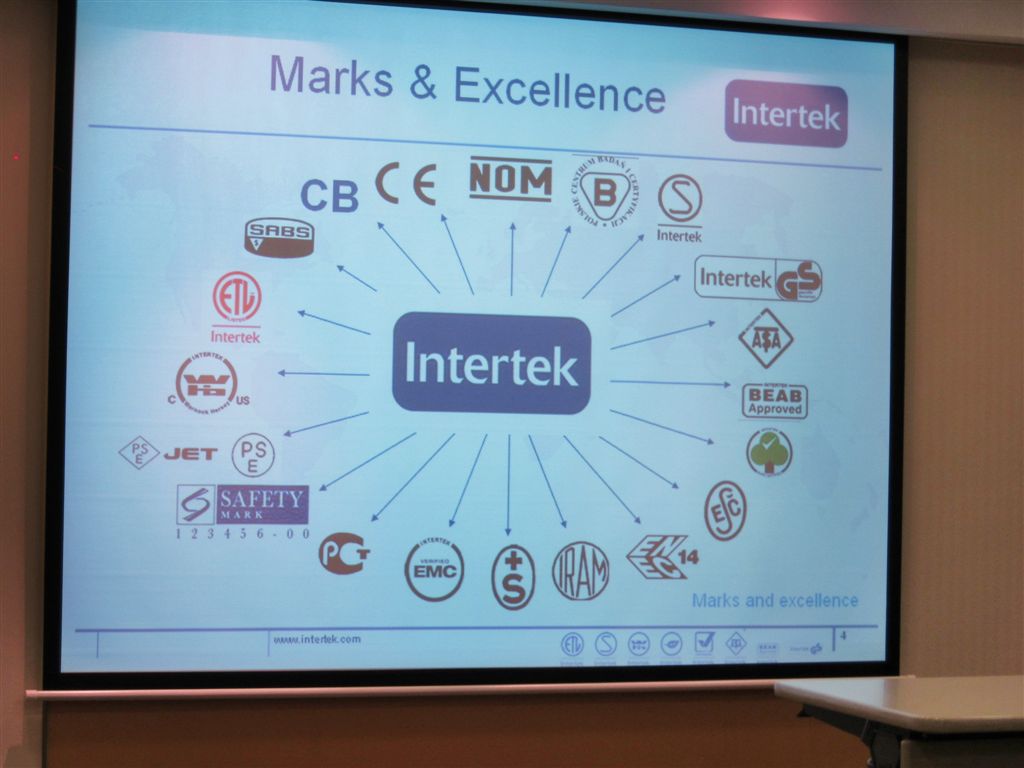
Intertek had achieved many international accreditation marks

Then he briefed the total solution on lighting tests in Hong Kong as follows:
- Performance test
- Photo-biological safety
- Safety (NA & EU)
- EMC, FCC

For performance test, three categories were “Lamp efficacy”, “Light distribution” and “Lamp life”.

The following show some international standards related lighting testing.
i) Lamp efficacy (CIE 13.3, 15, 18, 84 & 97; IEC 60969, 60901, 60064 & 60357, etc.)
ii) Light distribution (CIE 70, 121; IEC 61341, etc.)
iii) Photo-biological safety (IEC 62471)
iv) Electrical Safety – LED
v) EMC/FCC requirement (EN 55015, etc.)

After the introduction, we visited the center.

Mr. Leong introduced the equipment and light distribution result to us.
He showed how to measure the light bulb through integrated spheres. The light bulb should turn on for 100hr until it stabilized. Then it needed to test for 6000hr or more and measured its performance reduction per 2000hr.


Then we went into Goniophotometer room which connected to Baffles room and 2nd Mirror Sensor room. It is the largest and only one Goniophotometer in Hong Kong.


Photo-Biological Safety Testing facilities were introduced.
(e.g. a double monochromator based spectroradiometer system for the hazard classification of lamps)


Finally, Mr. Leong explained why Intertek would like to invest the testing centre in Hong Kong. It signified a major milestone in the development of the Asia Pacific Region’s testing and certification hub and the centre supported the emerging LED industry in the Region.

I presented a souvenir to Mr. Leong.


We took a group photo for memory.


For more information:Intertek Hosted the Hong Kong’s First Full LED Testing Center Grand Opening Ceremony (http://hk.intertek-etlsemko.com/about-intertek/news-releases/view/14/)

2010年5月13日星期四

Sharing to Key Success Factors of ISO 9001 certification

Recently, I briefed key success factors during company meeting and would like to share as follows.

1) Top Management Commitment
2) Electronic Document Management System
3) Aid through System Training
4) Message in the Communication


Top Management Commitment included:
- All senior staff participated the preparation of ISO 9001 project, defined the organization structure and selected quality representatives in each team.

Electronic Document Management System included:
- All documents used unique code and uploaded in electronic document management system for document control, as well as, sufficient training on this system.

Aid through System Training incorporated:
- ISO 9001 Awareness and Implementation Training (100% of staff participants)
- ISO 9001 Internal Auditor Training (All quality representatives attended the training)

Message in the Communication incorporated:
- Quality meeting with management, operation meeting with all staff for briefing quality issues including Quality Policy, Objectives, customer feedback, any deviation, etc.


TEAM WORK is the key for achieving ISO 9001.
• All colleagues participation (including meeting, internal audit, external assessment, follow-up actions, etc.)
• To achieve the common goal

Moreover, my teammates and I were recognized by company to obtain performance award for Corp ISO 9001 project.

I was in the middle. (a tall man.)

Lectures on Pharmacy Legislation (Lec 04)

I attended Lecture 4 on 7 May 2010. The topics were “Licensing of Authorized Sellers of Poisons and Listed Sellers of Poisons” and “Import / Export Control of Pharmaceutical Products and Dangerous Drugs”.


The following laws governed the operation of a dispensary:
- Pharmacy and Poisons Ordinance Cap.138
- Antibiotics Ordinance Cap.137
- Dangerous Drugs Ordinance Cap.134
- Undesirable Medical Advertisements Ordinance Cap.231
- Public Health and Municipal Services Ordinance Cap.132
- Chinese Medicine Ordinance Cap.549
- Trade Descriptions Ordinance Cap.362
- Control of Chemicals Ordinance Cap.145
- Protection of Endangered Species of Animals and Plants Ordinance Cap.586
- Business Registration Ordinance Cap.310
- The Companies Ordinance Cap.32
- Waste Disposal Ordinance Cap.354
- Employees’ Compensation Ordinance Cap.282
- Mandatory Provident Fund Schemes Ordinance Cap.485
- Pesticides Ordinance Cap.133, … etc.

The following figure showed the type of companies and its legal person.


Authorized Seller of Poisons (ASP) (獲授權毒藥銷售商 – 俗稱 “藥房牌”)
- A business comprising the retail sale of poisons carried on by a registered pharmacist or by a body corporate or an unincorporated body of persons shall be an ASP if the actual sale of poisons is conducted on premises duly registered under the Pharmacy and Poisons Ordinance by a registered pharmacist or in his presence and under his supervision.
Licensing Conditions in Form 16 are shown as follows:
i) ASP shall produce his certificate of registration of premises for inspection.
ii) The receipt of Part I Poisons or Antibiotics shall be attended to and signed by the registered pharmacist.
iii) PIS1 Poisons & Antibiotics shall be kept in a locked receptacle, the key to which shall be kept only by the registered pharmacist.
iv) Record of transactions involving Psychotropic Substances shall be maintained.

- An ASP may display at the premises, where the retail sale of poisons is conducted, a logo in the prescribed form in the Eighth Schedule (Form 17).
Listed Seller of Poisons (LSP) (列載毒藥銷售商 – 俗稱 “藥行牌”)
- The Pharmacy and Poisons Board (the Board) shall keep a list of persons who, not being ASP, to be entitles to conduct the retail sale of a class or classes of poisons included in Part II of the Poisons List.
Example of LSP: medicine company (e.g. Waston’s & Mannings), Supermarket (e.g. Park’N, Wellcome), Department store (e.g. Sogo, Wing On), Convenience store (e.g. 7-Eleven, Circle K), Cosmetic company (e.g. Sa Sa), and Household shop (e.g. Jusco $10 Plaza).


Import / Export Control of Pharmaceutical Products were governed by the following laws:
- Import and Export Ordinance Cap.60
- Dangerous Drugs Ordinance Cap.134
- Antibiotics Ordinance Cap.137
- Pharmacy and Poisons Ordinance Cap.138


Under the Import and Export Ordinance Cap.60 of the Laws of Hong Kong, all imports and exports of pharmaceutical products and medicines (includes dangerous drugs) must be covered by a relevant and valid import/export license that is issued by the Director-General of Trade and Industry.

The following requirements showed the application of Import License.
- Import License Form 3 (blue) together with the following relevant license/permit or combination for the appropriate application:
i) Certificate of Registration as an Importer and Exporter of Pharmaceutical Products (Form 14)
ii) Wholesale Poisons License (Form 1)
iii) License for Manufacturer
iv) Antibiotic Permit
v) Certificate for Registration of Premises

The following requirements showed the application of Export License.
- Export License Form 6 (white) together with the following relevant license/permit or combination for the appropriate application:
i) Certificate of Registration as an Importer and Exporter of Pharmaceutical Products (Form 14)
ii) Wholesale Poisons License (Form 1)
iii) License for Manufacturer
iv) Antibiotic Permit
v) Certificate for Registration of Premises

For Dangerous Drugs (D.D.), including non-pharmaceutical products, it required:
- Wholesale Dealer’s License to Supply Dangerous Drugs
- License to Manufacture Preparations of Dangerous Drugs

Application for Import License Additional Requirements
- The product is registered in Hong Kong – Certificate of Drug/Product Registration (Form 7)
- For Clinical Trial – Certificate of Clinical Trial / Medicinal Test

Exceptions:
- Pharmaceutical raw material imported by manufacturer for own manufacturing
- Import for re-export
- Sample (reasonable quantity) for registration purpose or clinical trial application
- For treatment of named patient(s) or particular animal(s)

For importing D.D. (Psychotropic), international matching was required.
The following figure showed the procedure of dangerous drug import and export.

For more information:
Pharmaceutical Services Website at www.psdh.gov.hk

2010年5月10日星期一

Lectures on Pharmacy Legislation (Lec 03)

Lecture 3 started on 30 April and it separated into two sections. The first one was “Manufacture of Pharmaceutical Products” and the second one was “Registration of Pharmaceutical Products & Substances”.


The definition of Manufacture was shown as follows:
- Preparation of pharmaceutical products for sale or distribution but shall NOT include the individual dispensing on a prescription or otherwise or any Pharmaceutical Products
- Repackaging for sale or supply falls within the limit of the definition of “Manufacture”

There were 40 holders of a manufacturer’s license in Hong Kong at the end of 2009. They were:
- 25 Certified GMP Manufacturers (Only 3 to manufacture sterile preparations)
- 12 Contract-out Manufacturers
- 6 Vet. Pharmaceutical Product Manufacturers.

Application for Manufacturer License(s) should include the following information:
* Site Master File
- Name and address of the applicant
- Activities related
- Premises (Model and Capacity of the equipment and facilities, as well as, floor-plan)
- Qualifications of Key Personnel
- Records

Key Personnel Structure and their qualification requirement were shown below.
i) Quality Assurance / Authorized Person
Authorized Person (AP) should be HK Registered Pharmacist with at least 3 year of relevant GMP pharmaceutical manufacturing / quality control experience.
ii) Quality Control & Production
The head of Production & QC should at least have:
- BSc in relevant science subject with at least 3 years of relevant GMP pharmaceutical manufacturing / quality control experience; or
- HD in Pharmaceutical Technology, or with at least 3 years of relevant GMP pharmaceutical manufacturing / quality control experience; or
- Certificate in Dispensing Studies with at least 2 years of relevant GMP pharmaceutical manufacturing / quality control experience

Health and Hygiene of workers required to avoid contamination of productions as follows:
- Medical Examination & History records
- Report of sickness or injury
- Protective clothing
- Provision of isolated eating, smoking and rest areas
- Training and education of technical staffs and employees

Premises for manufacturing requirement for fittings and machinery included:
- Permit Ready and Efficient Cleaning of all surfaces
- Premises in a Clean and Orderly condition
- Controlled Temperature and Humidity
- Separate Aseptic Area for Parenteral Products

Quality Control included:
- Testing of each batch of raw material to ensure identity and purity
- Testing of each batch of finished product to ensure identity and potency
- Parenteral Products in accordance with British Pharmacopoeia or other Pharmacopoeia
- Control sample kept for not less than normal shelf life or 2 years after the last transaction
- Recall System

Labeling of products and maintenance of records were also required.

The history of Hong Kong GMP was briefed as follow. A working party on GMP for manufacturers formed in 1993. Then HK GMP Guidelines for Pharmaceutical Products was published in 1995. The implementation schedule showed:
Phase I To be completed before 31 Dec 1996 (Documentation Phase)
Phase II (SOP in place)
IIa (31 Dec 1998) (Personal hygiene & training for technical staffs)
IIb (31 Dec 1999) (Handling of materials, Documentation and GMP for API)
IIc (31 Dec 2000) (Principles and practices relating to QC)
Phase III (31 Dec 2002) (HK GMP implemented)

The second topic was “Registration of Pharmaceutical Products & Substances”.(USA – CFR Title 21 Sec. 314.3; UK – Directive 2001/83/EC)


Pharmaceutical product included Poisons, Antibiotics, Dangerous Drugs, Product not belong to the above such as vitamins and minerals. The definition of a Pharmaceutical Product was stated in “Guidance Notes on Classification of Products as Pharmaceutical Products” at www.psdh.gov.hk .

The registration of pharmaceutical product based on Reg. 36(1) of Pharmacy & Poisons Ordinance to ensure the Quality, Safety and Efficacy.

During the application for registration, filled Form 6 and submitted the following supporting documents are requested.
i) complete master formula
ii) manufacturer’s license
iii) GMP certificate
iv) Free sale certificate
v) Certificate of analysis (CoA)
vi) Method of analysis
vii) Specifications
viii) Stability test data
ix) Clinical and scientific papers

The registration certificate is valid for a period of 5 years.

For more information:
Section1:
- Sec. (2) of the Pharmacy and Poisons Ordinance, Cap. 138.
- Reg. (29) – (35), Part VII of the Pharmacy and Poisons Regulations, Cap. 138A.
- Sec. (4-6) of the Dangerous Drugs Ordinance, Cap. 134.
Section2:
- Pharmacy & Poisons Ordinance – Section 29(q)
- Pharmacy & Poisons Regulations – Part VIII

2010年5月8日星期六

Biotech Seminar: Aligning IP with the Growth of a Biopharmaceutical Company

A biotechnology seminar entitled “Aligning IP with the Growth of a Biopharmaceutical Company: the FibroGen Experience” was organized by Hong Kong Institute of Patent Agents (HIPA) and Hong Kong Biotechnology Organization (HKBIO), supported by Hong Kong Science and Technology Parks, on 7 May 2010. I would like to summarize the seminar as follows.

Dr. Jacqueline Lui (President of HIPA) gave an opening speech and she introduced the mission of HIPA that it is a non-profit organization established to promote and support Hong Kong as an international hub for the acquisition and commercialization of and respect for rights in technology, inventions, patents and other intellectual assets by acting as a professional governing body for training and recognizing patent practitioners in Hong Kong. Then she introduced two speakers from FibroGen.


The first speaker was Dr. James E. Nesbitt (Director of Intellectual Property at FibroGen, Inc.).


Dr. Nesbitt briefed the background of FibroGen, Inc.


He took that the company founded on 2 core platforms which were:
i) Recombinant human collagens as replacement for animal-derived materials;
ii) Therapeutics in tissue fibrosis (including collagen prolyl hydroxylase inhibitors and connective tissue growth factor (CTGF) (人類結締組織生長因子))

The following photo showed the recombinant collagen expression.


Then he also compared FibroGen Recombinant Human Gelatins and Animal-derived Gelatins. Some applications included pharmaceutical stabilizers, vaccine stabilizers, hard/soft gelatin capsules and plasma expanders.

They are developing a portfolio of powerful, selective product candidates for the treatment of life-threatening diseases affecting the kidneys, lungs, eyes, skin, heart, and liver. CTGF worked as central mediator of tissue remodeling and fibrosis.


Dr. Nesbitt said several clinical trials had being performed such as Diabetic Nephropathy (Phase 2), Pancreatic Cancer (Phases 1), Liver Fibrosis and Cardiovascular Disease.


The second speaker was Dr. Christopher Turner (Direct of IP Team at FibroGen, Inc.). His talk was focused on Prolyl Hydroxylase inhibitors and Hypoxia-Inducible Factor (HIF) (缺氧誘發因子).


A new target of prolyl hydroxylase was identified in 2001 (i.e. HIF).
HIF modulates transcription of numerous genes associated with tissure response to hypoxia including Erythropoietin (EPO) (紅血球生成素), Vascular Endothelial Growth Factor (VEGF) (血管內皮細胞生長因子), Iron regulatory genes (鐵質吸收之調節基因) and Glycolytic enzymes (醣酵解脢).

Regulation of Hypoxia-Inducible Factor (HIF) stability and activity was mentioned.


The comparison of current therapy using rhEPO supplemented with iron and FG-4592 HIF-PHI treatment was discussed.


Finally, Dr. James Nesbitt mentioned FibroGen Intellectual Property worldwide patent portfolio including US patents (30+), Foreign patents (70+) and 200+ pending applications.

The development of IP Portfolio was concluded as follows.
i) Identify and work closely with foreign counsel
ii) Develop territory-specific filing and prosecution strategies
iii) Understanding of territory-specific procedures
iv) Consistent integration of strategy worldwide


For more information:
Hong Kong Institute of Patent Agents (http://www.hipa.org.hk/)
Hong Kong Biotechnology Organization (http://www.hkbio.org.hk/)
Hong Kong Science and Technology Parks (http://www.hkstp.org/)
FibroGen, Inc. (http://www.fibrogen.com/)

2010年5月6日星期四

ISSC Six Sigma Networking Dinner

I am honor to be invited for joining Six Sigma Networking Dinner which organized by the International Six Sigma Council (ISSC) on 5 May 2010. I would like to share the memory night to all.

In the beginning, Dr. Rita Wan (Chairman of ISSC) gave introduction speech. She introduced ISSC and its mission shared as follows:
The ISSC is a non-profit making organization of quality practitioners and subject matter experts that saw the need for standardization in the Six Sigma field. Its mission is to promote the best practice and standards in all areas of Six Sigma and Quality fields.


Before the dinner, Mr. Justin Quinn (the AXA Way Leader) shared the key success factors to deployment of AXA’s Six Sigma Program. He said that Quality of Service involved about 50-60% effort of AXA Way project.


Global Key Success Factors were identified by Mr. Quinn as follows.
i) AXA Way Standards included “Training”, “Application of Methodology” and “Six Sigma Black Belt Certification”
ii) Governance on “Tollgates & Benefit Tracking”, “Knowledge Sharing” and “Annual Program Review”


Specific Key Success Factors in Hong Kong were stated below.
i) Voice of Customer (VOC) mindset involved “Customer’s Expectation Solicited”, “Collection of VOC” and “Build Strong Relationship between Marketing & AXA Way”. Example showed in the following figure.
ii) Link project outcomes to strategic goals (e.g. KPI)
iii) Pragmatism (Practicable – using technical tools and data)
iv) Change Management (Black Belt spend 25% on relationship / change management)
v) Maintain Relevance (Tailor programme goals to match business conditions)


After that Ms. Iza Ng (Business Development Manager – Techmax HK) introduced different Minitab products.


She said that Minitab 16 would be launched soon.


During the networking time, I took some photo with quality professionals.

Right: Dr. Aaron Tong (Managing Director – TQM Consultants Co. Ltd.)


Right: Mr. Henry Soo (Managing Director at DataDevelop Consulting Ltd.)


Left Second: Dr. Fugee Tsang (Professor at HKUST)


Left: Dr. C.O. Chan received a souvenir.


Dr. Fugee Tsang won the gift.


Finally, all honorable guests took a photo.


Group photo of all participants


It is a very good gathering for quality professionals and I believe it could enhance the cooperation between different quality associations and societies in near future.

For more information:
http://www.isixsigmacouncil.org/

2010年5月1日星期六

Technical Visit to MTR West Rail Operations Control Centre and Depot

The visit to MTR West Rail Operations Control Centre (OCC) and Pat Heung Depot (PHD) was organized by Hong Kong Society for Quality (HKSQ) on 30 April 2010. The West Rail OCC is located at the Kam Tin Building near Kam Sheung Road Station. In the event of the OCC becoming inoperable, West Rail system-wide control can be carried out at the Backup Control Centre (BCC) located at the PHD. The depot is equipped with a Train Wash Plant, an Under Floor Wheel Lathe, Overhead Mobile Platforms and 20 tracks for Electric Multiple Unit (EMU) stabling, maintenance of EMU and Auxiliary Vehicles, high speed test, heavy cleaning and wheel turning.

Photo showed that we seated in Train Pilothouse


We were gathered in Kam Sheung Road Station with about 17 HKSQ members and then walked to the Kam Tin Building.


OCC representative (chief controller) briefed the operation of OCC to us. There were three OCCs and they located Tsing Yi Station, Fo Tan Station and Kam Sheung Road Station, respectively. He explained why OCC was operational 24 hours a day because of considering train maintenance window.


Then we observed OCC real operation through the demonstration room.


Two systems were observed. The upper one was for electricity system and the lower one was for signal system.


Contingence plan was the key practice for MTR including ventilation system, tunnel design, communication and report to fire / police department, etc. Drill must be practice for all pilots and controllers (The full cycle was around four year).

Souvenir was presented.


Group Photo was taken in front of Kam Tin Building and then we went to PHD.


Inside Pat Heung Depot


In the engineer room, we observed 5S practice and some information about quality and safety in notice board.


Then, engineer in charge explained their daily operation. He said the train lifecycle was expected above 50 years. The preventive maintenance included balance exam and eye check, moreover, the train system had self-check and showed the fault automatically.


Another engineer presented how to arrange trains for cleaning, maintenance and checking.


After that we visit pilothouse of the train.
I took a photo for memory.


Pilot explained the daily operations.


We went outside to visit the building for wheel polishing.


And then we come back to under floor wheel lathe to observe their maintenance work.


At the end, we left by MTR staff bus at Pat Heung Maintenance Centre station.


For more information:
http://www.mtr.com.hk/

LinkWithin

Related Posts with Thumbnails